
Add ₹999 more to unlock FREE SHIPPING!
Your sacred cart is currently empty.
Shop Photo Frames
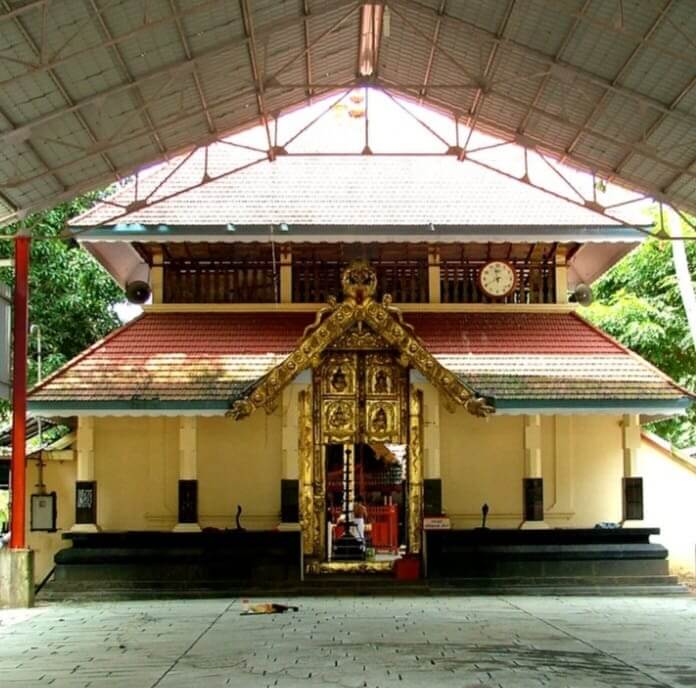
Located about 8 km from Tripunithura in Ernakulam district, Ameda Temple stands on the banks of the Vembanad Lake. The temple complex, including the illam ( Brahmin house ) and its surrounding premises, spreads across nearly 10 acres of land. Ameda Temple is considered one of the five most prominent Naga worship temples in Kerala. Devotees believe that the divine presence here responds instantly to sincere prayers.
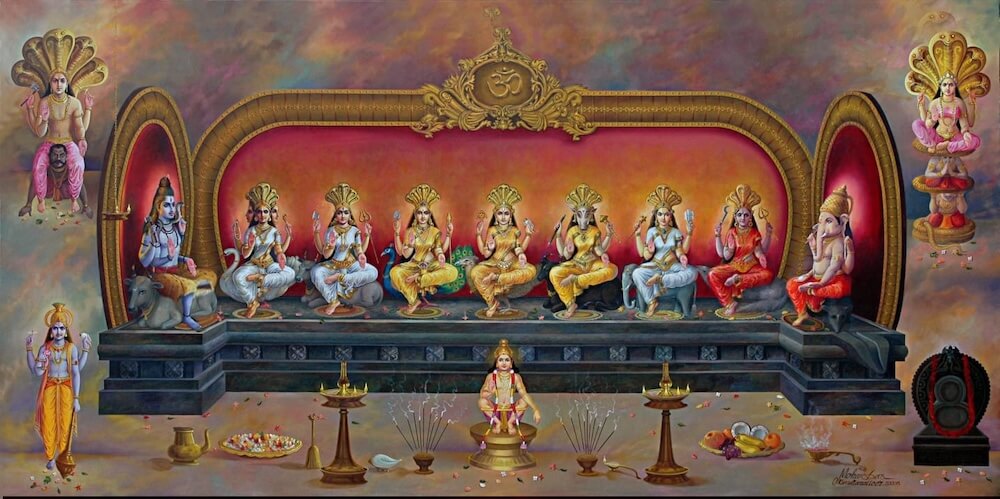
The main deities of the temple are the Sapthamathrukkal (Seven Mother Goddesses), Nagaraja and Nagayakshi. In addition, the seven divine mothers — Brahmi, Vaishnavi, Maheshwari, Indrani, Varahi, Kaumari and Chamundi — are worshipped here along with Ganapathi, Veerabhadran and Mahavishnu, who is revered as the family deity of the Vettathu Nadu branch associated with the Zamorin royal lineage. The temple rituals are traditionally performed by the members of Puliyannoor Illam according to established tantric customs.
Ameda Temple is a centuries-old centre of Naga worship deeply rooted in Kerala’s spir-itual heritage. According to local belief, this region was once covered with dense forests and sacred Naga groves, making Naga worship an ancient tradition here. It is believed that the site originally began as a sacred Naga grove before gradually evolving into a temple.
Although there are no precise historical records regarding the temple’s origin, it is be-lieved that generations of local residents and Brahmin families played an important role in preserving and maintaining the temple traditions. One of the temple’s greatest dis-tinctions is the combined worship of Naga deities and the Sapthamathrukkal, making it a rare spiritual centre where Shakti worship and Naga worship coexist.
Traditionally, most ancestral homes in Kerala maintained sacred Naga groves. However, with the transition from joint families to nuclear families and the resulting limitations of space, many Naga groves gradually disappeared. House renovations, natural calamities, relocation and divine instructions believed to have been received through rituals also led to Naga idols being shifted and reinstalled elsewhere.
Even today, Naga idols from such sacred groves are ceremonially invoked and brought to Ameda Temple for reinstallation through special rituals. Every year, numerous Naga idols are consecrated here, reflecting the temple’s continuing role as a major centre of Naga worship.
According to local legend, Sage Parasurama arrived at the present-day Ameda region while traveling across Kerala. During sunset, when he entered the waters of the Vembanad Lake to perform Sandhya Vandana, he witnessed a brilliant divine light emerging from the middle of the lake. Curious to discover its source, Parasurama walked into the waters and through his divine vision, realised that the light originated from the Sapthamathrukkal traveling upon turtles.
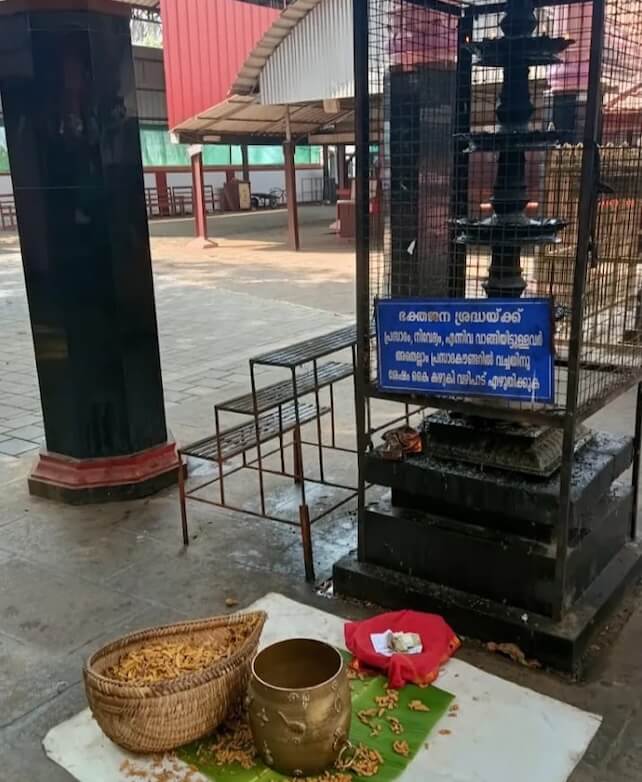
As the waters parted to make way for Parasurama, the turtles could no longer move forward and remained there. It is believed that the place where the turtles stopped eventually came to be known as ”Ameda.” Parasurama is also believed to have established tantric rituals and modes of worship here, which have continued through generations.Another enduring belief associated with the temple is that a sacred lamp lit by Parasur-ama still continues to burn without being extinguished. The oil from this lamp, known as ”Vilakkile Enna,” is distributed among devotees as a sacred offering believed to possess healing powers for various ailments.
As devotees approach the temple entrance, they are welcomed by the sound of Pulluvan Pattu — traditional Naga devotional songs sung for Nagadevatha appeasement. Devotees often conduct these ritual songs by mentioning their names and birth stars as offerings for Nagadevatha’s blessings. From the entrance itself, one can witness numerous Naga idols and Naga-themed artworks reflecting the temple’s deep-rooted Naga worship traditions.
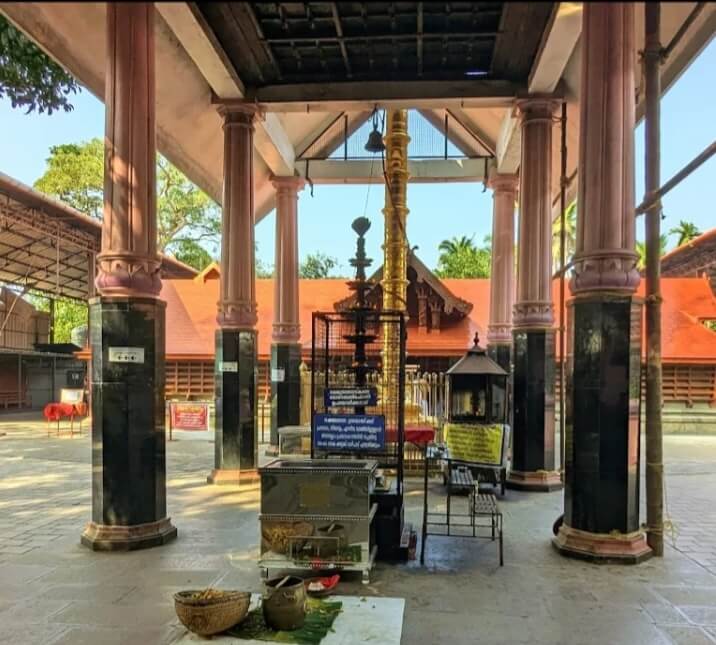
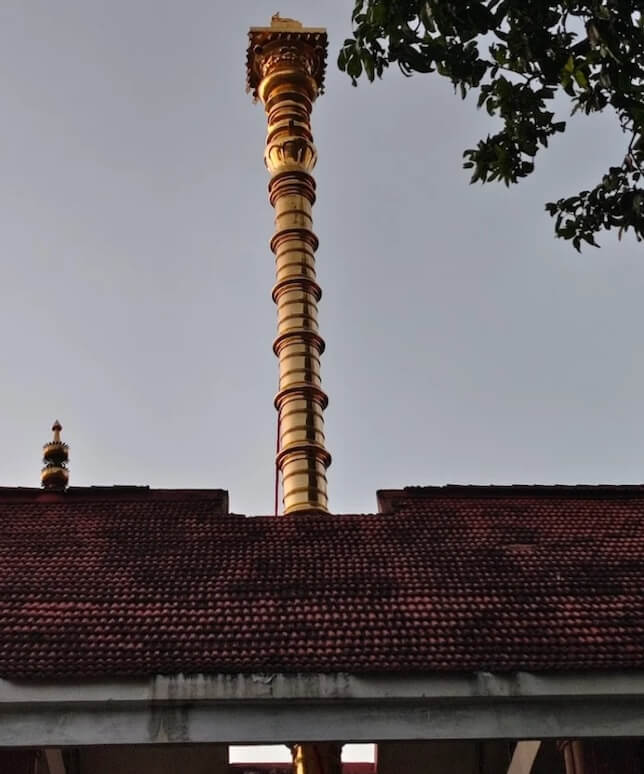
Walking through the circumambulatory path into the temple courtyard, devotees first see the temple flagstaff and the traditional nalambalam behind it. The temple faces east and has three entrances, though all three are not open every day. The northern entrance remains open for 41 days beginning from the first day of the Malayalam month of Vrischikam. On the forty-first day, a special Guruthi ritual is performed, during which all three entrances are opened together, an occasion considered highly auspicious.
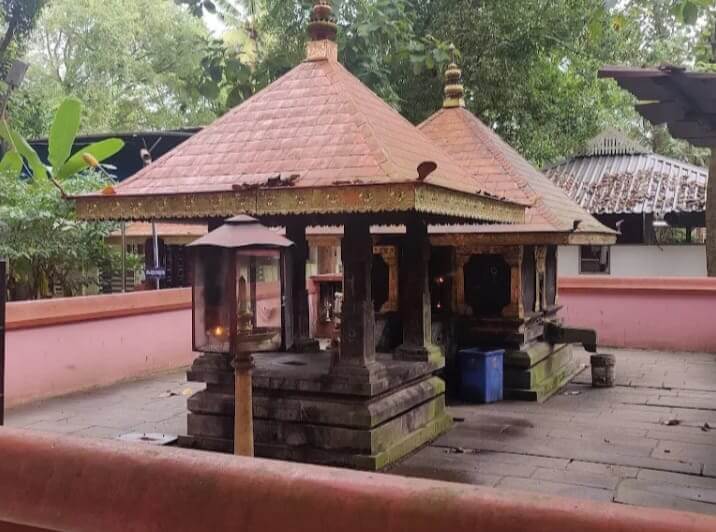
The main sanctum sanctorum is located within the nalambalam. Built in the traditional Kerala temple architectural style, the sanctum is circular in shape. The sloping roof, intricate wooden craftsmanship and copper-covered sections beautifully showcase Kerala’s traditional temple architecture.
Along the circumambulatory path on the southern side stands the sacred Paala tree, surrounded by numerous Naga idols, highlighting the importance of Naga worship in the temple. Behind the tree lies the temple’s original sacred spot, where a turtle-shaped form can be seen, closely connected to the temple legend. Nearby lies the vast Vembanad Lake, which is closely associated with the temple’s legend.
On the western side of the pathway stands the shrine of Nagaraja, while on the northern side is the sub-shrine dedicated to Mahavishnu, regarded as the family deity associated with the Vettathu Nadu lineage connected to the Zamorin dynasty. Adjacent to the Vishnu shrine is the expansive Ameda cowshed, reflecting the temple’s emphasis on cow protection and traditional spiritual values.
One of the temple’s most remarkable features is the rare installation of the Sapthamath-rukkal. Each goddess is worshipped in distinct forms with symbolic weapons and divine attributes.
Brahmi, the Shakti of Lord Brahma, is depicted holding a rosary and kamandalu. Vaish-navi, the Shakti of Mahavishnu, appears holding the conch, discus, mace and sword. Maheshwari, the Shakti of Lord Shiva, is adorned with Naga ornaments and carries a trident, accompanied by the symbolism of the sacred bull.
Indrani blesses devotees in the Abhaya Mudra while wielding the Vajra. Varahi, the Shakti of Varaha, is also worshipped here. Kaumari, the Shakti of Lord Murugan, is depicted seated upon a peacock and holding a spear. Chamundi, the fierce form of the Divine Mother, appears carrying a sword and trident. These unique representations of the Sapthamathrukkal make Ameda Temple one of Kerala’s rare centres of goddess worship.
The temple’s annual festival is celebrated during the Malayalam month of Meenam. The festivities begin with the ceremonial flag hoisting on the Makayiram star and concludewith the grand Vilakku ceremony on Pooram day and the Arattu ritual on Uthram. During this period, the temple atmosphere becomes vibrant with lamps, rituals and large gatherings of devotees.
As a major Naga worship centre, the temple also gives special importance to Ayilyam and Karthika star days. Ayilyam rituals during the Malayalam months of Thulam, Vrischikam and Meenam are observed with great devotion. The Kalasha rituals during Makaram and important observances such as Pathamudayam and Naga Panchami also attract many devotees.
Special rituals dedicated to the Sapthamathrukkal form another major attraction of the temple. Vaishnavi Devi is worshipped through a twelve-day Bhagavathi Seva during the month of Karkidakam. Similarly, Guruthi rituals for Chamundi Devi are conducted throughout the Mandala season, culminating in the grand Guruthi ceremony performed in twelve ritual vessels on the forty-first day.
Another notable feature of the temple is its daily annadanam and prasadam distribution. Sweet payasam is offered every morning to devotees and free meals are served daily as part of the temple’s long-standing tradition of charity and service.
Among the temple offerings, Sarpa Bali is one of the most significant rituals, performed to appease Naga deities and remove Naga-related doshas. Norrum Palum is another important offering believed to bring family prosperity and blessings for children.
Ayilyam Pooja is one of the temple’s most important rituals, during which elaborate Naga worship ceremonies are conducted. Pulluvan Pattu also holds a special place here, with devotees sponsoring ritual Naga songs by mentioning their names and birth stars. Guruthi Pooja dedicated to Chamundi Devi is another major offering, especially dur-ing the Mandala season and the grand Guruthi on the forty-first day. Bhagavathi Seva, Kalasha Pooja, lamp offerings and Payasa Nivedyam are also commonly performed rit-uals. Receiving the sacred lamp oil associated with Parasurama is considered another unique spiritual blessing of the temple.
The temple opens daily at 4:00 am with the Palli Unarthal ritual, followed by Nirmalya Darshan at 4:30 am. Abhishekam takes place at 5:00 am, Ushapooja at 6:00 am and Uchapooja at 7:30 am, after which the temple closes at 12:00 pm noon. The temple reopens at 5:00 pm in the evening. Deeparadhana is conducted at 6:30 pm, followed by Athazha Pooja at 7:00 pm and the temple closes for the day at 8:00 pm. Timings may vary during festivals and special occasions such as Ayilyam.
This sacred temple stands as a testament to deep spiritual devotion, ancient architectural grandeur, and rich local cultural traditions.
The sanctum sanctorum houses the divine idol consecrated according to ancient Vedic traditions, surrounded by serene courtyards and traditional temple architecture.
Navratri, Maha Shivratri, Annual Temple Jatra & Deepotsav
Compare and book flights, secure top-rated local hotels near the temple, hire reliable guides, and rent cars instantly.
Extend your pilgrimage by visiting other highly sacred temples located nearby.


Add ₹999 more to unlock FREE SHIPPING!
Your sacred cart is currently empty.
Shop Photo FramesFill in your delivery details below to place your order.
Add comment