
Add ₹999 more to unlock FREE SHIPPING!
Your sacred cart is currently empty.
Shop Photo FramesNevasa Taluka in Ahilyanagar district holds immense religious significance. This taluka is home to several renowned pilgrimage sites, including the nationally and internationally famous Shree Kshetra Shani Shingnapur, the state’s only Mohiniraj Temple, Shree Kshetra Devgad—a revered center of faith for millions of Lord Dattatreya devotees, the sacred Pais Khamb where the Dnyaneshwari was written, and the Vriddheshwar Temple. In this very league of revered sites, the temple of Goddess Ghodeshwari Mata in Ghodegaon is widely famous. The unique feature of this shrine is that the deity is Ashwarupi, meaning in the form of a horse. Local villagers claim that no duplicate or similar idol of this goddess exists anywhere else in the state or the country.
According to the temple legend, the present-day Ghodegaon in Nevasa taluka was originally named Vadgaon; however, it was widely known as Nipani Vadgaon. The reason behind this was the severe and persistent scarcity of water facing the village. Around the 12th century, the villagers decided to dig a well in the village. Initiating the work on an auspicious hour (muhurta), the villagers dug a well up to a depth of 10 paras. (Paras is a unit for measuring depth, derived from the word ‘Purusha’. It is typically used to measure the depth of wells, water tanks, or land. Thus, 1 paras is considered to be about 7 feet, though in some places it ranges from 6 to 7.5 feet). Despite digging so deep, not a single drop of water was found, leaving the villagers disappointed, and they abandoned the effort. Due to the severe water scarcity, many people migrated from the village.
Following this incident, a luminous sage arrived at the local Tulja Bhavani Mata Temple. He used to perform penance for hours in the temple and would periodically assist the villagers in resolving their troubles. One day, the villagers laid out their plight regarding the water shortage before the sage. Thereupon, the sage pointed out a spot beside the Tulja Bhavani Temple and advised the villagers to dig a well there. Following the sage’s instructions, after worshipping Goddess Tulja Bhavani, the villagers commenced digging the well. Even after digging 5 paras deep, there were no signs of water. Yet, the villagers held firm faith in the sage’s words and continued their work with full vigor. When the depth of the well reached 6 paras, they suddenly discovered a stone idol shaped like a horse (Ashwarupi) in the earth. The villagers carefully brought the idol out from the soil, placed it in the courtyard of the Tulja Bhavani Temple, and returned to their homes as evening fell. However, thoughts of the mysterious idol lingered in everyone’s minds.
That very night, the Divine Mother appeared in a dream vision to the village Patil (chief) and said, ‘I am Goddess Ghodeshwari. Consecrate My idol (Prana Pratishtha) in the Tulja Bhavani Mata Temple. Henceforth, the village shall never suffer from water scarcity, and its fame will spread far and wide.’ The next day, the Patil shared this divine vision with the villagers. Choosing an auspicious muhurta, the villagers consecrated the horse-shaped idol of the Divine Mother in the Tulja Bhavani Temple. When the villagers inquired again with the sage about water that day, he advised them to dig just one more paras deeper. As they resumed digging as directed, a powerful stream of water suddenly gushed forth from the ground, and in no time, the well overflowed with water.
By the grace of Shri Ghodeshwari Mata, who manifested from the well, the village’s water shortage ended permanently, and the old name ‘Nipani Vadgaon’ gave way to ‘Ghodegaon’, named after the Goddess. Blessed by this water, the surrounding area became fertile and prosperous (sujalam sufalam). Not only that, Ghodegaon is now also famous as a major market for agricultural produce. Situated on the Ahilyanagar-Aurangabad highway, the original temple of Goddess Ghodeshwari in Ghodegaon was built in the Hemadpanti architectural style. Precise records regarding its original construction date are unavailable. Over time, the temple underwent periodic restorations. A few years ago, the villagers raised about 4 crore rupees through voluntary contributions to renovate the shrine, giving it its grand present form.
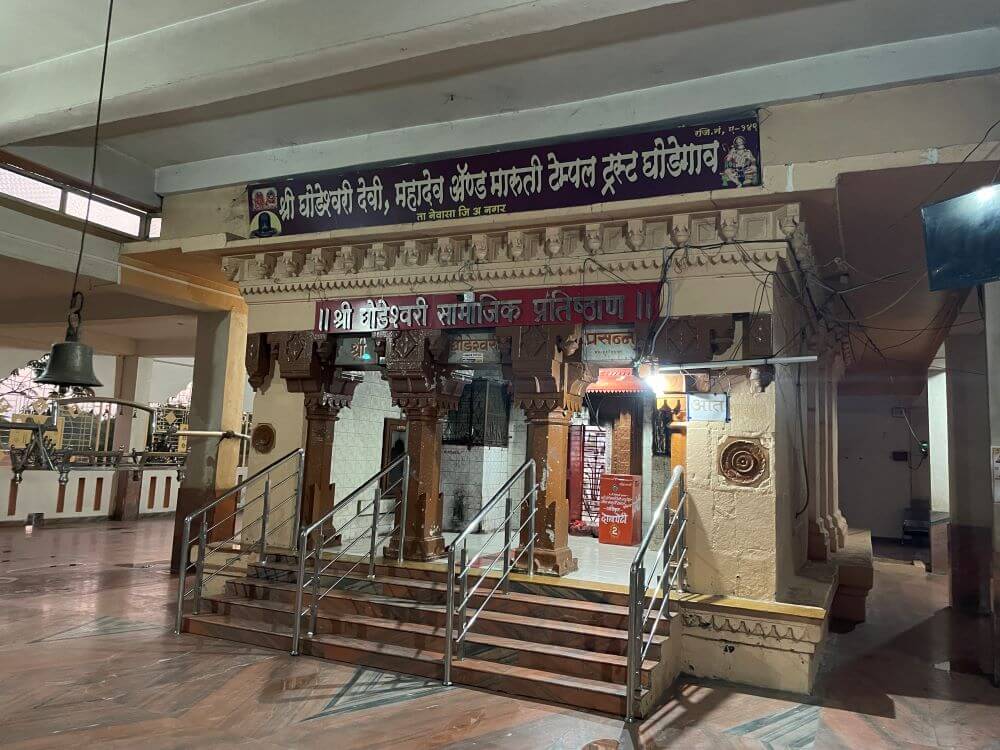
The premises of the Ghodeshwari Temple are spacious and completely paved with stone tiles. Upon entering through the main gate, an ancient Deepmaal (lamp tower) catches the eye. This Deepmaal features a doorway at its base, with a staircase inside leading to its top. Adjacent to the Deepmaal stands a shrine dedicated to Lord Shiva.
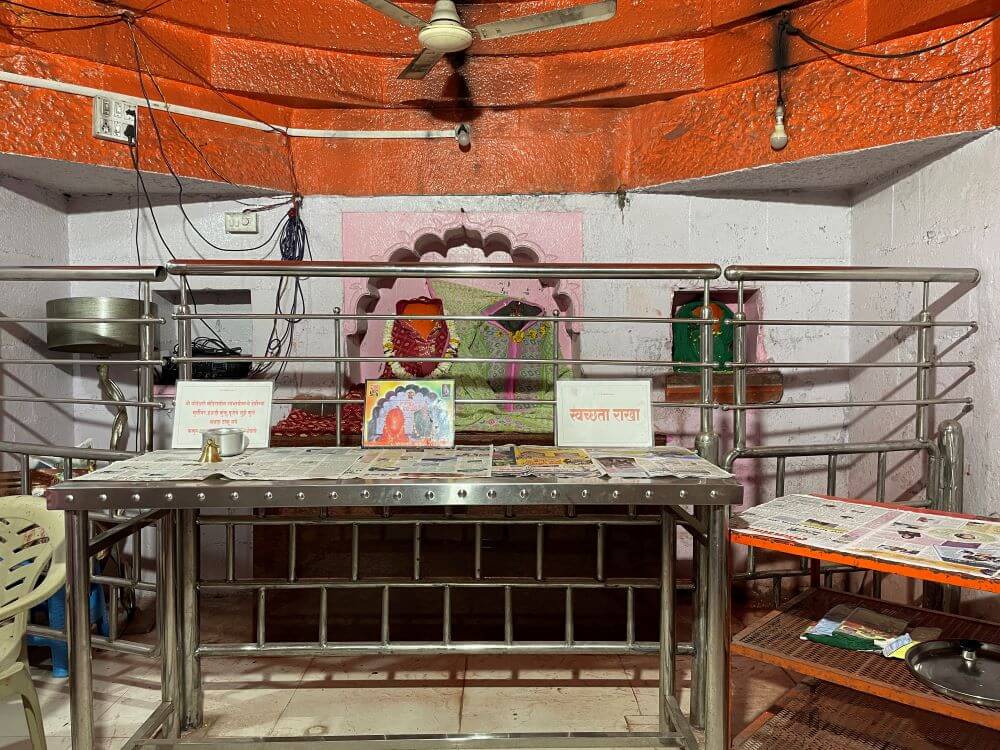
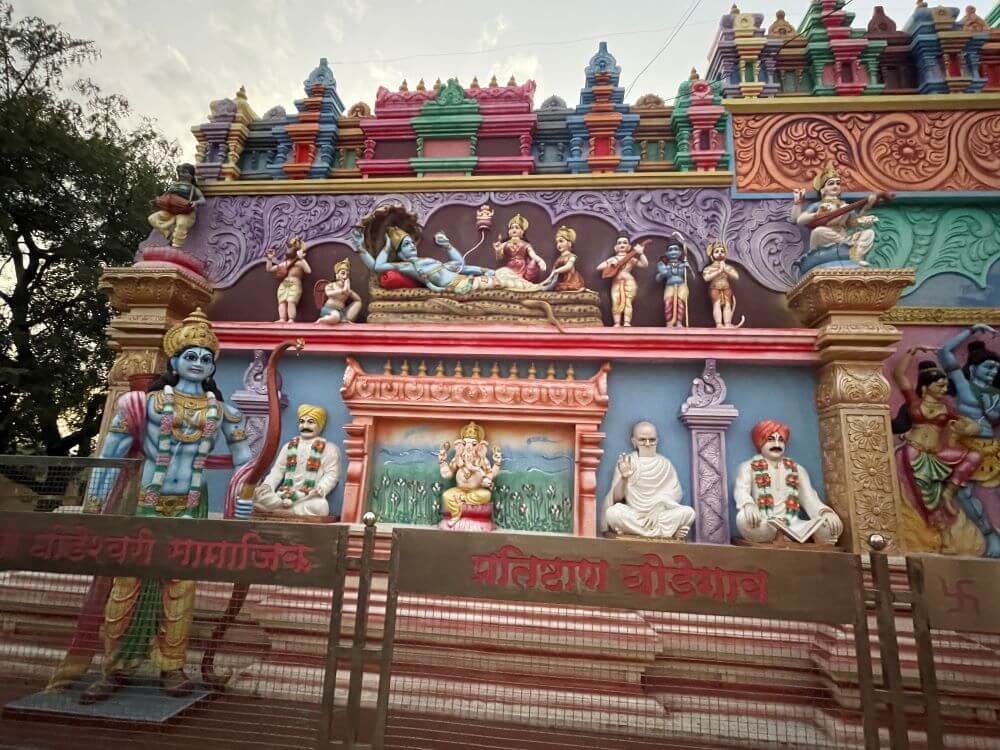
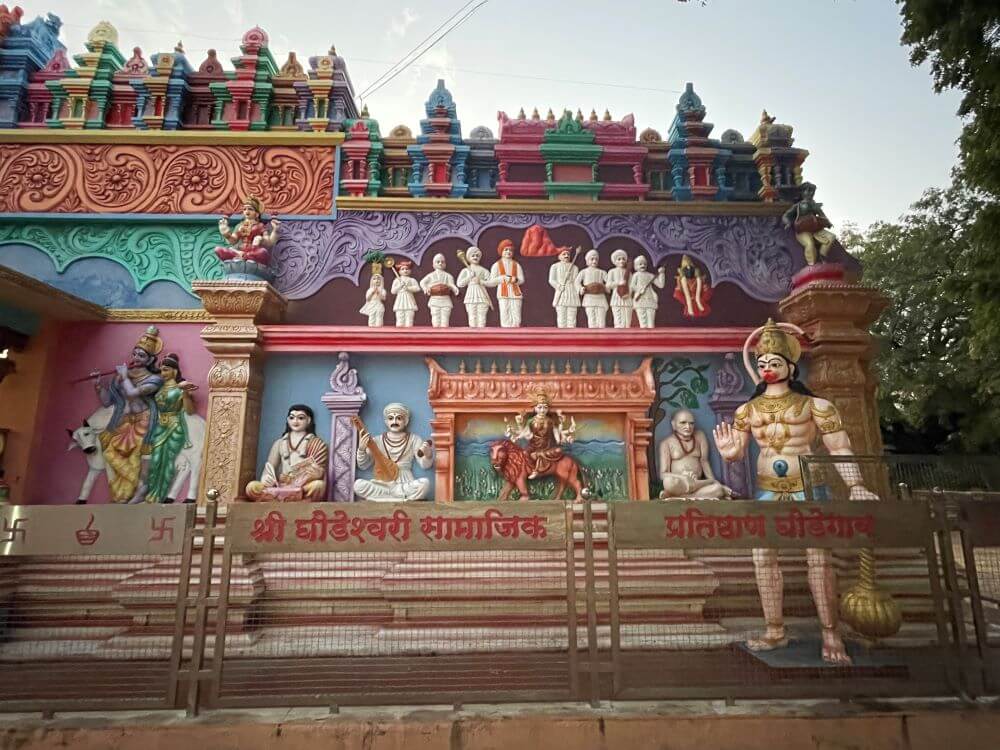
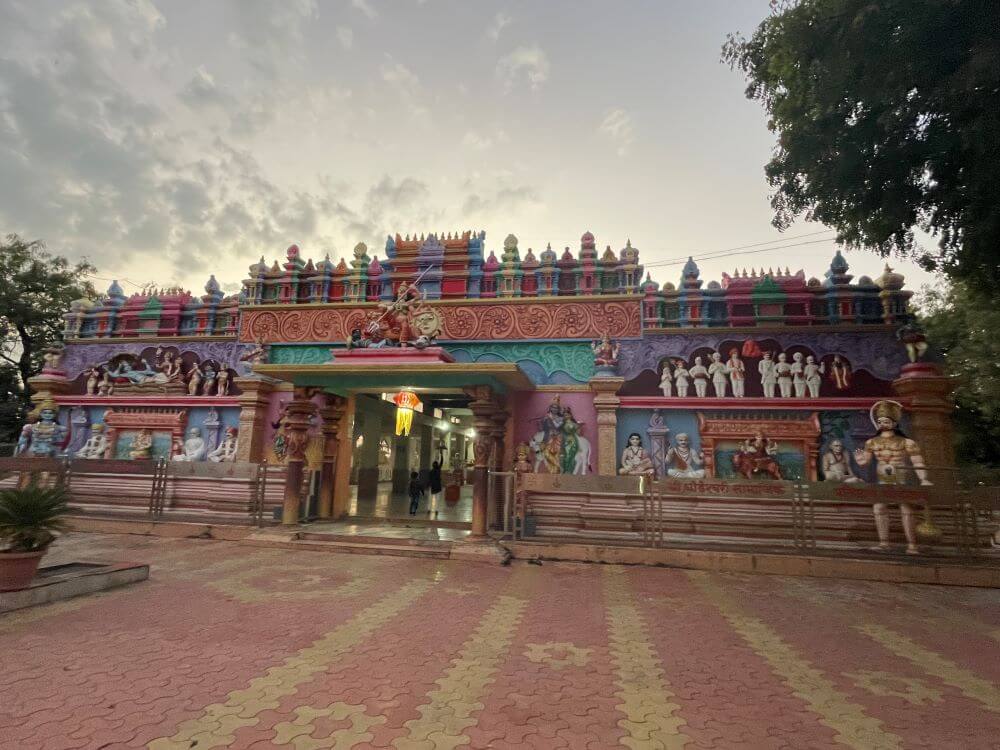
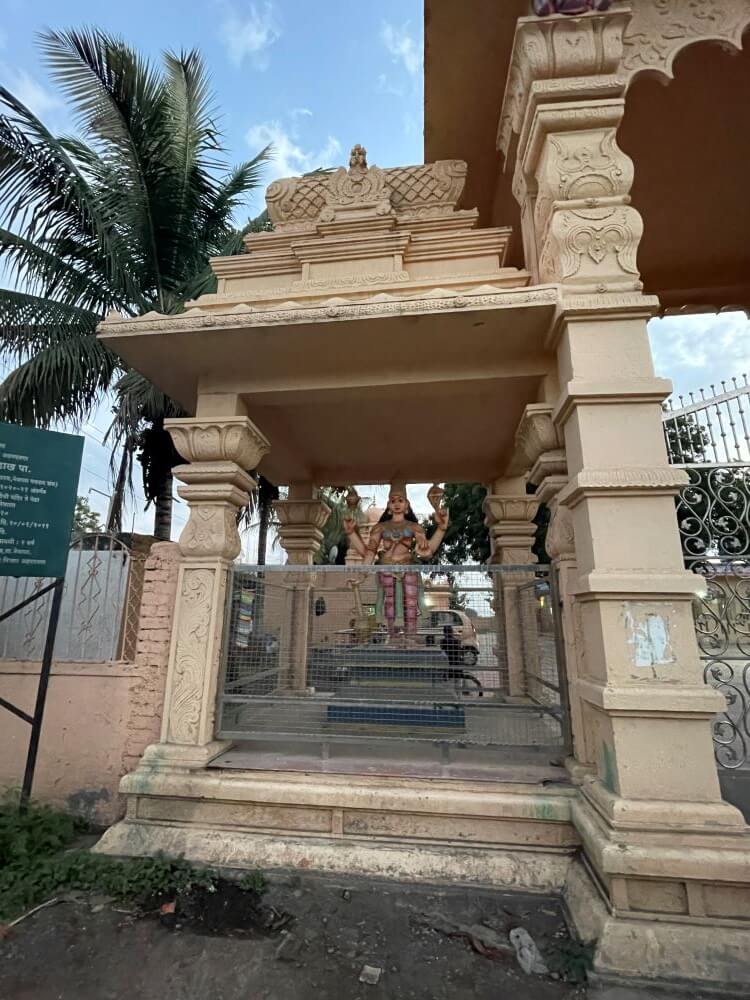
The architecture of the Ghodeshwari Temple comprises a Darshan Mandap, a Sabha Mandap (assembly hall), and a Garbhagriha (sanctum sanctorum). Above the Darshan Mandap sits a magnificent idol of Goddess Mahishasuramardini. In front of the temple stand idols of Lord Rama holding His bow and Lord Hanuman bearing His mace. The walls of the entrance are adorned with numerous distinctive sculptures depicting the rich heritage of Ahilyanagar district. These include sculptures of Lord Ganesha, Sheshashayi Lord Vishnu, Lord Shiva and Goddess Parvati in a cosmic dance, Radha-Krishna, Sant Dnyaneshwar, Sant Tukaram, Sant Janardan Swami (Maungiri), and Bhagwan Baba. The vibrant coloring of these sculptures enhances the temple’s beauty. The Sabha Mandap is spacious and beautifully finished with modern flooring. Within the sanctum sanctorum (Garbhagriha), there are two Tandala (aniconic stone) forms of the Divine Mother—one representing Goddess Renuka Mata and the other representing Goddess Ghodeshwari Mata.
The grand temple fair (yatra) is held on Chaitra Krishna Panchami and lasts for five days. On the eve of the fair, villagers embark on a journey carrying kawads (water pots) to fetch sacred water from the Godavari River. Walking barefoot throughout the night, the kawads reach the village at dawn. Goddess Ghodeshwari is ritualistically bathed with the sacred Godavari water and worshipped according to holy traditions, marking the commencement of the festival. During this five-day celebration, events such as the Goddess’s Palkhi (palanquin) procession, devotional bhajans and kirtans, and traditional wrestling competitions (kustincha hangam) are organized. Additionally, a special Abhisheka of the Goddess is performed on every full moon day (Purnima). The 15-day Sharadiya Navratri festival is celebrated with great devotion from Ashwin Shukla Pratipada to Kojagiri Purnima. A unique feature of this village is that no building is constructed higher than the height of the temple’s Kalash (spire) (i.e., multi-story buildings are avoided). Furthermore, horses are never used for any work or ceremonies in this village.
This sacred temple stands as a testament to deep spiritual devotion, ancient architectural grandeur, and rich local cultural traditions.
The sanctum sanctorum houses the divine idol consecrated according to ancient Vedic traditions, surrounded by serene courtyards and traditional temple architecture.
Navratri, Maha Shivratri, Annual Temple Jatra & Deepotsav
Compare and book flights, secure top-rated local hotels near the temple, hire reliable guides, and rent cars instantly.
Extend your pilgrimage by visiting other highly sacred temples located nearby.

Add ₹999 more to unlock FREE SHIPPING!
Your sacred cart is currently empty.
Shop Photo FramesFill in your delivery details below to place your order.
Add comment