
Add ₹999 more to unlock FREE SHIPPING!
Your sacred cart is currently empty.
Shop Photo FramesThe holy Kshetra of Kunkeshwar is nestled in the naturally abundant Devgad taluka on a pristine, beautiful white-sand beach. Known as the Kashi of South Konkan, this pilgrimage destination features the magnificent and splendid temple of Lord Kunkeshwar. Since the abode of Lord Shambhumahadeva here was located in a forest of wild sugarcane (kanak), it came to be known as Kunkeshwar. This sacred site of Kunkeshwar is extremely ancient and of great religious importance, with a history dating back to around the eleventh century. It is said that Chhatrapati Shivaji Maharaj himself visited this temple to have the darshan of Lord Kunkeshwar.
According to a legend regarding this temple, once a Brahmin’s cow began giving less milk than usual. Observing her closely, he noticed that the cow would go to a specific spot in the sugarcane forest and let down her milk there. As the cow was doing this, he tried to strike her. The cow fled in fear, but the blow landed on a stone, which began to bleed. To his astonishment, upon closer inspection, he realized that the stone was a Swayambhu (self-manifested) Shivalinga. From that day on, he began worshipping that stone daily. It is said that the scar from that strike is still visible today on the Shivalinga inside the Kunkeshwar temple. A popular story is also narrated here that this temple of Kunkeshwar was renovated by an Arab merchant.
The legend behind this goes that once an Arab merchant’s ship was caught in a storm. He began praying to God. Just then, he saw the light of a lamp burning far away in the eastern direction. Looking at that perpetual lamp (Nandadipa), he made a vow that if he survived this peril safely, he would spend a large fortune there to renovate the temple. After a while, his ship reached the shore safely. He then went to that small shrine and, over three years, spent a vast sum of money to build a large temple there. It is also said that so he could secure a permanent place at the feet of the Lord, the merchant jumped from the shikhara (spire) of this temple and gave up his life. His tomb is located to the north of Kunkeshwar. However, according to the historical novelist and Shivshahir Babasaheb Purandare, this story is fabricated. According to some scholars, the tale of the temple being built by an Arab merchant was deliberately spread at that time so that the temple would remain safe under the guise of blinding the Muslim rulers’ eyes. Some scholars believe this story was authored by Naro Nilkanth.
According to historical records, Naro Nilkanth served as an Amatya (minister) to Chhatrapati Shivaji Maharaj for some time. During the royal coronation (Shivrajyabhishek), Naro Nilkanth and his brother Ramchandrapant Nilkanth were appointed as Amatyas in Shivaji Maharaj’s Council of Eight Ministers (Ashtapradhan Mandal). After the death of their father, Nilopant Mujumdar, the position of Mujumdar was to pass to the eldest son, Naro Nilkanth; however, since he was deemed incapable, it was given to Ramchandrapant. Ramchandrapant was the author of Shivchhatrapati’s royal decree (Ajnapatra). According to historian Kamal Desai’s book ‘Shivputra Sambhaji’, Ramchandrapant Amatya was entrusted with the responsibility of the province stretching from Kudal to the Tungabhadra river.
To root out the Marathas from Konkan, Emperor Aurangzeb appointed Shah Alam Bahadur (Shahzada Muazzam) on September 15, 1683. Descending the Ramghat, he arrived in Sawantwadi, where the Marathas made life miserable for him. According to the Mughal historian Khafi Khan, ‘Many of his men and animals perished in this campaign. No horses were left in the army. The local enemy forces (meaning the Marathas) blockaded all routes of the Mughal army and cut off their food supplies. The condition of the Mughal army became extremely critical and dependent on fate. It became impossible for the prince to stay longer in that region. Finally, he sought permission from Emperor Aurangzeb to retreat.’ Shah Alam spent approximately three months in this region of Konkan. Accompanying him was Nagoji Maratha, a sardar well-acquainted with the area. During this time, the eyes of his army turned toward Kunkeshwar. Regarding this, a story is told that to prevent Shah Alam from harassing the temple, Naro Nilkanth removed the idol from a small shrine in the Kunkeshwar temple complex and shaped it to resemble a tomb. Later, he shaved the temple’s pinnacle (kalash) to give it a dome-like shape and spread the rumor that the Kunkeshwar temple was built by an Arab merchant. Nevertheless, Shah Alam’s forces attacked Kunkeshwar. At that time, Naro Nilkanth displayed immense valor, and the Maratha forces repulsed the attack. However, witnessing the damage inflicted upon the temple gave Naro Nilkanth a severe shock. Consequently, he passed away at Kunkeshwar. His Samadhi is located within the temple complex, and a Tulsi Vrindavan has been built there.
There are records indicating that this site of Kunkeshwar is extremely ancient. Kunkeshwar is mentioned in a Sanskrit copper plate dating back to 1436 CE. Known as the ‘Nagdev Copper Plate,’ it records that: ‘…A Brahmin named Devsharma of the Kashyap gotra was preeminent in divine knowledge, well-versed in the Yajurveda, and engaged in the six daily ritual duties (Shatcharma). Because of an invasion by the Turushka people there (i.e., on the banks of the Janhavi), he went to Konkan. In a prosperous village named Indul (present-day Hindale), the king honored him repeatedly. Later, attaining royal fortune and by the grace of Lord Shankara at the holy site of Kunkeshwar, he was blessed with a son.’ It is said that such an ancient temple has been renovated from time to time. The temple was also renovated during the Shiv era.
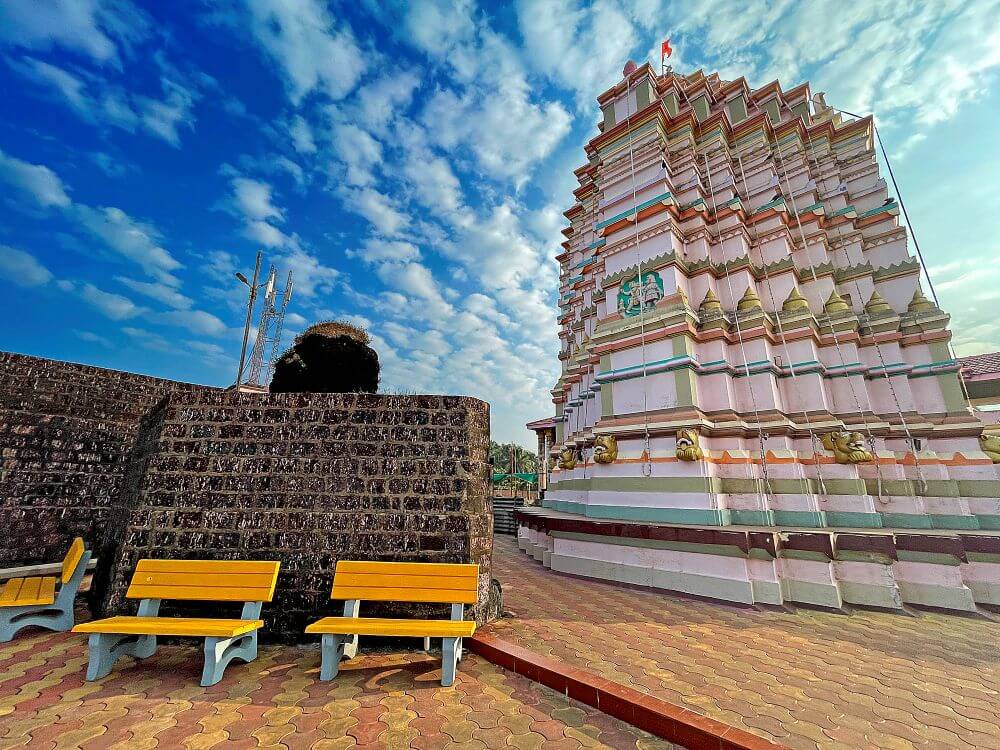
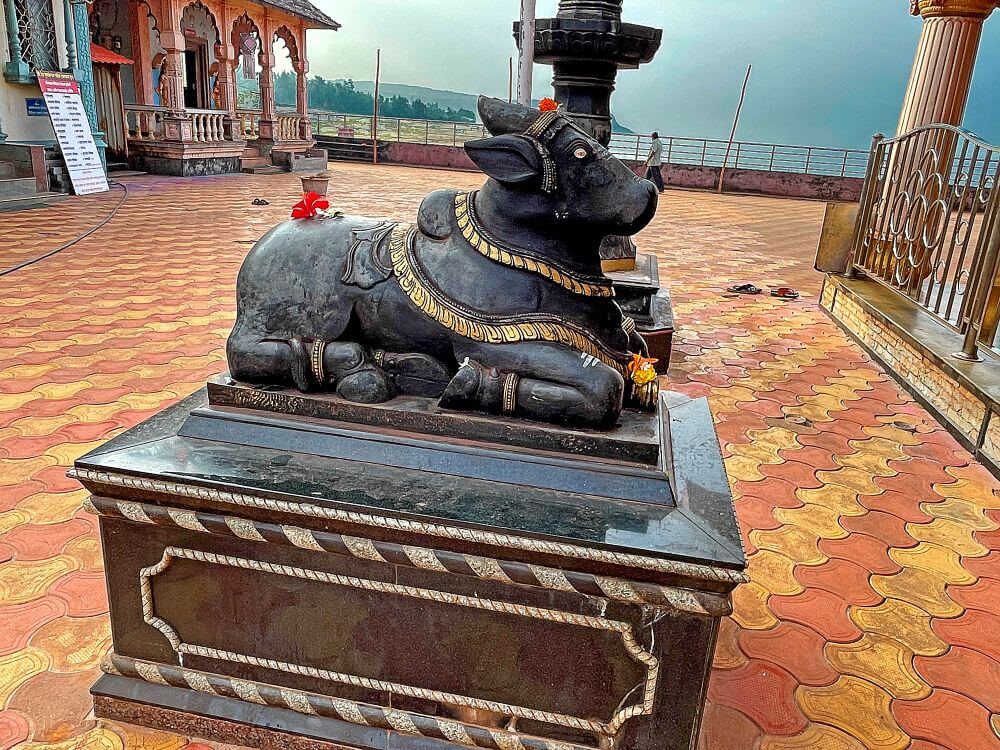
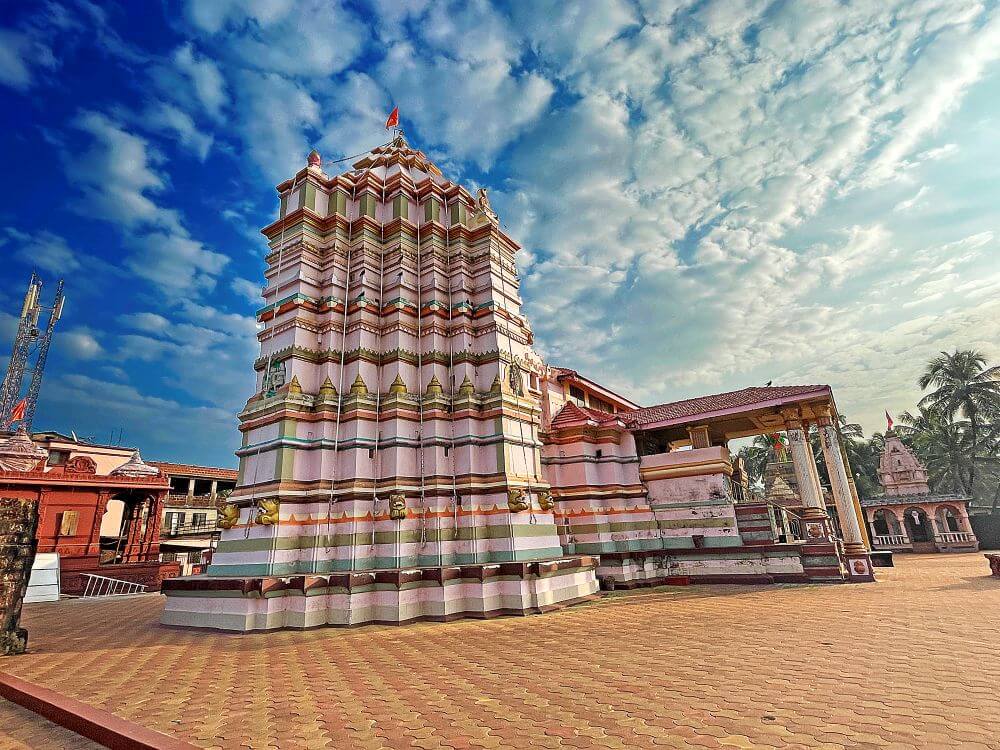
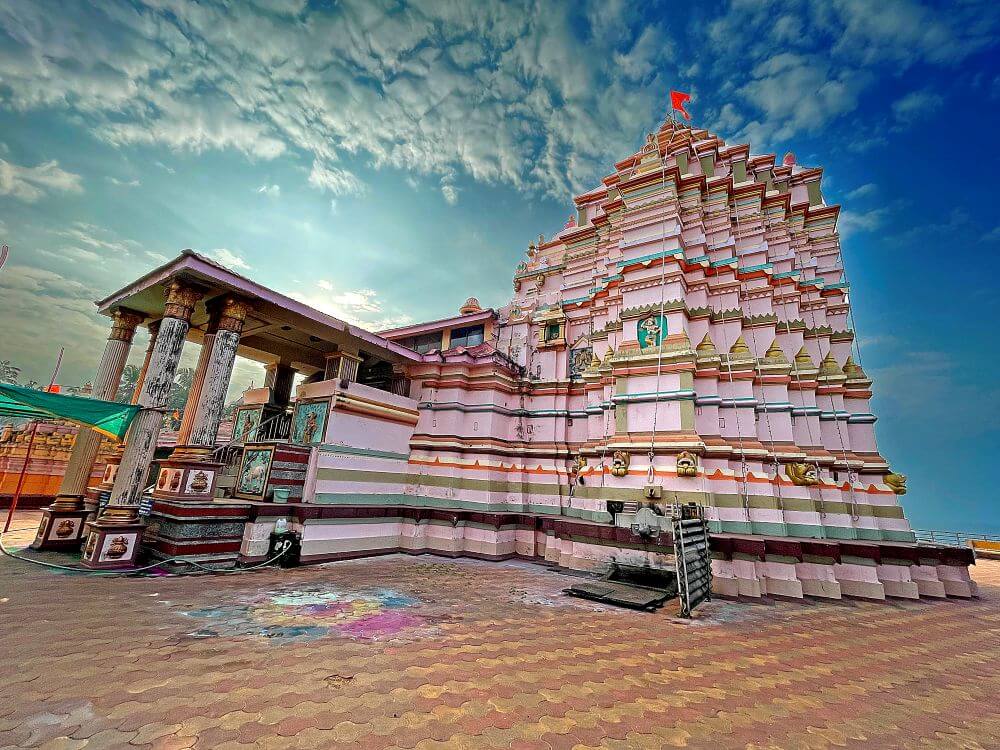
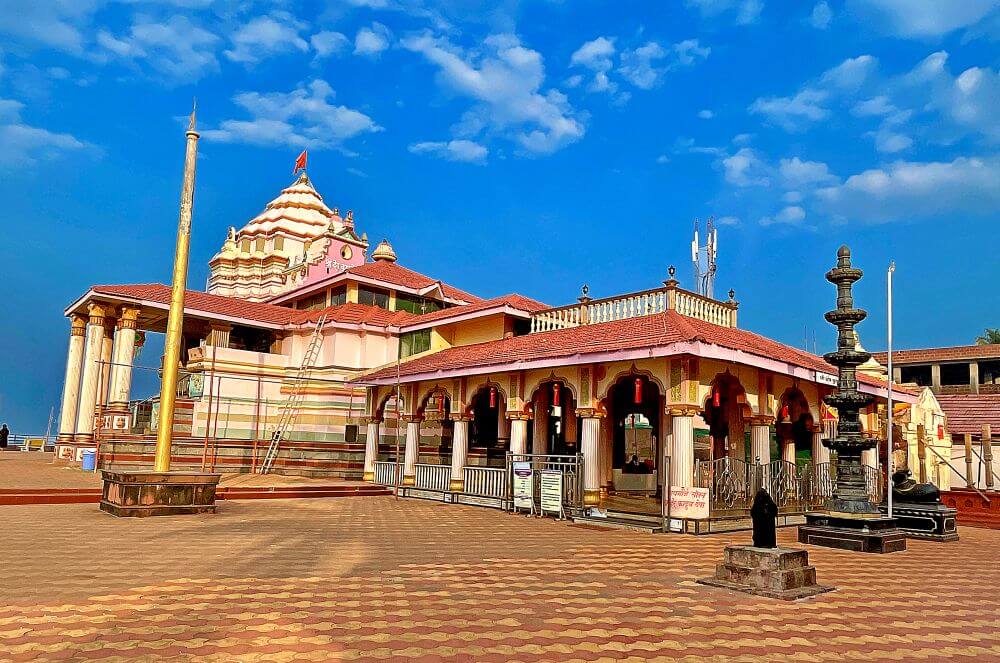
This temple stands on flat ground atop a high hillock along the sea coast. On the side facing the beach, the temple complex is enclosed by a large protective wall. On the approach road to the temple, there are a few shops selling worship materials and eateries on both sides. Right in front is the grand temple arch. Climbing a few steps from there, one finds the main entrance of the temple courtyard on the right side. Built entirely of red laterite stone, this entrance resembles the gateway of a fort. Climbing twelve to thirteen steps leads into the temple courtyard. Directly ahead, the soaring high spire of the magnificent Kunkeshwar temple comes into view. The height of this shikhara is approximately 22 to 24 meters. The temple comprises a grand sabhamandapa (assembly hall) built in the Konkani architectural style, an antaral (vestibule), and the garbhagriha (sanctum sanctorum) topped by a tall shikhara. In front of the sabhamandapa stands an ancient, intricately carved stone lamp pillar (deepstambh). Next to it, on a small platform, is the statue of Nandi.
Here, stepping up eleven steps from the open-type sabhamandapa (assembly hall), one enters the antarala (vestibule). On the front wall of the antarala, beside the entranceway, there are small niches containing idols of the Ashtavinayakas. Right ahead in the antarala, there is a small Shivalinga placed on a chowrang (low wooden platform), and further ahead, an idol of Nandi is positioned on a small pillar. Devotees whisper their wishes into the ears of this Nandi. It is a special feature of this temple that there are two such idols of Nandi.
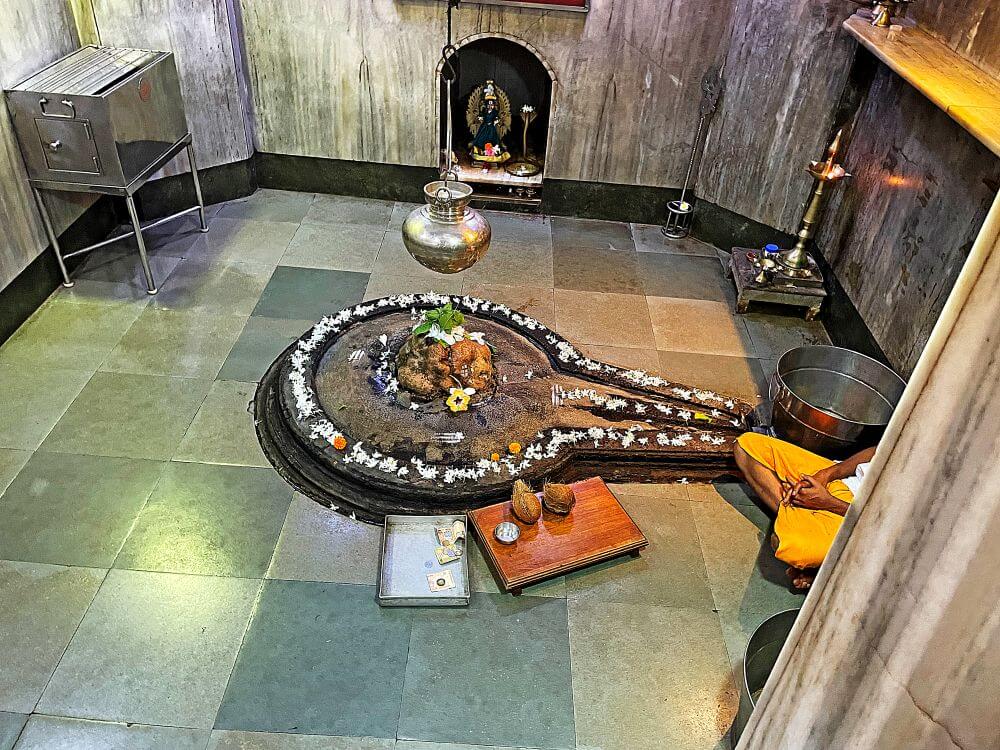
The entrance to the sanctum sanctorum (garbhagriha) is ancient and made of stone. It features three door-jambs (dwarashakhas). Lord Ganesha is seated at the lalatabimba (center of the lintel) above the door frame. The Dashavatara (ten incarnations of Lord Vishnu) are carved upon the door-jambs. These sculptures are a fine example of ancient Maharashtrian sculptural art. Notably, above the lalatabimba on the doorway of this Shiva temple—specifically in the upper tier—a large sculpture of Sheshashayi Vishnu is carved. In this sculpture, Lord Vishnu resting upon Adi Sesha and Goddess Lakshmi massaging His feet are also visible. To indicate that Sheshashayi Vishnu is upon the ocean, fish forms are carved around Shesha here. Inside the sanctum sanctorum lies the ancient Shivalinga of Lord Kunkeshwar.
Including the entrance from the sabhamandapa, this star-shaped temple has a total of three entrances. There is a mukhamandapa (porch) there, along with steps for ascending and descending. On the retaining wall beside the steps of the left mukhamandapa, there are large relief sculptures in the Maharashtrian style depicting Garuda, Hanuman, Vishnu’s Matsya avatar (fish incarnation), as well as Garuda flying with the Amritakumbha (pot of divine nectar). Meanwhile, on the retaining wall beside the steps of the right mukhamandapa, there are relief sculptures of Narada, Tumburu, Vamana, and the Kapila cow. On the outer wall of the sanctum sanctorum, up to the shikhara (spire), there are various carved divine idols, including a five-faced cow and its calf, Garuda in a reverential posture, Hanuman fighting a demon, and Lord Krishna. On the second tier from the base of the sanctum wall lies the vyalaranga (row of mythical lion-like creatures).
Within the temple premises spanning approximately three-quarters of an acre, there are shrines dedicated to Goddess Yogeshwari, Lord Ganesha, Dev Narayan, and Shri Mandlik. The prabhavali (divine halo) of the idol in the Shri Dev Narayan temple here features carved Dashavatara figures. Additionally, right in front as one enters the temple precincts is a small shrine. It is said that this shrine contains the tomb of an Arab merchant; however, only ‘Samadhi Mandir’ is inscribed on the temple. In the temple courtyard, in front of the left mukhamandapa, stands the Tulasi Vrindavan of the samadhi of Naro Nilkanth. Furthermore, in the coastal area of the temple grounds on a high platform, there is a rough, unshaped Shivalinga.
Rituals such as Ekadashini, Rudrabhishek, and Laghurudra are performed at the Kunkeshwar temple. Here, the deity’s palanquin procession takes place daily during the month of Chaitra, and Gudi Padwa is celebrated with great enthusiasm. A grand fair (yatra) is held here on Maha Shivaratri. Millions of devotees visit for the darshan of Lord Kunkeshwar on this day. On this day, the tarangs (divine umbrellas/symbolic representations) of deities from the surrounding five villages arrive here to visit Kunkeshwar. On the auspicious day of the new moon (amavasya) in the month of Magh, devotees take a holy dip in the sea here. A large crowd of devotees gathers here every Shravani Monday as well. Due to the breathtakingly serene beach here, there is a continuous influx of tourists along with devotees. Within the coastal area around this temple complex, there are twenty-one Shivalingas. They are clearly visible during low tide. Devotees have a firm belief that these Shivalingas were created by the Pandavas.
This sacred temple stands as a testament to deep spiritual devotion, ancient architectural grandeur, and rich local cultural traditions.
The sanctum sanctorum houses the divine idol consecrated according to ancient Vedic traditions, surrounded by serene courtyards and traditional temple architecture.
Navratri, Maha Shivratri, Annual Temple Jatra & Deepotsav
Compare and book flights, secure top-rated local hotels near the temple, hire reliable guides, and rent cars instantly.
Extend your pilgrimage by visiting other highly sacred temples located nearby.


Add ₹999 more to unlock FREE SHIPPING!
Your sacred cart is currently empty.
Shop Photo FramesFill in your delivery details below to place your order.
Add comment