
Add ₹999 more to unlock FREE SHIPPING!
Your sacred cart is currently empty.
Shop Photo FramesThe Swaminarayan Sampraday is a renowned religious sect in India. The Swaminarayan temples established by this sect across the country and abroad are considered a beautiful blend of architecture, aesthetics, and spirituality. Neelkanth Varni, also known as Swami Sahajanand, is the founder of this sect. He is considered to be Swaminarayan, an incarnation of Lord Shri Krishna. During his lifetime, he himself built several temples. Today, the temples known by his name are places of faith for millions of devotees. There is also a grand and beautiful temple dedicated to him in the city of Bhusawal.
The founder of this sect, which began in the early 19th century, Swami Sahajanand, was originally named Ghanshyam Pande. He was born in the year 1781 in the village of Chhapaiya near Ayodhya in Uttar Pradesh. At the age of twelve, he renounced his home. Thereafter, he traveled across India for seven years and performed penance in the Himalayas. During this period, he was known by the name Neelkanth Varni. In the year 1800, he arrived at Mangrol in Saurashtra. There, he received initiation from Swami Muktanand and later from Guru Ramanand at Piplana. Subsequently, he chose Gujarat as his field of religious and social reform work. Drawing upon the philosophies of Vishishtadvaita of Ramanujacharya and Shuddhadvaita of Vallabhacharya, he propagated a harmonizing religion.
The name Sahajanand was given to Neelkanth Varni by Ramanand. In the year 1801, Sahajanand became the head of Ramanand’s Uddhav Sampraday. His teaching was that Swaminarayan is Lord Shri Krishna himself and that people should seek refuge in him. It is the faith of the devotees that Sahajanand, alias Neelkanth Varni, is indeed Swaminarayan, the incarnation of God. Swami Sahajanand himself believed this to be true. It is said that in November 1820, Sahajanand himself explained to Gopalanand Swami the six reasons for his incarnation. During his lifetime, he built temples in Ahmedabad, Bhuj, Vadtal, Dholera, Junagadh, and Gadhada. Among these six, the temple in Ahmedabad is well-known. Swaminarayan had excellent relations with the British, who were the rulers at that time. The British had given him land to build a temple in Ahmedabad. At the time of the consecration ceremony of this temple, the British gave a 21-gun salute. Swaminarayan also performed many works of social reform. He had encouraged the British Governor James Walker to take action against the practice of Sati.
Swaminarayan passed away on Jyeshtha Shuddha Dashami, Samvat 1886 (1 June 1830). Before his death, he had established two seats: the Narnarayan Dev Gadi in Ahmedabad and the Laxminarayan Dev Gadi in Vadtal. He adopted the two sons of his cousins from Uttar Pradesh and appointed them as Acharyas on these seats. Their names were Ayodhyaprasad Pande (Ahmedabad Gadi) and Raghuvir Pande (Vadtal). Swaminarayan had given them the authority to install idols in temples and to grant sectarian initiation to ascetics and householders. Over time, due to differences with the original seats of this sect, some organizations were formed. The Bochasanwasi Akshar Purushottam Swaminarayan Sanstha (BAPS), Swaminarayan Gadi (Maninagar), and Gunatit Samaj are some of the famous organizations among them. The temple in Bhusawal is associated with the Vadtal Gadi of the original Swaminarayan Sampraday.
The history of this temple is that it was built with the permission of the ‘Vadtal Temple Managing Trustee Board’ and under the command of Acharya Rakeshprasad Maharaj, who is in the sixth lineage of disciples of Aksharmurti Gopalanand Swami. On 15 December 2008, the ground-breaking ceremony (Bhoomi Pujan) of this temple was performed in the presence of Swami Prabhujivandas and Purushottamcharandas. The construction of this temple continued for about eight years. Swami Dharmaswarupdas, a gurubhai of Rakeshprasad Maharaj, and other saints completed the work of this temple construction. The consecration of the idols in the temple was performed on Margashirsha Shuddha Shashthi, Samvat 2073 (Monday, 5 December 2016).
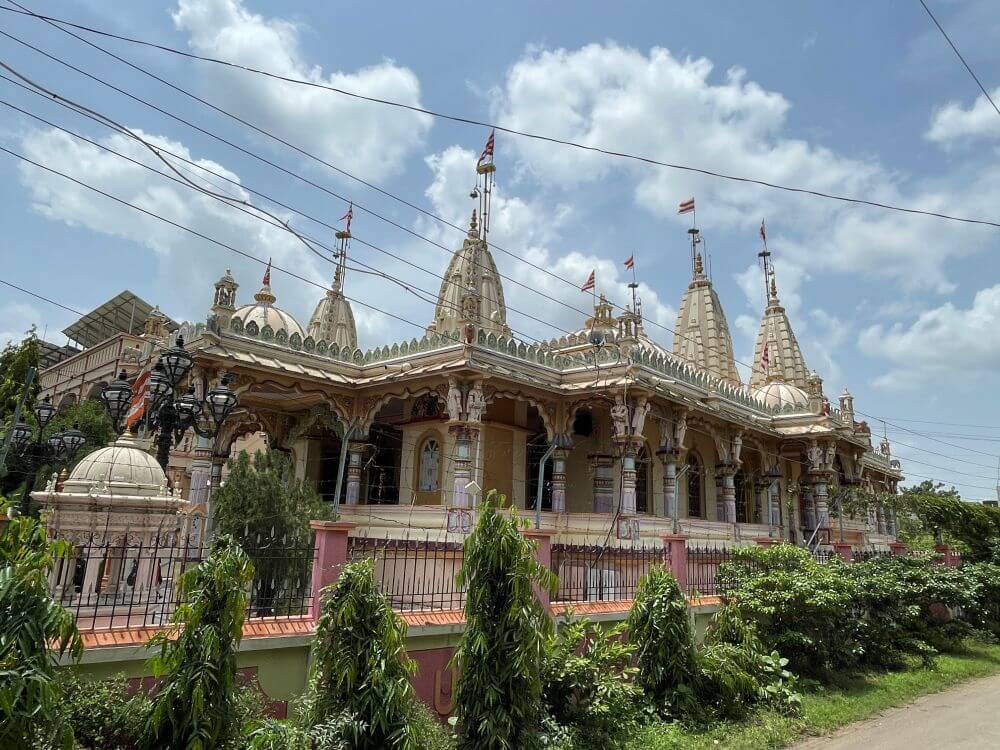
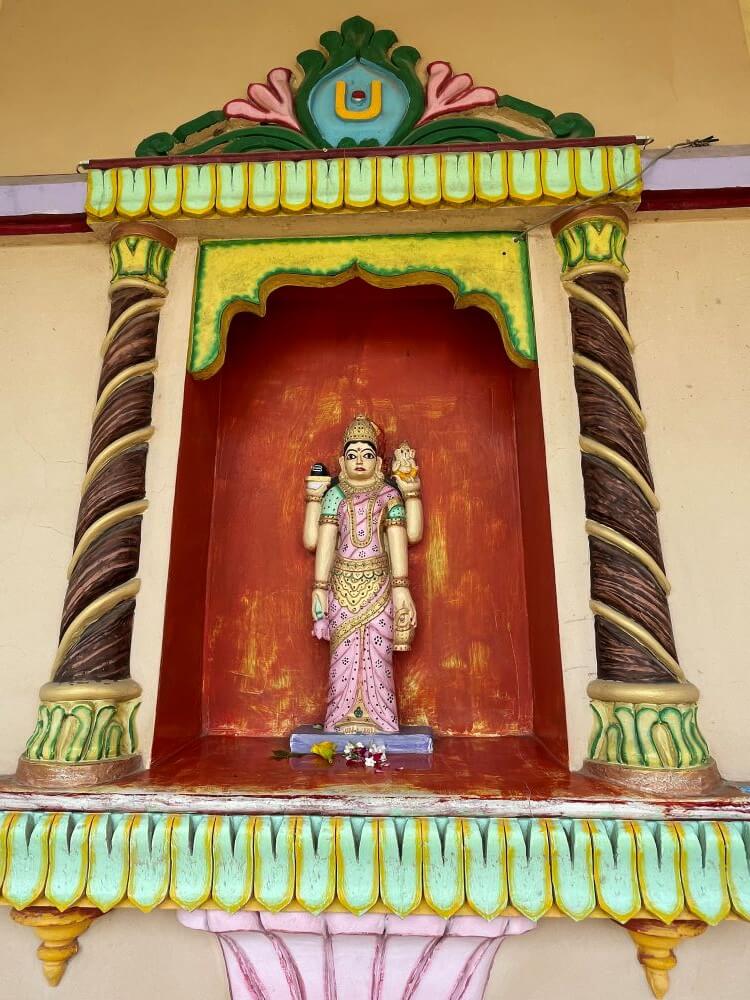
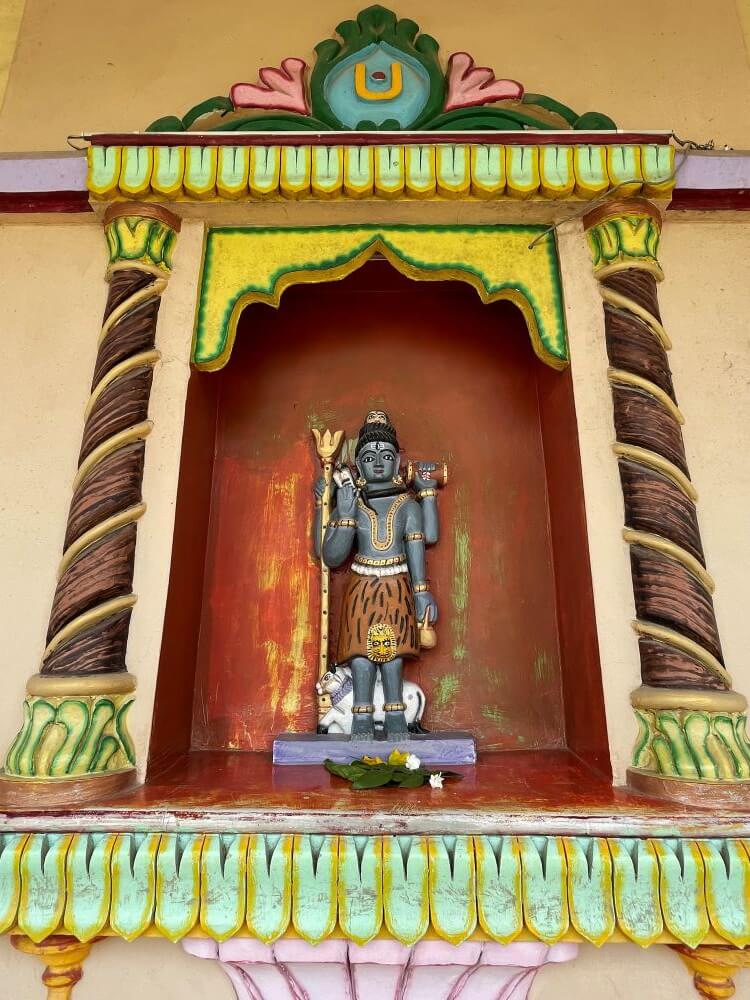
This temple is situated in a large courtyard in the Tukaram Nagar area of Bhusawal. As soon as one enters through the iron gate of the temple courtyard, two bells hanging on decorated pillars are visible in front. There are also ornate lamp pillars (Deepstambhas) here. From here, there are 11 steps to reach the main porch (Mukhamandap) of the temple. On both sides of these steps are beautiful statues of elephants carrying howdahs. The structure of this temple consists of a main porch, an assembly hall (Sabhamandap), sub-halls on both sides, and a sanctum sanctorum (Garbhagriha). The carved pillars in the halls, the makar-toranas between the pillars, as well as the grand spires (Shikharas) and sub-spires, which are the characteristics of the architectural design of Swaminarayan temples, can also be seen in this temple. In the niches of the temple’s main porch, there are idols of Vighnavinayak Ganapati and Kashtabhanjandev Hanuman. In the area above the door frame of Hanuman’s niche, there is a very unique idol of Shri Ram and Sita seated on a throne. In it, Hanuman has placed the lotus feet of Shri Ram on his lap.
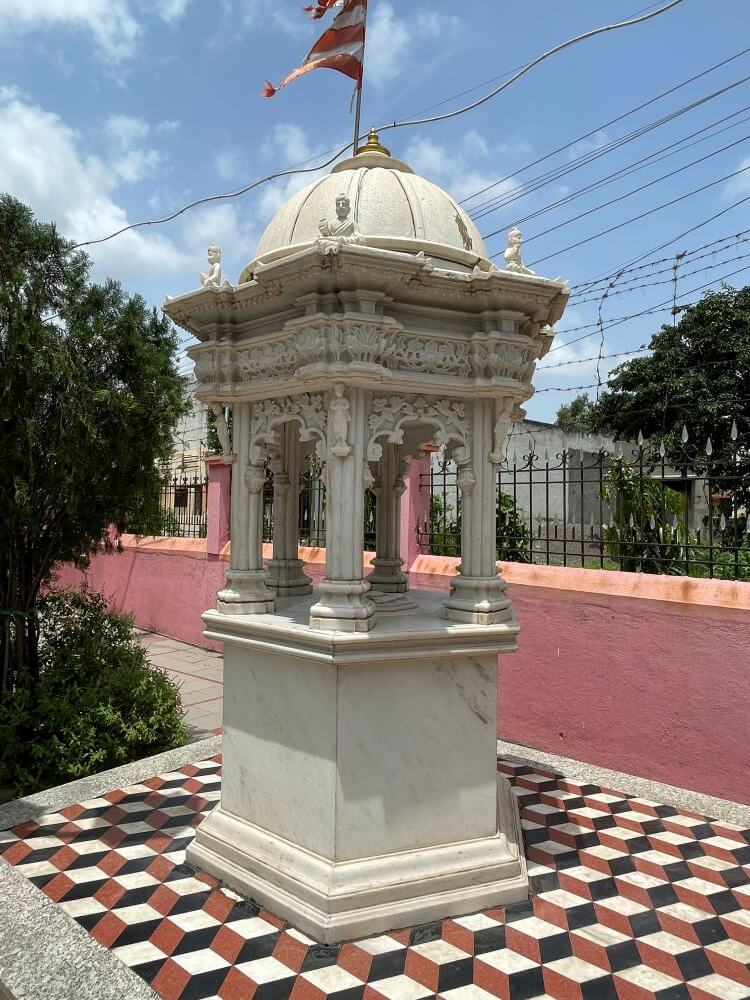
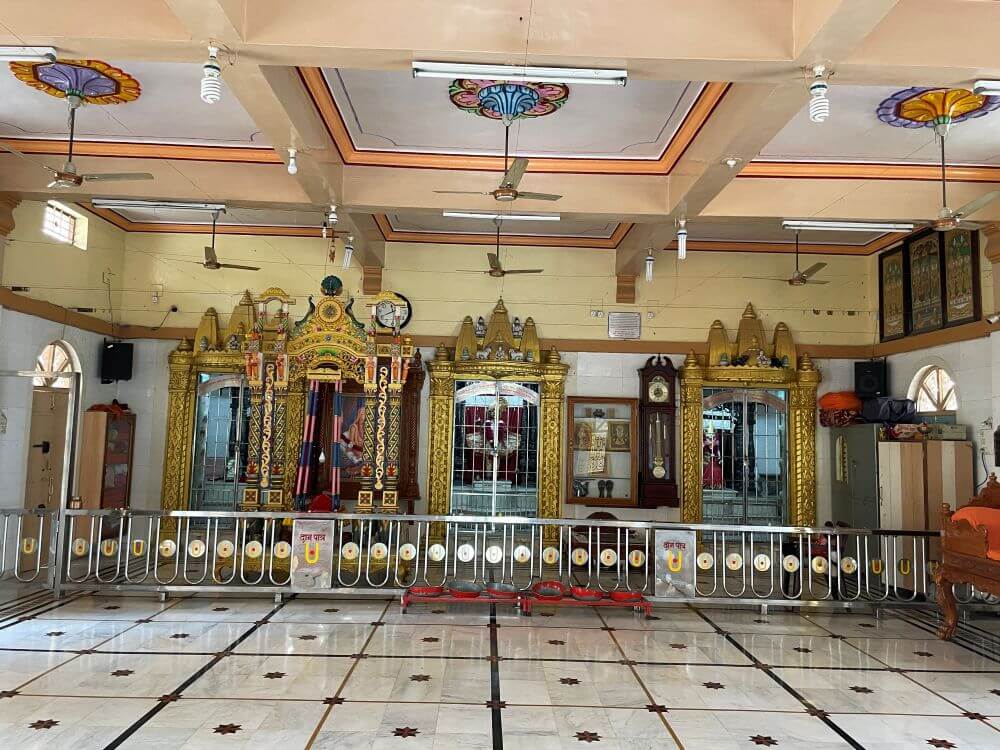
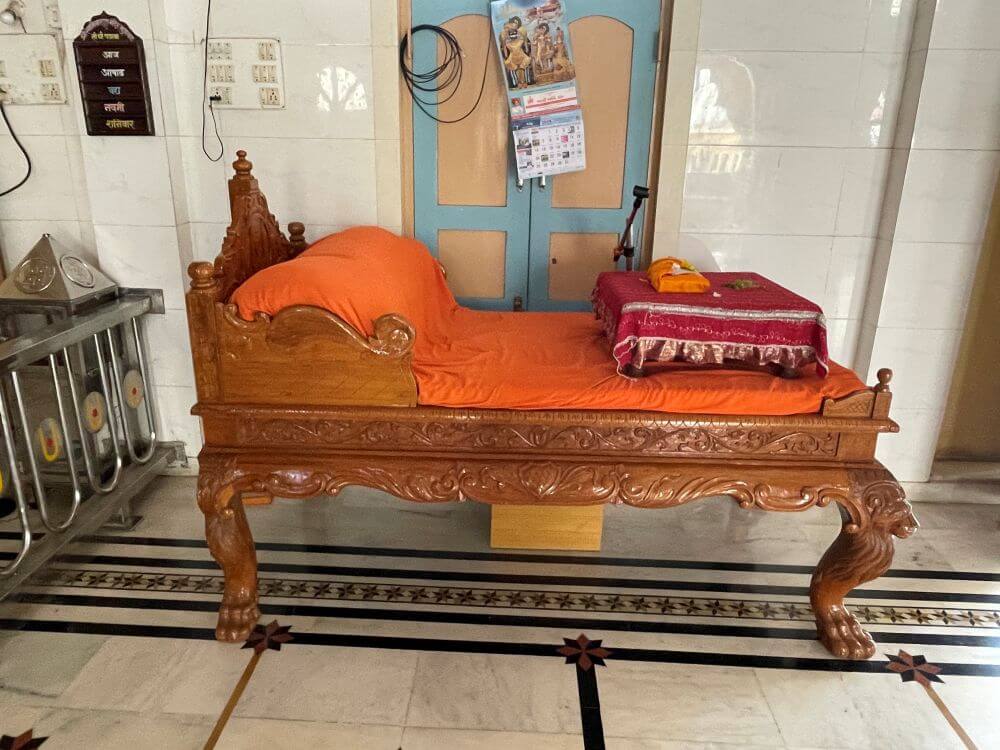
On both sides of the arched entrance of the assembly hall, there are colorful sculptures of gatekeepers (Dwarapalas). The upper portion is adorned with peacock motifs. The assembly hall, paved with smooth marble tiles, features entrances on both the left and right sides. Directly ahead, there are three sanctum sanctorum: one main and two auxiliary. The door frames of these sanctums are decorated with ornate, golden-hued pillars. The upper section features three small spires. In the main sanctum, the black stone, standing-posture idol of Harikrishna Maharaj is enshrined on a marble pedestal. This idol is adorned in Gujarati-style garments and a turban on its head. In the left auxiliary sanctum, marble idols of Radha-Krishna are installed on a high marble pedestal, while in the right auxiliary sanctum, marble idols of Lakshmi-Narayana are enshrined. Near these auxiliary sanctums, there is a place for the images, holy sandals, and the seat of Swaminarayan. In the space in front of the sanctums, there is a beautifully carved and painted swing. The swing is decorated with pillars raised on elephant sculptures, musician sculptures at the top of the pillars, canopy-like structures in the upper part, and a triangular, crown-like section in the center, all topped with peacock sculptures. Outside the temple, there is a circumambulatory path along the corridor. The tops of the pillars here feature sculptures of various musicians. The canopy-style ceiling has small dome-like structures. The temple has five tall spires and three dome-shaped spires.
Hundreds of devotees visit this temple daily for darshan. Festivals and celebrations such as Krishna Janmashtami, Hanuman Jayanti, Ashadhi Ekadashi, Ganeshotsav, Vaman Jayanti, Jaljhilani Utsav, and Bhagwat Saptah Gyanyajna are celebrated here with great enthusiasm.
This sacred temple stands as a testament to deep spiritual devotion, ancient architectural grandeur, and rich local cultural traditions.
The sanctum sanctorum houses the divine idol consecrated according to ancient Vedic traditions, surrounded by serene courtyards and traditional temple architecture.
Navratri, Maha Shivratri, Annual Temple Jatra & Deepotsav
Compare and book flights, secure top-rated local hotels near the temple, hire reliable guides, and rent cars instantly.
Extend your pilgrimage by visiting other highly sacred temples located nearby.


Add ₹999 more to unlock FREE SHIPPING!
Your sacred cart is currently empty.
Shop Photo FramesFill in your delivery details below to place your order.
Add comment