
Add ₹999 more to unlock FREE SHIPPING!
Your sacred cart is currently empty.
Shop Photo FramesYamai Devi, whose original seat is at Aundh in Satara district, is believed to be a form of Renuka Devi, the mother of Parashurama and wife of Jamadagni. This ancient site of the Goddess at Mardi holds special significance because Yamai Devi is enshrined here as the elder sister of Tulja Bhavani, the Kulswamini (family deity) of Maharashtra. Due to the presence of the primordial Shakti herself, Mardi has been blessed with the heritage of a Shakti Peetha. Many devotees follow the tradition of seeking the blessings of Yamai Devi here after having the darshan of Tulja Bhavani.
The legend of Yamai Devi is mentioned in the ‘Kedarvijay’ scripture. ‘Kedarvijay’ was originally a Sanskrit text, which was brought into Marathi by Hari Angarpurkar in 1779. This scripture consists of 36 chapters, and the story of Yamai Devi is in the 27th chapter. It states that in ancient times, a demon named Kolhasur created havoc in the Karveer region. Lakshmi, who resided there, had to migrate. Seeing this, Kedarnath took up the task of re-establishing Lakshmi there. To assist Kedarnath in that mission, Yamai Devi, in her form as Moolmaya, appeared on the Kanthgiri mountain near Aundh. She slew the demon Aundhasur, who was part of Kolhasur’s demon army. The Yamai Devi at Mardi is considered the elder sister of Goddess Bhavani, the Kulswamini of Chhatrapati Shivaji Maharaj.
The village of Marodi is mentioned in the ‘Markandeya Purana’ as the land of penance for Sage Markandeya, the author of the ‘Devi Saptashati’ scripture and the revered family deity of the Padmashali community. Over time, the name Marodi evolved into Mardi. The story regarding the temple of the Goddess in this village is that about 800 years ago, a staunch devotee of the Goddess named Ranganathswami Gosavi lived in Sedam and Chitapur in the Gulbarga district of Karnataka. He built this temple at Mardi and performed the consecration of Yamai Devi. The privilege of performing worship in this temple has been held by the Gurav community for the last 27 generations.
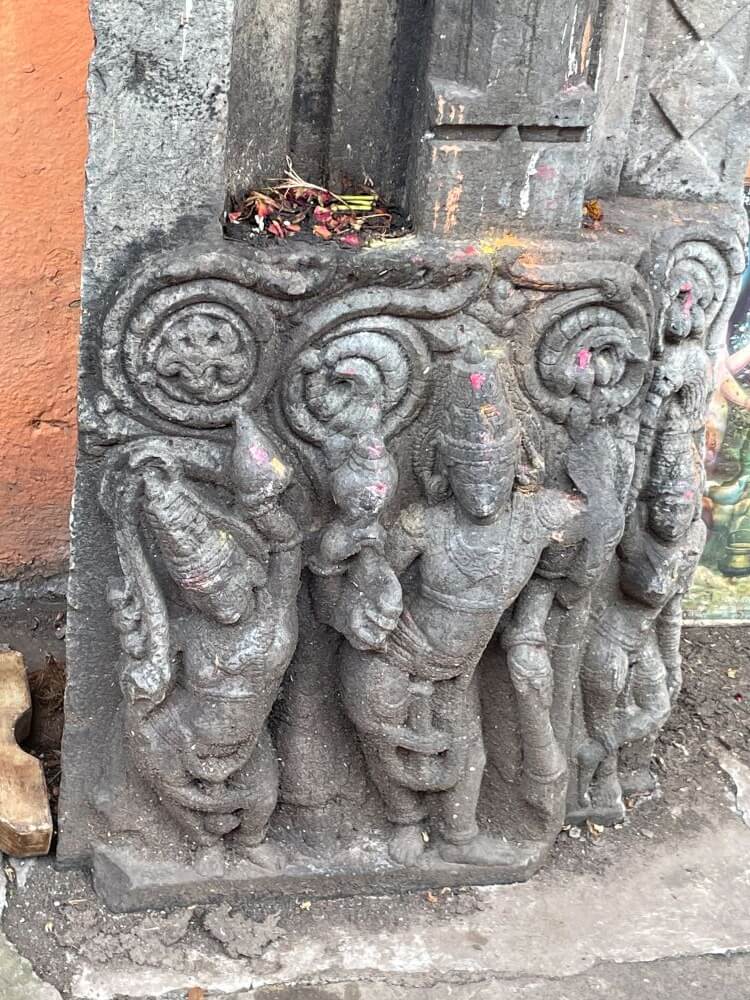
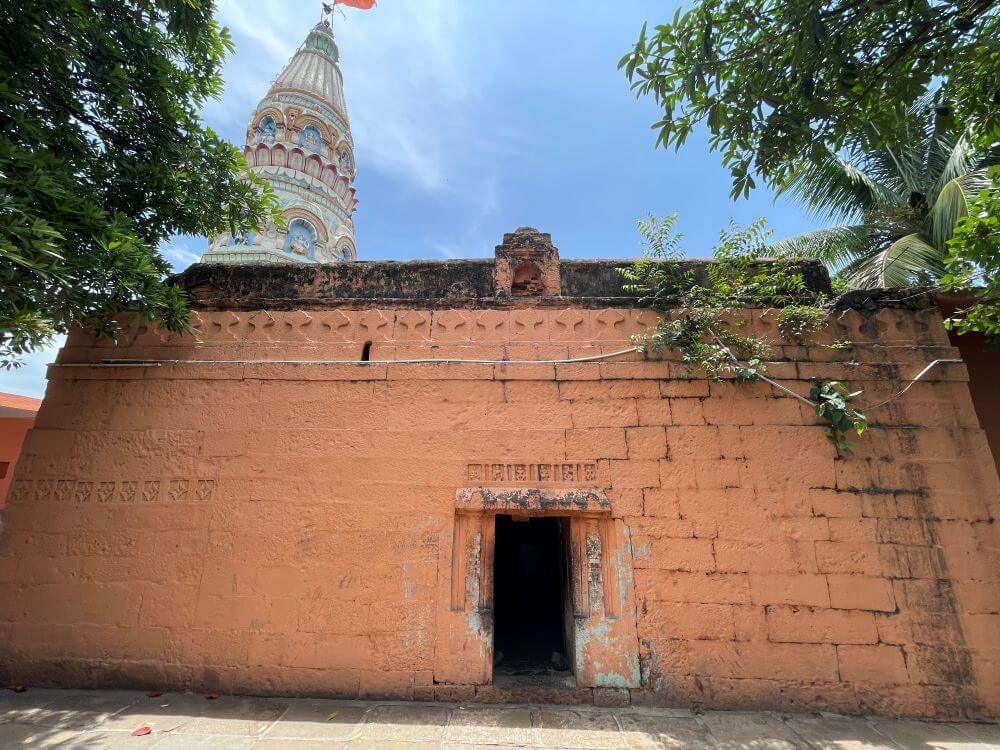
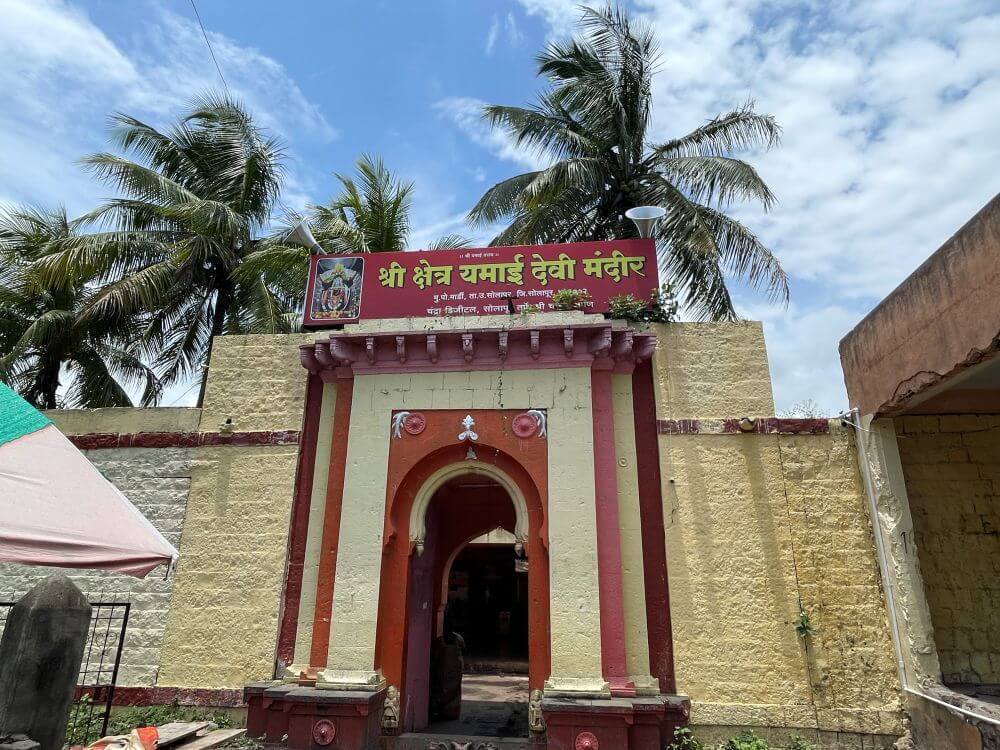
This ancient and awakened temple of Yamai Devi is situated in the central part of Mardi village in North Solapur taluka. The temple is surrounded by a high stone fortification resembling a fort. Near the entrance in the fortification, there is a large stone Pushkarani (square well) on the outside. On both sides of the entrance, there are three pillar branches and sculptures of gatekeepers (Dwarapalas). At the bottom of the arched entrance is a Kirtimukh, and at the top, there are wheel motifs and fish sculptures. One enters the temple courtyard through this entrance, which feels like a fort gate. Inside the entrance are chambers for the gatekeepers. The fortification adjacent to the entrance has galleries on the inner side.
The structure of this Hemadpanti-style temple consists of a Mandapa, Sabha Mandapa, Antarala, and Garbhagriha. The open-style Mandapa here was built in a later period. There is an arrangement for a queue for darshan in the Mandapa to manage the crowd of devotees. In the center of the Mandapa is a Havan Kund (sacrificial fire pit). At the entrance of the Sabha Mandapa, there are ornate pillar branches on both sides with gatekeeper sculptures below them. In the Sabha Mandapa, baskets of flour and salt are kept. Devotees offer various types of grains, flour, and salt in these baskets.
In the Sabha Mandapa, in front of the Antarala, there is a platform with the Goddess’s vehicle, the lion, and a sculpture of her footprints (Paduka). In the Garbhagriha, the Goddess is enshrined in a silver arch on a high Vajrapitha. It is said that the idol of the Goddess here is about seven feet tall and in a standing position. Since a dais was built in front of this idol a few years ago, only the upper part of the idol can be seen now. The Goddess wears a silver crown, silver eyes, a pearl nose ring, and various garments and ornaments. In her upper right hand, the Goddess holds a Damaru, and in her lower right hand, a sword. In her upper left hand, she holds a Trishul, and in her lower left hand, a drinking vessel (Panpatra). On the left side of her seat, the head of a demon is carved, and on the right side, the face of a buffalo. A unique feature of this temple’s architecture is that during Gudi Padwa, for three days, the sun’s rays fall directly on the idol of the Goddess in the Garbhagriha.
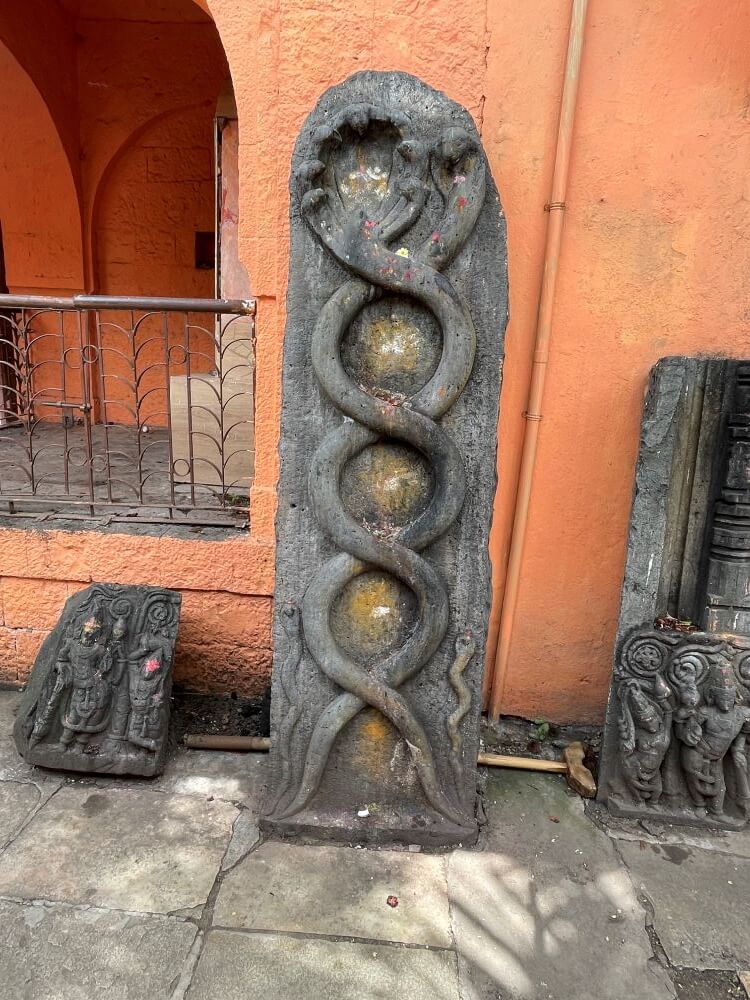
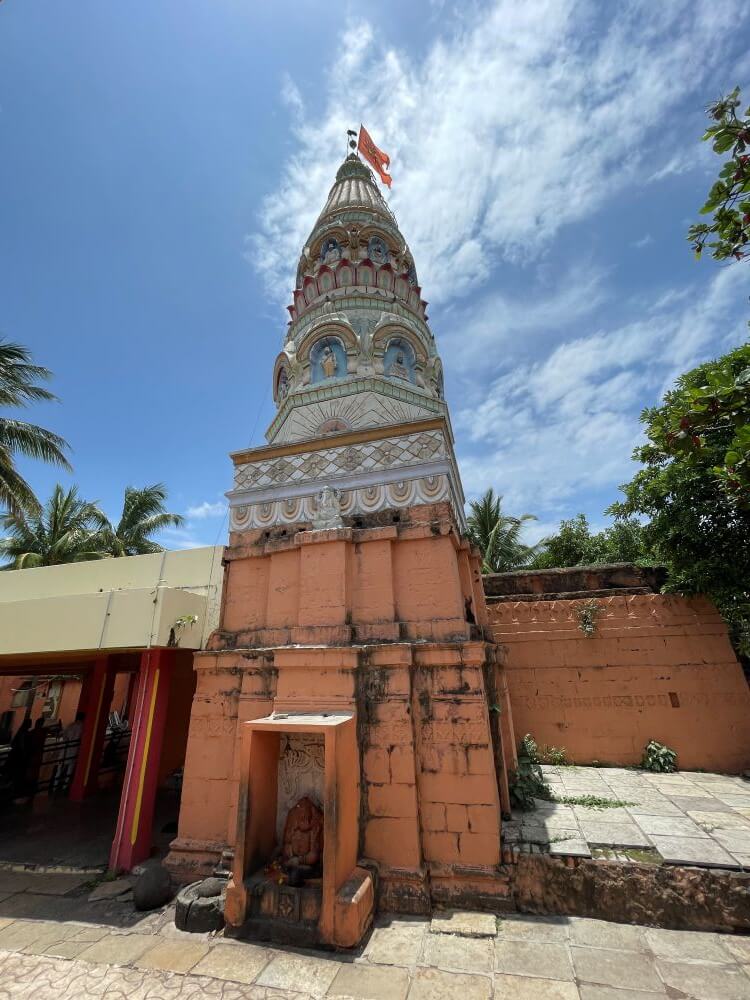
There is a unique ancient Vishnu idol in this temple. It is said that this idol was found underground while construction was going on in the temple premises. According to scholars, this idol is 1,000 to 1,200 years old. On the upper part of the back slab of this carved idol made of solid black stone, the Dashavatara (ten incarnations) of Vishnu are carved. This four-armed idol holds the Sudarshan Chakra in one hand, a conch in the second, a mace in the third, and the fourth hand is in a gesture of blessing. There is a tall, beautifully crafted Shikhara (spire) over the Garbhagriha. There are many idols of gods and goddesses in the niches of this Shikhara. There are many ancient sculptures in the temple premises.
Various festivals and pilgrimages are celebrated with great enthusiasm in the temple throughout the year. The pilgrimage of Yamai Devi takes place for five days starting from Chaitra Vadya Ashtami. During this pilgrimage period, four Chhabina processions are taken out. The Navratri festival is also celebrated here on a grand scale. Hundreds of devotees attend the daily Aarti during this time. On every full moon day, a procession of the Goddess is taken out in a palanquin. Also, every Tuesday, a circumambulation (Pradakshina) is performed around the temple. A large number of devotees from Andhra and Karnataka states, along with Solapur district, participate in these pilgrimages and festivals. Devotees can have the darshan of Yamai Devi in this temple daily from 7 in the morning to 8 at night.
This sacred temple stands as a testament to deep spiritual devotion, ancient architectural grandeur, and rich local cultural traditions.
The sanctum sanctorum houses the divine idol consecrated according to ancient Vedic traditions, surrounded by serene courtyards and traditional temple architecture.
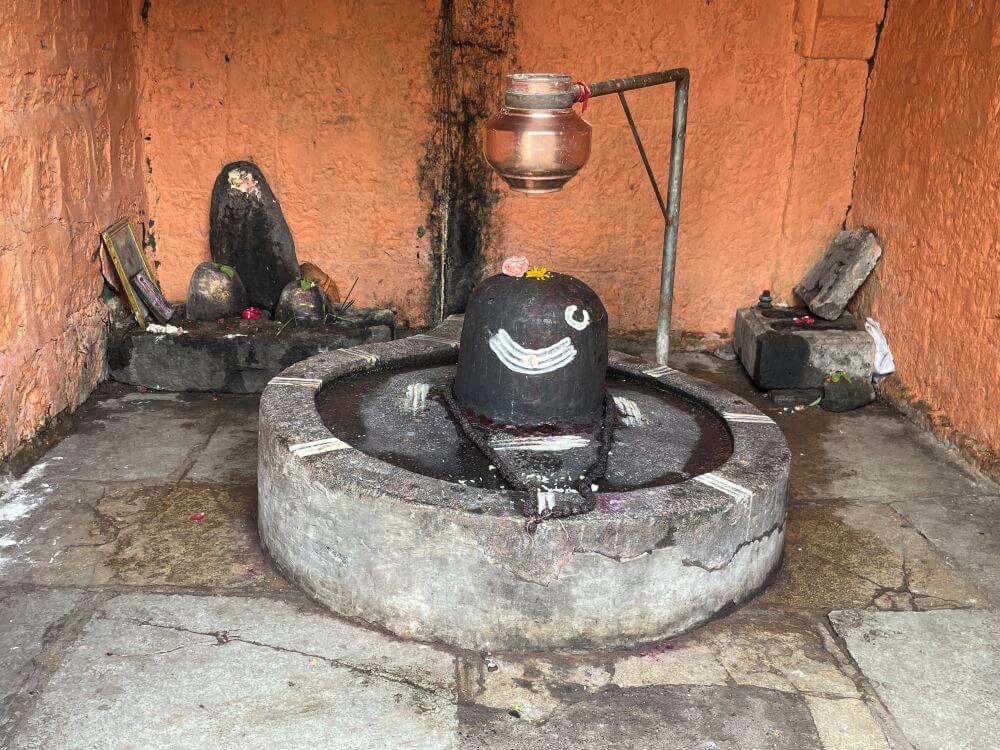
Navratri, Maha Shivratri, Annual Temple Jatra & Deepotsav
Compare and book flights, secure top-rated local hotels near the temple, hire reliable guides, and rent cars instantly.
Extend your pilgrimage by visiting other highly sacred temples located nearby.


Add ₹999 more to unlock FREE SHIPPING!
Your sacred cart is currently empty.
Shop Photo FramesFill in your delivery details below to place your order.
Add comment