
Add ₹999 more to unlock FREE SHIPPING!
Your sacred cart is currently empty.
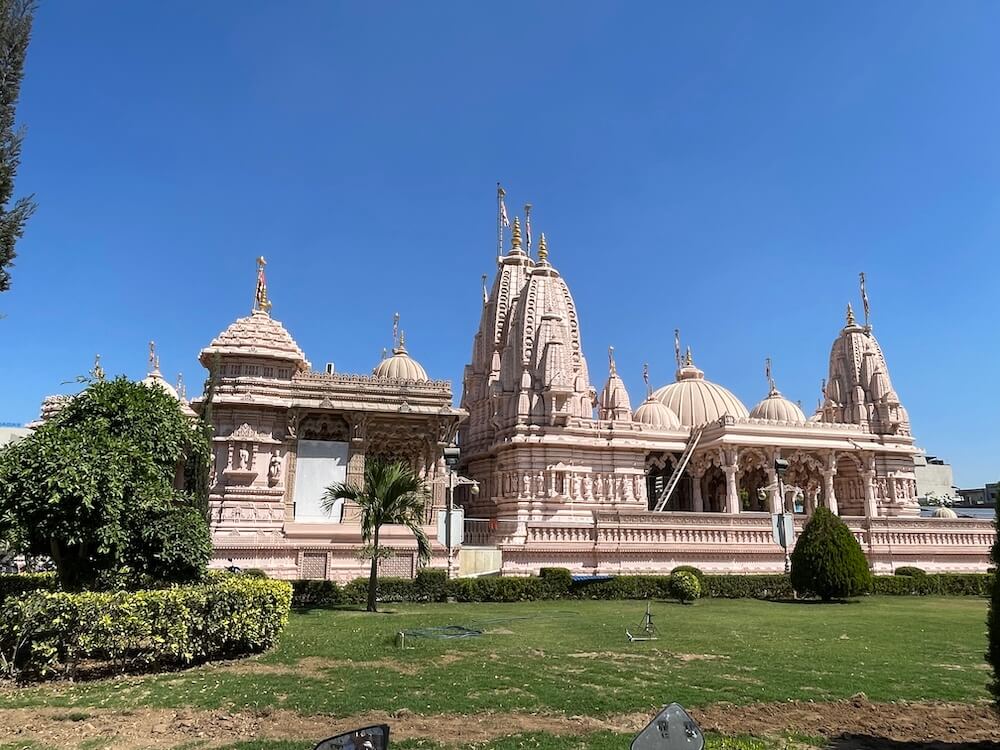
Shop Photo FramesSituated within a sprawling and magnificent estate in the city of Mehsana – a place steeped in ancient and spiritual heritage – stands a grand temple dedicated to Lord Swaminarayan. The primary allure of this shrine lies in its exquisite carvings in pink sandstone, its sky-piercing spires and its profoundly serene environs. The temple enshrines the idols of Lord Swaminarayan and Gunatitanand Swami, alongside various other Hindu deities. Adorned with a beautiful garden, captivating sculptures and equipped with state-of-the-art amenities, the temple welcomes hundreds of devotees daily. Established by the ‘Bochasanwasi Akshar Purushottam Swaminarayan Sanstha’, this temple serves today not merely as a place of worship, but as a vibrant center for child character-building (Bal Sanskar), youth assemblies and various social initiatives.
Swaminarayan is a renowned religious sect in India, founded by Swami Sahajanand. Born in 1781 in Chhapaiya near Ayodhya, his original name was Ghanshyam Pande. He performed rigorous penance in the Himalayas for many years, during which time he was known as Nilkanth Varni. A grand ‘Abhishek Mandap’ (consecration hall) featuring his idol has been erected within the Mehsana temple complex. In 1800 AD, he arrived in Saurashtra and received initiation from Ramanand, the guru of the Ramanandi sect, who bestowed upon him the name Sahajanand. Travelling from village to village, he imparted the ‘Swaminarayan Mahamantra’ to countless followers. Devotees firmly believe that Sahajanand is the manifestation of Lord Swaminarayan himself. Following the demise of Sahajanand, alias Swaminarayan, in 1830 AD, the leadership of the sect was assumed by Gunatitanand Swami. Subsequently, in 1905, Shastri Yagnapurushdas, also known as Shastri Maharaj, established the ‘Bochasanwasi Akshar Purushottam Swaminarayan Sanstha’ within the Swaminarayan fold. The lineage of leadership later passed to Pramukh Swami Maharaj. Under his guidance after 1971, BAPS witnessed a monumental global expansion. Presently, there are two magnificent Swaminarayan Akshardam temples worldwide, of which the one in New Delhi is considered one of the largest in the world. Spread across 100 acres on the banks of the Yamuna, this temple is also featured in the Guinness Book of World Records. Furthermore, BAPS oversees 150 ‘Shikharbaddha’ temples (shrines distinguished by tall, ornate spires over the sanctum) and over 1,700 other temples globally. Most of these were constructed under the visionary direction of Pramukh Swami and the Mehsana temple is a prominent example of this architectural legacy.
The history of this temple is marked by significant milestones. According to available records, the groundwork for this project gained substantial momentum in December 1994, coinciding with the 74th birth anniversary celebrations of Pramukh Swami Maharaj. Owing to the increasing influx of devotees and the vision for a grander edifice, the current ‘Shikharbaddha’ temple was constructed using pink stone. On 7 May 2006, the grand ‘Murti Pratishtha’ (idol consecration) ceremony of this new temple was performed by the sacred hands of Pramukh Swami Maharaj.
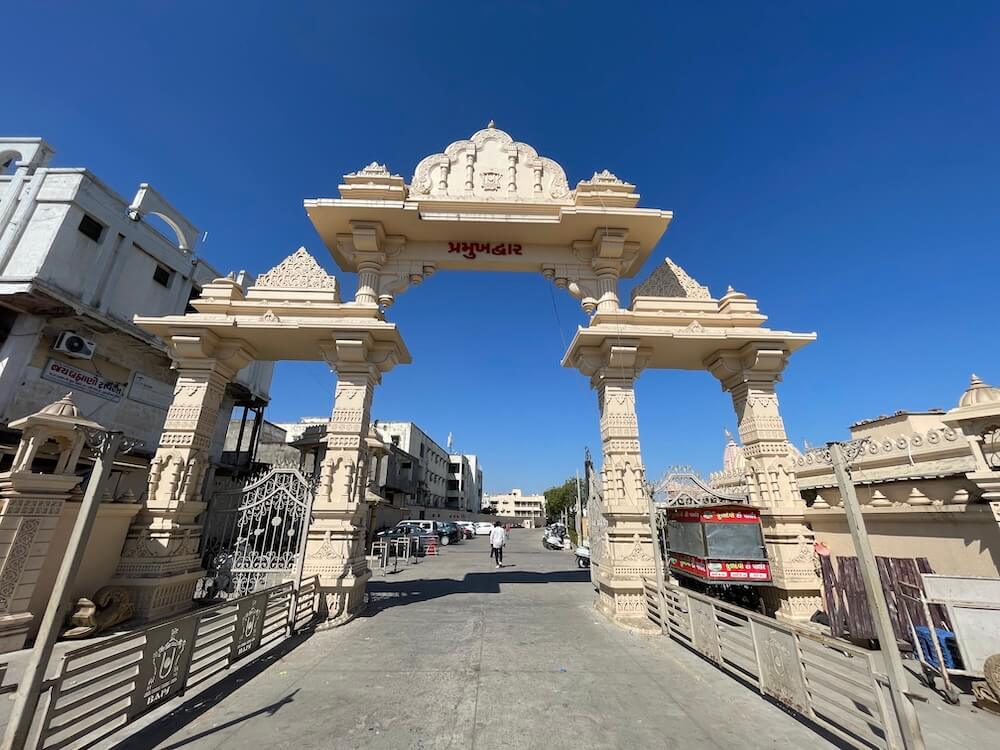
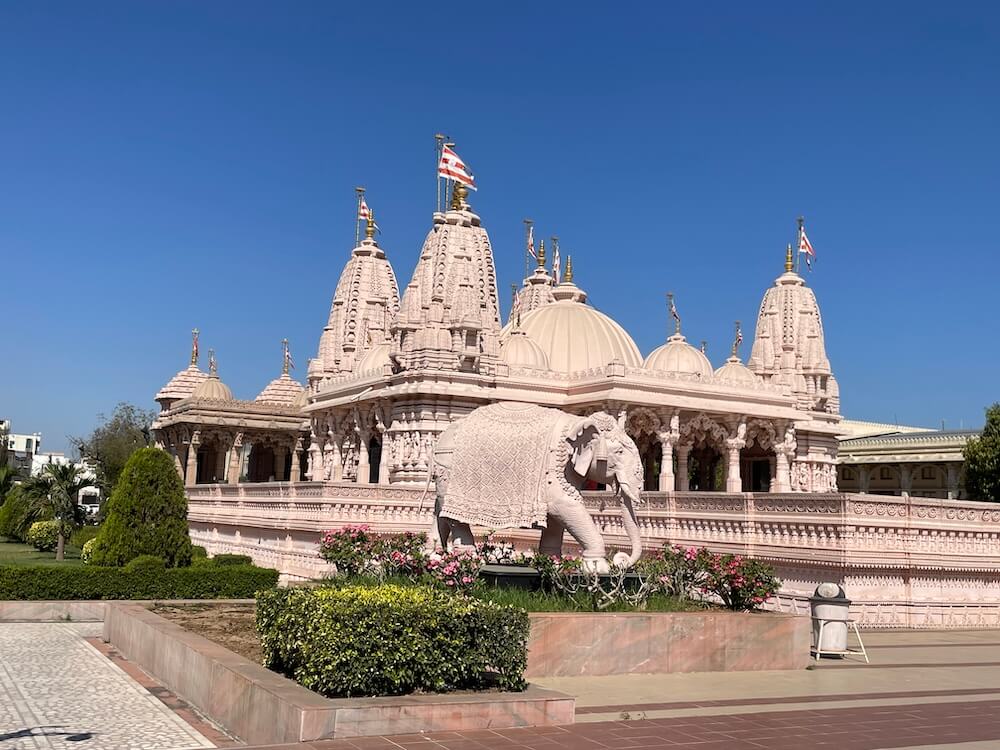
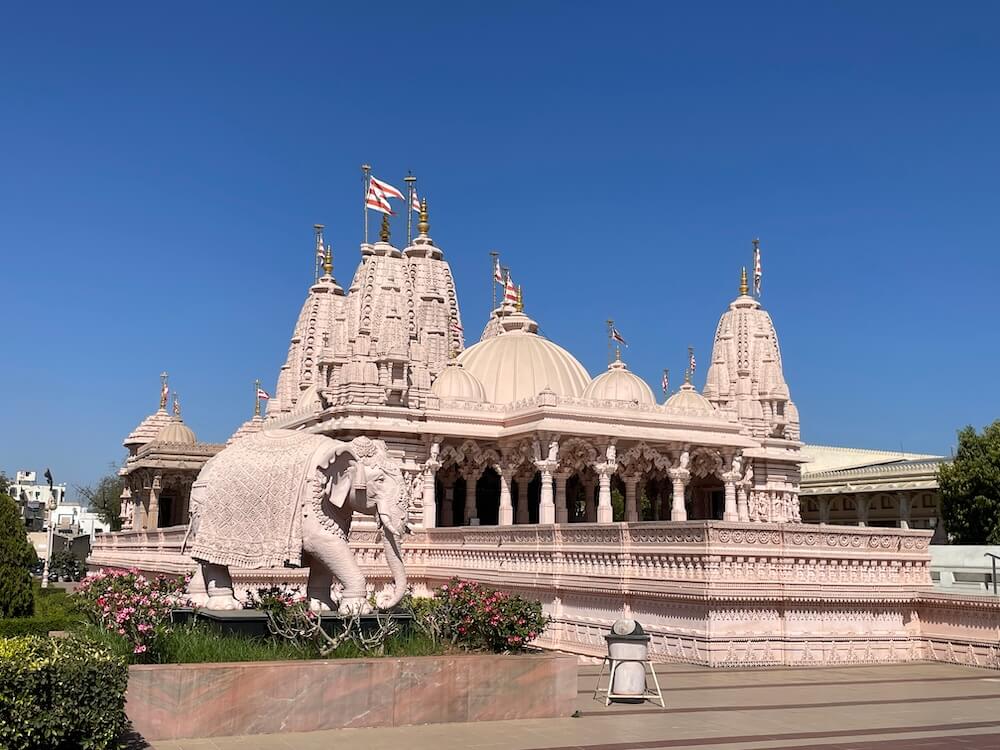
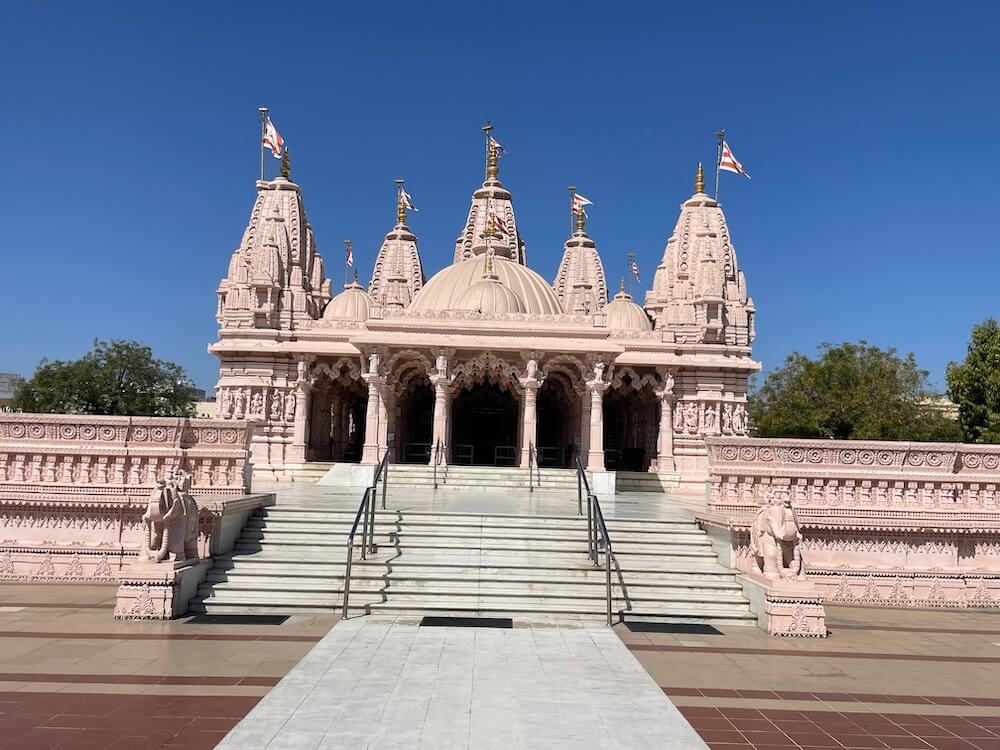
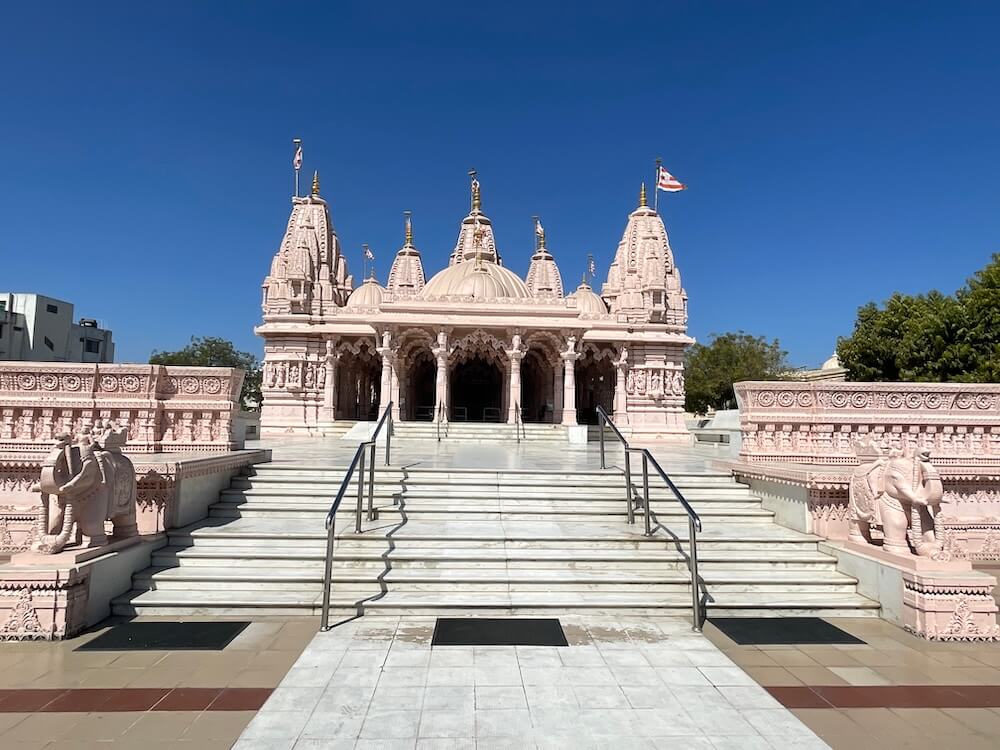
The temple is enclosed by a high perimeter wall, with entry granted through a majestic gateway named the ‘Pramukh Dwar’. The entire premises are paved and interspersed with meticulously landscaped gardens. A short distance from the gate stands the imposing temple structure. The hallmarks of Swaminarayan temple architecture – the ‘Darshan Mandapa’ (viewing hall), ‘Sabha Mandapa’ (assembly hall), pillars adorned with intricate carvings, decorative ‘Makar-toranas’ (arched gateways) between pillars and majestic spires and sub-spires – are all elegantly represented here. One witnesses a seamless blend of grandiosity and minute craftsmanship. Life-sized statues of elephants (Gajaraj) guard both sides of the temple structure.
The temple is built upon a high plinth (‘Jagati’). One ascends eight steps to reach the main platform; the marble railings of these stairs are flanked by elephant sculptures. The platform is entirely paved in marble and features seating arrangements for the repose of devotees. From here, four more steps lead into the ‘Darshan Mandapa’. On either side of this hall are two shrines topped with ‘Urushringa’ (nested) spires. One shrine houses an idol of Lord Ganesha, seated upon a lotus throne within an ornate golden canopy on a raised marble pedestal. Flanking him are the idols of Riddhi and Siddhi. A carved representation of the ‘Shiv-panchayatan’ is also affixed to this marble pedestal, in front of which lie a small Shiva Lingam and Nandi. The second shrine features a majestic idol of the Veer Hanuman, seated within an ornate golden canopy on a high marble pedestal. The back-slab of this idol is carved with various monkey figures, while the upper section features the carved figures of Lord Ram, Lakshman and Sita.
The temple’s ‘Sabha Mandapa’ is spacious and open-designed. At the crown of the finely crafted pillars, exquisite sculptures of prominent Swamis of the sect are installed. The domed ceiling of the assembly hall features delicate carvings. The main sanctum sanctorum (‘Garbhagriha’) is fronted by an arched entrance. This beautifully carved doorway is flanked by sculptures of ‘Dvarapalas’ (gatekeepers). The threshold is adorned with ‘Ardhachandrashila’ (half-moon stones) and ‘Kirtimukhas’ (glory masks). Inside, upon a high marble throne within an ornate shrine, reside the marble idols of Gunatitanand Swami, Swaminarayan and Gopalanand Swami. These idols are beautifully adorned with fine garments and ornaments. In the Swaminarayan tradition, Gunatitanand Swami and Gopalanand Swami are revered as ‘Paramhansas’, having been initiated by Lord Swaminarayan himself. Adjacent to this sanctum is the ‘Sukhashayya’ (sacred bed) of Swaminarayan.
In the sub-sanctum to the left of the main chamber are the marble idols of Harikrishna Maharaj and Radha-Krishna. The sub-sanctum to the right enshrines a marble idol of Ghanshyam Maharaj. All three sanctums are topped with tall ‘Urushringa’ spires, crowned with two-tiered circular ‘Amalakas’ and three-tiered ‘Kalashas’ (finials). The ‘Dharma Dhvaja’ (religious flag) flutters atop every spire. The exterior walls of the temple are carved with figures of various deities and devotees. Behind the main temple lie smaller shrines dedicated to Bhagatji Maharaj (the second spiritual successor) and Shastriji Maharaj (the third spiritual successor). On the ground floor of the temple is the grand ‘Abhishek Mandap’, where a golden idol of Nilkanth Varni is enshrined within a golden canopy. The premises also house a grand two-storeyed building known as the Pramukh Swami Hall.
In the ‘Abhishek Mandap’, the ‘Aarti’ (ritual of light) of Nilkanth Varni is performed daily at 6:00 am and 6:45 pm. Prior to this, the main temple follows a schedule of five ‘Aartis’: ‘Mangala Aarti’ at 5:45 am, ‘Shringar Aarti’ at 7:15 am, ‘Rajbhog Aarti’ at 11:15 am, ‘Sandhya Aarti’ at 7:00 pm and ‘Shayan Aarti’ at 8:15 pm. A daily assembly takes place from 8:00 to 9:00 am, while a ‘Satsang Sabha’ (spiritual congregation) is held every Sunday from 5:00 to 7:00 pm. Devotees may seek ‘Darshan’ daily from 5:00 am to 12:00 pm and from 4:00 pm to 9:00 pm.
The ‘Annakut’ festival is celebrated on the second day of Diwali (Kartik Shuddha Pratipada). This is among the grandest annual festivals of the Swaminarayan sect. To express gratitude to the Divine at the start of the New Year, hundreds of vegetarian delicacies are artistically arranged before the deities. As a mountain (‘Kut’) of food is offered, it is termed ‘Annakut’. From the second day of Ashadh Vadya to the second day of Shravan Vadya, the month-long ‘Hindola Utsav’ is celebrated. During this festival, the deity is placed in a new and attractively decorated swing (‘Hindola’) every day. These swings are crafted variously from dry fruits, vegetables, ‘Rakhis’, or fresh flowers. Furthermore, on Vaishakh Shuddha Tritiya (Akshaya Tritiya), ‘Chandan Archana’ is performed. When the land scorched by the mid-summer sun of Vaishakh cries out for respite, this ritual is performed to provide coolness to the deity. The idols are anointed with a fragrant paste of sandalwood, onto which intricate and unique designs are carved.
This sacred temple stands as a testament to deep spiritual devotion, ancient architectural grandeur, and rich local cultural traditions.
The sanctum sanctorum houses the divine idol consecrated according to ancient Vedic traditions, surrounded by serene courtyards and traditional temple architecture.
Navratri, Maha Shivratri, Annual Temple Jatra & Deepotsav
Compare and book flights, secure top-rated local hotels near the temple, hire reliable guides, and rent cars instantly.
Extend your pilgrimage by visiting other highly sacred temples located nearby.

Add ₹999 more to unlock FREE SHIPPING!
Your sacred cart is currently empty.
Shop Photo FramesFill in your delivery details below to place your order.
Add comment