
Add ₹999 more to unlock FREE SHIPPING!
Your sacred cart is currently empty.
Shop Photo FramesThe Ganpati temple at Ganpatipule in Ratnagiri district is a place of faith for millions of devotees across the country. Like the Ashtavinayakas, this shrine is famous for being Swayambhu (self-manifested) and Jagrut (spiritually awakened). This region is also known as the Paschimdwar Devata (Guardian Deity of the Western Gate) on the Konkan coast. The temple is situated in a nature-rich area at the foothills of lush green hills, with the vast sea to the west. It is said that the temple has a history of 400 years. This place is also mentioned in the Mudgala Purana. According to the information provided by the temple committee, 1.8 to 2 million devotees visit for the darshan of Ganpati every year.
The legend of the temple states that 400 years ago, during the Mughal era, a Brahmin named Tryambakbhat Bhide lived in the village where the Swayambhu Ganesh Temple stands today. He was the village Khot. Once, he faced a great crisis. Taking a vow that he would not consume food until this crisis was averted, he stayed in the local Kevada forest to worship Lord Ganesha. One day, Lord Ganesha appeared to Balambhat in a vision and said, “I have manifested here from Ganeshgule, assuming a form with two temples and tusks, to fulfill the desires of my devotees. This hill is my formless manifestation. Worship me, and your crisis will be resolved.”
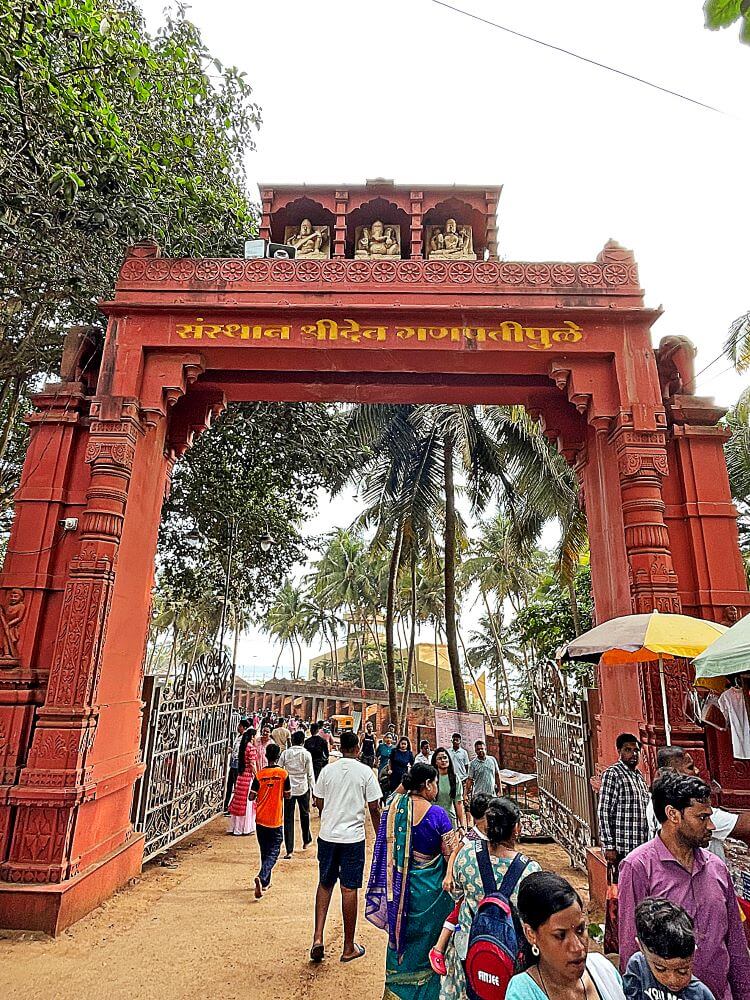
Following the vision, Tryambakbhat immediately cleaned the entire area. There, he found the idol of Lord Ganapati exactly as he had seen it in his dream. He built a small temple with a thatched roof around this idol. Since then, the worship of Ganapati began here. Even today, devotees first pay their respects at the Samadhi of Tryambakbhat Bhide, located near the entrance of the Ganapati temple. Being a coastal area, a large part of the region consists of sandy shores. Because Ganapati manifested on this sandy shore (Pule), the village came to be known as Ganapatipule. Annaji Datto, a minister in Chhatrapati Shivaji Maharaj’s Council of Eight (Ashtapradhan Mandal), renovated this temple. The thatched roof was replaced with a dome. Later, the Peshwa’s commander, Govindpant Bundele, built a Sabha Mandap (assembly hall) in front of the temple. Nanasaheb Peshwa made arrangements for the Nanda Deep (perpetual lamp), while Ramabai, the wife of Madhavrao Peshwa, built a Dharmashala (pilgrims’ rest house). The temple attained its current form following renovations carried out between 1998 and 2003.
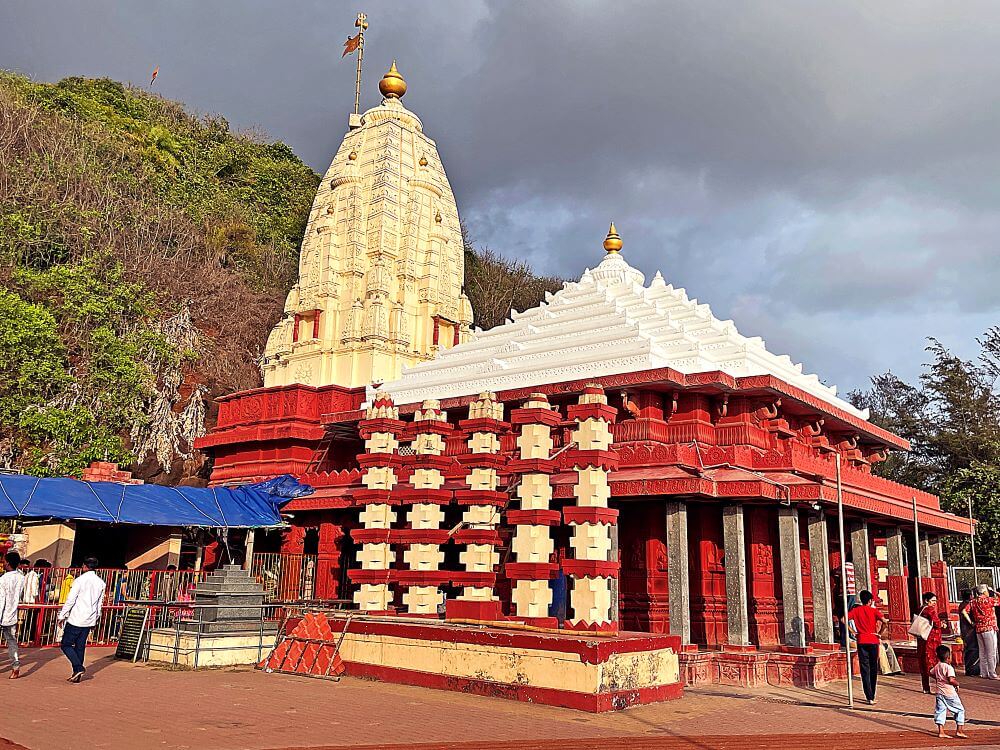
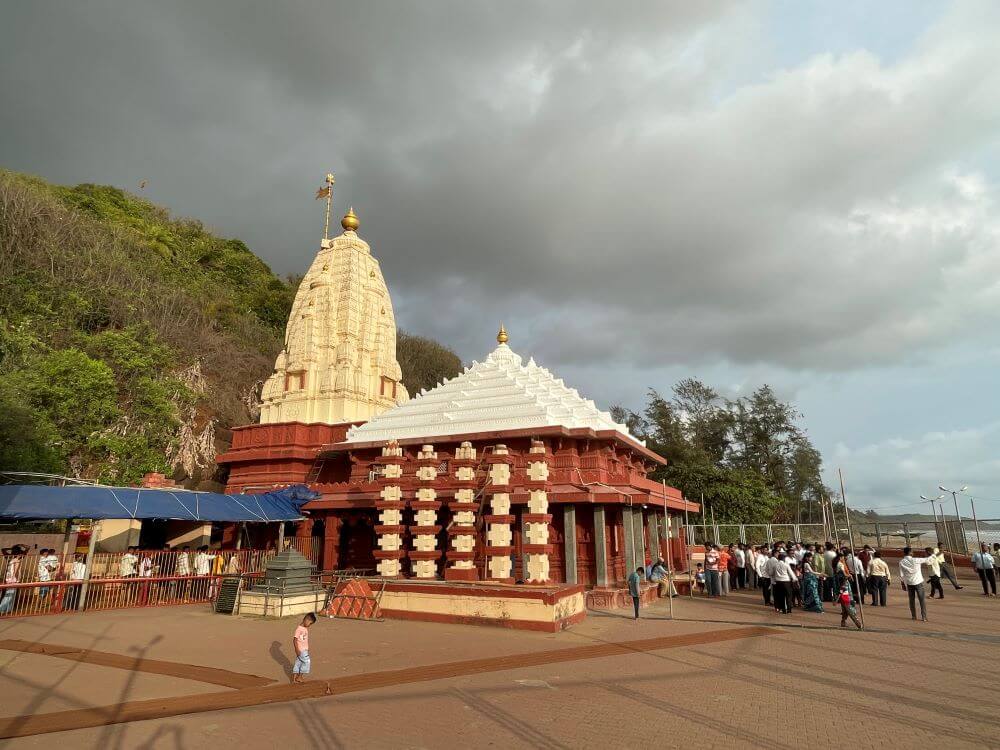
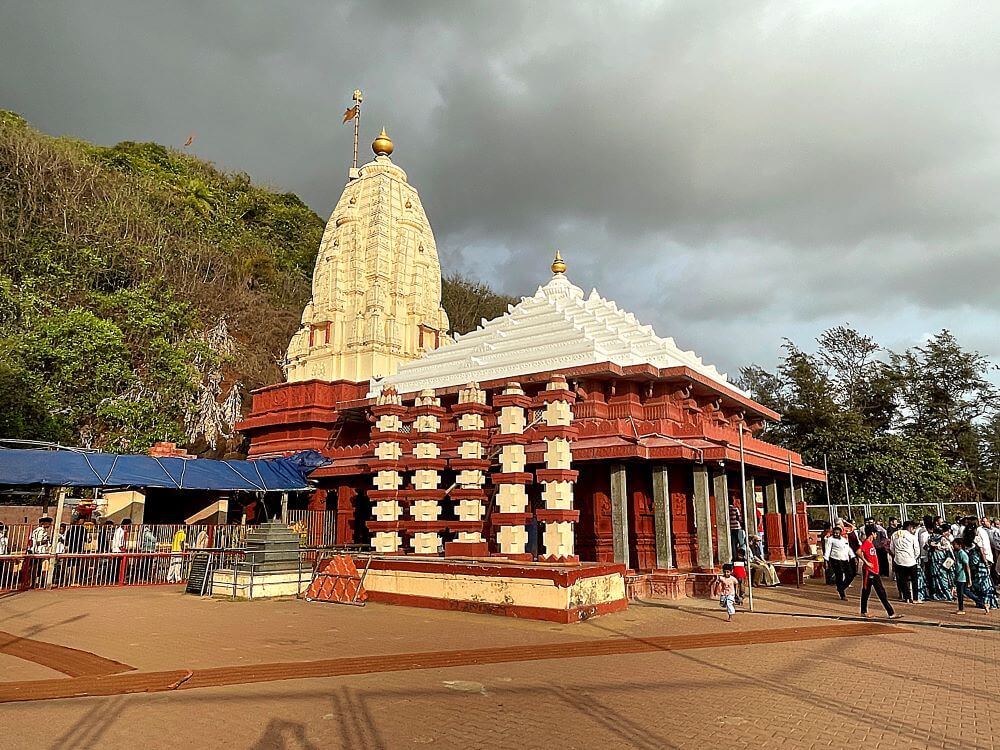
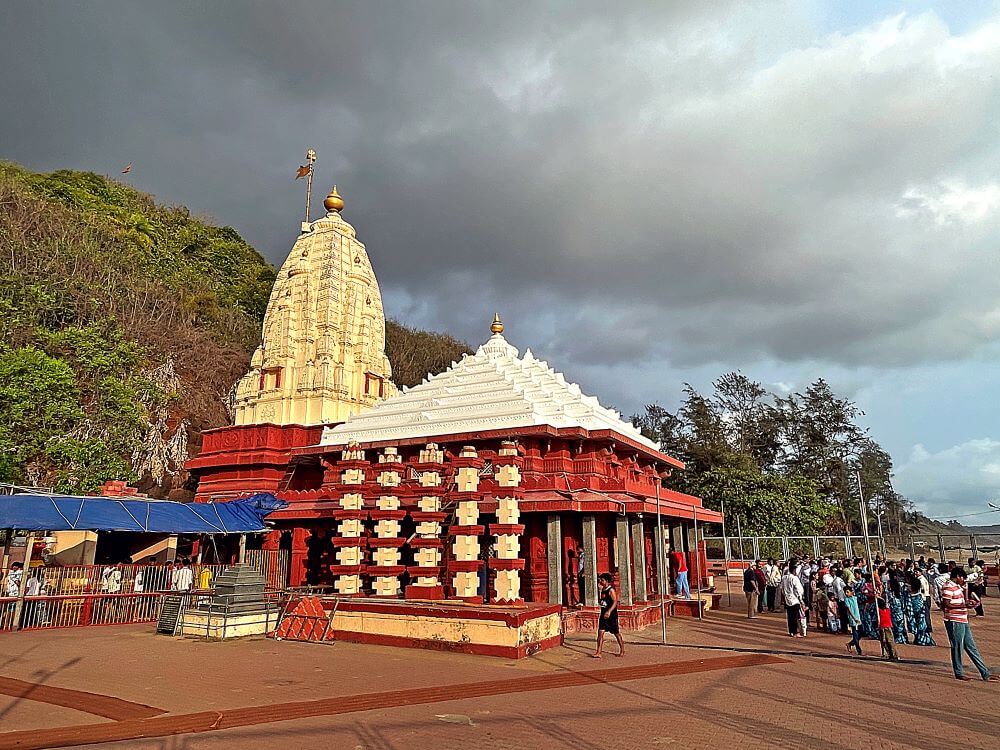
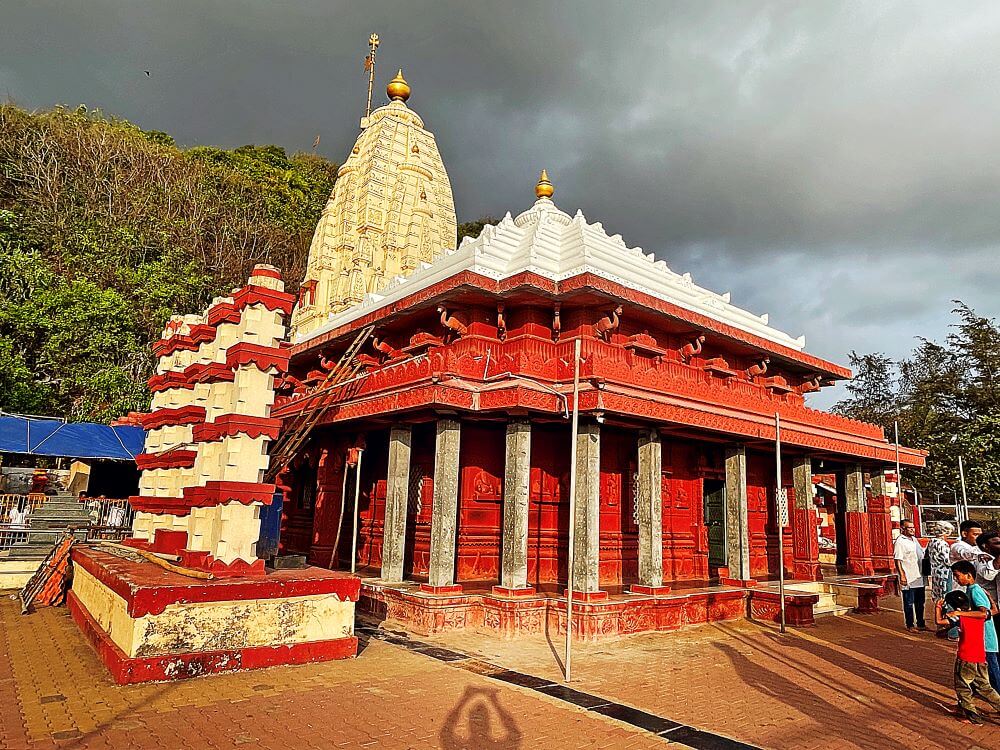
At first glance, the temple appears to have been carved from a single stone. The temple is constructed from a special stone known as ‘Red Agra’. There are five lamp towers (Deepmalas) each on the southern and northern sides of the temple. When lamps are lit on these during Tripurari Purnima, the beauty of the temple is further enhanced. A queue system for darshan is arranged in the temple courtyard. Near the main entrance, there is a large brass idol of Mushakraja holding a modak in his hands. The structure of the temple consists of a Sabha Mandap (assembly hall) and a Garbhagriha (sanctum sanctorum). Inside the Garbhagriha, in a slightly recessed area, there is a three-foot-high and two-and-a-half-foot-wide vermilion-smeared stone, which is worshipped as Lord Ganapati. Due to the unique architecture of this temple, every year from February 2 to 8 and November 2 to 8, at the time of sunset, the setting The rays of the sun fall directly upon the idol of Lord Ganesha in the sanctum sanctorum. To the south of the assembly hall (Sabhamandapa) lies the bedchamber of Lord Ganesha. On the bed placed here, there are mattresses and bedding. The outer walls of the assembly hall feature exquisite craftsmanship, where many elephants appear to be supporting the weight of the temple spire on their heads. Both the assembly hall and the sanctum sanctorum have spires, and the distinctive spire of the sanctum sanctorum is adorned with a golden pinnacle (Kalash).
The hill behind the temple is considered to be a manifestation of Lord Ganapati, and therefore, devotees perform circumambulation (Pradakshina) around it. It is recorded that the Pradakshina path around the hill, which is approximately one kilometer long, was constructed using laterite stones by Govindpant Bundele. The meditation cave (Dhyangufa) on the Pradakshina path has been renovated, and arrangements have been made for devotees to sit and meditate there. Historical documents mention that Chhatrapati Shivaji Maharaj had visited this Ganapati for darshan. From the time of Shivaji Maharaj until The history up to the Peshwa era is connected to this temple in one form or another.
Two major festivals are celebrated in the temple every year. The first is held from Bhadrapada Shuddha Pratipada to Panchami, and the second on Magh Shuddha Chaturthi. A large pilgrimage (yatra) takes place here during these times. Apart from this, on every Sankashti Chaturthi of the year, as well as on Diwali, Dussehra, Padwa, and Bhadrapada and Magh Shuddha Chaturthi, a procession of the silver Ganesha idol gifted by the Peshwas is taken out in a palanquin.
Devotees can visit the temple for the darshan of Lord Ganpati daily from 5:00 AM to 9:00 PM. Aarti is performed here at 5:00 AM, 12:00 PM, and 7:00 PM. Khichdi Prasad is distributed to devotees arriving between 12:30 PM to 2:00 PM and 7:15 PM to 8:15 PM. Thousands of devotees visit this place every day for the darshan of this Ganesha. For their convenience, the Temple Trust has constructed a spacious Bhakta Niwas (Contact: 8669931145, 8669931146) equipped with state-of-the-art amenities. This facility also includes elevator services and air-conditioned rooms. Additionally, there are many hotels and homestay facilities available in the vicinity.
The Konkan Museum (Ancient Village) is situated approximately one kilometer away from the Ganpatipule Ganpati Temple. It offers a glimpse into the lifestyle, social structure, occupations, hairstyles, history, and traditions of the Konkan region from 500 years ago. This initiative is being implemented through the Konkan Tourism Development and Research Center. Various trees have also been planted at this site. Information boards placed here display the names of these trees along with their medicinal properties. Replicas of the village deity and various traditional village occupations can be seen here. For more information, one can contact the number 02357 – 223068.
This sacred temple stands as a testament to deep spiritual devotion, ancient architectural grandeur, and rich local cultural traditions.
The sanctum sanctorum houses the divine idol consecrated according to ancient Vedic traditions, surrounded by serene courtyards and traditional temple architecture.
Navratri, Maha Shivratri, Annual Temple Jatra & Deepotsav
Compare and book flights, secure top-rated local hotels near the temple, hire reliable guides, and rent cars instantly.
Extend your pilgrimage by visiting other highly sacred temples located nearby.


Add ₹999 more to unlock FREE SHIPPING!
Your sacred cart is currently empty.
Shop Photo FramesFill in your delivery details below to place your order.
Add comment