
Add ₹999 more to unlock FREE SHIPPING!
Your sacred cart is currently empty.
Shop Photo FramesPanhala Fort, which has been a witness to many historical events since ancient times, is also associated with numerous mythological legends. According to the legends in the text ‘Karveer Mahatmya’, this mountain is linked to the creation of the universe. It is said that Lord Brahma established the Someshwar Linga here and performed penance to facilitate the creation of life. Because of this, the fort is known as Brahmagiri, the mountain of Brahma. Similarly, Sage Parashara resided here with his wife. The place where his ashram was located is the present-day Harihareshwar Temple. The Nagzari spring and an ancient Vitthal temple are also situated in this vicinity.
The Marathi text ‘Karveer Mahatmya’, written in the 19th century by the scholar-poet Dajiba Joshirao of the Joshi family of Kolhapur, contains a verse-based legend about this site. It narrates that Sage Parashara lived on Panhala Fort with his wife Satyavati and his disciples. He performed great penance here. At that time, fire emanated from his head and began to scorch all the worlds. To disrupt his penance, Indra sent Madana (Kamadeva) to him. Madana went there accompanied by the celestial nymph Rambha and deities like Vayu. Madana released his arrow, breaking Parashara’s concentration. When the Sage opened his eyes, Madana and the other deities fled, leaving Rambha behind. However, Parashara realized what had happened. Knowing that cursing them would deplete his spiritual merit, he asked his wife Satyavati to curse Rambha. As Satyavati prepared to curse them, Rambha, Madana, and Vayu began to flee. Seeing this, Parashara said, “Do not flee, stay calm and do not fear. By coming to my abode and not accepting my hospitality, my place would become void; therefore, accept my offerings.” Thus, upholding the dharma of hospitality, Satyavati and Parashara granted them refuge. This event took place at this very ashram of Parashara, which is the site of the Harihareshwar Temple.
‘Karveer Mahatmya’ describes another legend regarding this place. It states that after Madana’s arrows failed, Parashara resumed his penance. The heat from his penance caused the netherworld (Patala) to heat up, troubling the Nagas (serpents). They decided to disrupt his penance by absorbing the water that fueled his power. Accordingly, they drained the water from the Somkund and the kund created by Satyavati and Parashara. Consequently, Parashara could not find water for his ablutions. Realizing this was the work of the serpents, he released blades of grass (darbha) charged with powerful mantras, killing many serpents. Eventually, the remaining Nagas surrendered. Parashara granted them refuge and said, “O Nagas, listen to my words. You have absorbed the water that was brought here for rituals. May you be purified by that water and by your own worship and devotion. Stay here forever, O serpents. May this place be famous by your name as Pannagalaya.” Thus, Parashara named this place Pannagalaya, which later became Panhala. At that time, the serpents brought the Patala Ganga (water from the netherworld) for the Sage. Parashara then declared, “This spring of Patala Ganga shall be known as Nagzari. The Lord you have established here shall be famous as Nagesh.” This Nagesh temple is located near the Vitthal temple here.
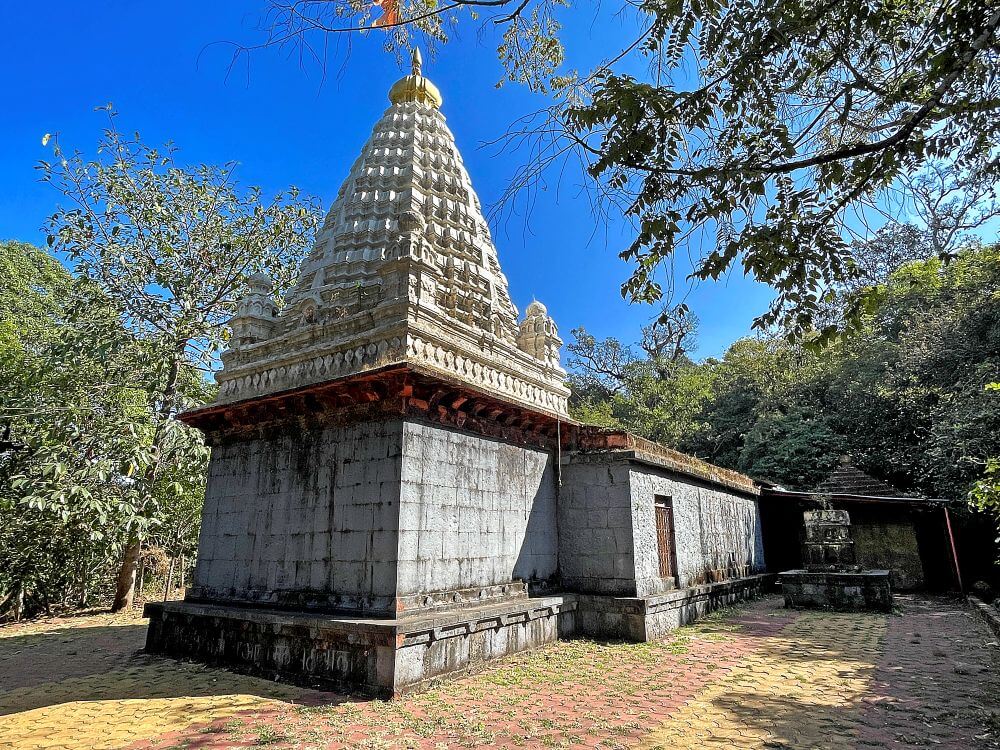
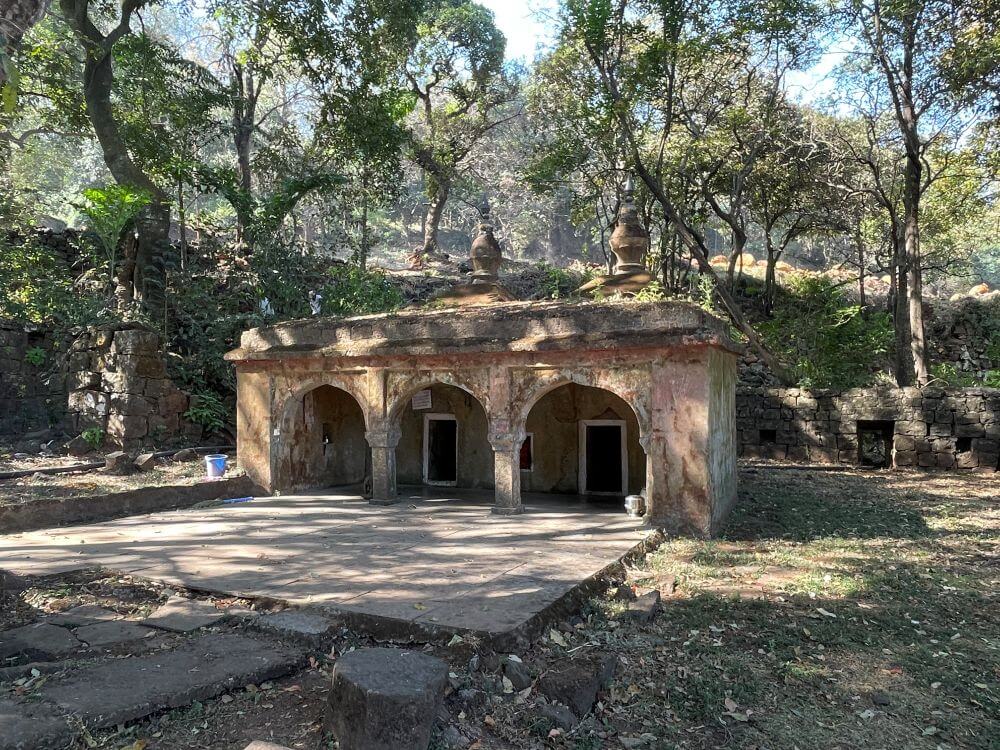
On the eastern road leading to Panhalgad, near the Char Darwaja, stands the statue of Shiva Kashid. Opposite this, on the near side of the road, is a large pond, and from there, a steep, unpaved path leads to the Parashara Ashram, Nagzari, and the Vitthal Temple. This area is still densely forested today, home to various birds and medicinal plants. After climbing a short distance, one finds the Parashara Ashram, i.e., the Harihareshwar Temple, on the left. This is considered a simple yet significant temple on Panhalgad. The temple is surrounded by a large, open courtyard shaded by trees. This entire area constitutes the Parashara Ashram. The Harihareshwar Temple features a structure consisting of a small assembly hall (sabhamandapa) with three arches, two sanctums (garbhagrihas), and a simple stone spire (shikhara) above. Its construction suggests that the temple has undergone renovations in recent times.
In the sanctum to the left of the temple, there is a tall Linga of Hareshwar on the floor, topped by a brass cobra with its hood spread. A stone Nandi statue stands before the entrance. In the right-hand sanctum, a black stone idol of Vishnu is seated on a carved stone pedestal. Reflecting the sculptural style post-16th century, the idol is ‘sampada’ (standing straight) and four-armed, holding a discus, mace, noose, and scripture. A crown is carved on the head, and a dhoti-like garment is draped around the waist, with a necklace adorning the neck. Between the two entrances of the sanctums of this Harihareshwar Temple, there is a vermilion-smeared idol of Ganesha in a wall niche. Nearby is the Nagzari Kund, a spring with continuously flowing water, surrounded by stone masonry. In this area, there is also the Siddhakund, created by Sage Parashara, known as Siddhabav.
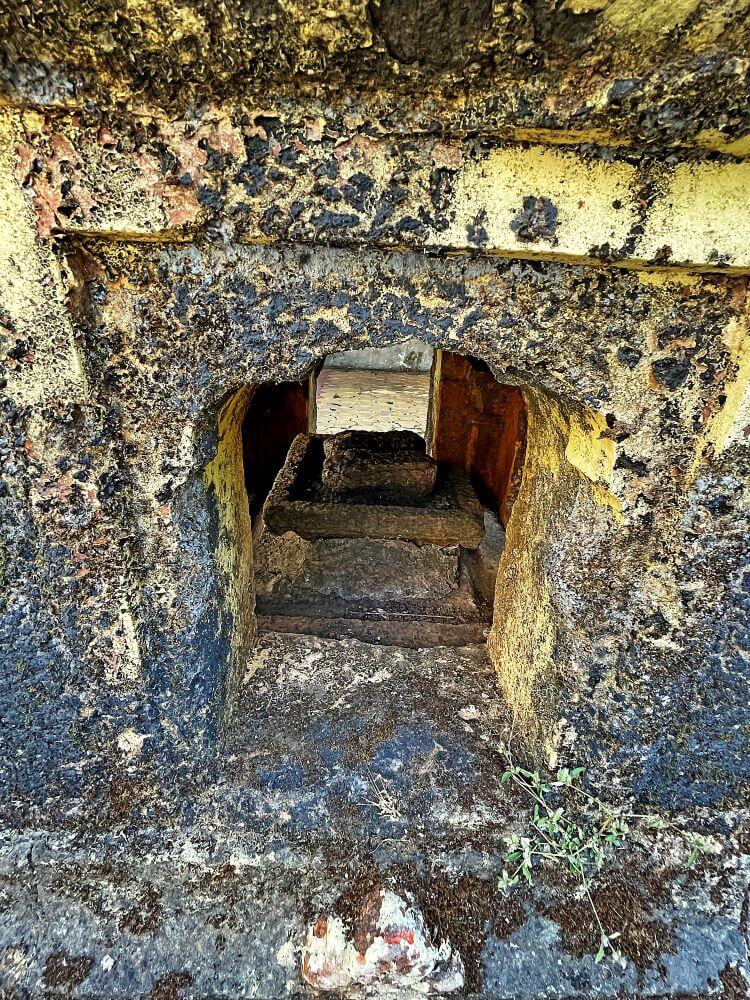
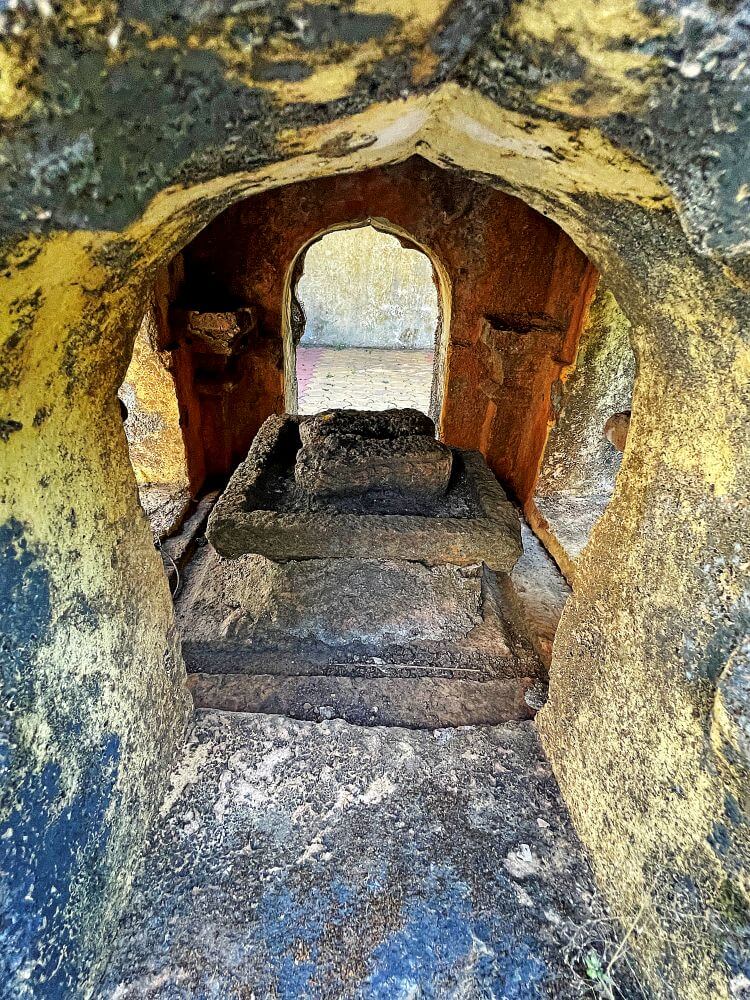
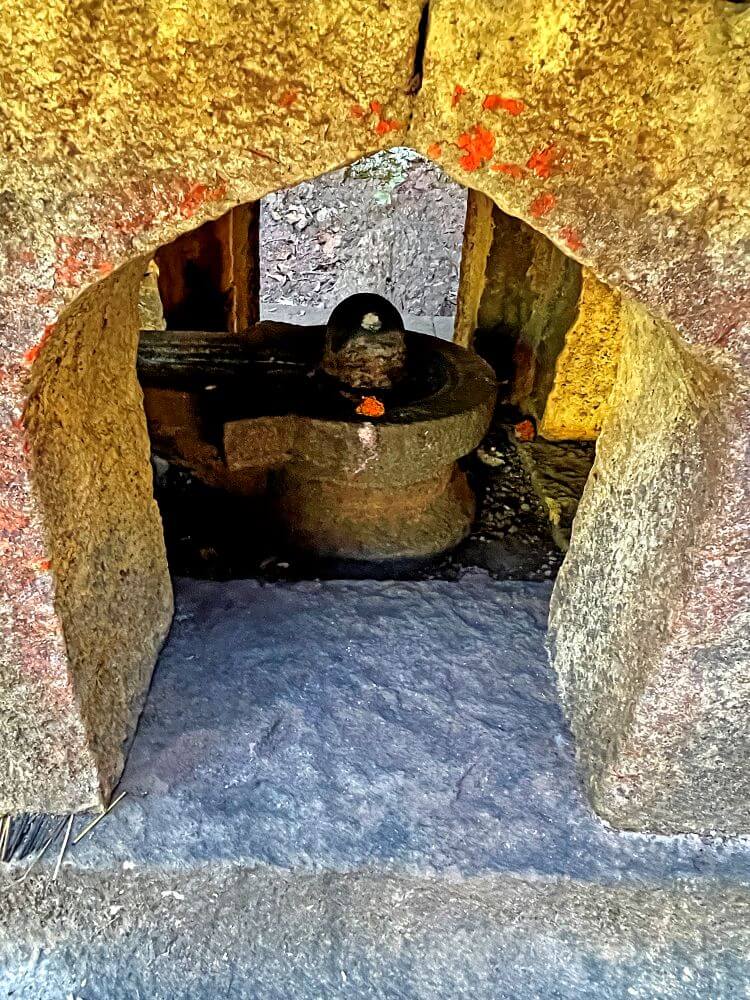
A short distance from the Harihareshwar Temple is the ancient Vitthal Temple. This site is said to date back to the 14th century. In the temple courtyard stands a stone lamp pillar (deepastambha). There are two Tulsi Vrindavans (basil altars) placed parallel to each other. Looking straight through the hollow part of one Tulsi Vrindavan, one can see the other Vrindavan beyond the main temple. One of these contains footprints (padukas), while the other is unique for having a Shiva Linga installed within it. It is said to be the Satyavati Linga, established by Parashara’s wife, Satyavati.
Built entirely of dressed stone, the Vitthal Temple consists of an assembly hall and a sanctum. It is topped by a spire that tapers towards the top on all four sides. This spire features rows of small, stacked pillars, with a unique shrine-like shape on all four sides. The temple’s assembly hall is spacious and enclosed. A row of stone pillars stands inside, a short distance from the side walls. The design of these pillars shows the influence of the pillars in the Karveer Nivasini Ambabai Temple, though these pillars are plain and polished.
The entrance to the sanctum is a simple stone structure with an idol of Ganesha on the lintel. At the threshold, there is a square stone instead of a semi-circular one. Inside, on a high, carved pedestal, stands the black stone idol of Vitthal with hands on his hips (kar katavar), accompanied by Rukmini and Satyabhama (Rahi and Rakhumai). In the temple courtyard, there is also a small temple of Nageshwar, which houses a Nagesh Linga and a Nandi statue in front of the entrance. Thus, the Vitthal Temple here also has a close connection with the legend of Sage Parashara and Satyavati.
This sacred temple stands as a testament to deep spiritual devotion, ancient architectural grandeur, and rich local cultural traditions.
The sanctum sanctorum houses the divine idol consecrated according to ancient Vedic traditions, surrounded by serene courtyards and traditional temple architecture.

Navratri, Maha Shivratri, Annual Temple Jatra & Deepotsav
Compare and book flights, secure top-rated local hotels near the temple, hire reliable guides, and rent cars instantly.
Extend your pilgrimage by visiting other highly sacred temples located nearby.


Add ₹999 more to unlock FREE SHIPPING!
Your sacred cart is currently empty.
Shop Photo FramesFill in your delivery details below to place your order.
Add comment