
Add ₹999 more to unlock FREE SHIPPING!
Your sacred cart is currently empty.
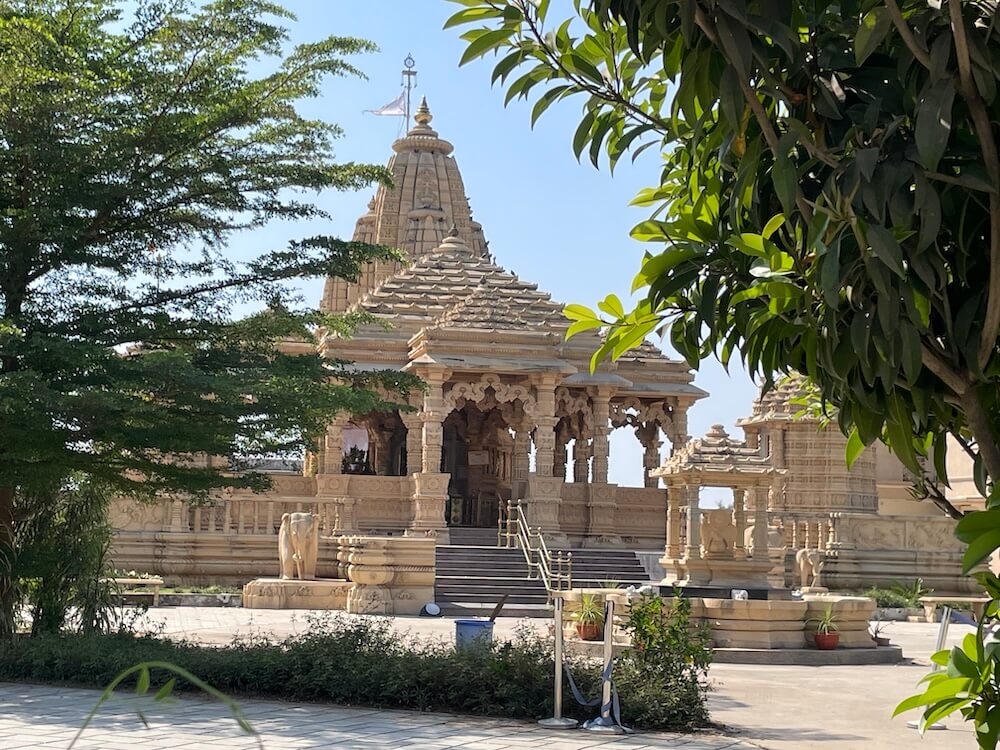
Shop Photo FramesSituated along the Umreth-Dakor road within the Umreth Taluka of Anand district lies the profoundly hallowed and significant religious sanctuary of Kotyark Dham. This magnificent edifice is dedicated to Bhagwan Kotyark Prabhu, the presiding deity of the Khadayata community, revered as the integrated manifestation of Lord Vishnu and Surya Narayan (the Sun God). It is reputed to be a rare Surya Mandir (Sun Temple) established precisely upon the Tropic of Cancer. This geographical precision is manifest on the 21st of June at exactly 12:00 noon, when the solar rays penetrate directly through the temple’s Shikhara (spire) to illuminate the Garbhagriha (sanctum sanctorum).
The ‘Kotyark Mahatmya’, a vital constituent of the Padma Purana, provides an exhaustive chronicle of the divine form of Kotyark Prabhu, His incarnation and the quintessential process of cosmic creation. The name ‘Kotyark’ denotes a formidable and infallible energy equivalent to the brilliance of one crore suns. According to the descriptions within this text, at the moment the resolve for universal creation was taken, Lord Brahma was born from the lotus emerging from the navel of Kotyark Prabhu (Shri Vishnu). During this mystical process of creation, two cruel demons named Madhu and Kaitabha were birthed from the mal (impurities) within the Lord’s ears. As Lord Brahma composed the Vedas for the welfare of the universe, these demons obstructed his sacred work, inflicting mental and physical torment. When the protection of the Vedas and primordial knowledge became imperilled, Brahma sought the intervention of Kotyark Prabhu. Responding to this invocation, the Lord awoke from His Yoganidra (divine sleep) on the day of Kartik Shud Ekadashi, also known as Prabodhini Ekadashi. He projected the fierce radiance of millions of suns from His divine body. Beneath the waves of this transcendental and immense energy, both Madhu and Kaitabha were instantaneously reduced to ashes.
An unbreakable bond is said to exist between the Khadayata community and Kotyark Prabhu, who is venerated as their Kuldaivata (ancestral deity). According to mythological conviction, the community was established at the very site where the demons were vanquished—specifically at Mahudi (Kotyark Dham) in the Gandhinagar district of Gujarat. The Khadayata people are predominantly of the Vaishnava sect and regard Kotyark Prabhu as the protector and pillar of their lineage. It is a time-honoured tradition that every auspicious event, whether a marriage or the ‘Babari’ (tonsure) ceremony of children, is completed only at the feet of Kotyark Prabhu. Regardless of their geographic location across the globe, the members of this community regard Kotyark Dham as their maternal spiritual institution. In contemporary times, the inspiration of the late Jayantilal Jethalal Kachwala led to the creation of this temple in Umreth to consolidate the ancient and scattered heritage of the community. The actual construction commenced on the 28th of April 2017, with the rites performed according to ancient tenets by Jagdishbhai Shukla and Pancham Pithadhishwar 108 Goswami Shri Vallabhalalji Maharaj. Following the passing of Jayantilal Kachwala during the construction phase, a memorial was erected within the temple precincts to honour his dream and preserve the family’s history for future generations. The structure, a sublime blend of traditional architecture and modern amenities, reached completion around 2022.
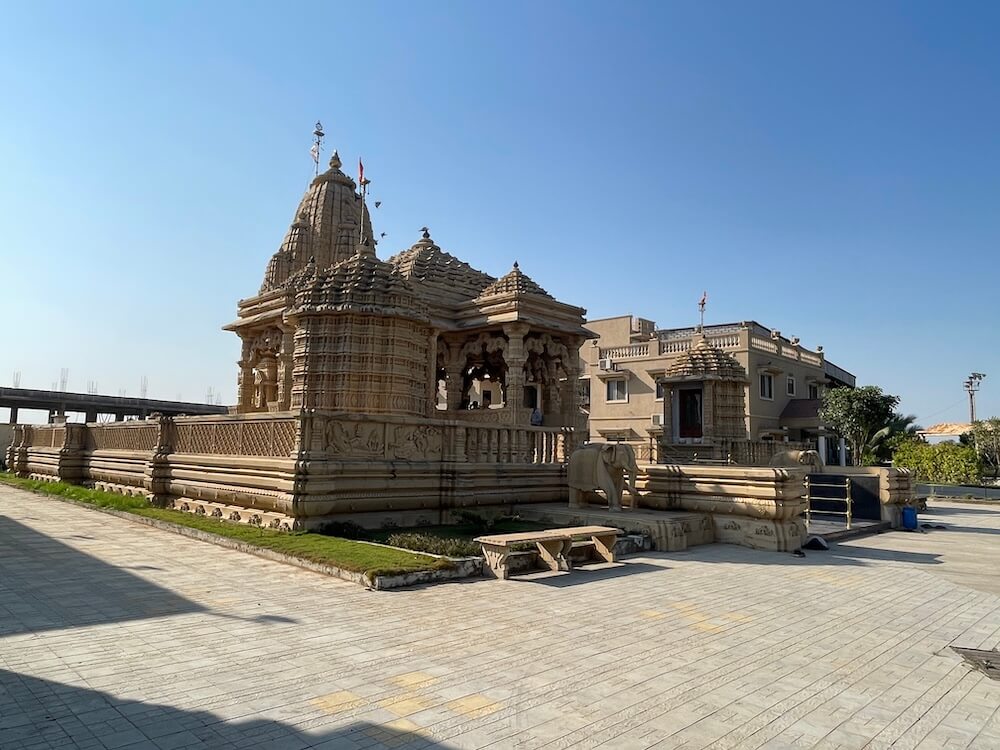
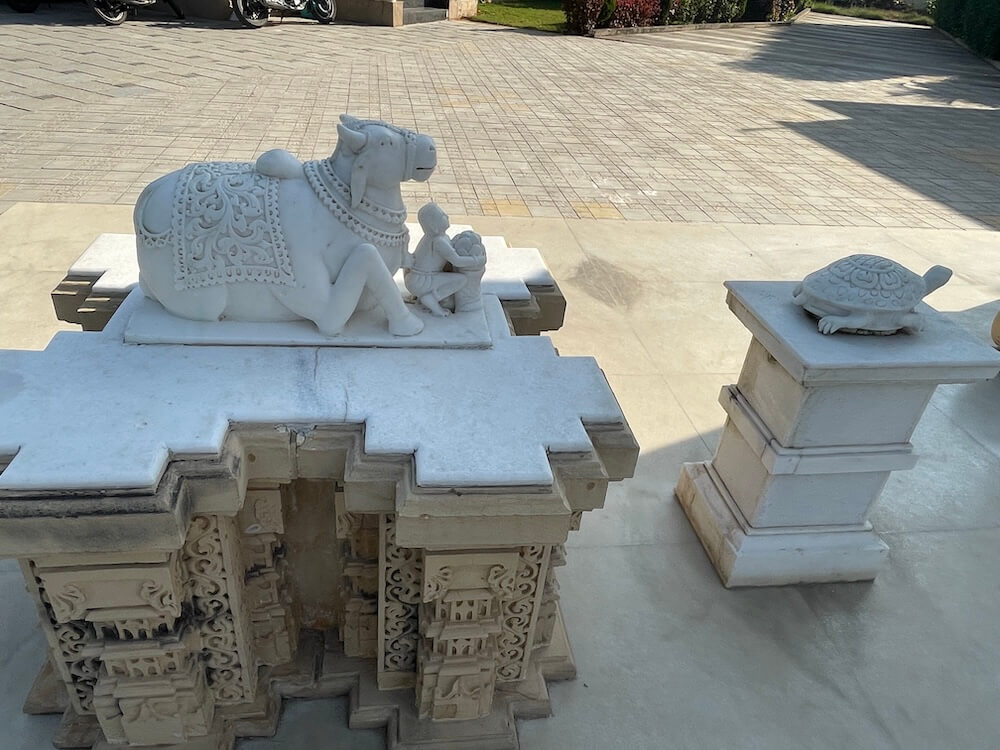
One enters the vast courtyard of the temple through a grand gateway adjacent to the Umreth-Dakor main road. To the left of the entrance lies a designated parking area. The courtyard houses several structures besides the principal shrine. Architecturally, the main temple follows the North Indian Nagara style, influenced significantly by the Maru-Gurjara style prevalent in Rajasthan and Gujarat. Constructed from yellow sandstone, the edifice acquires a particular golden lustre under the solar glow. In front of the temple, within a lotus-shaped Kunda (tank) and set upon an octagonal pedestal, sits an idol of Maruti (Hanuman), preceded by a sculpture of a tortoise. Eight Gajaraj (elephant) sculptures adorn the sides of the pedestal. Beyond this, after ascending approximately ten steps, one enters the Mukhamandap(entrance porch) of the temple situated on a high plinth. The stairwell is flanked by further elephant sculptures. The temple composition consists of three entrance porches, a Sabhamandap (assembly hall), an Antarala (vestibule) and the Garbhagriha. The porches and the assembly hall are designed in a semi-open fashion, featuring pillars intricately carved with images of various deities, floral creepers and geometric patterns. Exquisite Toranas (arched hangings) grace the tops of the pillars.
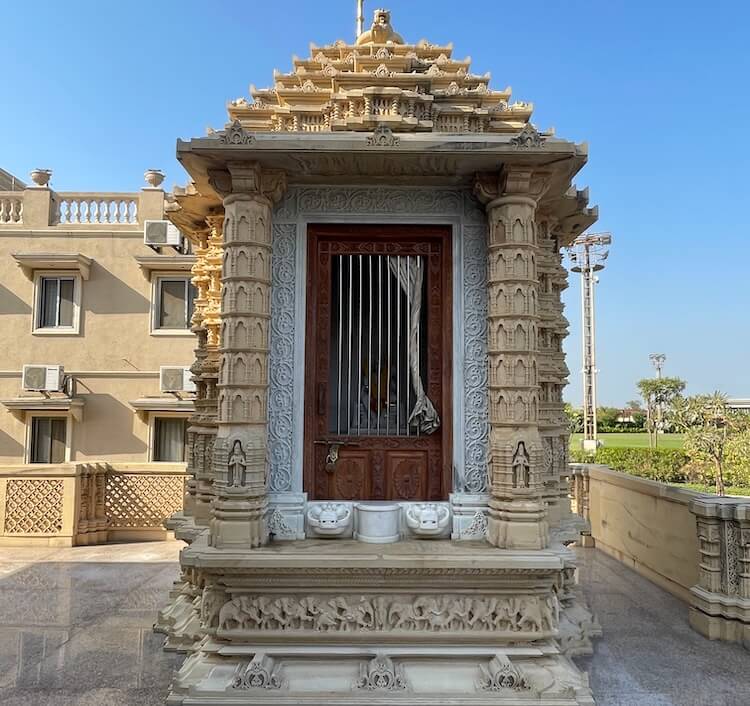
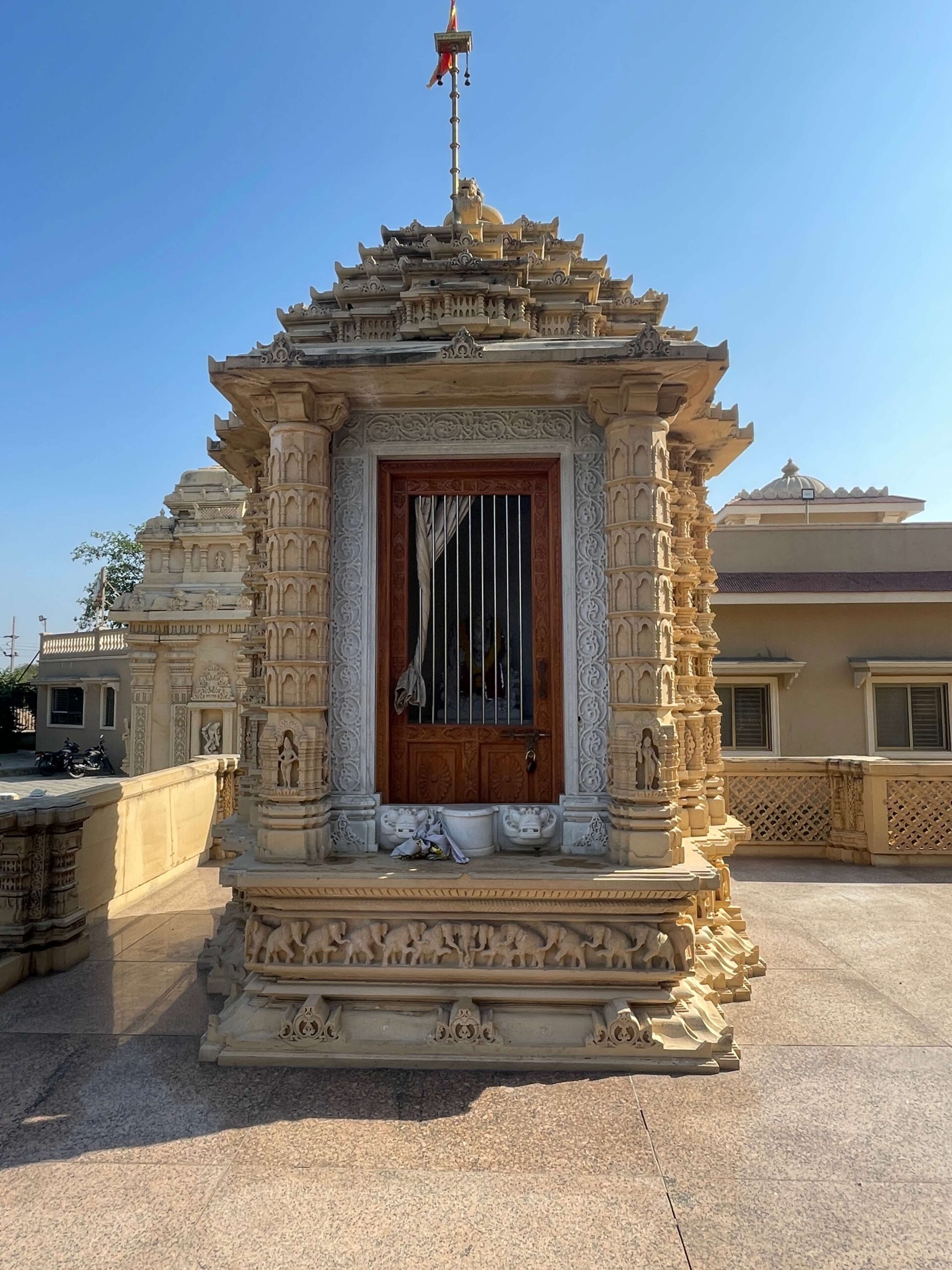
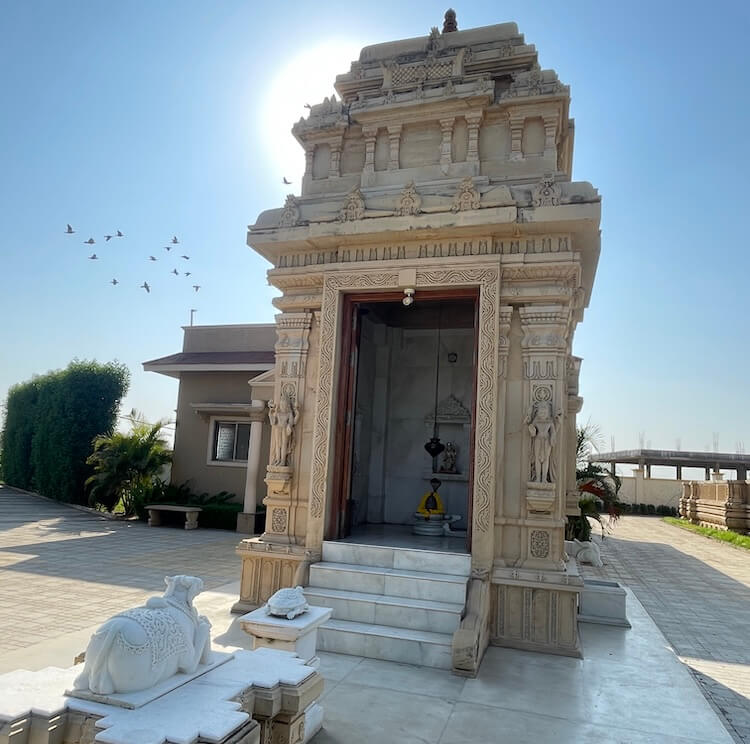
Within the sanctum, a four-armed idol of Kotyark Prabhu is consecrated upon a Vajrapitha (stone pedestal), wielding a mace and a Chakra (discus) in His upper hands. The deity is adorned with a peacock feather, a crown and various ornaments and floral garlands extending from neck to feet. Above the sanctum rises a tall Nagara-style spire of the ‘Latina’ variety, carved with several smaller sub-spires known as Urushrungas. The summit is graced by an Amalaka (ribbed stone disk) and a Kalasha (finial). The plinth of the temple is carved with Gajathar (rows of elephants representing strength). The exterior walls, known in architectural terms as the Jangha, feature niches containing beautiful sculptures of Shri Krishna, Radha and Vishnu, alongside various Apsaras (celestial nymphs) and dancers. Independent shrines for Ganesha, Hanuman and Mahadev stand adjacent to the main temple. Additionally, the Durga Mata temple houses the idols of the 19 Kuldevis (lineage goddesses) representing the 7 Brahmin and 12 Vanik Gotras (clans) of the Khadayata community, with a metallic idol of Durga upon a lion positioned centrally.
Various religious festivals and social events are celebrated here with great fervour throughout the year. Kartik Shud Dwadashi, marking the victory over the demons, is the premier festival here, drawing the entire Khadayata community for a ‘Mahaprasad’ (sanctified feast). Festivals such as Janmashtami and Diwali are likewise observed with deep devotion. On Janmashtami, the sanctum is decorated with floral arrangements and the tradition of offering Rajbhog (royal feast) to the Lord is meticulously followed.
The daily routine at Kotyark Dham commences with the Mangala Aarti between 7:15 am and 8:15 am. This is followed by the Shringar ceremony from 10 am to 11 am, during which the idol is elaborately adorned. The Rajbhog Aarti rites are conducted from 11:45 am until 1 pm. Following an afternoon hiatus, the Utthapan (awakening from rest) of the Lord occurs between 4:15 pm and 4:30 pm, making the Darshan (sacred viewing) available again. This is followed by the Sandhya (evening) Puja from 4:45 pm to 5:45 pm. The day concludes with the Shayan (retiring) ritual between 6:15 pm and 7:15 pm. Devotees may avail themselves of Darshan daily from 7:15 am to 1 pm and from 4 pm to 7:15 pm.
This sacred temple stands as a testament to deep spiritual devotion, ancient architectural grandeur, and rich local cultural traditions.
The sanctum sanctorum houses the divine idol consecrated according to ancient Vedic traditions, surrounded by serene courtyards and traditional temple architecture.
Navratri, Maha Shivratri, Annual Temple Jatra & Deepotsav
Compare and book flights, secure top-rated local hotels near the temple, hire reliable guides, and rent cars instantly.
Extend your pilgrimage by visiting other highly sacred temples located nearby.


Add ₹999 more to unlock FREE SHIPPING!
Your sacred cart is currently empty.
Shop Photo FramesFill in your delivery details below to place your order.
Add comment