
Add ₹999 more to unlock FREE SHIPPING!
Your sacred cart is currently empty.
Shop Photo FramesShantadurga is a popular deity among the devotees of the Goddess in Gomantak (Goa). Goddess Shantadurga is worshipped as the deity who established peace in the universe by ending the great war between Lord Vishnu and Lord Mahadeva. Sateri or Santeri, who is worshipped in the form of an anthill in the Konkan region and considered one of the Saptamatrikas (Seven Mothers), is the same Goddess as Shantadurga of Gomantak. The original seat of this Goddess was in Keloshi village on the banks of the Zuari river in Goa. Due to the persecution by the Portuguese, the idol of the Goddess was moved from there to the village of Kavale in the Ponda region. Later, the migrated families settled in various parts of Goa and established their family deity, Goddess Shantadurga, in their respective villages. Today, there are more than fifty ancient temples of Goddess Shantadurga in Goa, and this Mauli Shantadurga Temple in Varkhand is one of the famous ones among them.
The mythological legend explaining the name of this form of Goddess Sateri as Shantadurga is that in ancient times, a fierce war took place between Shiva and Vishnu. It lasted for two thousand years. The clashing sounds of Vishnu’s Sudarshana Chakra and Shiva’s Pashupatastra shook the entire universe. There was a possibility of the end of the universe due to this war. Because of the war, the duties of sustenance and destruction of these two deities began to stall. Seeing this, Lord Brahma finally created the Adishakti Jagadamba with his divine radiance. He sent her to the earth and asked her to bring about reconciliation between these two gods. Accordingly, the Goddess arrived on the battlefield, stood between the two warriors, and preached to them. According to the ‘Ambika Khanda’ of the ‘Skanda Purana’, the Goddess preached to them that Brahma is the same as Hari and Maheshwara. In this way, the Goddess stopped the war and established peace, which is why she came to be known as Shantadurga.
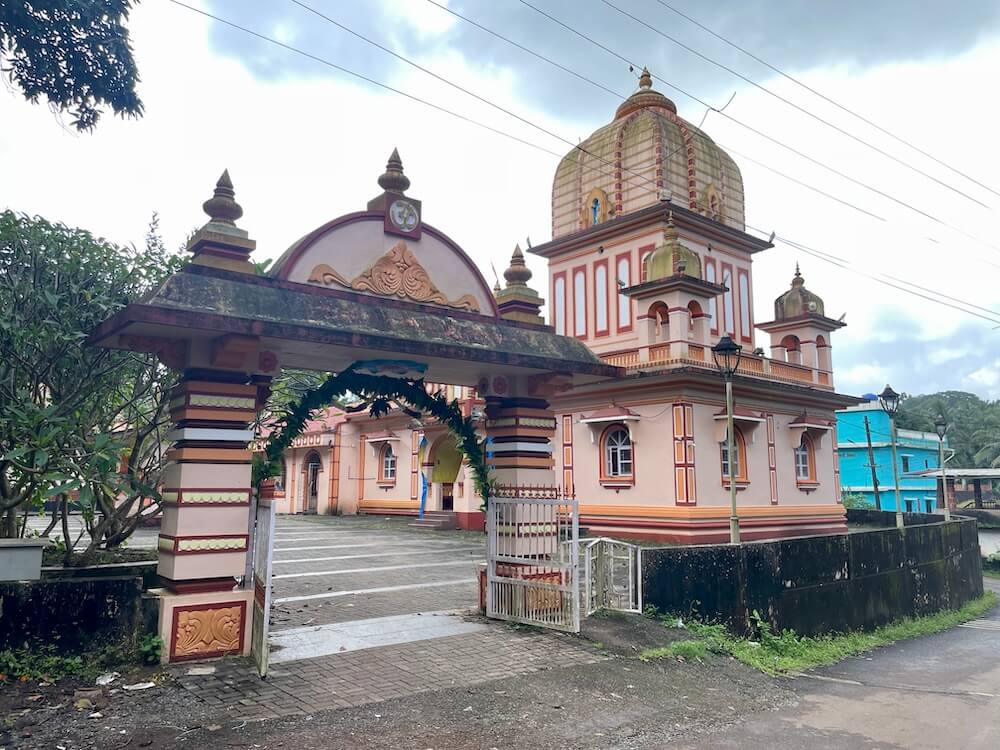
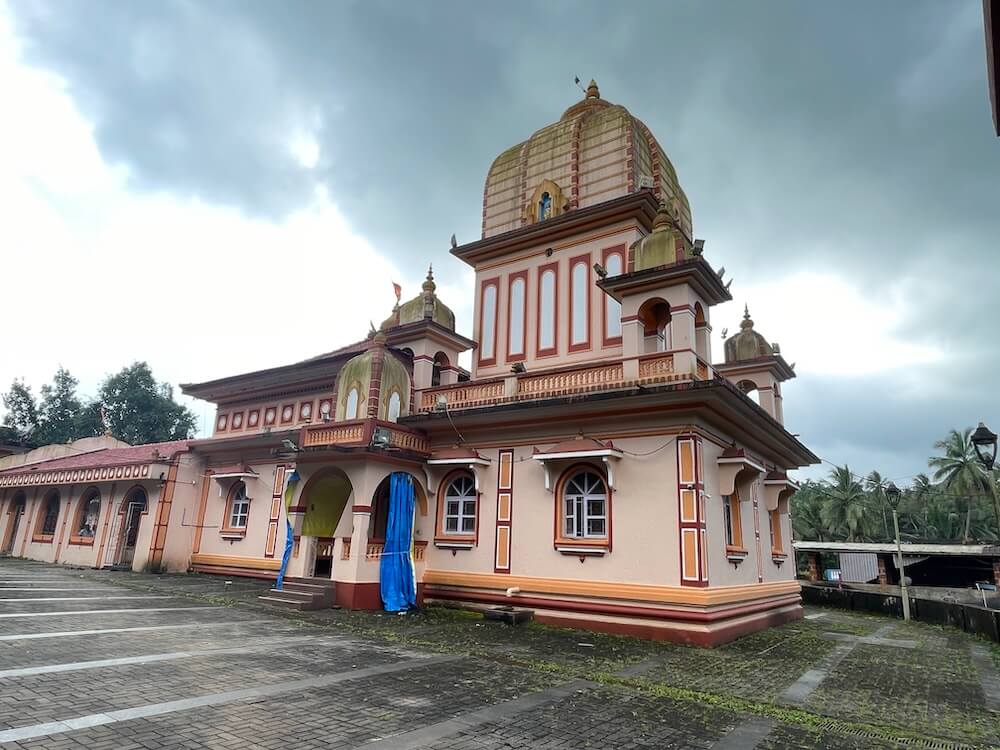
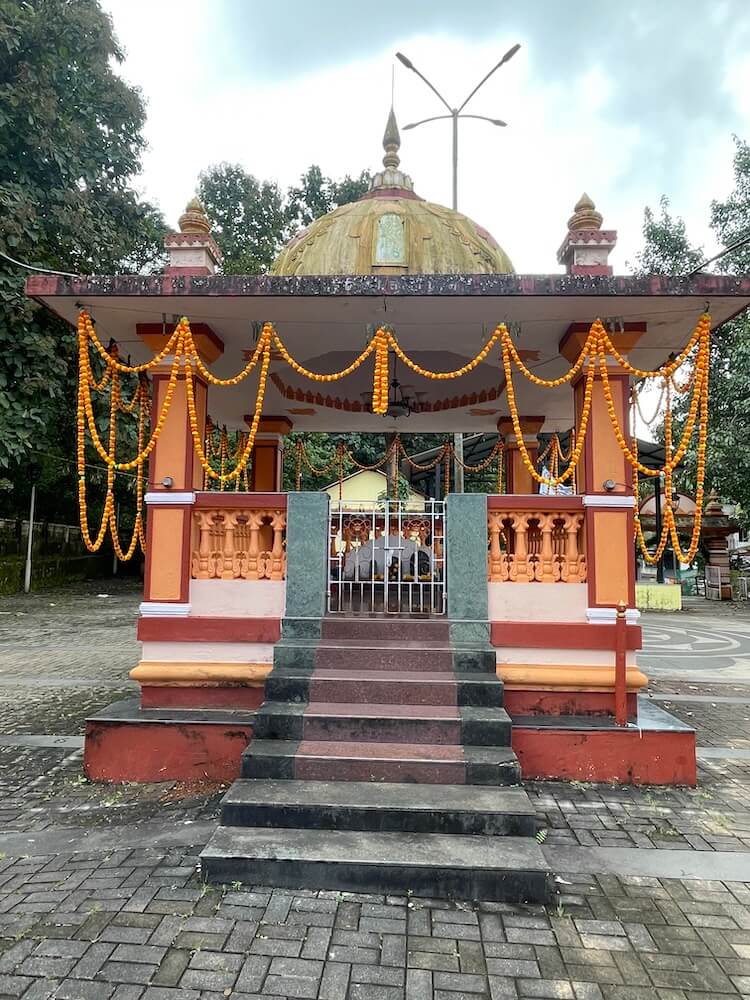
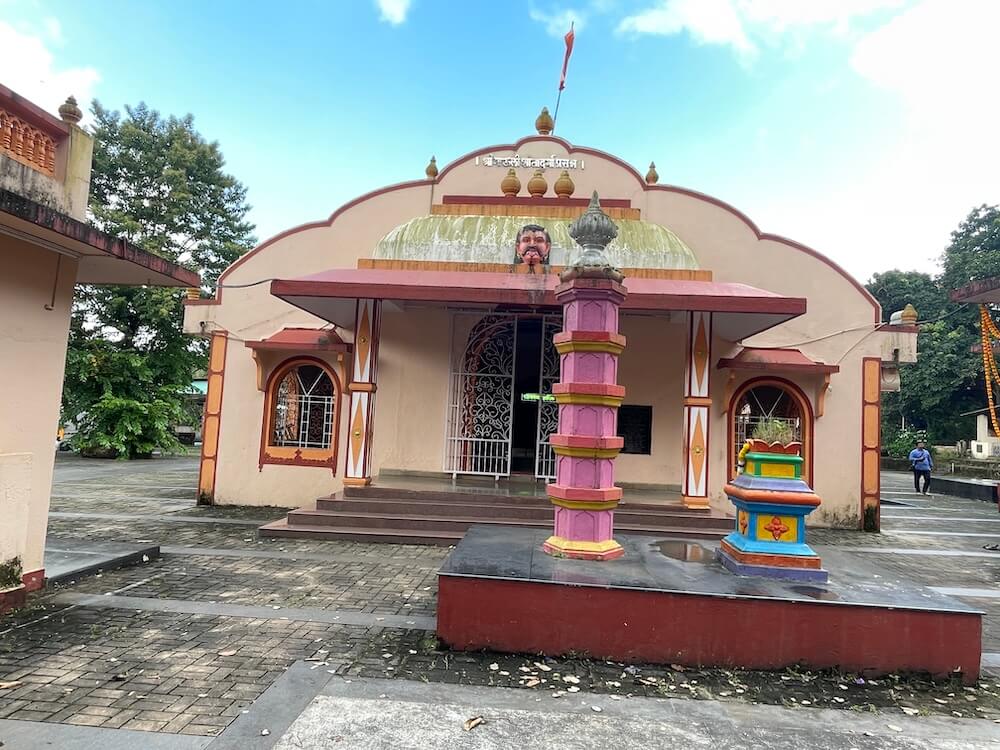
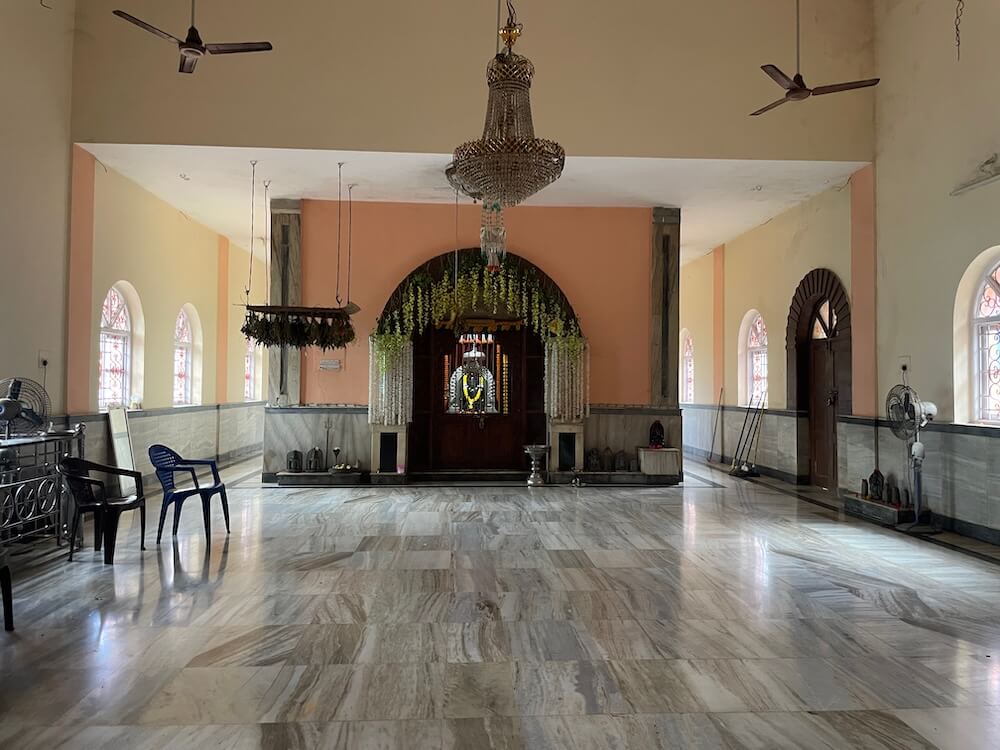
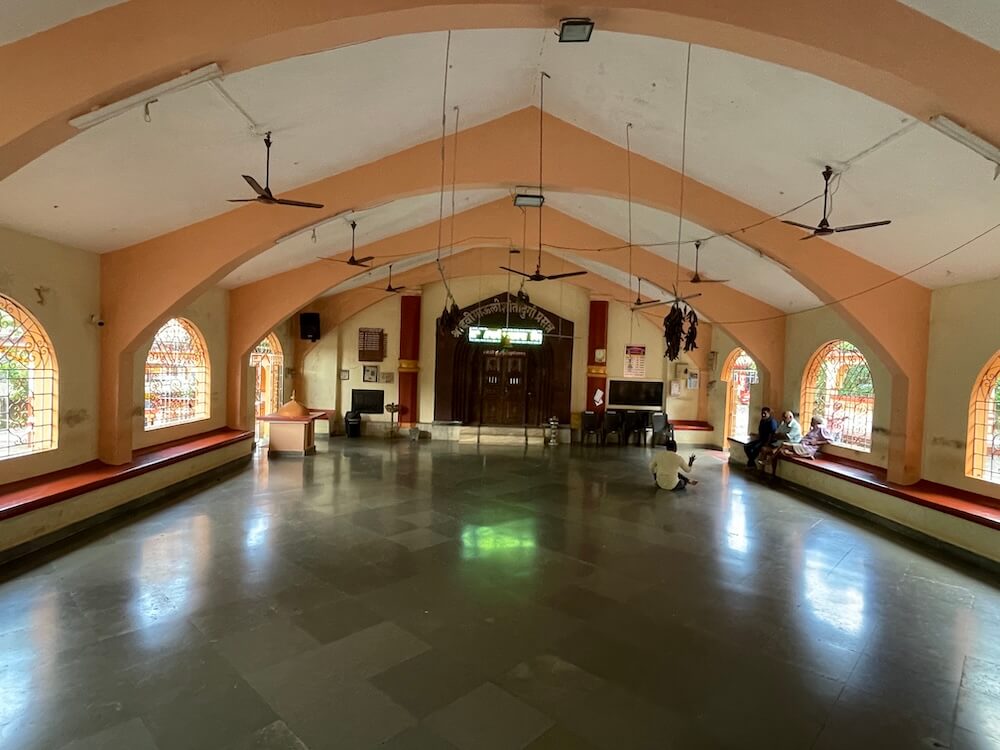
It is said that this temple is about three hundred years old. This deity is originally from Mithila, and some Brahmin families went on a pilgrimage to Rameshwaram from Kanyakubja. Among them, Brahmins like Deshavarma, Lokasharma, and Shivasharma settled in the land of Goa on their return journey and established their family deity, Goddess Shantadurga, here. There is a perimeter wall around this temple. One enters the temple courtyard through the entrance gate in this wall. In the courtyard, in front of the temple, there is a Tulsi Vrindavan on a platform and a five-tiered lamp pillar (Deepmal). The structure of this temple consists of a Mukhamandapa (front porch), Sabhamandapa (main hall), Antarala (vestibule), and Garbhagriha (sanctum sanctorum). The Mukhamandapa is at a higher level than the courtyard, and the platform of the Mukhamandapa has steps on all three sides. In the front of the Mukhamandapa, there are two ornate square pillars and a dome-shaped ceiling on the beam above the pillars. The enclosed Sabhamandapa here has ventilators for light and air. There are two doors each in the left and right walls of the Sabhamandapa. In the niches (Meghadambaris) in the Sabhamandapa, there are stones of local deities. Apart from this, a stage has been constructed in the Sabhamandapa for cultural programs. There are benches along the walls in the Sabhamandapa for devotees to sit.
Further ahead is the seven-framed entrance of the Antarala. Since the Antarala is higher than the Sabhamandapa, there are two steps to the entrance. In the center of the Antarala is the Garbhagriha. In the Garbhagriha, on a Vajrapitha (diamond pedestal), stands the eight-armed idol of Shri Shantadurga Devi made of black stone. The Goddess holds weapons like a trident, sword, shield, and noose in her hands. The idol has a silver mask and crown. In the silver halo behind the idol, there is a Kirtimukha in the center and floral patterns on both sides. A silver umbrella is hung over the head of the Goddess. There is a circumambulation path (Pradakshina path) around the exterior of the Garbhagriha.
On the roof of the Mukhamandapa, there is a dome-shaped spire and a Kirtimukha on the front side of the spire. There are three finials (Kalash) in a horizontal row on the spire. On the tiled square roof of the Antarala, there is an Amalaka at the top and a finial above it. On the roof of the Garbhagriha, there are four small niches (Meghadambaris) on all four corners. On the roofs of the niches, there are dome-shaped small spires with finials on them. In the center of the roof, there is a tall square dome-shaped spire, with a stupika and finial at the top. Near the temple, there are temples of Darval, Ravalnath, Bhutnath, Mharingan, Gavarhati, Baracha Purvas, Bhavkai Devi, and Baracha Brahman. There is a spacious hall building in the temple courtyard.
The Sharadiya Navratri festival is the main annual festival celebrated here with great enthusiasm. This festival is celebrated for fifteen consecutive days from Ashwin Shuddha Pratipada to Purnima. At this time, thousands of devotees from the surrounding area come for the darshan of the Goddess and to fulfill their vows. The Goddess is offered a sari-choli, auspicious ornaments, and a basket containing coconut and betel nut (Oti). The annual Jatrotsav of the Goddess is celebrated in the month of Margashirsha. Jatrotsav, Holi, Chaitra Padwa, and Dussehra are the days of the Goddess’s palanquin procession. At this time, the Goddess sits in a palanquin and goes out for a village procession. Thousands of devotees participate in the palanquin procession, dancing and singing amidst the sound of drums and the throwing of Gulal. Other festivals of the year are also celebrated in the temple. There is a crowd of devotees coming for darshan at the temple on Tuesdays, Fridays, Purnima, Amavasya, Ashtami, and other such days.
This sacred temple stands as a testament to deep spiritual devotion, ancient architectural grandeur, and rich local cultural traditions.
The sanctum sanctorum houses the divine idol consecrated according to ancient Vedic traditions, surrounded by serene courtyards and traditional temple architecture.
Navratri, Maha Shivratri, Annual Temple Jatra & Deepotsav
Compare and book flights, secure top-rated local hotels near the temple, hire reliable guides, and rent cars instantly.
Extend your pilgrimage by visiting other highly sacred temples located nearby.


Add ₹999 more to unlock FREE SHIPPING!
Your sacred cart is currently empty.
Shop Photo FramesFill in your delivery details below to place your order.
Add comment