
Add ₹999 more to unlock FREE SHIPPING!
Your sacred cart is currently empty.
Shop Photo FramesTemple No. 272 (Gujarat)
In the village of Jasalpur, situated within the Kadi Taluka of Mehsana district, lies the renowned temple of Meldi Mata, revered as an incarnation of Goddess Durga. Legend has it that approximately seven hundred years ago, at the breaking of dawn, the Goddess manifested within a ‘Vav’ (a traditional stepped well) located to the east of the village. Owing to her appearance at the hour of sunrise, she is also affectionately addressed as ‘Ugtai Mata’ (the Rising Mother). Having manifested ‘swayambhu’ (self-manifested) to protect the village, the Mother Goddess demonstrated her divine prowess to Malharrao Gaekwad, the ruler of the Baroda State, some one hundred and fifty years ago. Devotees hold a firm belief that the Goddess, who annihilates the ‘Shada-Ripu’ (the six internal enemies: lust, anger, greed, attachment, pride and envy), serves as a celestial shield against malevolent forces.
The legend associated with this temple narrates that one day, whilst passing through Jasalpur with his cavalry, Maharaj Malharrao Gaekwad paused by the village ‘Vav’ to quench his thirst. Struck by the exquisite carvings upon the stones of the well, he conceived the idea of using these stones to construct a palace in his capital, Kadi. Upon reaching Kadi, Malharrao commanded his soldiers to dismantle the stones and bring them forth. The labourers hewed the stones and loaded them onto bullock carts. However, despite exhaustive efforts, the carts remained immobilised. Subsequently, Malharrao dispatched elephant-drawn carts to Jasalpur. The route to Kadi via Visalpur was an incline, where the earth suddenly gave way, burying several elephants alive. To this day, that spot is known as ‘Hathi Temba’. Notwithstanding these omens, Malharrao remained obstinate in his quest to build the palace. Curiously, the construction completed during the day would collapse during the night. After this phenomenon persisted for several days, Malharrao finally surrendered to the Goddess. Through an ‘akashwani’ (a divine voice from the heavens), the Goddess set a condition that her idol must be consecrated on the seventh floor of the palace. Acceding to this condition, Malharrao completed the palace and installed the deity on the seventh floor.
The village of Jasalpur, located a short distance from the taluka town of Kadi, is home to a diverse tapestry of communities, including the Patel, Brahmin, Sutar, Shimpi, Rabari, Thakore, Harijan Rawal, Nadia, Valand and Garasia. It is a remarkable feature of this village that at least one member from almost every household has settled abroad. The villagers attribute this prosperity and abundance to the grace of the Mother Goddess. Until 1982, no formal temple structure existed here. The villagers offered their prayers at the original site within the ‘Vav’. Eventually, the village youth congregated and resolved to erect a temple adjacent to the well. Significant donations were contributed by the diaspora settled overseas. The foundation stone of this edifice was laid on Wednesday, 11 March 1982 (Phalguna Vadya Pratipada). The construction spanned seven years and the formal ‘Pratishthapana’ (consecration) of the idol in the new temple was performed on Sunday, 11 October 1989 (Ashwin Vadya Ashtami).
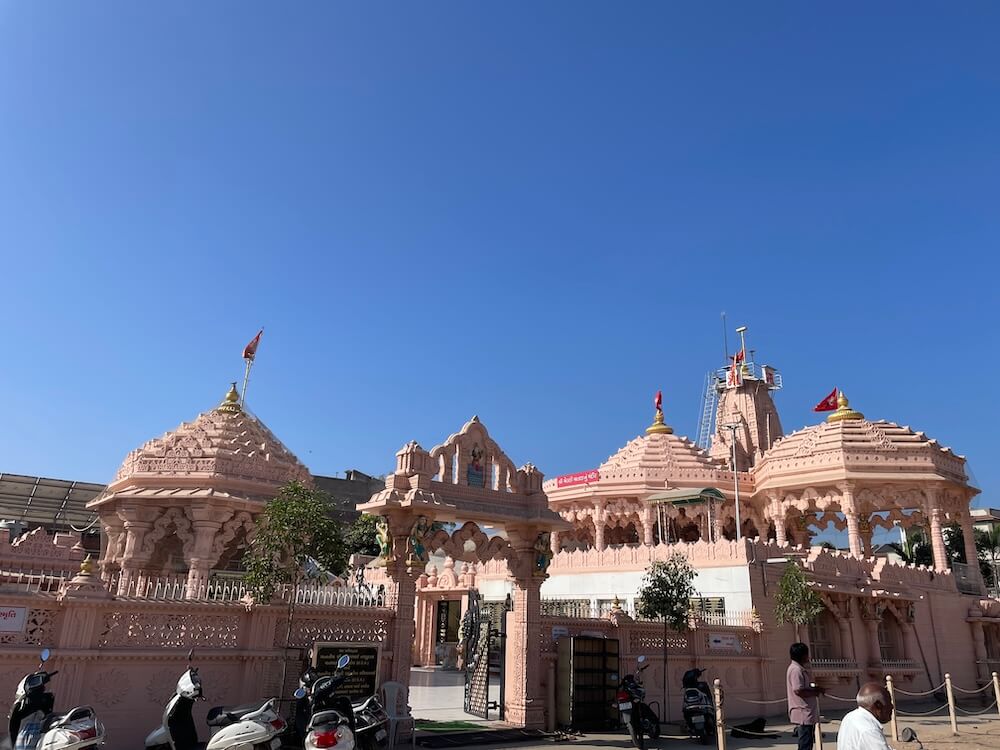
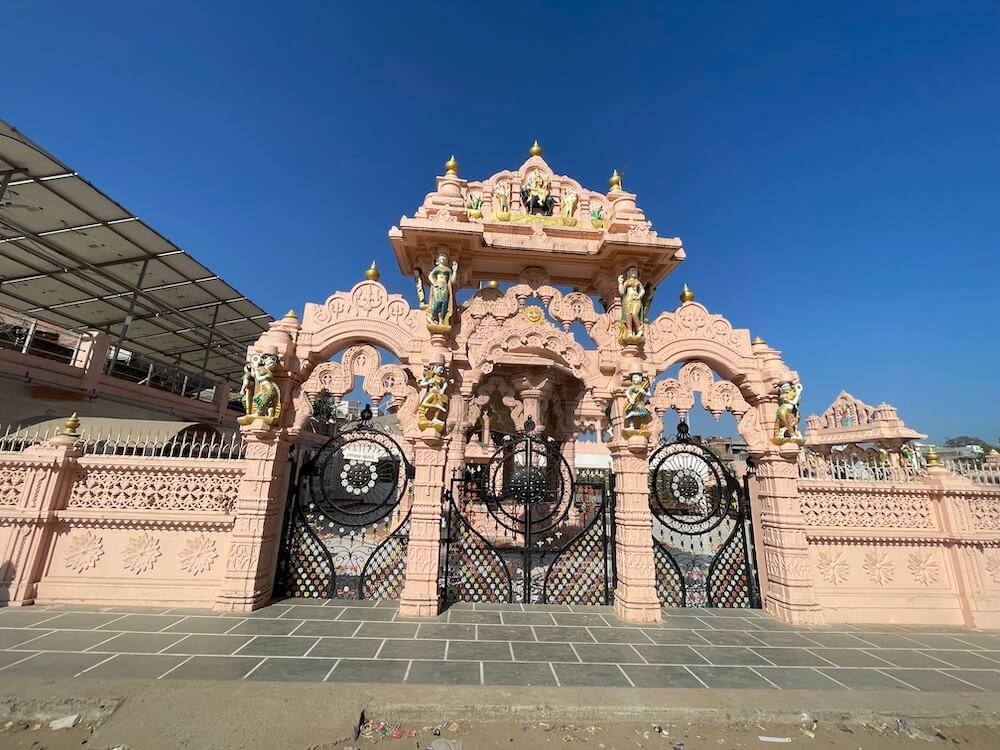
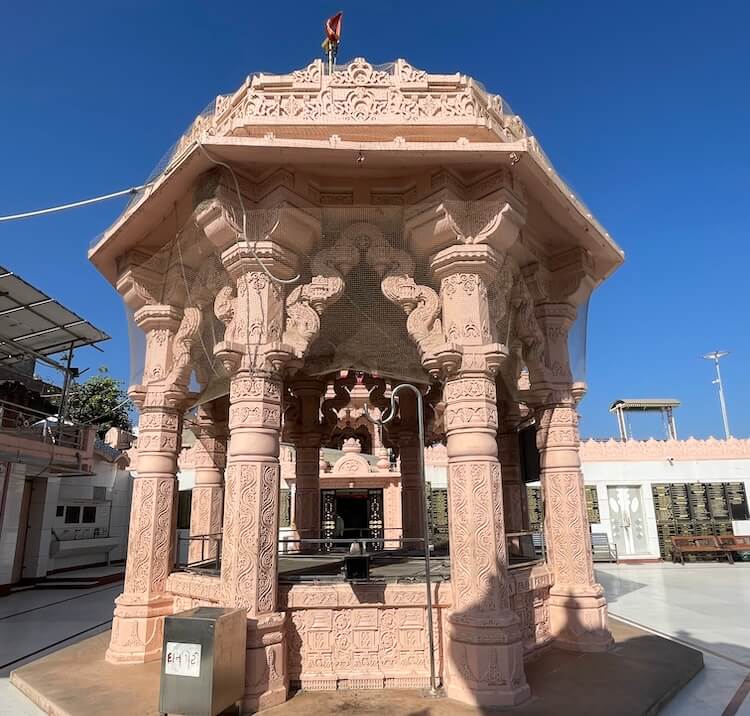
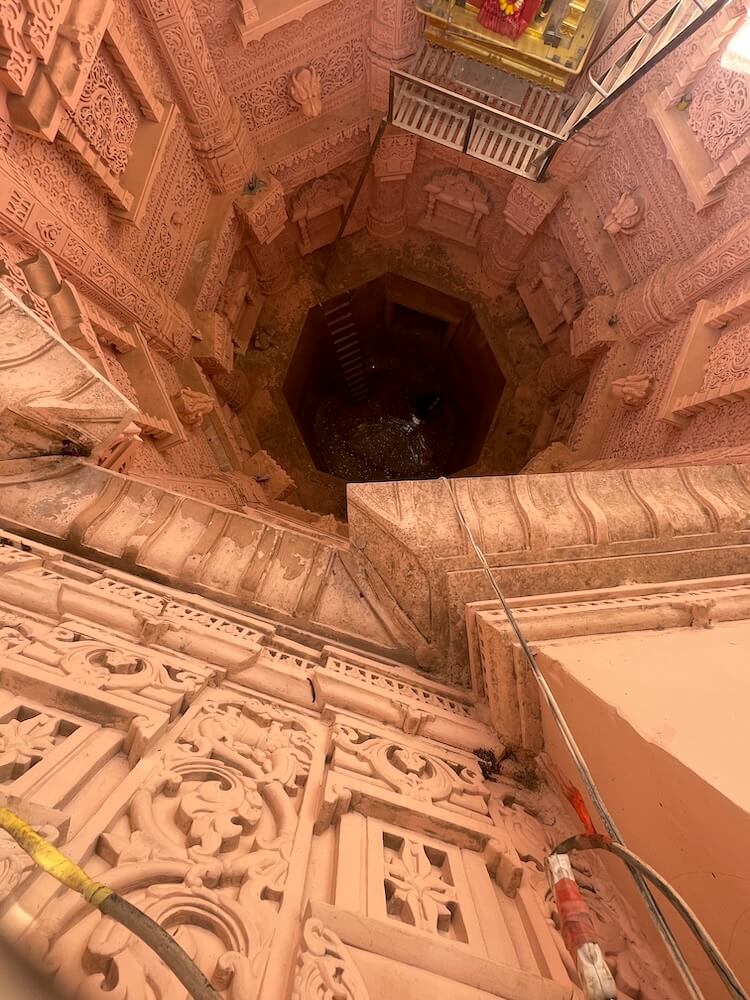
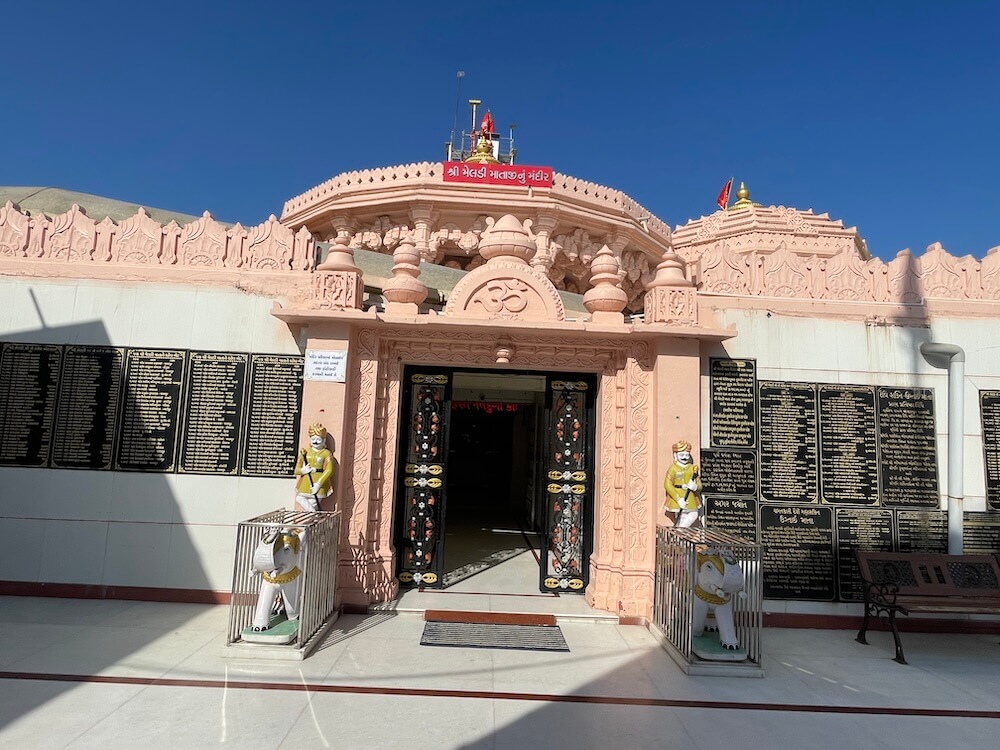
Situated a short distance from the village gateway, this magnificent temple rises, crafted from the red Bahua stone of Rajasthan. An ornate and exquisitely carved entrance leads into a paved courtyard. To the left of the courtyard lies the ancient ‘Vav’, the site of the Goddess’s manifestation. During the temple’s construction, the original well was also restored. Red Bahua stone has been employed in the inner and upper sections of the deep well, which is adorned with intricate carvings. Within its depths are several ‘devakoshtakas’ (niches), one of which enshrines an image of the Goddess. Although a ladder is provided for descending into the well, devotees are prohibited from using it for safety reasons and iron grilles have been installed over the opening. The exterior of the octagonal well features eight pillars supporting a ‘shikhara’ (spire), all interconnected by graceful cusped arches. The pillars and arches are embellished with fine craftsmanship. Local lore suggests that in the past, when the villagers used the well for drinking water, if a young girl accidentally fall into the water, even her hair would remain dry—a testament to the divine protection.
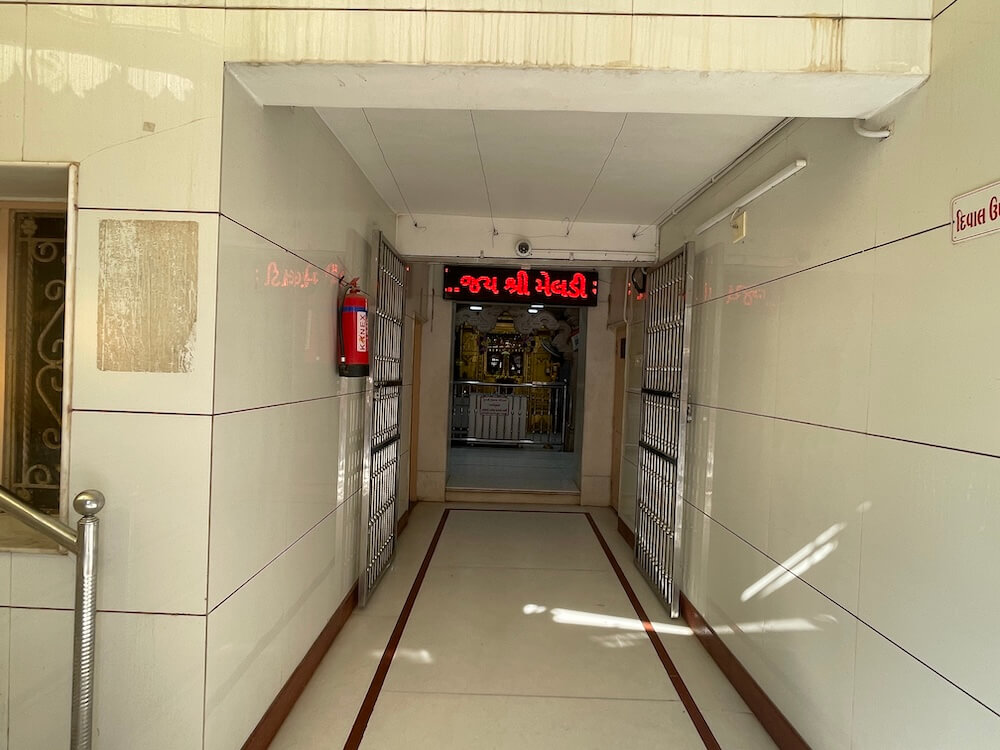
A few paces from the ‘Vav’ stands the two-storeyed temple of the Goddess. Twin ‘gajaraj’ (elephant) figures and ‘dwarpalas’ (sentinels) flanking the entrance welcome the pilgrims. The temple, comprising a ‘sabhamandap’ (assembly hall) and a ‘garbhagriha’ (sanctum sanctorum), features pillars adorned with delicate carvings and figures of ‘sursundaris’ (celestial maidens). In the lower section of the sanctum, there is a small deity wearing a metallic mask. Above, within two ‘makharas’ (ornate frames), reside two images of the Mother Goddess. To the left of the sanctum entrance, an ‘akhand jyot’ (eternal flame) burns perpetually. Within the temple, devotees may seek blessings from the idols of the ‘Navdurga’ (nine forms of Durga), including Brahmani, Chamunda, Khodiyar, Mahakali, Vardayini, Bahuchar, Umiya, Ambaji and Lakshmi. Climbing a flight of stairs leads to the upper floor, which offers a view of the ‘shikhara’ of the lower sanctum, atop which a ‘dhvajpataka’ (sacred flag) flutters. The sanctum on the second floor, situated near the spire, houses a marble idol. Seated upon a goat, the eight-armed Goddess holds various ‘ayudhas’ (weapons) such as a sword, a trident and a discus, while one hand is held in the ‘abhaya mudra’ (the gesture of fearlessness). The benevolent-faced Goddess is adorned with a golden crown.
The temple complex includes the office of the Board of Trustees, a garden, a ‘dharmshala’ (rest house) and a ‘bhojanshala’ (dining hall). Devotees may take ‘darshan’ (divine viewing) of the Mother daily between 5 am and 12 pm and from 3 pm to 9 pm. On Sundays, Tuesdays and ‘Purnima’ (full moon days), the temple remains open continuously from 5:00 am until 9:00 pm. Devotees offer ‘sukhadi’ as ‘bhog’ (consecrated food). A ‘bhandara’ (community feast) is organised every full moon. The temple’s anniversary is celebrated with great fervour on Ashwin Vadya Ashtami and special ‘Garba’ festivals are held during Navratri and Diwali.
This sacred temple stands as a testament to deep spiritual devotion, ancient architectural grandeur, and rich local cultural traditions.
The sanctum sanctorum houses the divine idol consecrated according to ancient Vedic traditions, surrounded by serene courtyards and traditional temple architecture.
Navratri, Maha Shivratri, Annual Temple Jatra & Deepotsav
Compare and book flights, secure top-rated local hotels near the temple, hire reliable guides, and rent cars instantly.
Extend your pilgrimage by visiting other highly sacred temples located nearby.


Add ₹999 more to unlock FREE SHIPPING!
Your sacred cart is currently empty.
Shop Photo FramesFill in your delivery details below to place your order.
Add comment