
Add ₹999 more to unlock FREE SHIPPING!
Your sacred cart is currently empty.
Shop Photo FramesThe Mhalsakant Khandoba Temple in Dhamani, located in the Ambegaon taluka of Pune district, is a major place of faith and the family deity (Kuldaivat) for thousands of devotees. According to the locals, the idol of Khandoba here is the largest in the state. The District Gazetteer describes that even during the British rule, recognizing the sanctity of this region, written orders were issued to protect the sacred grove (Devrai) surrounding this temple. Thousands of devotees attend the fair held here on Magh Purnima. The bullock cart races held during this fair have spread the cultural identity of this region far and wide. The state government has recognized this site as a ‘C’ grade tourist destination.
A legend regarding the temple at Dhamani states that, pleased by the unwavering devotion of Tambebaba, a staunch devotee of Khandoba, the deity set out from Nimgaon towards Dhamani village. During the journey, a doubt arose in Tambebaba’s mind, and he turned back to see if the deity was following him. Due to this action of Tambebaba, Khandoba vanished right there, and a small teak sapling containing a divine essence sprouted at that spot. Over time, this grew into a vast teak forest, which is known today as ‘Sagadara’. Another story regarding this is that the original Khandoba resided on Dhamanling Gad, and the Bhagat and Tambe families used to climb the hill daily to serve Him. However, due to old age, it became difficult for them to climb the mountain. The Lord realized the hardship of His devotees. The deity appeared in a vision to the devotees and promised to manifest on a cactus patch at the foothills. On the dawn of Magh Purnima, a tiger appeared there and vanished in a few moments. Where the tiger was seen, seven self-manifested (Swayambhu) lingas, known as ‘Saptalinga’, emerged from the ground. These Saptalingas are considered the entire family of Khandoba, including Mhalsai, Banai, and other divine attendants.
According to information from the Pune District Gazetteer of the 18th and 19th centuries, a significant historical event occurred regarding the teak forest in this area during British rule. A British officer ordered the trees in this sacred grove to be cut down and arrived there with laborers. As soon as the trees were struck, the officer and the laborers began suffering from physical ailments, and they begged the villagers for forgiveness. After this incident, the British officer recognized the religious significance of the Sagadara area and registered these teak trees as a sacred grove (Devrai). He issued a written order that no one should touch or harm even a single leaf or piece of wood in this forest and that it must be protected. It is said that this historical record still exists in government archives today.
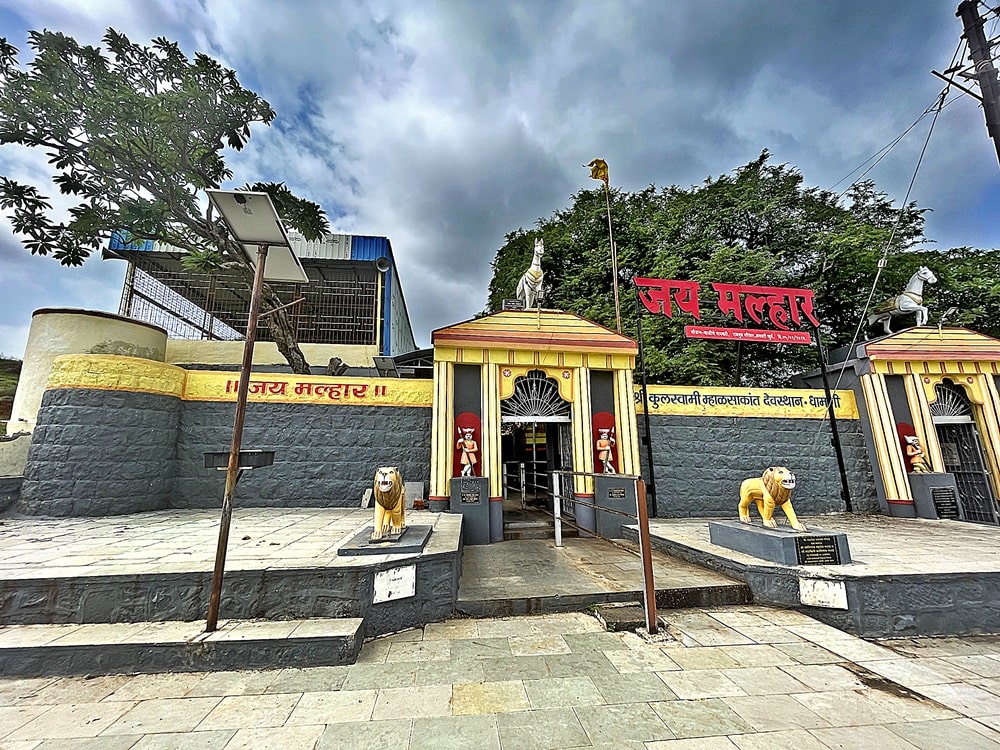
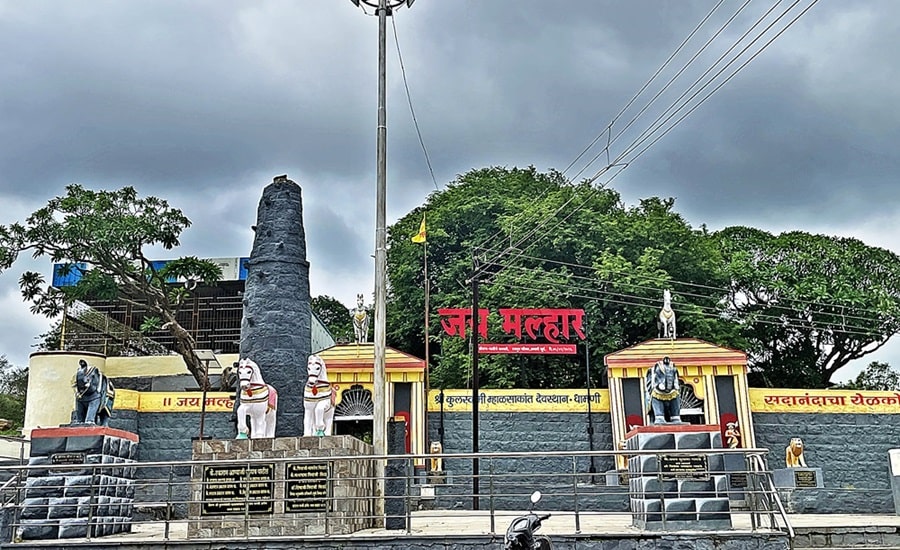
To reach this temple, devotees must travel to Dhamani village, which is a short distance from the main market of Manchar on the Pune-Nashik highway. This temple is situated on a high platform in a nature-rich area. The entire temple premises are covered with dense teak trees, known as the teak sacred grove. Because the trees in Sagadara are considered to contain the essence of the Divine, the local people protect this nature even today. One enters the temple platform by climbing five to six steps from the parking area. There are large elephant sculptures on both sides of this stairway. Adjacent to the stairway is a lamp pillar (Deepstambh) that tapers from bottom to top. On the platform next to this lamp pillar is a dog sculpture. Beyond that is a fortification wall about 10 feet high. There are two entrances in the front part of this fortification. In the center of both entrances, above the fortification, a large board reading ‘Jai Malhar’ is installed. On both sides of each entrance, there are lion sculptures on small platforms. On the doorframes of the entrances, there are gatekeeper (Dwarpal) sculptures holding spears. These entrances have spire-like carvings on the top, and at the apex, there are sculptures of horses, which are the vehicle of Khandoba. One enters the temple courtyard through these entrances in the fortification. A large pavilion (Mandap) has been erected in the courtyard to protect devotees from the sun and rain. There are galleries (Ovaryas) on the left side of the pavilion. Mythological information and paintings are depicted in these galleries. Additionally, there is a seating facility for devotees. In front of these galleries, on a platform, stands an ancient stone lamp tower (Deepmal).
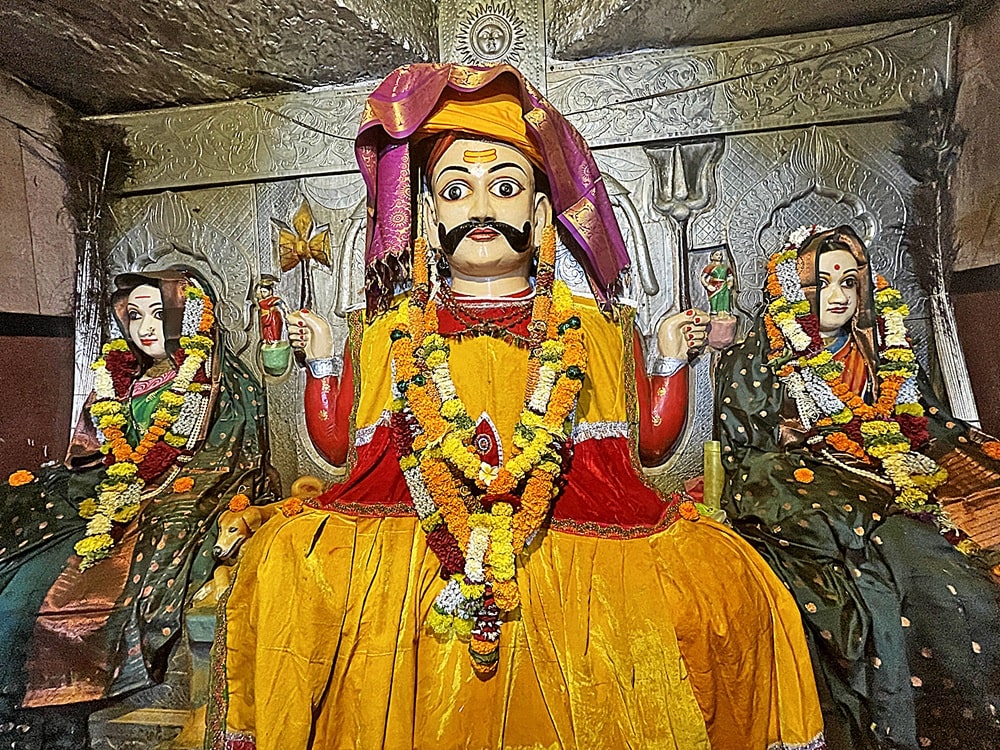
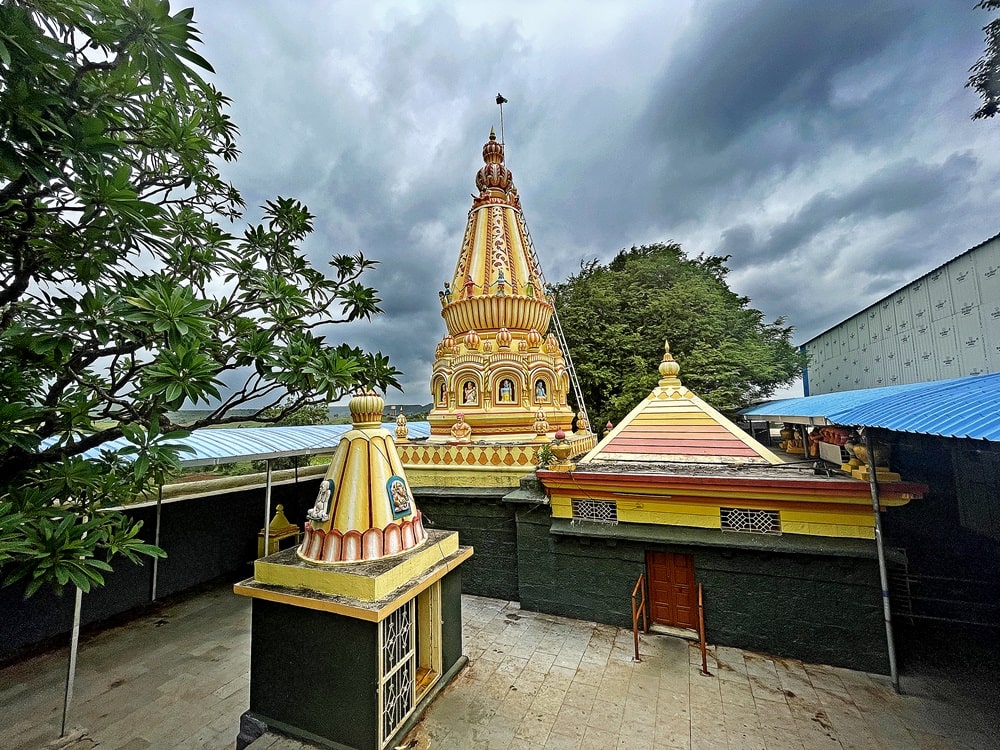
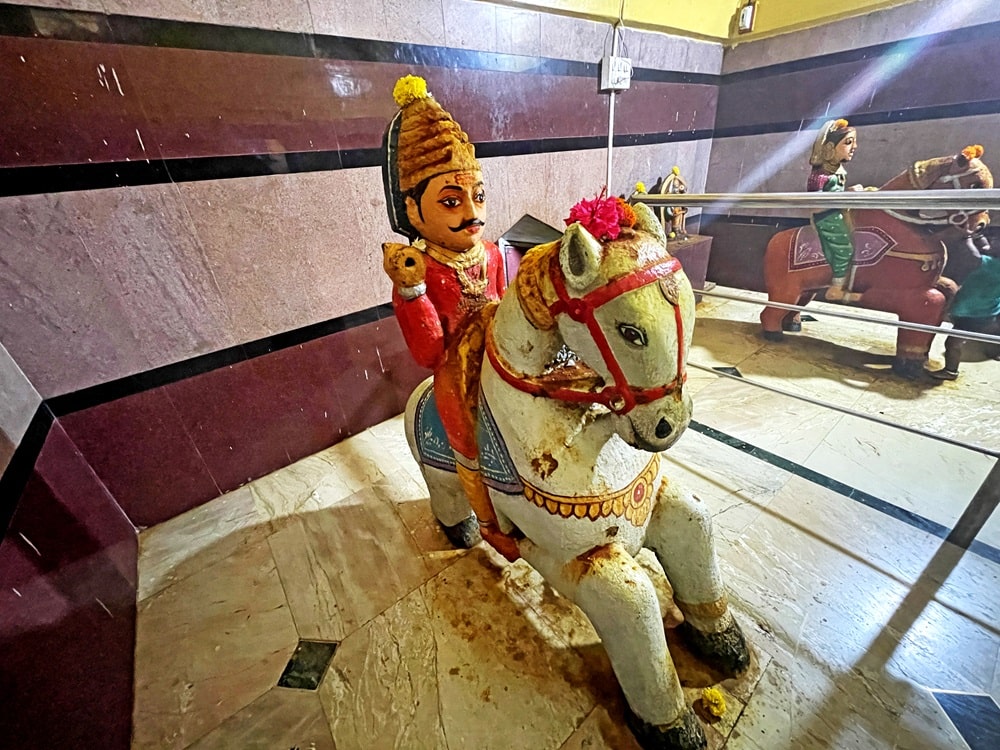
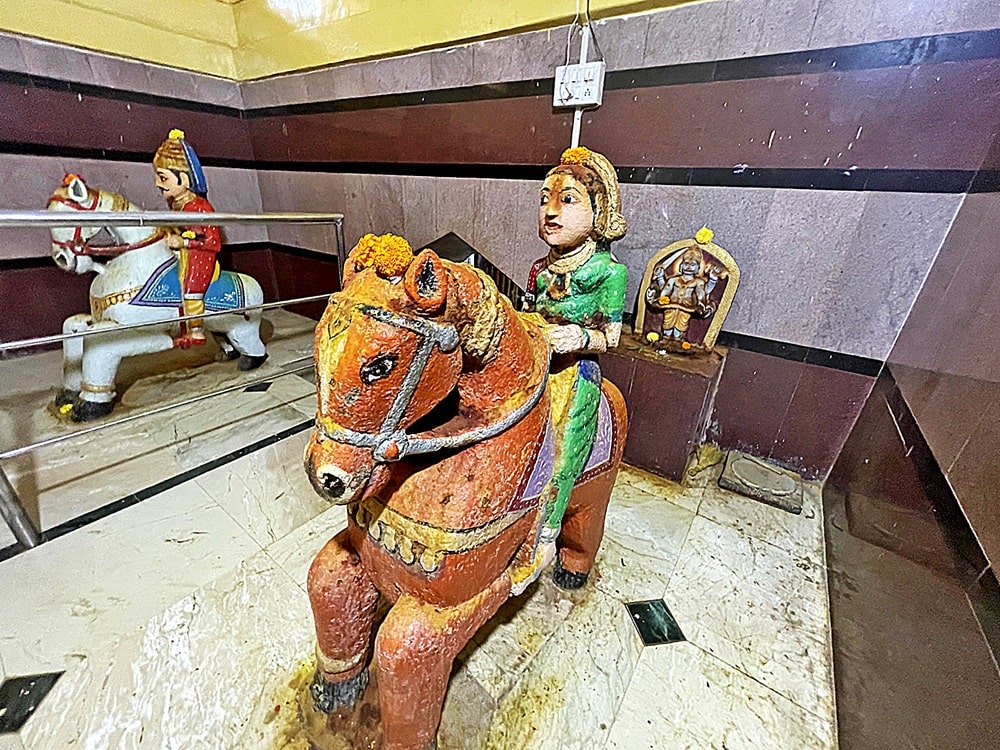
The main temple structure consists of an open pavilion, an antarala (vestibule), and a sanctum sanctorum (Garbhagriha). In the pavilion, on a platform near the temple entrance, there is a Nandi made of black stone, and in front of it, a tortoise idol made of white marble. There is a sculpture of Ganpati on the lintel of the entrance. From here, one enters the temple’s antarala. To the left of the sanctum entrance in the antarala, there are idols of Khandoba, and to the right, Mhalsadevi, both mounted on horses. Descending steps from the antarala, one enters the slightly sunken sanctum sanctorum. Along the wall of the sanctum, on a Vajrapitha, are the self-manifested Saptalingas, and behind them are the attractive and grand idols of Shri Mhalsakant Khandoba, Mhalsai, and Banai. According to the locals, the idol of Khandoba here is the largest in the district. Khandoba holds a trident in one hand and a damaru in the other. These idols are adorned with beautiful colors. A unique feature of this temple is that in the sanctum, along with these three idols, there is also a large idol of Khandoba’s sister on the Vajrapitha in the left wall. According to various folk tales of Maharashtra, Yogeshwari Devi of Ambejogai is considered to be Khandoba’s sister. Her separate idol is installed in this temple. In the devotional tradition of Khandoba, this sister is held in special regard. This Goddess is considered a power that protects devotees and keeps the family united. There is a staircase to reach the temple spire (Shikhara), and this spire is adorned with traditional Nagara-style carvings. There are niches for deities on all sides of this spire, and it is topped with a brass finial (Kalash).
Various festivals and celebrations are observed with great enthusiasm at the temple throughout the year. The two-day fair held on Magh Purnima is the largest festival here. This pilgrimage begins with the offering of garlands to the deity and the performance of ritual worship. The festivities include a procession of bulls and bullock carts, bullock cart races held as offerings of vows, and the Palkhi procession. The bullock cart race at Dhamani is not held for any prize money but is played solely out of devotion to the deity. On the second day of this fair, a grand procession of Gadibagad and bullock carts is taken through the village. Thousands of devotees chant “Yelkot Yelkot Jai Malhar” while showering turmeric powder (Bhandara) and dried coconut. During these two days, wrestling matches (Akhada) and various entertainment programs are organized. On Chaitra Purnima, the Vasantik Chandan Uti ceremony takes place at the temple. On this day, a sandalwood paste is applied to the Swayambhu Saptalinga. The Champashasthi festival is celebrated in the month of Margashirsha, and the Khandoba Navratri is observed. Special religious rituals are also performed here on the day of Somvati Amavasya.
This sacred temple stands as a testament to deep spiritual devotion, ancient architectural grandeur, and rich local cultural traditions.
The sanctum sanctorum houses the divine idol consecrated according to ancient Vedic traditions, surrounded by serene courtyards and traditional temple architecture.
Navratri, Maha Shivratri, Annual Temple Jatra & Deepotsav
Compare and book flights, secure top-rated local hotels near the temple, hire reliable guides, and rent cars instantly.
Extend your pilgrimage by visiting other highly sacred temples located nearby.


Add ₹999 more to unlock FREE SHIPPING!
Your sacred cart is currently empty.
Shop Photo FramesFill in your delivery details below to place your order.
Add comment