
Add ₹999 more to unlock FREE SHIPPING!
Your sacred cart is currently empty.
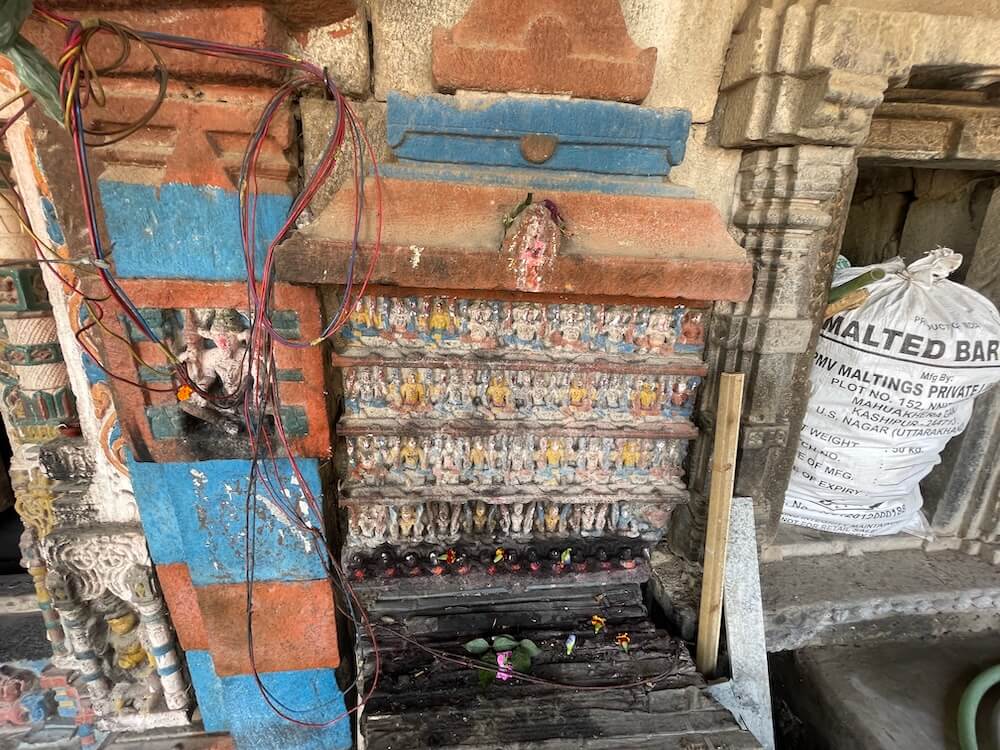
Shop Photo FramesThe Narasimha Temple at Chandol in Buldana district is a rich historical heritage site dating back to the 11th – 12th century. Built during the Yadava period, this temple is considered an excellent example of the Hemadpanti architectural style. The octagonal shape of this temple and the rare sculpture of 13 Shiva Lingas on the entrance doorway give this structure special significance. Along with the main idol of Lord Narasimha, two Shiva Lingas have also been consecrated in this temple. This temple is considered a great symbol of Shaiva-Vaishnava harmony. The village of Chandol was once known as the village of temples. Even today, three other temples in the Hemadpanti style exist here. Among them, the famous Khol Mahadeva Temple is located right next to the Narasimha Temple.
Various Puranic legends mention that Lord Vishnu took the Narasimha avatar to destroy the demon named Hiranyakashipu and to protect his devotee Prahlada. Highlighting the importance of this avatar, many texts such as the Shrimad Bhagavata, Mahabharata, Linga Purana, Matsya Purana, Padma Purana, Brahmanda Purana, Vayu Purana, and Devi Bhagavata have described this form in detail. There are various types of Narasimha idols all over India. While the fierce form of slaying Hiranyakashipu is more prevalent, in some places, the calm form in the presence of Goddess Lakshmi or Narasimha sitting in a yogic posture is also found. Although there are only a few Narasimha temples in India, there are ancient temples of this deity in Chandol, Janori, Umard, and Mehkar in the Buldana district of Vidarbha. Among these, the idol at Mehkar is mentioned in the Skanda Purana and Gita Mahatmya. This mention underscores the religious importance of this region.
Regarding the Narasimha Temple at Chandol, it is said that this temple was formerly a Shiva temple. About five hundred years ago, Lord Narasimha appeared in a vision to a Vairagi (ascetic) who was worshipping here. In this vision, the Lord said, “I am in the stepwell (barav) in front of the temple; take me out from there and install me.” According to this divine command, the idol was taken out of the stepwell and installed in the temple. However, according to the records in the ‘Central Provinces and Berar District Gazetteers – Akola District, Volume A’ (1910), the idol currently in the sanctum sanctorum is not the original one. It is mentioned that the old idol might have been damaged over time, leading to the installation of a new one. The stepwell that was once in the temple premises has now been filled in. That stepwell contained important inscriptions and some idols. According to the records in the same gazetteer, around 1910, an Inam land (gifted land) with an annual rent of 6 rupees was leased for the lighting and daily expenses of the temple.
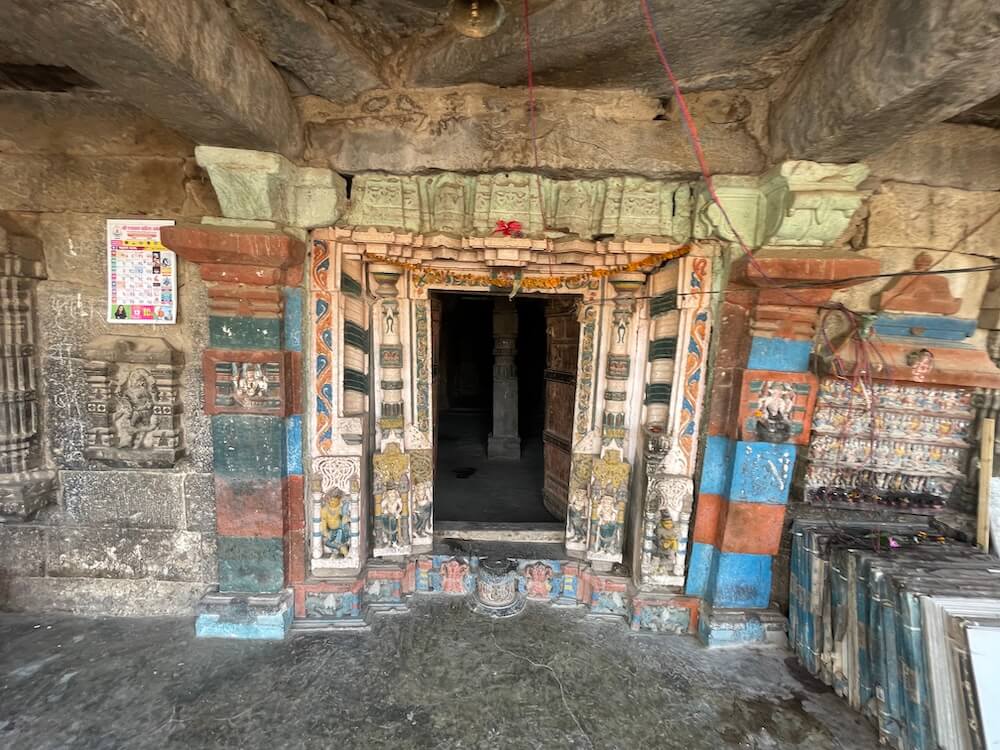
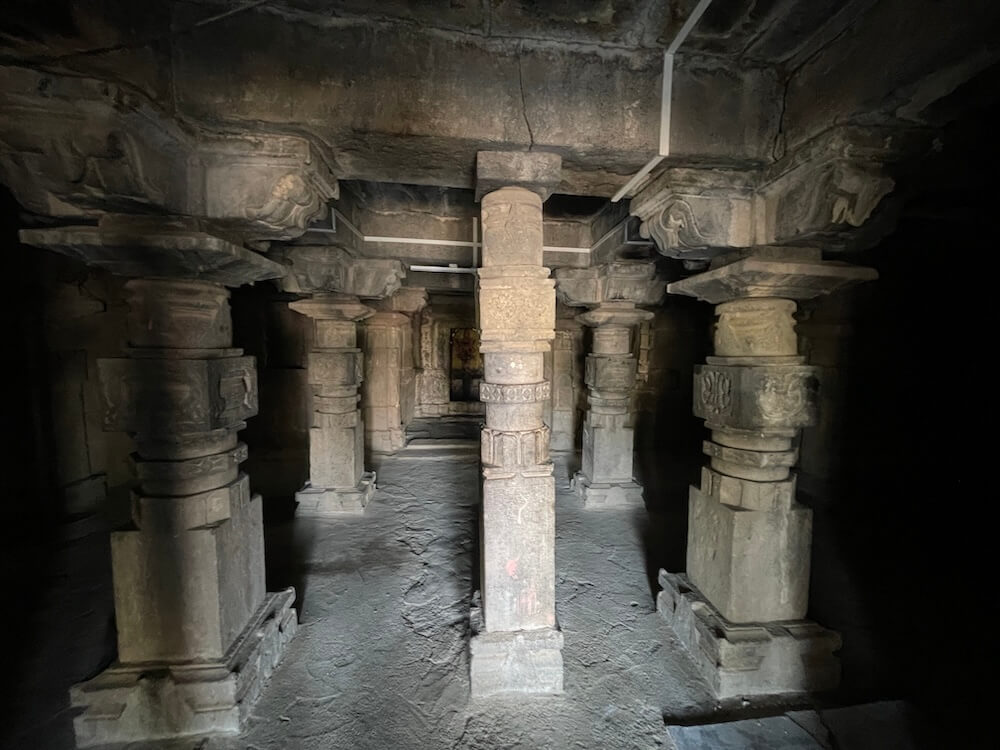
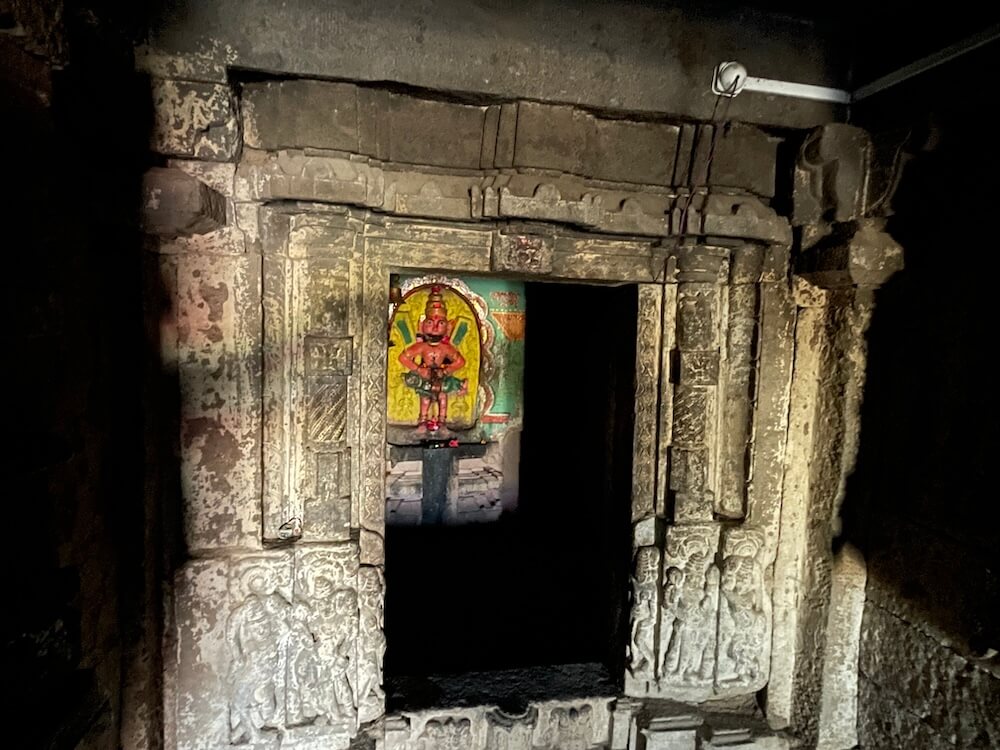
The main structure of the temple faces north. Its octagonal floor plan bears witness to the advanced state of architecture at that time. The structure of this temple is highly planned. It includes a Darshan Mandapa (viewing hall), Sabha Mandapa (assembly hall), Antarala (vestibule), the main Garbhagriha (sanctum sanctorum), as well as two sub-sanctums. The facade of the Darshan Mandapa has four pillars standing on pedestals. Various geometric shapes are carved on the shafts of these pillars. Designs of auspicious pots (Mangal Kalash) and Kirtimukhas are also visible. There are stone benches (Kakshasanas) on both sides in the Darshan Mandapa for seating. The four niches (Devakoshtakas) here do not currently hold idols, but an ancient idol can still be seen carved in one of the niches on the wall.
An idol of Ganesha is carved on the right side of the entrance to the Sabha Mandapa. Nearby, on a large stone slab, idols of various deities are carved in horizontal and vertical rows. In the lowest strip of this sculpture, 13 Shiva Lingas are carved. This is considered a unique and rare feature of the temple. There is intricate craftsmanship on the pillars of the entrance, and door guardians (Dwarapalas) are carved at the bottom. There is also carving on the upper lintel of the entrance. An idol of Ganesha is carved on the central decorative block (Lalatbimba) of the door frame, and a demon’s Kirtimukha is carved at the bottom.
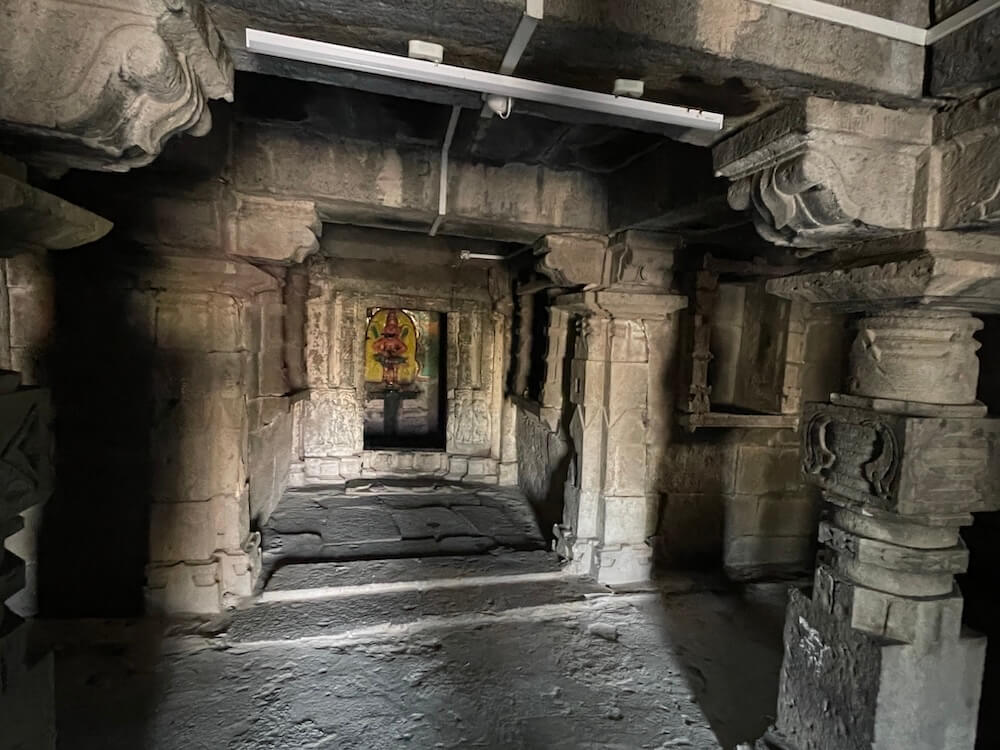
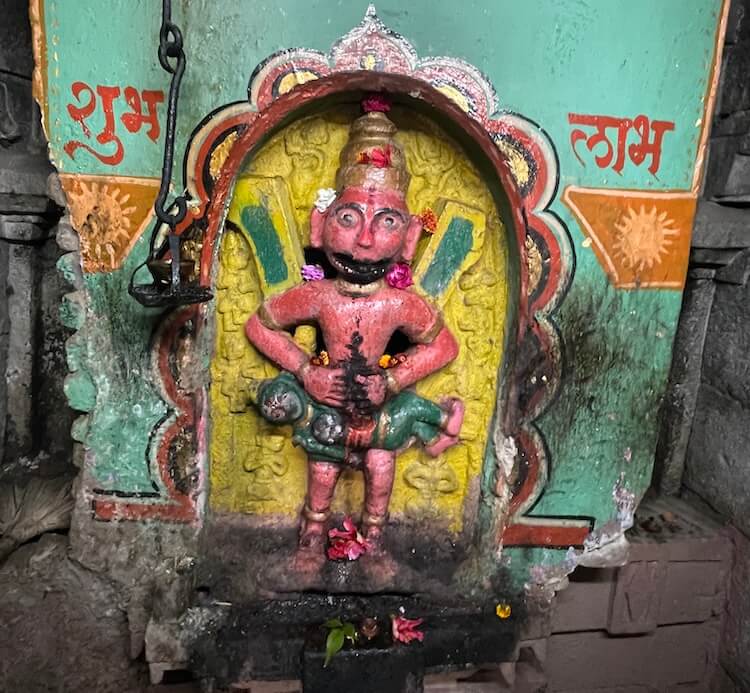
The square Sabha Mandapa of the temple has four pillars. These pillars also feature carvings of pots and Kirtimukhas. As this temple is of the Trikuta (triple-shrine) type, it has two sub-sanctums in addition to the main Garbhagriha. The door frames of both these sub-sanctums have unique craftsmanship and are carved with idols of various deities. Both these sub-sanctums contain Shiva Lingas. One of the two niches in the vestibule outside the main Garbhagriha contains an ancient idol. The door frames here also feature carvings. The idol of Lord Narasimha is enshrined in this Garbhagriha. This idol is simple in form and in a standing position. It depicts the fierce form of Lord Narasimha slaying the demon Hiranyakashipu. Other small idols are carved above and below the main idol. There is a stone frame behind this main idol. Folklore suggests that there is a tunnel behind it. It is said that this path leads to the hill of the Mahalakshmi Temple located some distance away. However, for security reasons, this frame has now been permanently closed.
The external structure of the temple has undergone many changes over time. The original spire (Shikhara) over the Garbhagriha must have been destroyed; because the current spire work was completed in later times using bricks and lime. There are some ancient Jain idols under an old tree in the temple premises. It is said that there was once a large complex of temples in this area. Near this temple, in a courtyard paved with paver blocks, is an ancient temple of Lord Shiva. This temple is famous as the Khol Mahadeva Temple. It is estimated that this temple, built in the Hemadpanti architectural style, must be contemporary to the Narasimha Temple. In front of this west-facing temple is a large idol of Nandi carved from a single stone. Behind this idol is an old idol and a small Shiva Linga. There is a sacrificial altar (Yajna Kund) in front of the temple, but there is no Sabha Mandapa here at present. Based on the remains of the stone paving here, it is said that there must have been a Sabha Mandapa in the past.
The entrance to the sanctum sanctorum of this temple features distinctive carvings. At the lower section, a Kirtimukha is carved. Since this sanctum is situated below ground level, one must descend steps to reach it, which is why it is known as Khol Mahadev or Kholeshwar Mahadev. As the steps leading down to the sanctum are steep and quite vertical, one must descend with caution. In the center of the sanctum, there is an oval-shaped Shiva Linga set within a large Shalunka. The construction of this temple is also half stone and half brick.
At Chandol, Nrusimha Jayanti is celebrated with great enthusiasm every year on Vaishakh Shuddha Chaturdashi. This festival commences from Vaishakh Shuddha Saptami. During this ten-day period, programs such as Bhajans, Kirtans, discourses, and Abhishekas are organized at the temple. On the day of Nrusimha Jayanti, a special tradition is observed here of applying a cooling sandalwood paste to soothe the fierce form of the Lord. On this day, devotees observe a fast and celebrate the appearance day of the Lord in the evening. At the conclusion of the festival, the palanquin procession of the deity is taken through the entire village. Devotees from the surrounding five-village radius participate in it.
This sacred temple stands as a testament to deep spiritual devotion, ancient architectural grandeur, and rich local cultural traditions.
The sanctum sanctorum houses the divine idol consecrated according to ancient Vedic traditions, surrounded by serene courtyards and traditional temple architecture.
Navratri, Maha Shivratri, Annual Temple Jatra & Deepotsav
Compare and book flights, secure top-rated local hotels near the temple, hire reliable guides, and rent cars instantly.
Extend your pilgrimage by visiting other highly sacred temples located nearby.


Add ₹999 more to unlock FREE SHIPPING!
Your sacred cart is currently empty.
Shop Photo FramesFill in your delivery details below to place your order.
Add comment