
Add ₹999 more to unlock FREE SHIPPING!
Your sacred cart is currently empty.
Shop Photo FramesVidarbha is referred to as ‘Dandakaranya’ as it is the land of King Dandaka. This region, located in the eastern part of Maharashtra, possesses an ancient tradition. Among the hundreds of temples in Western Maharashtra and its surrounding areas, eight select Ganesh temples became famous during the Peshwa era as ‘Ashtavinayak’. Similarly, there are places of Ganesha in Vidarbha as well, and for some years now, these eight select shrines have collectively come to be known as the ‘Ashtavinayak of Vidarbha’. Although there is no set protocol for the order in which to visit the Ashtavinayak of Vidarbha, unlike the original Ashtavinayak, it is customary to begin the pilgrimage from the Shami Vighnesh shrine in Nagpur.
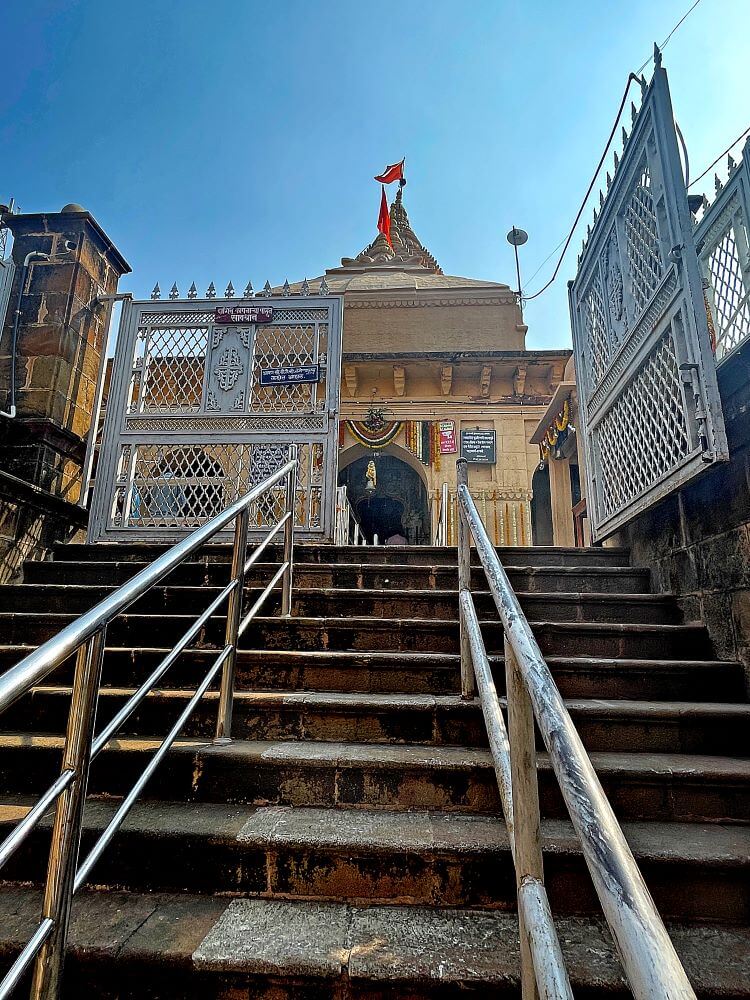
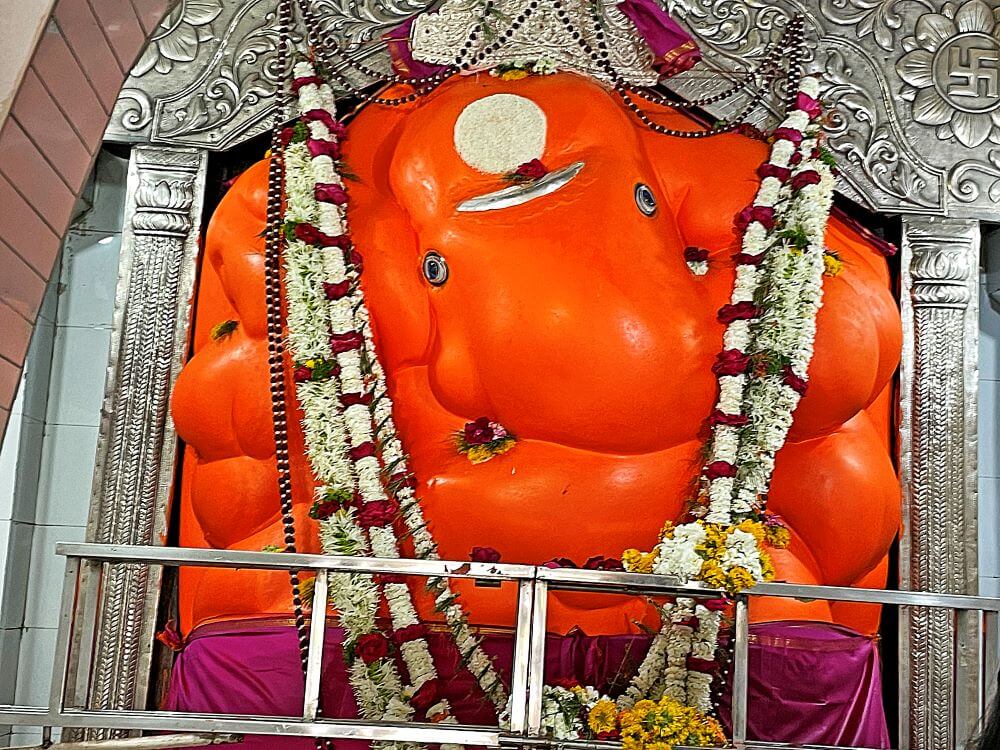
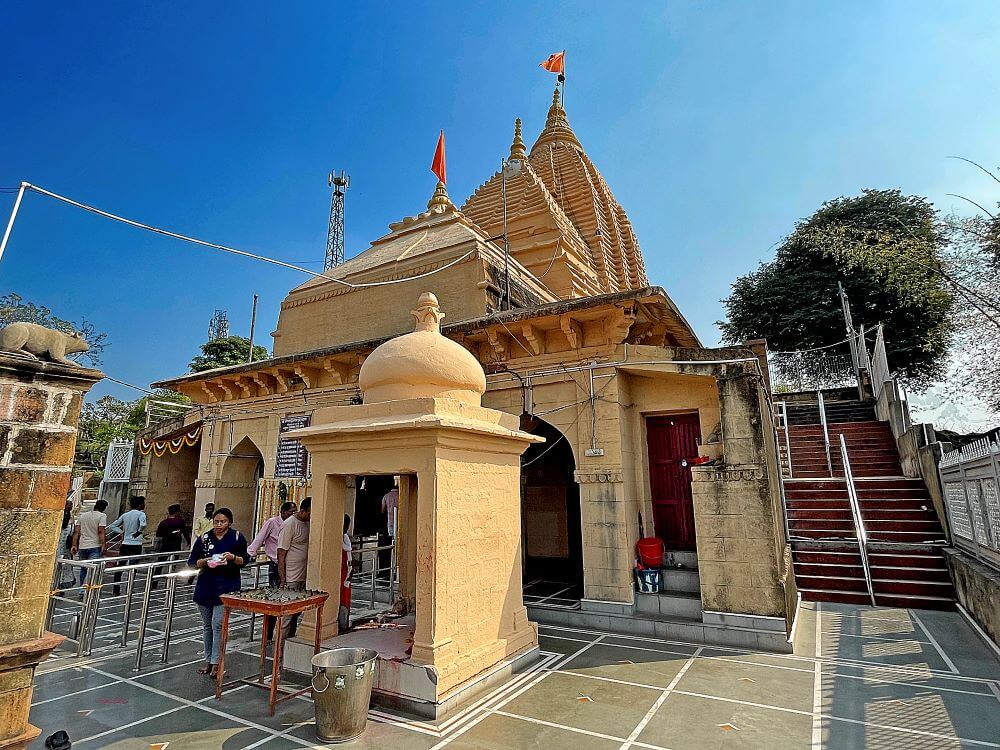
The Shami Vighnesh temple is considered the first and most prestigious among the Ashtavinayak of Vidarbha. This temple is situated on a hill in the village of Adasa in the Saoner taluka of Nagpur district. It is considered one of the most spiritually awakened (Jagrut) sites among the 21 prominent Ganesha shrines in Maharashtra. Based on the name of the village, this Ganesha is also referred to as ‘Adasa Ganpati’. In this ancient temple, there is a vermilion-smeared idol of Ganesha under a Shami tree, which is १२ feet tall and ६ feet wide. It is said to be the largest and self-manifested (Swayambhu) among the Ashtavinayak of Vidarbha. This idol is described in the ‘Ganesh Purana’, and according to scholars, it is an idol of Nritya Ganesha (Dancing Ganesha).
According to the Puranic account, at the request of Indra, Lord Brahma created the beautiful celestial nymph Tilottama; however, Brahma himself became infatuated with her beauty and began to chase her. As he ran, his semen was discharged and fell in ३ places. From this, the terrifying demons Mahapap, Sankasht, and Shatru were born. They performed penance for Lord Mahadev, and after Mahadev was pleased, they took control of the entire universe. They began to cause havoc in the world. To save the universe from the clutches of these demons, all the gods worshipped Ganesha under the Shami tree, which was the form of Mahadev and Parvati. At that moment, Ganesha manifested from the roots of that Shami tree and destroyed these demons. Sage Mudgal installed the Ganesha idol at the place where this event occurred. Hence, this Ganesha was named ‘Shami Vighnesh’.
According to another legend, many gods, including Indra, were born to Aditi, the wife of Sage Kashyap. Aditi had sons named Hiranyaksha and Hiranyakashipu. Prahlad was the son of Hiranyakashipu, Virochana was his son, and the mighty Bali was the son of Virochana. This Bali requested his preceptor, Shukracharya, saying, “Indra belongs to our lineage and is enjoying the kingdom of heaven, while we have been deprived of it. Please suggest a way so that we too can enjoy the kingdom of heaven.” After Shukracharya told him that he would have to perform १०० Ashwamedha Yagyas to attain the kingdom of heaven, Bali began preparations for the Yagyas. Fearing that his position would be destabilized as soon as the १००th Yagya began after the completion of ९९ Yagyas, Indra rushed to Lord Vishnu. Lord Vishnu assured him of safety and was born to Sage Kashyap’s wife, Aditi. This is considered the fifth (Vaman) avatar of Lord Vishnu. After this Vaman asked his father, Sage Kashyap, for a way to remove the suffering of the gods, Sage Kashyap initiated Vaman into the six-syllable mantra of Gajanan and told him to perform rituals. Accordingly, Vaman worshipped Ganesha, and Ganesha was pleased. Vaman installed the idol of Shri Ganesha at the place where Ganesha was pleased. It is said that this is the same Shami Ganesha.
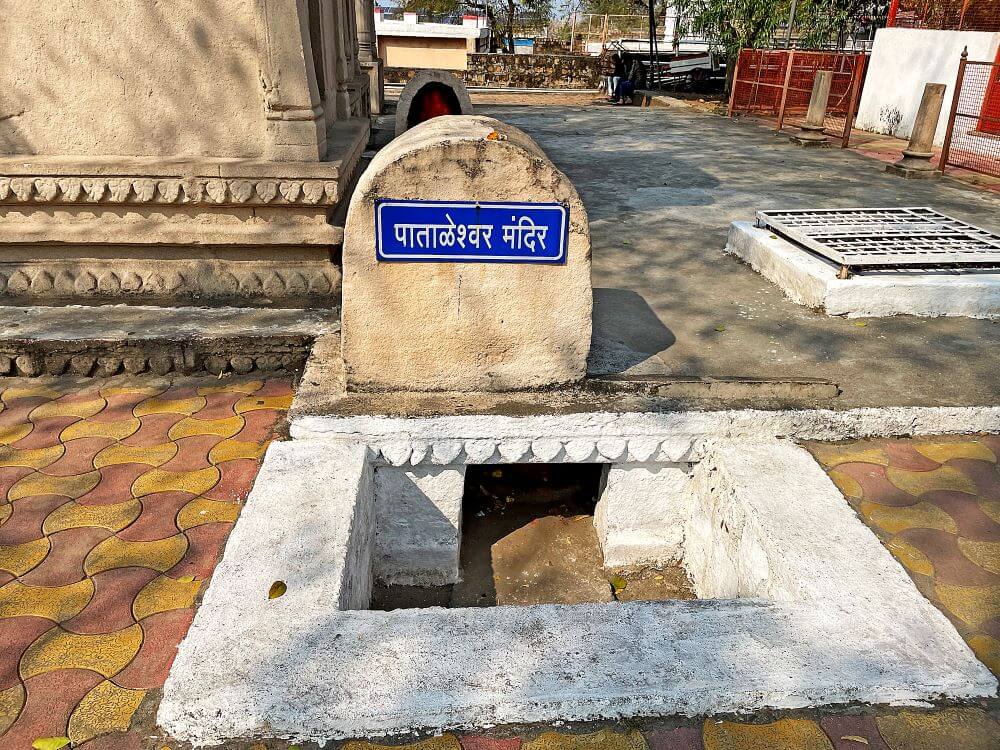
By then, King Bali had taken control of heaven. King Bali was a great philanthropist. He used to give alms to many. Once, this Vaman went to Bali and asked for a donation of ३ paces of land. Bali immediately agreed. Then, the dwarf-looking Vaman assumed a massive, grand form and placed his first step on the earth and his second step on heaven. When asked by Bali where to place the third step, he asked him to place it on his head. Accordingly, Vaman placed his foot on Bali’s head, sent him to the netherworld (Patala), and gave him the kingdom there. It is said that this Bali is immortal due to the boon of Lord Vishnu and is still ruling in Patala today, and Lord Vishnu in his Vaman form is guarding his gate.
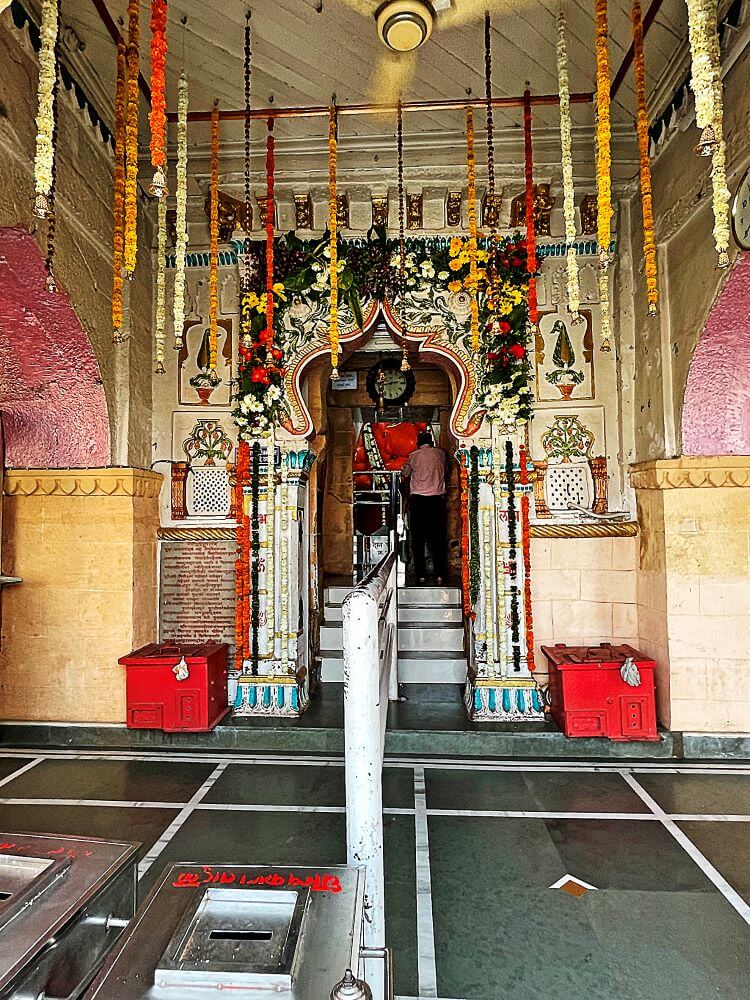
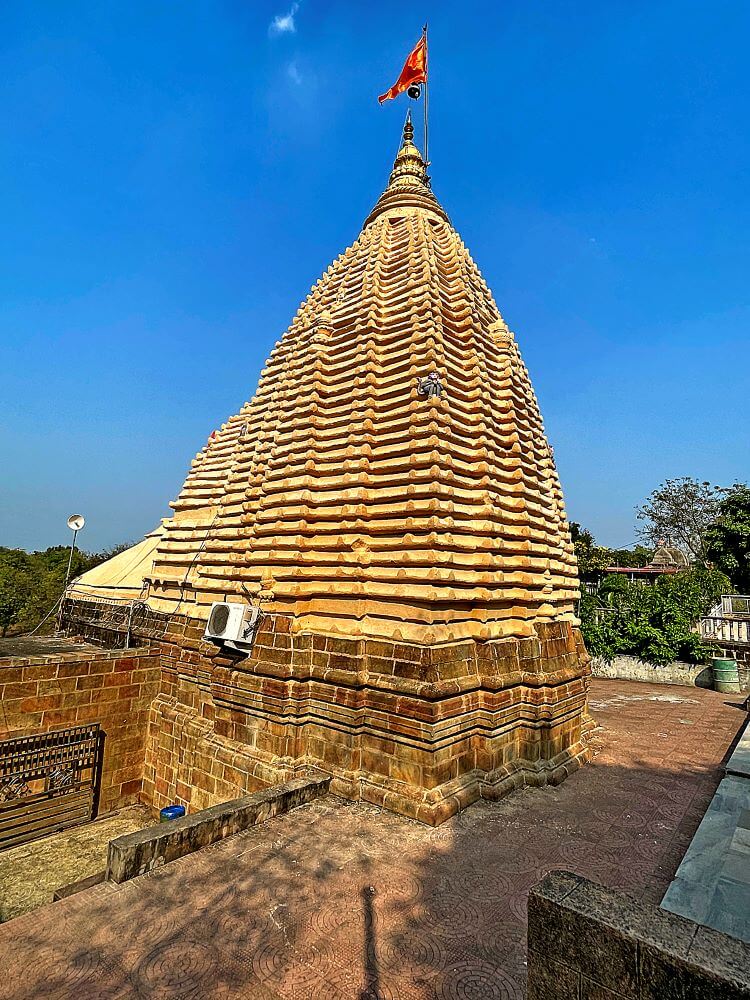
It is said that this Ganesha shrine at Adasa has been here for ४००० years. The Ganesha here is famous by the name ‘Shami Vighnesh Vakratunda Ganpati’. This shrine is spread over an area of ११ acres. This is an east-facing temple of Hemadpanthi architecture, and the idol of Ganpati is installed in the sanctum sanctorum in the middle of the assembly hall (Sabhamandap). Although the sharpness of the idol is not clear due to the vermilion coating, it is said that this idol is eight-armed (Ashtabhuja) or ten-armed (Dashabhuja). The idol is seated on a throne. A mark of rice grains (Akshata) is applied to the forehead of the idol. This idol with a left-turning trunk is in a state of leaning towards the right. There are records of this temple being renovated at the end of the १८th century during the reign of the Nagpurkar Bhosale dynasty. The temple attained its current form after periodic renovations.
In the Shami Vighnesh Ganesh temple complex, there are २० temples, including the Trimbakeshwar temple, Maharudra Hanuman temple, and temples of Durgadevi and Kalbhairav. The Shiva Linga in the Trimbakeshwar temple faces south. Generally, Shiva Lingas face north. There is also a Shiva Linga and Nandi in a cave adjacent to this temple. The idol in the Hanuman temple is in a reclining position and is १० feet long. There is an ancient well here which is called ‘Paybahuli’. This well has steps to reach the water level. As the temple is situated on a hill, one can see a panoramic view (aerial view) of the surrounding area from there.
Festivals are celebrated here every Sankashti Chaturthi and from Ganesh Chaturthi to Anant Chaturdashi. A two-day fair is held here on Magh Shuddha Chaturthi (Tili Chaturthi). There is a one-day fair on Vasant Panchami. On this day, special bus services are provided by the GSRTC for the fair from Nagpur as well as Saoner. Daily rituals in the temple begin from ४:३० in the morning. There is a crowd of devotees here on Tuesdays and Saturdays.
The temple management has provided various facilities for devotees such as arrangements for worship and offerings (Puja-Prasad), a machine for breaking coconuts, drinking water facilities, and restrooms. Due to these amenities and the scenic surroundings, the state government has granted this area the status of a tourist destination.
This sacred temple stands as a testament to deep spiritual devotion, ancient architectural grandeur, and rich local cultural traditions.
The sanctum sanctorum houses the divine idol consecrated according to ancient Vedic traditions, surrounded by serene courtyards and traditional temple architecture.
Navratri, Maha Shivratri, Annual Temple Jatra & Deepotsav
Compare and book flights, secure top-rated local hotels near the temple, hire reliable guides, and rent cars instantly.
Extend your pilgrimage by visiting other highly sacred temples located nearby.


Add ₹999 more to unlock FREE SHIPPING!
Your sacred cart is currently empty.
Shop Photo FramesFill in your delivery details below to place your order.
Add comment