
Add ₹999 more to unlock FREE SHIPPING!
Your sacred cart is currently empty.
Shop Photo FramesThe Ganpati at the Ganesh Mandir Sansthan in Dombivli, the cultural capital of the state, is the presiding deity of this city. Citizens here begin any auspicious work in their homes by placing the invitation card before this Ganesha. The tradition of welcoming the New Year with ‘Shobhayatras’ (processions), which now takes place in various parts of the state and even abroad on Gudi Padwa, originated in this very city. During the Shobhayatra organized by the Ganpati Mandir Sansthan, the streets are filled with a sea of youth. While women performing priestly duties is a matter of appreciation today, this temple had the distinction of having a woman perform priestly duties as early as 1930.
Dombivli, which has now expanded in all directions, was once a small village in the Thane district. The village was characterized by the Agri community cultivating rice in the black soil, a few educated families working in government departments, and a dense forest of silk cotton trees (savari) behind what is now Sangeetwadi. At that time, there was not a single large temple in the village. Villagers had to participate in the festivals and fairs held in nearby villages. Against this backdrop, through many discussions and meetings, everyone came together, deliberated, and with collective cooperation, a small tiled temple of Ganpati was built here on May 22, 1924. On the same day, the deities Shankar, Parvati, Maruti, and Mahalakshmi were formally consecrated.
The objective behind building this Ganesh temple was also to ensure that villagers would gather during religious festivals, fostering cultural and social awareness among them. After the first Board of Trustees was established in 1926-27, the temple’s constitution was drafted in 1936. A unique feature of that constitution was that it kept the temple open to all castes and communities, discarding the caste-based restrictions prevalent at that time. A woman named Ambubai Godbole was given the honor of performing the priestly duties of the temple. Godbole, who served here for several years, saved some money from her meager salary to build a platform around the banyan tree in the temple courtyard. This banyan tree, which is over 100 years old, is still present in the temple premises today. The temple underwent renovations in 1940, 1952, and 1978-79. The current form of the temple was attained after its renovation for the centenary year in 2024. During this renovation, the same type of stone used for the Ram Mandir in Ayodhya was utilized in the construction.
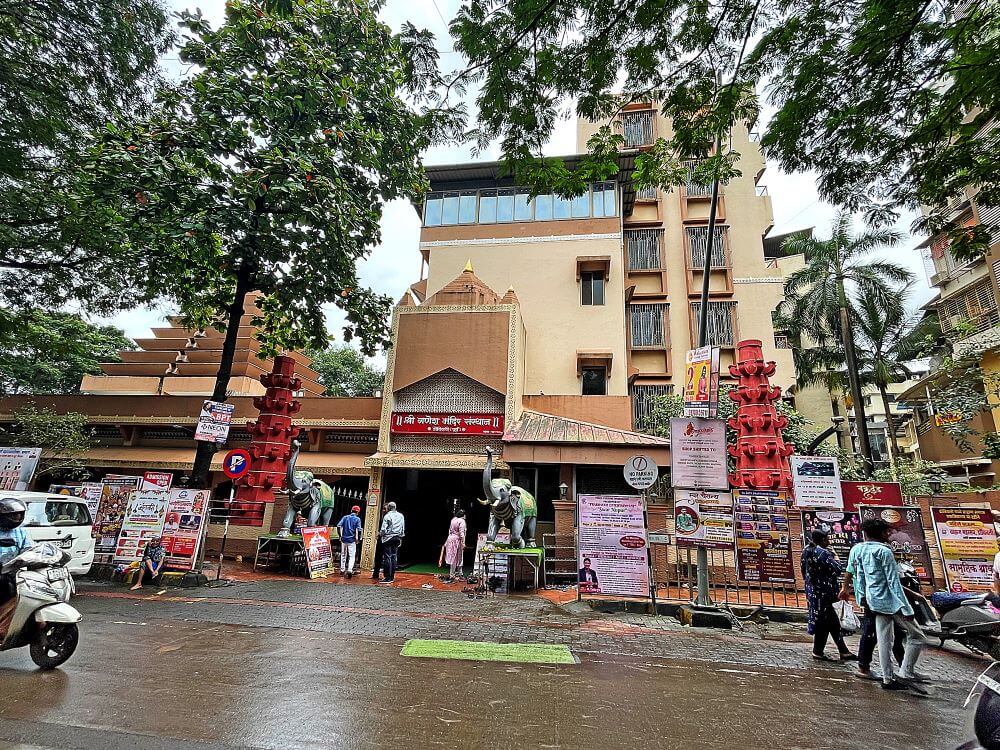
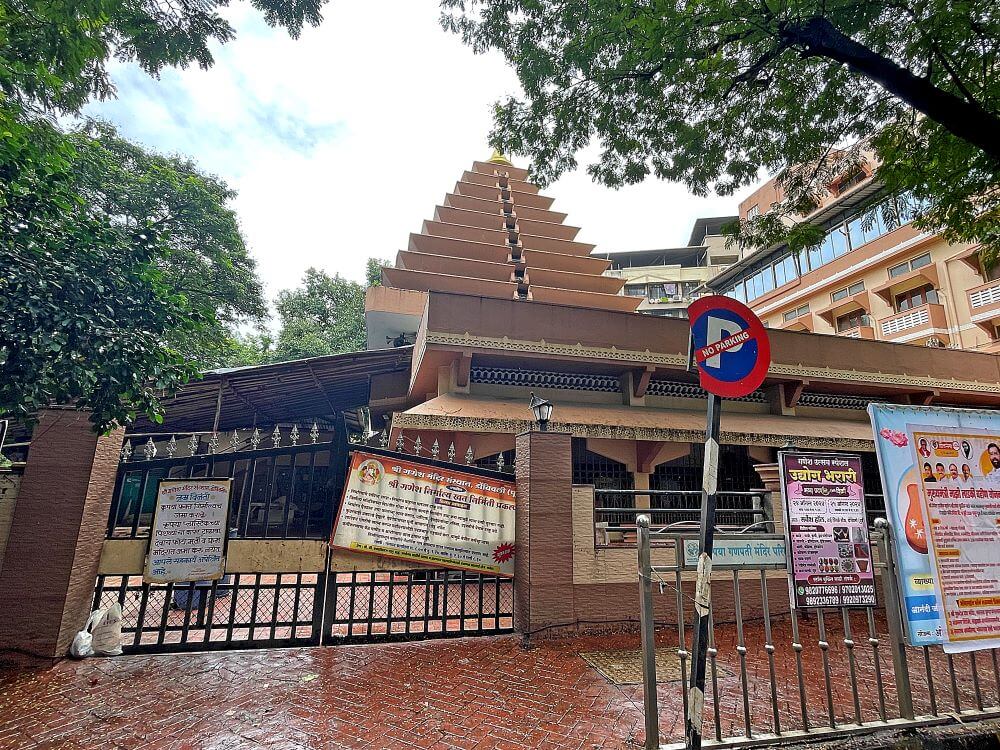
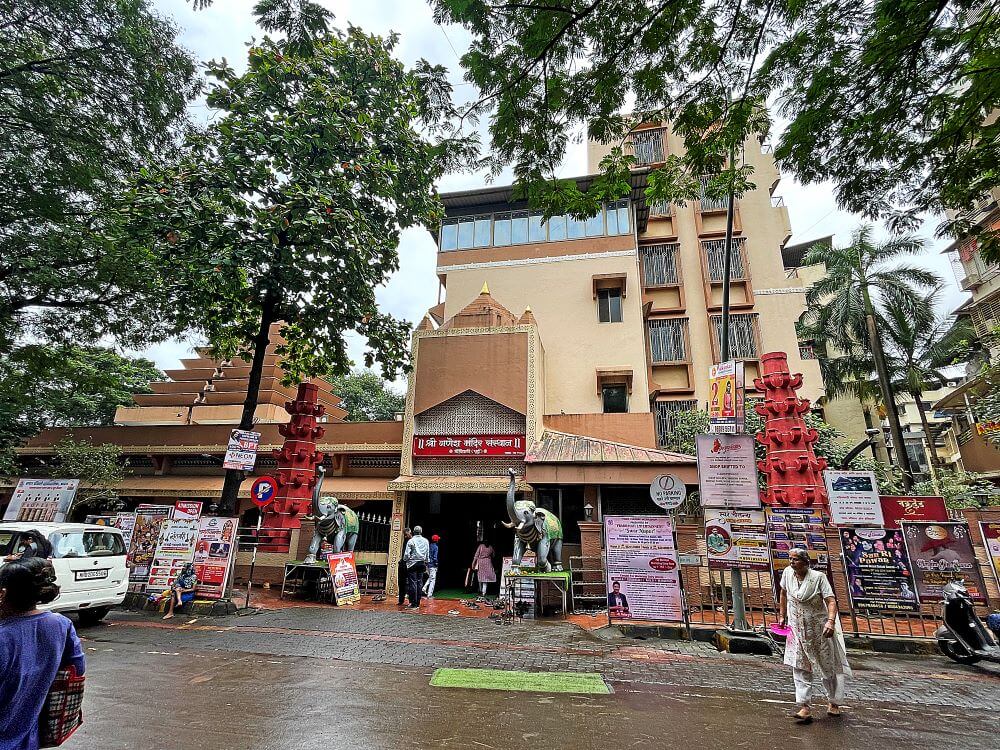
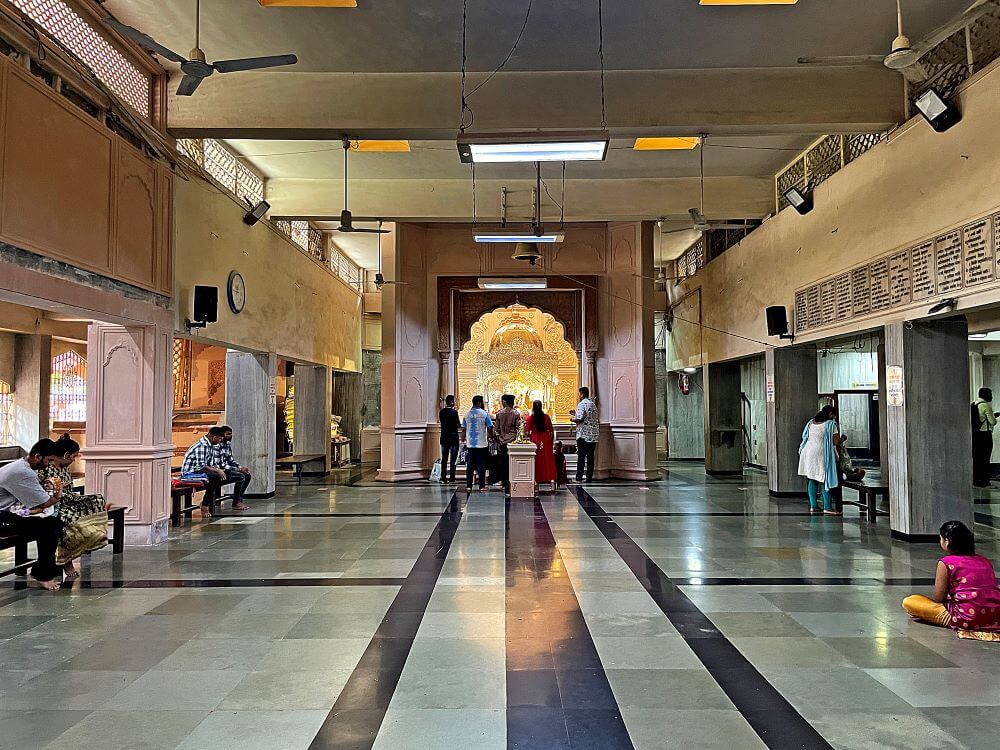
The temple is situated between Dombivli and Thakurli railway stations. The temple arch is along the road, and the spacious temple structure is on the left. The entire construction is in marble. Upon entering through the gate, one sees the ancient banyan tree and a grand ‘Deepmal’ (lamp tower) on the left. Benches have been provided in this area for devotees to sit. The design of the temple’s ‘Shikhara’ (spire) is entirely modern yet balances faith and sentiment. Its brass ‘Kalash’ (finial) was crafted in Nadiad, Gujarat.
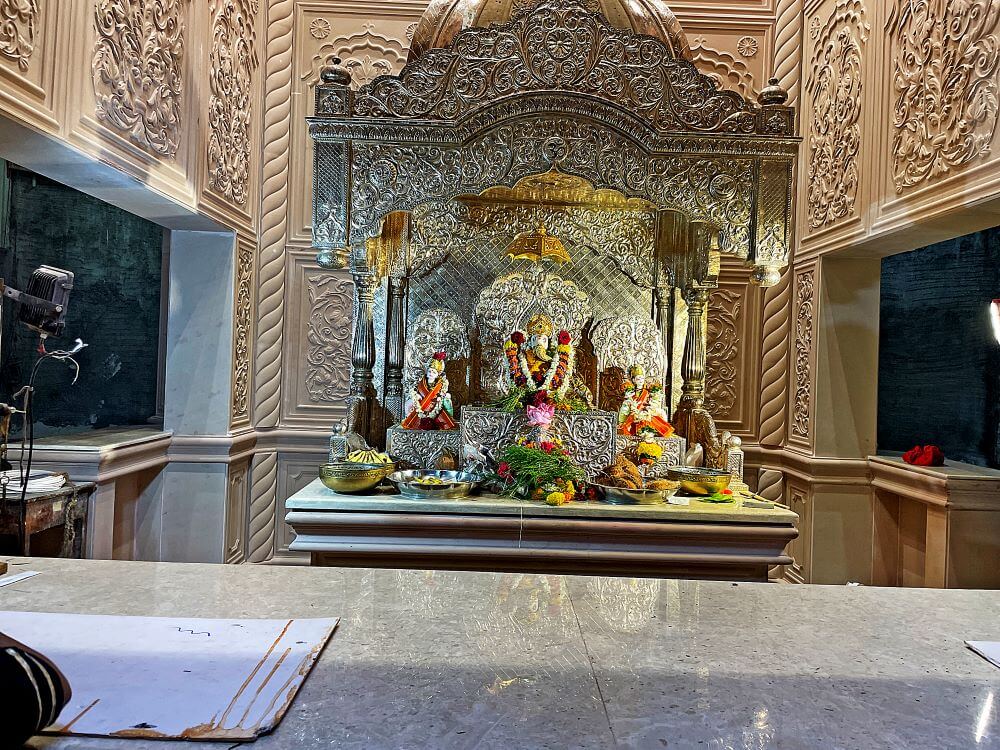
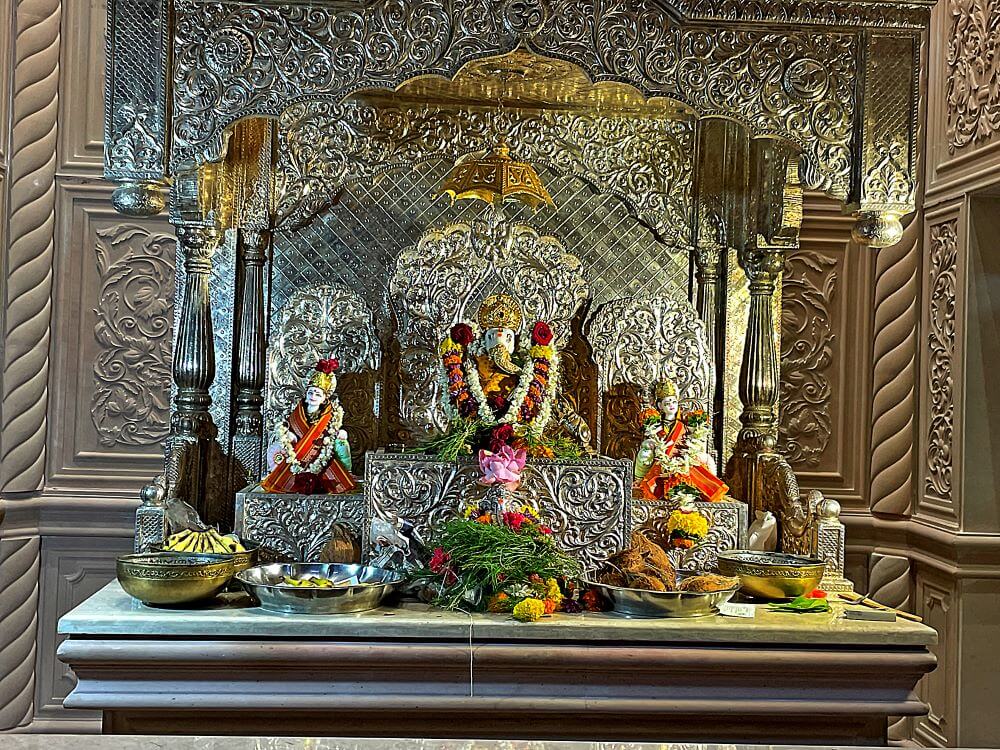
The temple is designed with a spacious ‘Sabhamandap’ (assembly hall) and a ‘Garbhagriha’ (sanctum sanctorum). Considering the number of devotees visiting, the Sabhamandap is designed to be open and well-ventilated. The pillars in front of the Garbhagriha have sculptures of ‘Dwarapalas’ (gatekeepers) on both sides. The ‘Mushakraja’ (the mouse, Ganesha’s vehicle) seated on the pedestal in front of the Garbhagriha holds a ‘Modak’. The original brass idol of the mouse is covered in gold leaf. The 30-foot-sized Garbhagriha has no pillars. Inside the Garbhagriha is a silver shrine with attractive carvings. In the center is a pleasant marble idol of the crowned Ganesha. The ‘Prabhaval’ (halo) behind it is also unique. Riddhi and Siddhi are seated beside Ganesha. These idols of Riddhi and Siddhi were consecrated here on June 30, 2024. These idols were brought from Jaipur. At Ganesha’s feet is the mouse, and in front of the main idol is a smaller idol of Ganesha.
On the circumambulation path of the Garbhagriha, there is a Shiva temple on the left. It contains a Shivalinga, and on the wall behind it is an idol of Annapurna. From the Shiva temple, one can reach the nearby Dattatreya shrine. The subsequent shrines contain idols of Vitthal-Rukmini, Shrikrishna, Durgamata, Shriram-Sita-Lakshman, and Maruti, respectively. A few steps away on the right is another vermilion-smeared idol of Maruti.
The temple holds ‘Kakad Aarti’ every morning at 6:00 AM. At 7:00 AM, ‘Abhishek’ and worship of all deities are performed. ‘Aarti’ takes place at 7:30 AM. From 8:00 AM onwards, Abhisheks registered by devotees are conducted. At 12:30 PM, the ‘Mahanivedya’ (grand offering) is presented to all deities. At 4:00 PM, discourses and ‘Kirtans’ by renowned speakers and Kirtankars are held. The evening Aarti is at 7:30 PM, and the ‘Shejarti’ (night prayer) is at 10:00 PM. For a fee, rituals and pujas such as daily Abhishek, Laghurudra, Sahasravartane, Satyanarayan Puja, Satyavinayak Puja, Sankalp Puja, and Vahan Puja are performed by Brahmins at the temple. Special Abhisheks are also performed on Sankashti Chaturthi, Angarki, Mahashivratri, Shravani Monday, Shravani Saturday, and various other festivals. Vishnu Sahasranama and Gita recitation are held on every Ekadashi. (Contact: Sansthan Office, Phone: 0251 2471167, 2473995)
Every Tuesday, the monthly Sankashti Chaturthi, and Angarki see a large crowd of devotees. Sankalp Abhisheks for devotees are performed on Sankashti Chaturthi. Festivals for every deity here are celebrated. The Ganesh Utsav began here in 1928, and the Mahalakshmi Utsav in 1952. During the Ganesh Jayanti festival, a ‘Mahapuja’ is held at 5:00 AM. The ‘Ganesh Yaga’ begins at 7:00 AM. The ‘Ganesh Janma’ (birth) Kirtan starts at 10:30 AM. On Gudi Padwa, after the Ganesh Puja in the morning, the ‘Panchang’ (almanac) is read. The ‘Palkhi’ (palanquin) procession leaves at 6:00 AM. On Ram Navami, the Mahapuja is held at 6:30 AM. The Ram Janma Kirtan is held after 10:00 AM. ‘Ram-naam’ chanting takes place in the evening. A ‘Deepotsav’ (festival of lights) is also held here every year on Tripurari Purnima.
The temple complex features a five-story administrative building. The first floor houses a meditation hall, a sonography center run by the Sansthan, the Lambodar Hall, and the Trustee meeting room. Various programs are held in the halls on the second, third, and fourth floors. The fifth floor contains the residence of the chief priest, guest accommodations, and residences for kirtankars and pravachankars. The temple Sansthan also conducts various social, cultural, educational, and medical initiatives. At the Shri Ganesh Ultrasound Sonography Center here, sonography services are provided at affordable rates. Blood donation camps are organized periodically by the Sansthan and through other organizations. The Sansthan provides financial assistance to economically weaker families in the city. Additionally, educational aid is provided to bright and needy students in the area. The temple Sansthan has also started classes for yoga, philosophy, astrology, Sanskrit, and Gita recitation.
A music festival is held here every year from December 28 to 31. During this time, many renowned singers perform their art. Patriotic songs are presented on December 31, accompanied by slide shows. During this festival, the younger generation is informed about the bravery of soldiers fighting at the borders. For newcomers in the field of music, a ‘Sangeet Seva’ program is conducted at the temple every Sunday. It has been running continuously for 37 years.
The Hindu New Year ‘Shobhayatra’ (procession), which is emulated in many cities across the state and even abroad, is a major attraction of Dombivli city. This procession was started in 1999 at the initiative of the temple Sansthan. This festival gradually took on a public form. On the eve of the Shobhayatra, fireworks are displayed in the city. On the morning of Gudi Padwa, after the worship of Lord Ganesha in the temple, the new year’s almanac (Panchang) is read. Thereafter, the Gudi is hoisted at the temple, and the Shobhayatra commences. Citizens in traditional attire participate in this procession, with a significant number of young men and women. Representatives of all spiritual and religious sects, all community organizations, and all social-service organizations in the city also participate in this Shobhayatra. To welcome the procession, rangolis are drawn at various places throughout the city. Participants dance to the rhythm of numerous vehicles, horses, bullock carts, floats, dhol-tasha, lezim, and cymbals. Demonstrations of dandpatta and swordsmanship are also performed. Many people carry saffron flags, palanquins, and images of various saints. A social message is conveyed through this Shobhayatra every year. Different troupes present performances based on that theme. Previously, social messages on topics such as the environment, organ donation, eye donation, and water conservation have been conveyed in this procession. Devotees can have darshan of Lord Ganesha in this temple daily from 6:00 AM to 1:30 PM and from 2:30 PM to 10:00 PM.
This sacred temple stands as a testament to deep spiritual devotion, ancient architectural grandeur, and rich local cultural traditions.
The sanctum sanctorum houses the divine idol consecrated according to ancient Vedic traditions, surrounded by serene courtyards and traditional temple architecture.
Navratri, Maha Shivratri, Annual Temple Jatra & Deepotsav
Compare and book flights, secure top-rated local hotels near the temple, hire reliable guides, and rent cars instantly.
Extend your pilgrimage by visiting other highly sacred temples located nearby.

Add ₹999 more to unlock FREE SHIPPING!
Your sacred cart is currently empty.
Shop Photo FramesFill in your delivery details below to place your order.
Add comment