
Add ₹999 more to unlock FREE SHIPPING!
Your sacred cart is currently empty.
Shop Photo FramesVashishtha, Vishwamitra, Kashyapa, Bharadwaja, Atri, Jamadagni, and Gautam are known as the ‘Saptarishi’ (the seven great sages). The legends and mythological tales associated with Gautam Rishi are deeply intertwined with folk life. These stories have become a part of folk culture through traditional folk songs. Near the village of Asarkheda in the Badnapur taluka of Jalna district, there is an ancient and famous temple dedicated to Gautam Rishi. Highlighting the glory of the Vedic era, this temple upholds the customs and traditions of the Warkari sect, which rejects caste discrimination. It is the firm belief of devotees that visiting this sacred site, sanctified by the touch of Gautam Rishi’s feet, fulfills all desires.
Although the temple has been renovated in modern times, legends suggest that this site is thousands of years old. According to mythological references, Gautam Rishi performed long penance in this region, which was known as ‘Dandakaranya’ during the Vedic period. Consequently, this area is uniquely recognized as a ‘Tapobhumi’ (land of penance). A legend connecting Gautam Rishi’s era to the time of the Ramayana is famous here. According to this story, Indra, the King of the Gods, set his eyes on Ahilya, the wife of Gautam Rishi. With the intention of possessing Ahilya, Indra created a magical rooster. The rooster crowed in the middle of the night, creating the illusion of dawn. Thinking it was morning, Gautam Rishi went to the river for his daily ablutions. Taking this opportunity, Indra assumed the form of Gautam Rishi, entered the hermitage, and seduced Ahilya.
Upon reaching the riverbank, the Rishi realized it was not yet dawn. The river goddess told him not to touch the water and sent him back. Gautam Rishi immediately returned to the hermitage, where he found his wife Ahilya and Indra together. Enraged, he cursed Indra to be covered in a thousand marks (yoni). He also cursed his wife Ahilya to turn into stone, under the misconception that she had violated her vow of chastity. Later, Ahilya was liberated from this curse by the touch of Lord Shriram’s feet. Another significant connection to the Ramayana period is that Gautam Rishi’s son, Shatanand, was the chief priest of King Janaka of Mithila.
The story of the origin of the Godavari or Gautami River is also linked to Gautam Rishi. Once, Gautam Rishi inadvertently committed the sin of killing a cow (Gohata). He was advised that the water of the celestial Ganga was necessary for his atonement. Accordingly, Gautam Rishi installed a Shiva Linga at Trimbakeshwar and began rigorous worship of Lord Mahadeva. Pleased by his devotion, Mahadeva brought the celestial Ganga to Earth in the form of the Godavari River. After bathing in the waters of this river, Gautam Rishi was absolved of his sins. It is said that Gautam Rishi composed many important hymns and chapters in the Vedas. Specifically, Gautam Rishi and his descendants, such as Rahugana, are explicitly mentioned as the seers of many hymns in the first and fourth Mandalas of the ‘Rigveda’.
Beyond mythology, his literary legacy is considered historically significant. The origin of the ‘Nyaya Darshana’ (School of Logic) in Indian philosophy is attributed to Gautam Rishi. By composing the famous ‘Nyaya Sutras’, he laid the foundation for logic and epistemology. For this reason, he is also known as ‘Akshapada Gautam’. Additionally, he authored the ‘Gautam Dharmasutra’, which is considered a vital foundation of ancient Indian jurisprudence and codes of conduct. This text is regarded as the oldest among the four major available Dharmasutras. It contains direct historical references to human duties, rules for kings, sacraments, and the social system of that time.
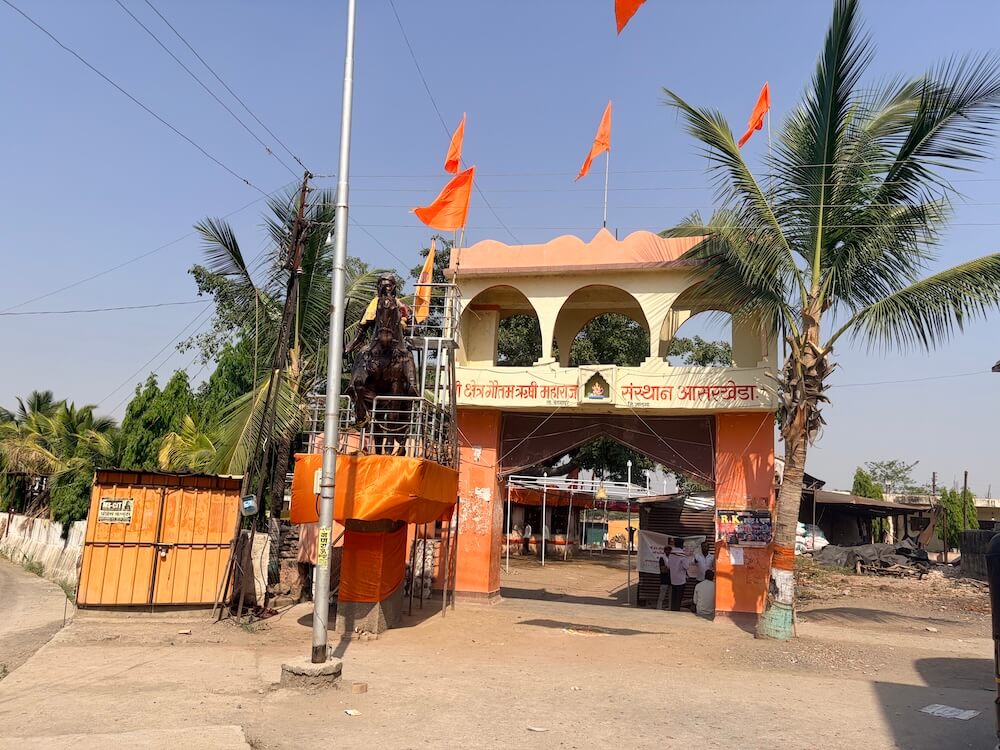
There is a paved road leading to the entrance of this temple, located a short distance from Asarkheda village. The entire temple is enclosed by a stone fortification, which features a two-story entrance gate. A nagarkhana (drum house) is constructed on the upper floor of the gate. The roof of the entrance is adorned with three dome-shaped spires. An equestrian statue of Chhatrapati Shivaji Maharaj is installed on a high pedestal in front of the entrance.
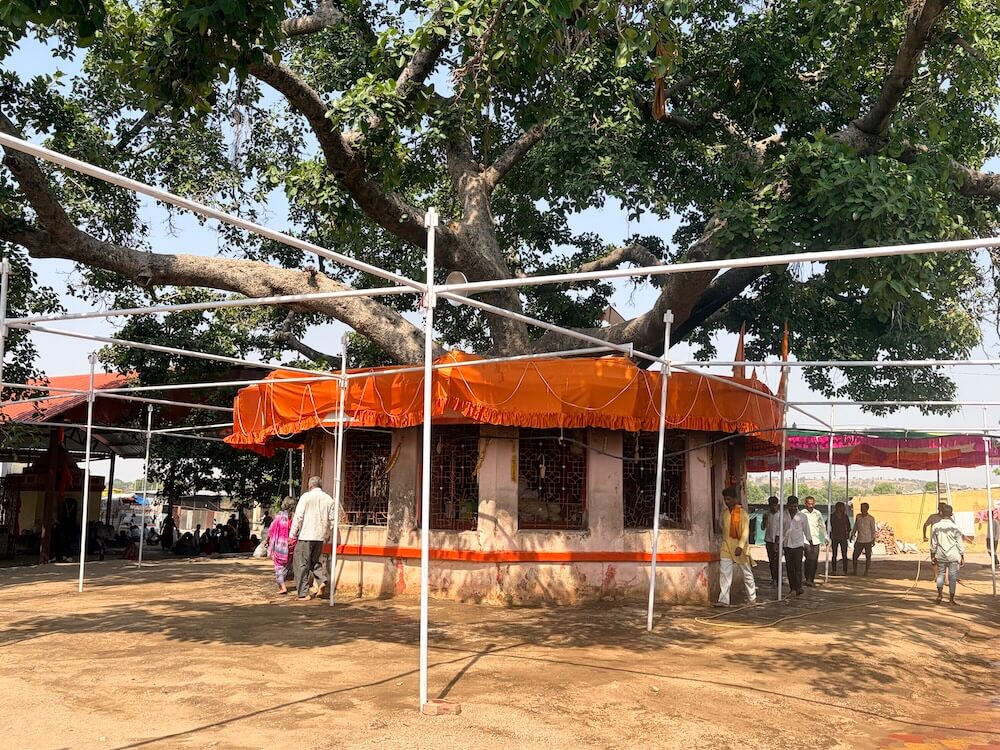
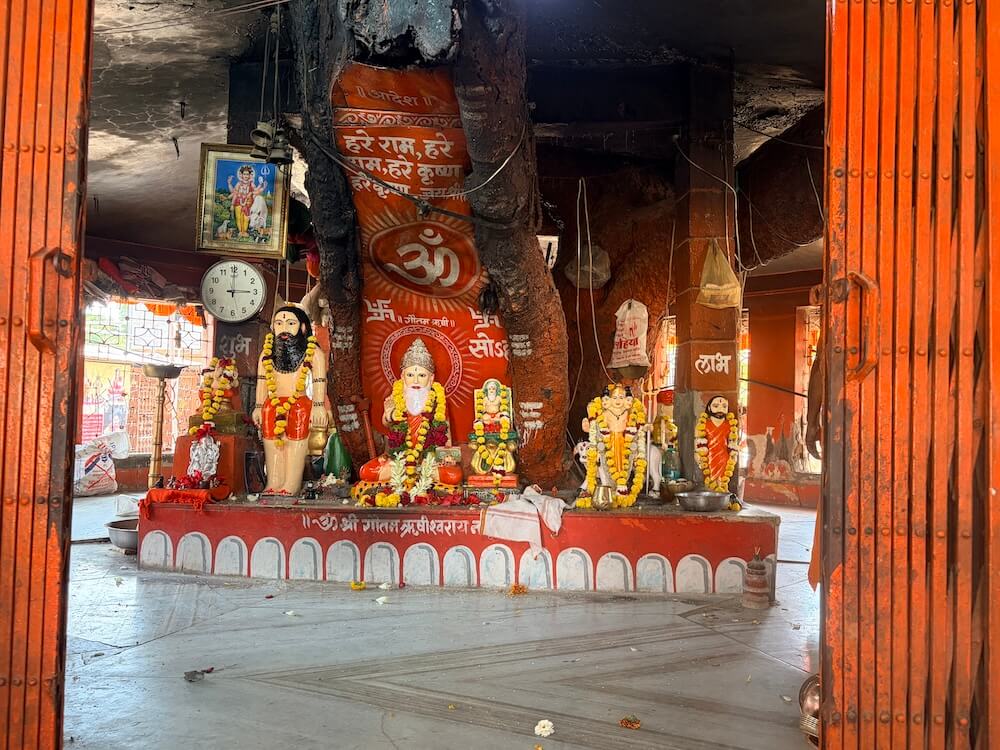
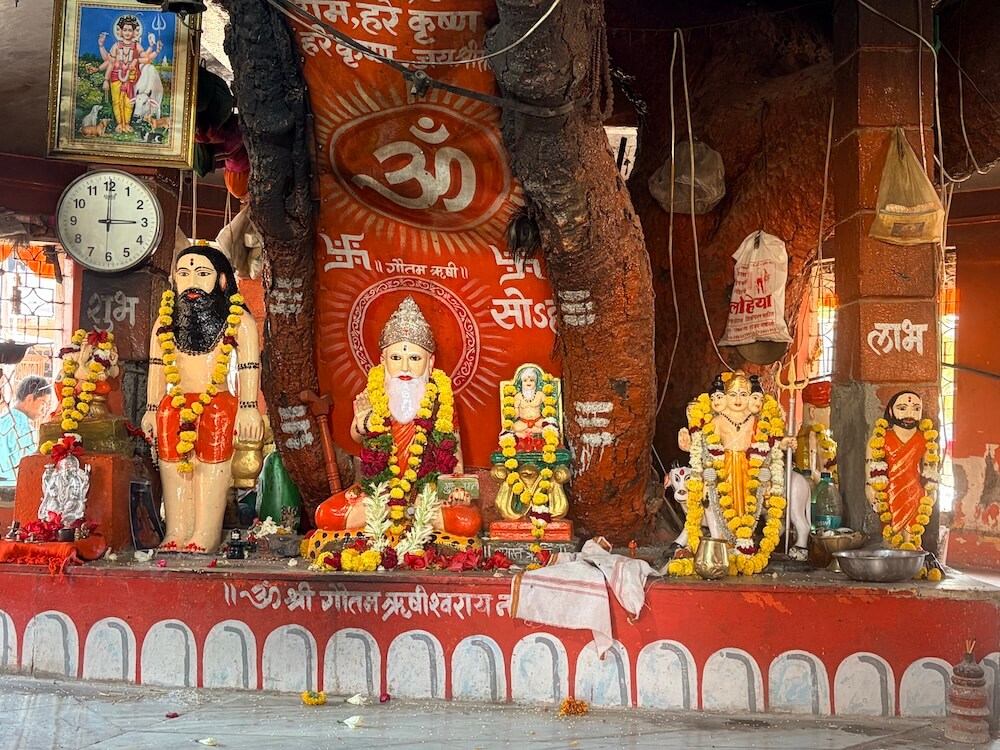
The temple is structured with a Sabha Mandap (assembly hall) and a Garbhagriha (sanctum sanctorum). A railing is built on the outer side of the semi-open Sabha Mandap. Brass bells offered by devotees hang from the ceiling of the hall. Iron meshes are installed between the railing and the ceiling, making the Sabha Mandap secure and enclosed. Beyond the Sabha Mandap, an Antarala (vestibule) has been created using iron grilled partitions. Further ahead lies the octagonal Garbhagriha of the temple. Inside this sanctum stands a massive, centuries-old banyan tree. It is said that Gautam Rishi used to sit under this very tree to perform his penance. A large platform has been built around this tree, on which idols of Gautam Rishi, Dattatreya, Samarth Ramdas Swami, and other deities are installed. The roof of the Garbhagriha is kept open on one side, allowing the banyan tree to grow directly upward through it. A circumambulation path (Pradakshina Marg) has been created around the exterior of the temple. The lush green branches of the banyan tree form a natural spire over the roof of the Garbhagriha.
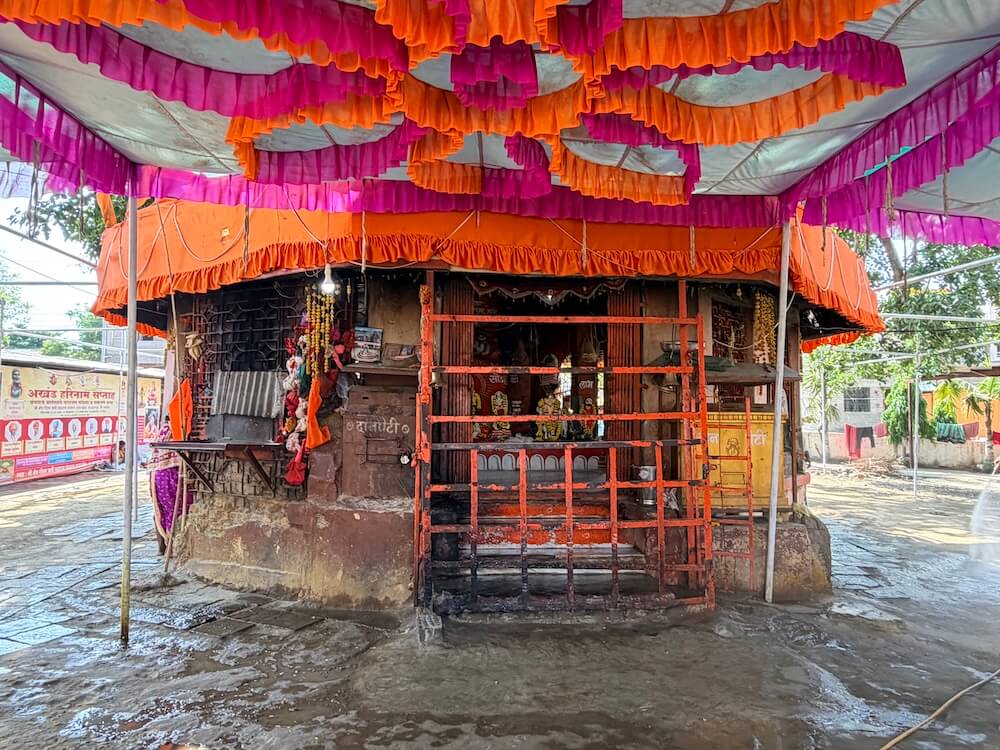
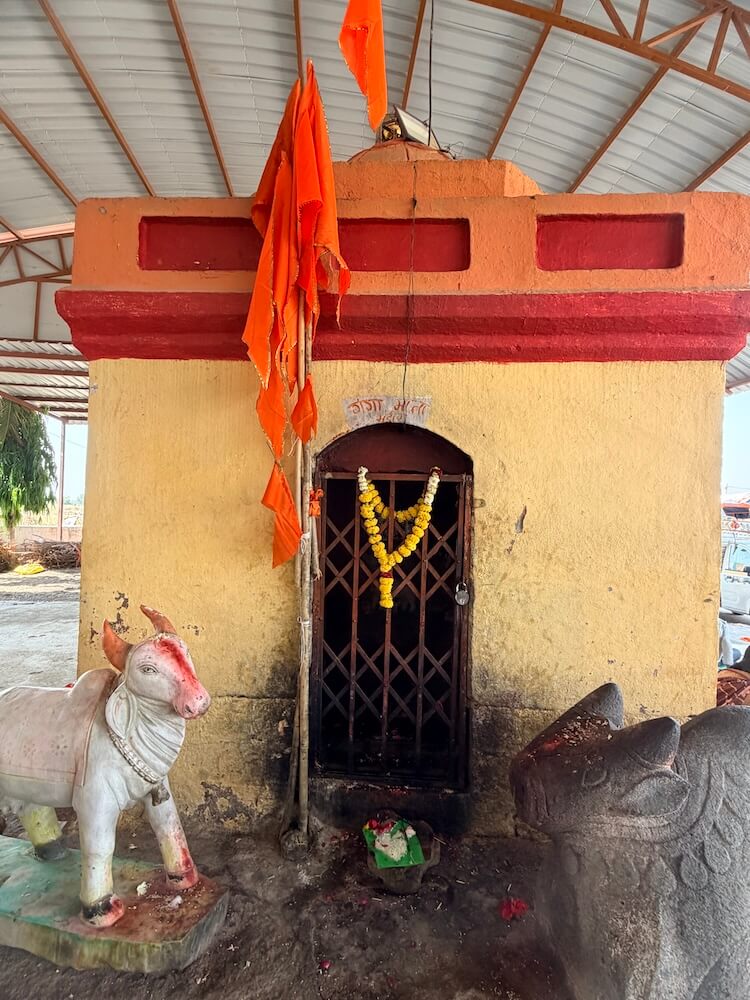
Near the temple, within the courtyard, is a small temple dedicated to Santoshi Mata, housing her idol. Adjacent to the Santoshi Mata temple is the Ganga Mata temple, built in a similar style. Next to the Ganga Mata temple is the Shani Dev temple. The temple premises include a trust office, priests’ residences, a food distribution center (Annachhatra) for devotees, and a hall for cultural programs.
Bhadrapada Shukla Panchami, known as Rishi Panchami, is celebrated as the annual festival here. A large fair is held in the temple premises during this time. Additionally, a seven-day ‘Harinam Saptah’ is organized from Phalguna Vadya Ashtami to Gudi Padwa. During this week, renowned kirtankars and bhajan singers from the region perform bhajans and kirtans. Throughout this period, continuous community meals (Mahabhog) are provided for devotees. On every full moon (Purnima) and new moon (Amavasya), the temple is crowded with devotees. Festivals like Gudi Padwa, Hanuman Jayanti, Ram Navami, Sharadiya Navratri, Dussehra, and Diwali are all celebrated here with great devotion. Thousands of devotees from the surrounding areas visit during these times. The temple remains open 24 hours a day for devotees to offer their prayers.
This sacred temple stands as a testament to deep spiritual devotion, ancient architectural grandeur, and rich local cultural traditions.
The sanctum sanctorum houses the divine idol consecrated according to ancient Vedic traditions, surrounded by serene courtyards and traditional temple architecture.
Navratri, Maha Shivratri, Annual Temple Jatra & Deepotsav
Compare and book flights, secure top-rated local hotels near the temple, hire reliable guides, and rent cars instantly.
Extend your pilgrimage by visiting other highly sacred temples located nearby.


Add ₹999 more to unlock FREE SHIPPING!
Your sacred cart is currently empty.
Shop Photo FramesFill in your delivery details below to place your order.
Add comment