
Add ₹999 more to unlock FREE SHIPPING!
Your sacred cart is currently empty.
Shop Photo FramesThe village of Kharosa in the Nilanga taluka of Latur district is famous for its historical caves. The temple of Renuka Devi is situated in the area above these caves. The Renuka Mata here is considered a vibrant manifestation of the Renuka Mata of Mahur, which is one of the three and a half Shakti Peethas of the Goddess. It is a place of faith for countless devotees in the region. Scholars estimate that this rock-cut temple was built after the creation of the Kharosa caves. According to local legend, the Renuka Devi here was established by Mother Sita.
Latur district has a very ancient history. Evidence suggests that human existence here dates back to the Paleolithic age, about three lakh years ago. In ancient times, this city was known by names such as ‘Lattalur’ or ‘Lattanur’, ‘Lattalaur’, and ‘Ratanpur’. The text ‘Anguttara Nikaya’ mentions that there were sixteen Mahajanapadas in the south during the Mauryan period. The ‘Ashmaka’ or ‘Assaka’ or ‘Andhaka’ Mahajanapada was one of them. Latur was included in the part of the Ashmaka Mahajanapada known as ‘Kuntal’ in the south. Over time, this part of Latur came under the rule of the Satavahanas, Vakatakas, and Rashtrakutas. A unique feature of this district is that it is the ancestral home of the Rashtrakuta dynasty that ruled over Maharashtra.
Latur was also ruled by the Chalukyas of Badami. According to some historians, the Latur-Bidar region was referred to as ‘Chalukya Desh’, and from this, the dynasty in Badami came to be called ‘Chalukya’. The Chalukyas of Badami were great patrons of architecture. According to the Latur District Gazetteer, the Kharosa caves were excavated during their period. This period dates from the sixth to the eighth century AD. The greatest feature of these caves is that there are caves related to Hindu, Buddhist, and Jain religions in one place. An ancient mention of Kharosa village is also found in the text ‘Kalpasamuh’. In this Marathi text composed by the Muslim author Said Muhammad during the Yadava period, ‘Kharose’ is mentioned as a place useful for the science of alchemy (Rasavidya). ‘Rasavidya’ was the science of transforming base metals like iron into gold through a specific process on mercury and making the body immortal with medicines made from mercury. Said Muhammad has mentioned many places of the Yadava period that were important in the context of this science, and Kharose village is included among them. This highlights the importance of this place.
In the tradition of Shakti Peethas in Maharashtra, Mahalakshmi of Kolhapur, Tuljabhavani of Tuljapur, and Renuka of Mahur are considered the three complete Peethas, while Saptashrungi of Vani is considered a half Peetha. According to the stories in the ‘Devi Bhagavata’ and ‘Skanda Purana’, when Lord Shiva carried the mortal remains of Sati on his shoulders and performed the Tandava dance, Vishnu’s Sudarshan Chakra cut Sati’s body into pieces, which fell at various places on Earth. Sati’s head fell at Mahurgad. Therefore, this place is known as a vibrant Shakti Peetha. Renuka Devi is also addressed by various names such as Yamai, Ekvira, and Yallamma. The local legend of the Renuka Devi temple at Kharosa is that Lord Rama stayed in this area during his exile. At that time, Sita established Renuka Devi here. To support this legend, a place on the hilltop of Kharosa is shown as ‘Sita’s Bathing Place’ (Sitechya Nhani).
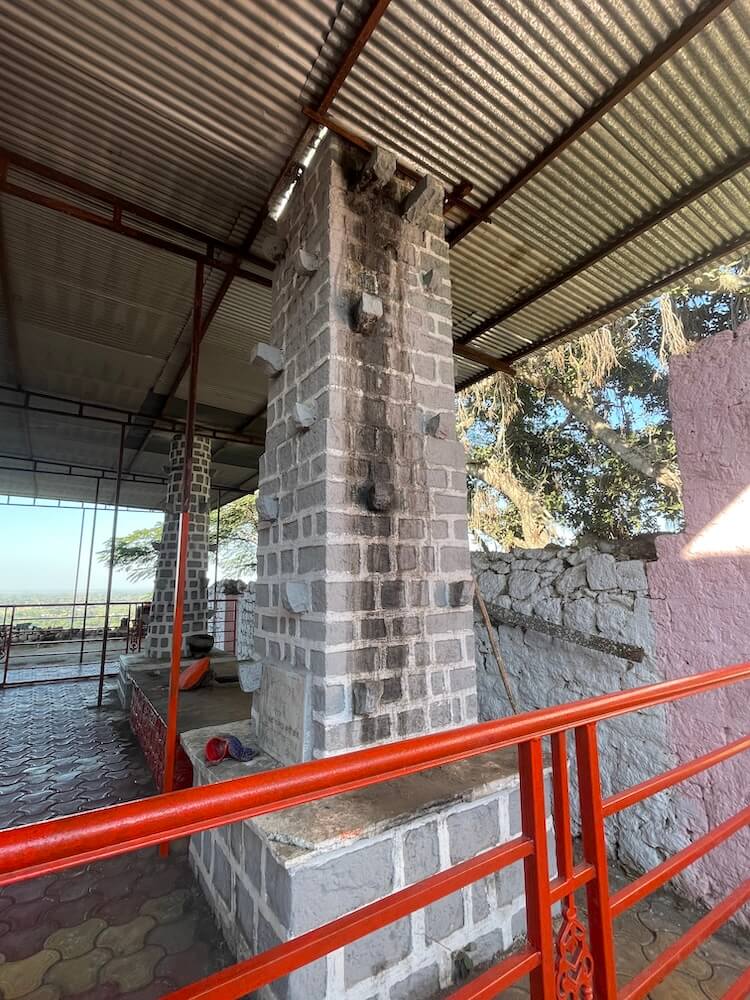
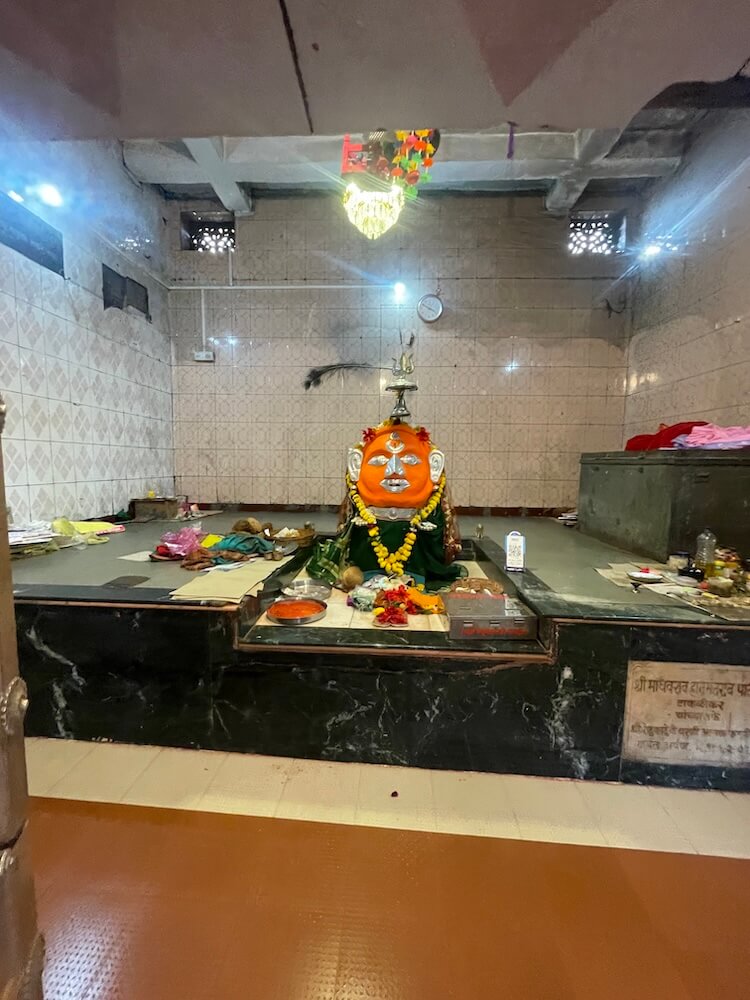
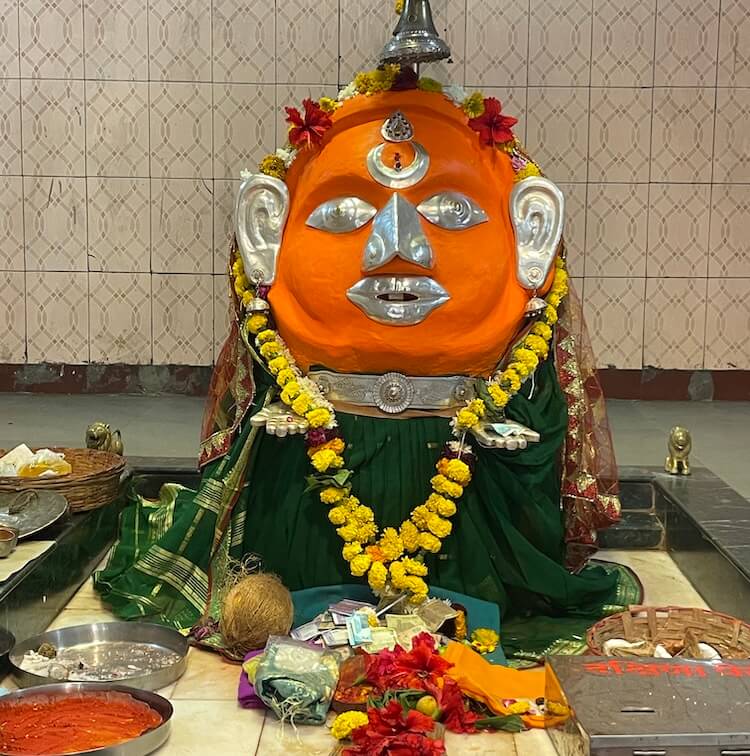
There is a stone perimeter wall around the Goddess’s temple, which has an old-style entrance gate. One enters the courtyard through this gate. In the courtyard, there is a Tulsi Vrindavan and two ancient stone lamp pillars (Deepmalas). Directly in front of them is a newly constructed spacious and open assembly hall (Sabhamandap). One enters the assembly hall of the temple by climbing six steps. The sanctum sanctorum of Renuka Devi is located in this assembly hall. Since its door is low in height, one has to bow down to enter. Inside, the self-manifested (Swayambhu) idol of Renuka Mata is installed on a Vajrapitha. On this circular stone, which has the shape of the Goddess’s face, silver nose, ears, eyes, and lips have been attached. The Goddess is adorned with vermilion (Shendur) and ornaments. There is a spire in modern architectural style above the sanctum sanctorum of the temple.
Various religious ceremonies take place in the temple throughout the year. The Navratri festival is the main celebration among them. During Navratri in the month of Ashwin, a grand festival is celebrated here for nine days. Every day, special decoration and worship of the Goddess are performed. On the day of Vijayadashami (Dussehra), the ceremony of Seemollanghan is celebrated with great enthusiasm. A large fair (Yatra) of the Goddess is held on Chaitra Purnima. At this time, thousands of devotees from the surrounding area come for Darshan. Various cultural programs are presented on the occasion of the fair. At this time, the Chhabina, i.e., the palanquin procession of the Goddess, is taken out. Mahaprasad is organized for the visiting devotees. In the month of Shravan, there is a rush of women to perform the ‘Oti Bharne’ ritual every Tuesday and Friday. Devotees can take Darshan in this temple from 6:00 AM to 1:30 PM and from 4:00 PM to 8:30 PM.
This sacred temple stands as a testament to deep spiritual devotion, ancient architectural grandeur, and rich local cultural traditions.
The sanctum sanctorum houses the divine idol consecrated according to ancient Vedic traditions, surrounded by serene courtyards and traditional temple architecture.


Navratri, Maha Shivratri, Annual Temple Jatra & Deepotsav
Compare and book flights, secure top-rated local hotels near the temple, hire reliable guides, and rent cars instantly.
Extend your pilgrimage by visiting other highly sacred temples located nearby.


Add ₹999 more to unlock FREE SHIPPING!
Your sacred cart is currently empty.
Shop Photo FramesFill in your delivery details below to place your order.
Add comment