
Add ₹999 more to unlock FREE SHIPPING!
Your sacred cart is currently empty.
Shop Photo FramesThe Swaminarayan Temple in Sankari, Bardoli Taluka, Surat District, is one of the renowned temples of the Bochasanwasi Akshar Purushottam Swaminarayan Sanstha (BAPS). Often referred to as the “Mini Akshardham”, this magnificent temple, built in pink sandstone, is a stunning blend of spirituality, art, and cultural heritage. Its awe-inspiring architecture, serene surroundings, and vibrant community make it a must-visit destination for devotees and tourists alike. Every full moon day (Purnima), more than 7,000 devotees visit the temple for the darshan of Lord Swaminarayan.
Swaminarayan is a prominent religious sect founded by Swami Sahajanand, originally named Ghanshyam Pande. Born in 1781 in Chhapaiya near Ayodhya in Uttar Pradesh, he renounced worldly life at the age of twelve and spent seven years travelling across India, including a spiritual retreat in the Himalayas. During this time, he was known as Neelkanth Varni. In 1800, he received initiation from Swami Muktanand in Mangrol, Saurashtra, and later from Guru Ramanand in Piplana. He chose Gujarat as the centre of his religious and social reform activities, promoting a harmonious spiritual path based on the teachings of Ramanujacharya’s Vishishtadvaita philosophy and Vallabhacharya’s Shuddhadvaita philosophy.
Ramanand gave Neelkanth Varni the name Sahajanand, and in 1801, he succeeded Ramanand as the head of the sect. Sahajanand Swami extensively spread the Swaminarayan Mahamantra and established the worship of Swaminarayan, regarded as an incarnation of Lord Krishna. Devotees believe Sahajanand Swami was a divine incarnation. In 1820, Sahajanand himself revealed six reasons for his incarnation to Gopalanand Swami. After Sahajanand’s demise in 1830, the sect’s leadership passed to Gunatitanand Swami. In 1905, Shastriji Maharaj (Shastri Yagnapurushdas) established the Bochasanwasi Akshar Purushottam Swaminarayan Sanstha (BAPS) within the sect, laying the foundation for its expansive reach. Today, Mahant Swami Maharaj is the sixth spiritual leader (aacharya) of this lineage.
The first BAPS Swaminarayan Temple was constructed in Bochasan in 1907. Since then, BAPS has established numerous temples worldwide, including the Akshardham Temple in New Delhi, which holds a Guinness World Record as the largest Hindu temple in the world. Spanning 100 acres along the Yamuna River, Akshardham is a marvel of architecture. BAPS operates 150 shikharbaddha (traditional spired) temples and over 1,700 smaller temples globally, many built under the guidance of Pramukh Swami, the sect’s fifth spiritual leader. Sankari Temple is one such temple.
According to the history of this temple, a Sankari resident and BAPS follower, Somabhai, dreamt of building a grand temple in his village. Yogiji Maharaj granted permission to construct the temple and install idols. However, Yogiji Maharaj passed away in January 1971 before the temple was completed. Pramukh Swami, his successor, was entrusted with the installation of the idols of Akshar Purushottam and Lakshmi Narayan. During his visit to Sankari, Pramukh Swami inspired thousands of tribal people to overcome addictions and superstitions, laying the groundwork for the temple’s expansion. The temple’s foundation stone was laid on 15 January 1996, and construction was completed within five years. Pramukh Swami inaugurated the temple on 18 May 2001.
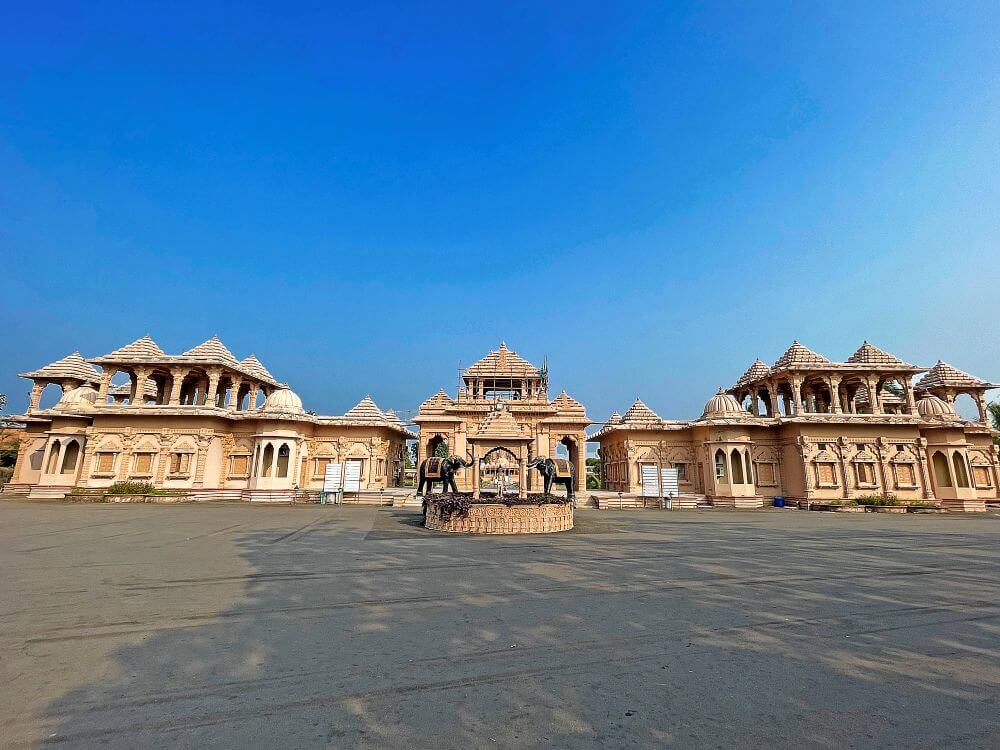
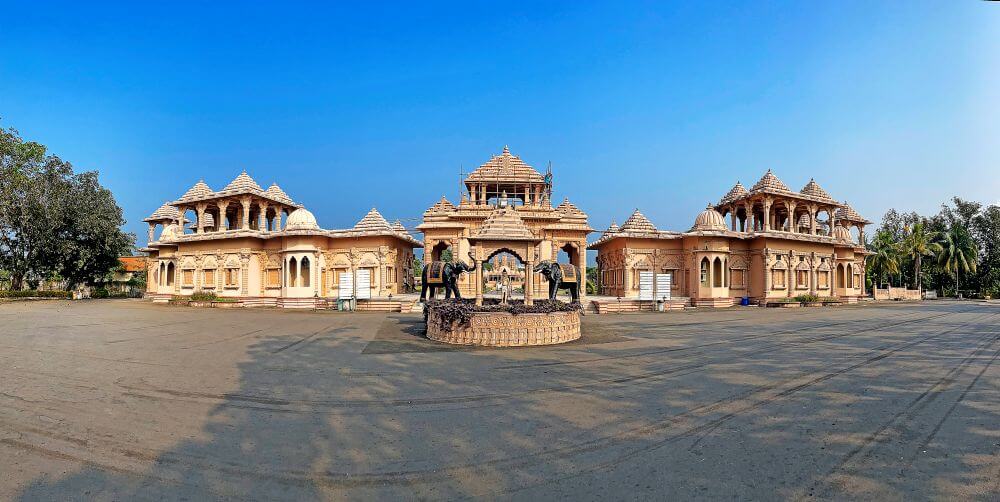
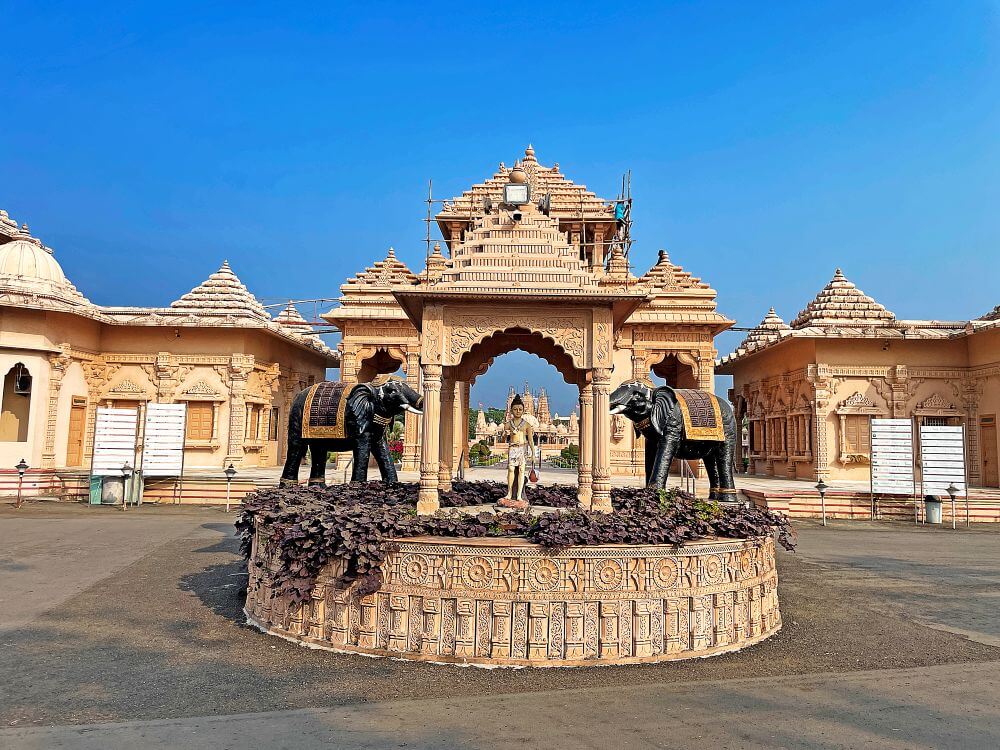
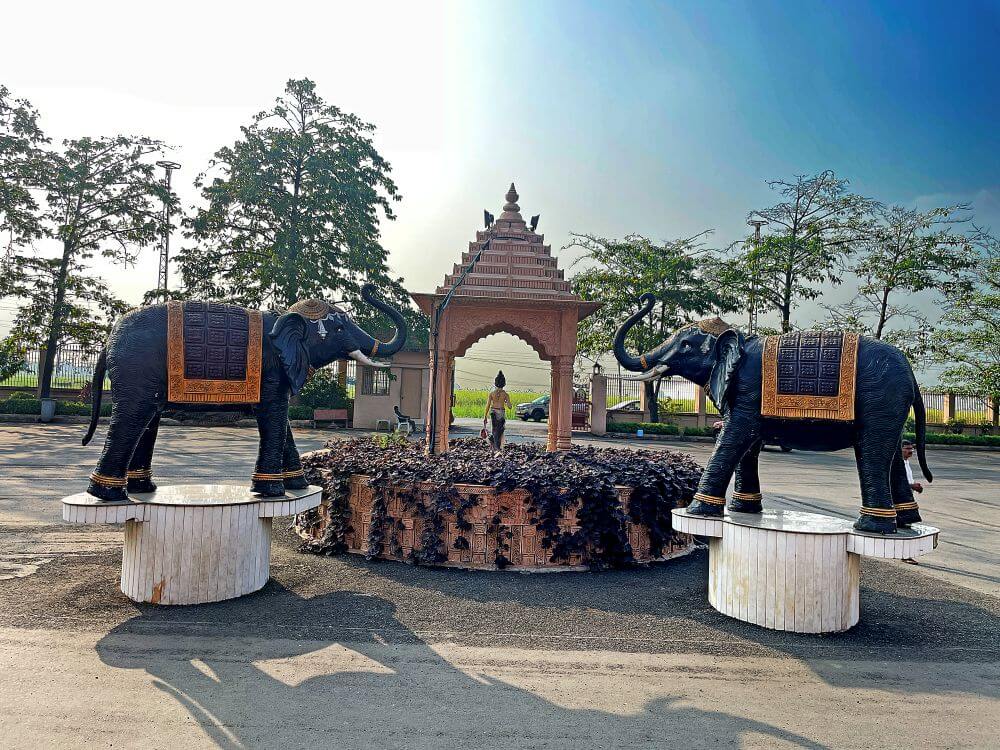
Situated 8 km from Bardoli, the temple’s grandeur is evident as one approaches its palace-like structure with a grand entrance. The temple, built using red-pink sandstone, features domes and pyramid-shaped spires, and tall columns, hinting at the magnificence within. At the entrance, a circular pavilion houses a beautiful idol of Neelkanth Varni in his youthful form, holding a rosary in one hand and a kamandalu (water vessel) in the other. Behind this idol are two majestic elephant sculptures.
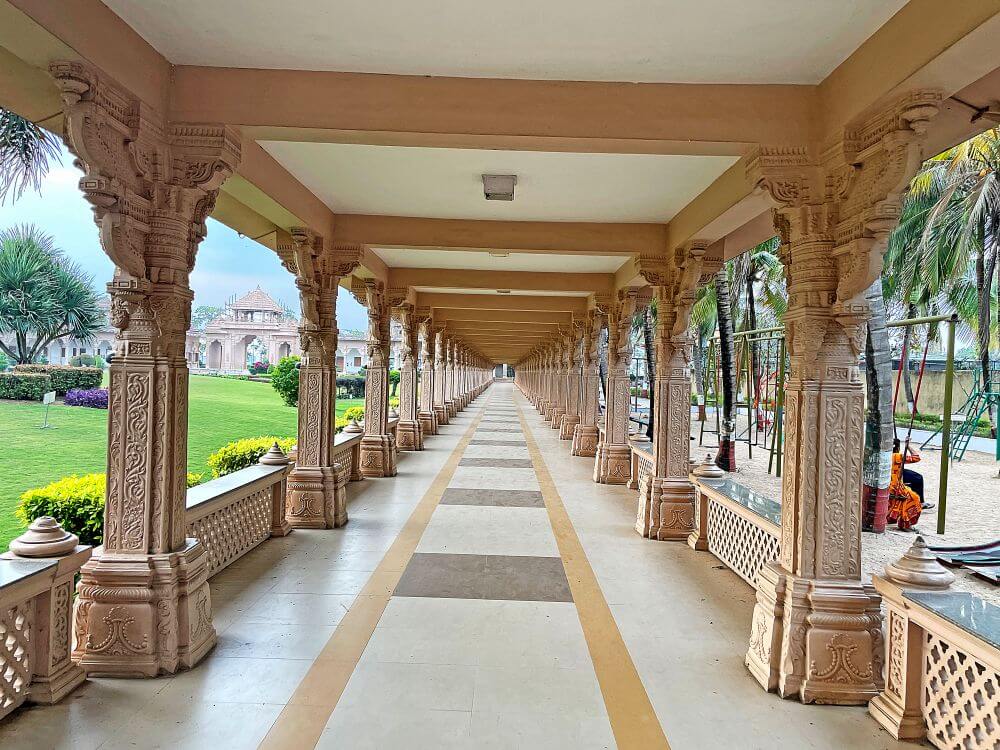
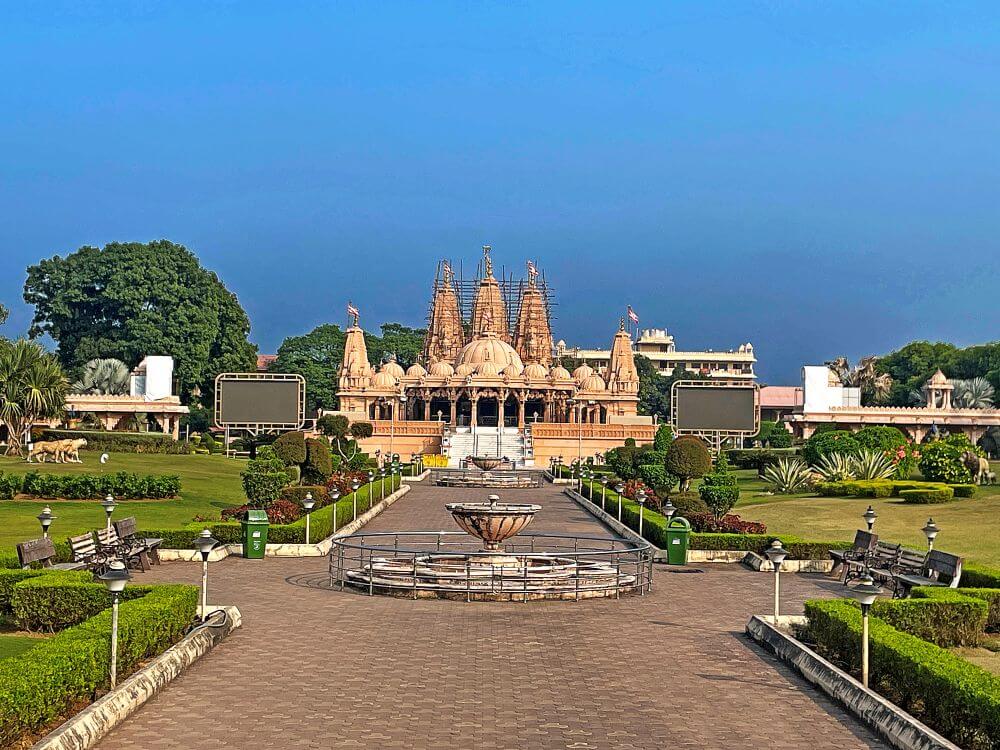
Passing through the grand entrance, a paved pathway with fountains leads to the temple. Both sides of the path feature lush gardens adorned with lifelike statues of animals and birds, including lions, tigers, deer, and rabbits. Surrounding the temple on three sides is a covered walkway with decorative domed pavilions.
The temple itself is built on a raised platform accessible via 15 steps. At the base of the steps, a square fountain features large padukas (sacred footprints) of Swaminarayan. On either side of the courtyard are two temples—one dedicated to Ram Panchayatana and the other to Shiva Panchayatana. At the centre stands the Swaminarayan Temple, comprising a mukhmandapa (front porch), sabhamandapa (assembly hall), an antarala (inner sanctum), and four sanctums housing deities.
The temple spans 196 feet in length, 135 feet in width, and rises to a height of 65 feet. It features five tall spires, 15 domes, 84 intricately carved pillars, 100 ornamental arches (makara toranas), and 290 statues of various deities, saints, and acharyas. Every pillar is richly adorned with carvings and arches. The open sabhamandapa is surrounded by mukhmandapas, whose outer pillars are decorated with sculptures of celestial maidens in various postures. The pillars and ceiling of the sabhamandapa are intricately carved with depictions of Swaminarayan saints and devotees, including Gopalanand Swami, Shastri Maharaj, Yogi Maharaj, Pramukh Swami Maharaj, Vijnandas Swami, Jaga Swami, Purushottam Swami of Khandesh, Bhagat Maharaj, Ayodhyaprasad Maharaj, Muktanand Swami, Vijnananand Swami, Ardeshar Kotwal, Bhaktaraj Parvatbhai, Devanand Swami, Nirgun Swami, Mulji Brahmachari, Achityanand Brahmachari, Bhalchandra Sheth, Bhaktaraj Dadakhavar. These saints are celebrated for their significant contributions to the Swaminarayan tradition, their spiritual teachings, and their devoted service to the community. Their inclusion in the temple’s carvings signifies their revered status within the faith.
The central sanctum houses the idols of Bhagwan Swaminarayan and Gunatitanand Swami, both depicted in a blissful standing posture on a high marble pedestal, framed by a golden ornate arch. The adjacent sanctums enshrine idols of Harikrishna Maharaj, Narayan Bhagwan, Lakshmi Mata, Ghanshyam Maharaj, Shastriji Maharaj, and Yogiji Maharaj. All idols are adorned with elegant garments and jewellery. Behind the temple is an Abhishek Mandap (ritual ablution pavilion) dedicated to Neelkanth Varni and shrines of Bhagwan Swaminarayan, Bhagatji Maharaj, and Jnanjivandas Maharaj.
The outer walls of the sanctum feature carvings of deities like Vitthal-Rukmini, Ganesh, Kuber, Shani, the Dashavatara (ten incarnations of Vishnu), and saints like Tukaram and Chaitanya Mahaprabhu. The main temple features three towering spires (shikhars) constructed in the Nagara style with the Urushringa design. In this architectural style, smaller spires of the same type are built or carved along the base of the central tall spire, giving it a layered appearance. The Ram Panchayatan and Shiv Panchayatan temples within the temple complex also showcase tall spires built in the Urushringa design, maintaining architectural harmony. The Sabhamandap (assembly hall) and Mukhamandap (entrance hall) are crowned with domed spires (ghumatakar shikhars). These spires are adorned with Amalakas (circular, notched stone discs) at their base and Kalashas at the top. Adding to the elegance, the corners of the temple roofs are decorated with small elephant figurines (gajaraj) symbolising prosperity and strength, a characteristic element of this architectural grandeur.
This sacred temple stands as a testament to deep spiritual devotion, ancient architectural grandeur, and rich local cultural traditions.
The sanctum sanctorum houses the divine idol consecrated according to ancient Vedic traditions, surrounded by serene courtyards and traditional temple architecture.
Navratri, Maha Shivratri, Annual Temple Jatra & Deepotsav
Compare and book flights, secure top-rated local hotels near the temple, hire reliable guides, and rent cars instantly.
Extend your pilgrimage by visiting other highly sacred temples located nearby.


Add ₹999 more to unlock FREE SHIPPING!
Your sacred cart is currently empty.
Shop Photo FramesFill in your delivery details below to place your order.
Add comment