
Add ₹999 more to unlock FREE SHIPPING!
Your sacred cart is currently empty.
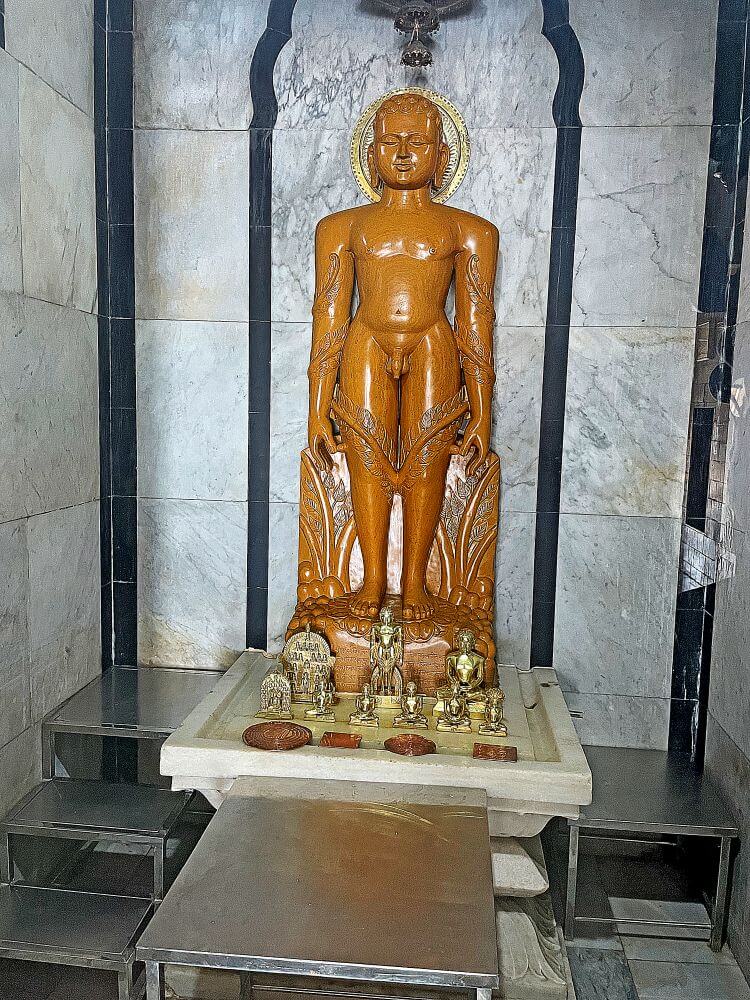
Shop Photo FramesKnown since ancient times as a land of penance for Jain ascetics, ‘Atishay Kshetra Bahubali’ is revered as a sacred pilgrimage site by followers of the Jain Dharma. At this very place on Kumbhojgiri, approximately three hundred and fifty years ago, the Jain ascetic Bahubali Maharaj from Nandre village performed severe austerities. Due to his miraculous powers, this kshetra became known as ‘Atishay Kshetra Bahubali’. This sacred place is also known across the nation and abroad as the ‘Mini Shatrunjay’ of South India. With a history spanning about eight hundred years, this site houses a magnificent and captivating twenty-eight-foot-tall idol of Bhagwan Bahubali.
As per the Jain spiritual tradition, Bhagwan Bahubali was the son of Bhagwan Rishabhnath, the first Tirthankara of the Jains. According to the renowned scholar of Hindu scriptures and Puranas, and English author, Shri Devdutt Pattanaik, Rishabhnath, also known as Rishabhdev, was a mighty emperor. He had एकशे पुत्र and दोन daughters. Before renouncing worldly life, Rishabhdev bestowed एकशे kingdoms upon his sons. To his daughters, Brahmi and Sundari, he imparted the arts of writing and counting. His eldest son was King Bharat, after whom our sacred land came to be known as Bharat. King Bharat was destined to be appointed as the emperor. However, his brothers found it unacceptable to remain as his feudatories. Therefore, they renounced their respective thrones and embraced asceticism. Yet, one of King Bharat’s brothers did not follow suit. His name was Bahubali.
Thus, Bharata declared war against Bahubali. However, to avert needless bloodshed, it was decided that these brothers should resolve the matter through a duel. In this duel, Bahubali proved to be the stronger. Just as he was about to deliver the final blow to Bharata and vanquish him, he attained self-realisation. He then He thought, “What shall I gain by defeating my elder brother?” and thus he ended the war. He renounced worldly life and departed to the forest for performing austerities. Standing in one place, he commenced his spiritual practice. He lost all awareness of the world. His body-consciousness faded away. The clothes on his body became tattered and fell off. Ants and snakes began to crawl upon his body. Vines entwined themselves around his feet. Yet, he did not open his eyes. For twelve years, he performed penance. However, in his mind, there was the egoistic thought, “I am performing austerities; I have become enlightened.” Finally, one day, his sister came to meet him. Seeing him, she said, “Descend from the elephant.” That single sentence removed the last impediment from his mind, and he attained Nirvāṇa.
In Shravanabelagola, Karnataka, there stands a colossal fifty-seven-foot-tall idol of Bhagwan Bahubali. At the left foot of this sacred image, there is an inscription in the Marathi language. It reads, ‘श्री चावुंडराजें करवियलें श्रीगंगराजे सुत्ताले करवियले’ (Shree Chavundarajen karaviyalen Shree Gangaraaje suttale karaviyale). This means that this divine form of Bahubali was sculpted by Chavundaraya, also known as Chamundaraya, and King Ganga constructed the enclosure around it. Gangārāja was a king of the Western Ganga dynasty in Karṇāṭaka, and Chāvuṇḍarāya was his commander and chief minister. It is said that he consecrated this idol in the year ९८१ CE. The sculptor of this idol, renowned as Gomaṭeśvara Bāhubali, was Ariṣṭa Nemi. A replica of this very idol can be seen at Kumbhoj.
The history of this sacred place recounts that from the eighth century onwards, it was known as a land of penance for Jain ascetics. Here, Munishri एकशेआठ Bahubali Maharaj, from Nandare in Miraj Taluka, used to perform austerities. The legend about him states that he was a perfected being (siddhapurusha) and possessed knowledge of mantra-vidya. Consequently, the wild animals in the forest on this hill never troubled the devotees who came here. The sacred footprints (charanachinhe) of Bahubali Maharaj are installed at this very spot. There are also records of Prabhachandra Muni having performed penance here in one thousand आठशे एक्कावन्न C.E., and Kamalakara Muni in one thousand आठशे अठ्ठावन्न C.E. In the Cāturmāsa of nineteen twenty-seven, Ācārya Śāntisāgara Mahārāja resided here according to the Jain tradition.
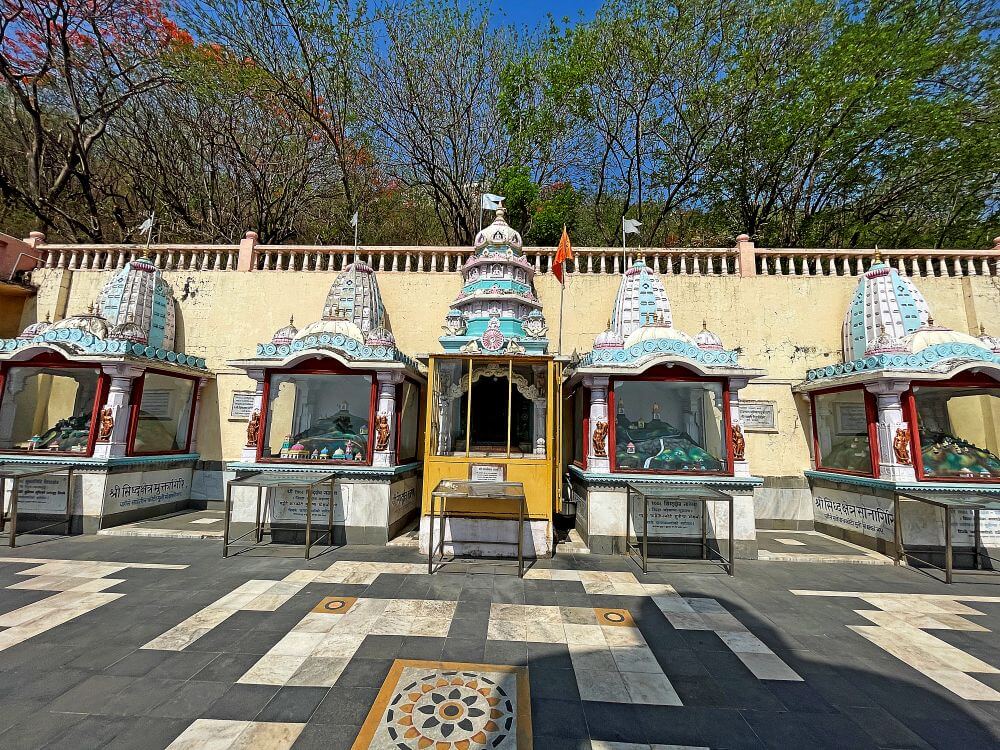
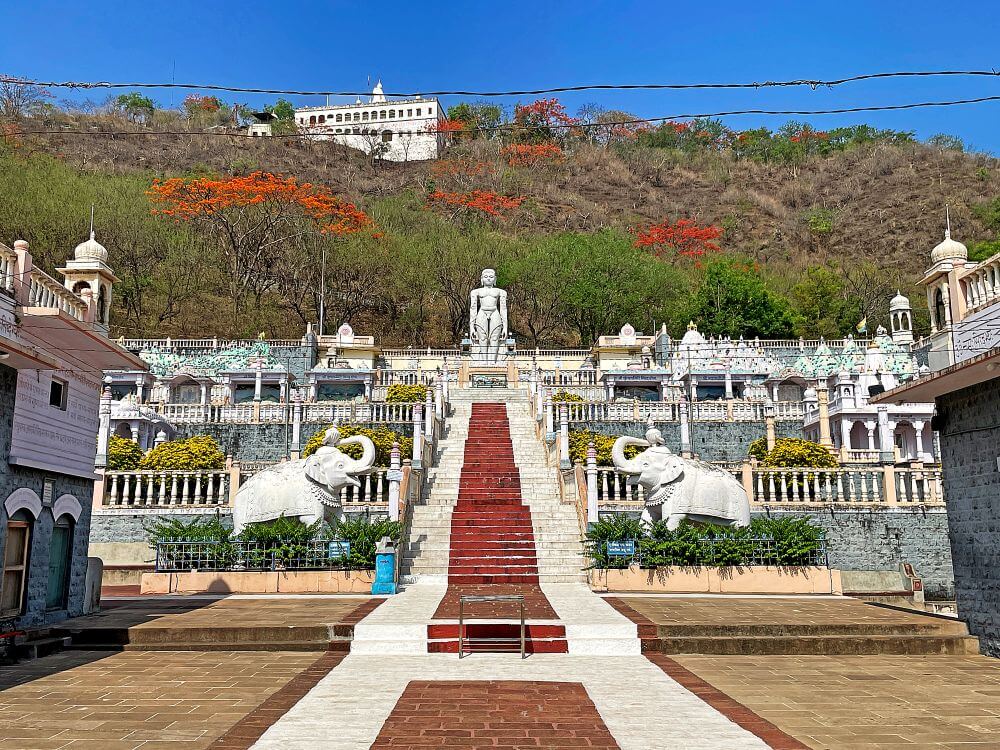
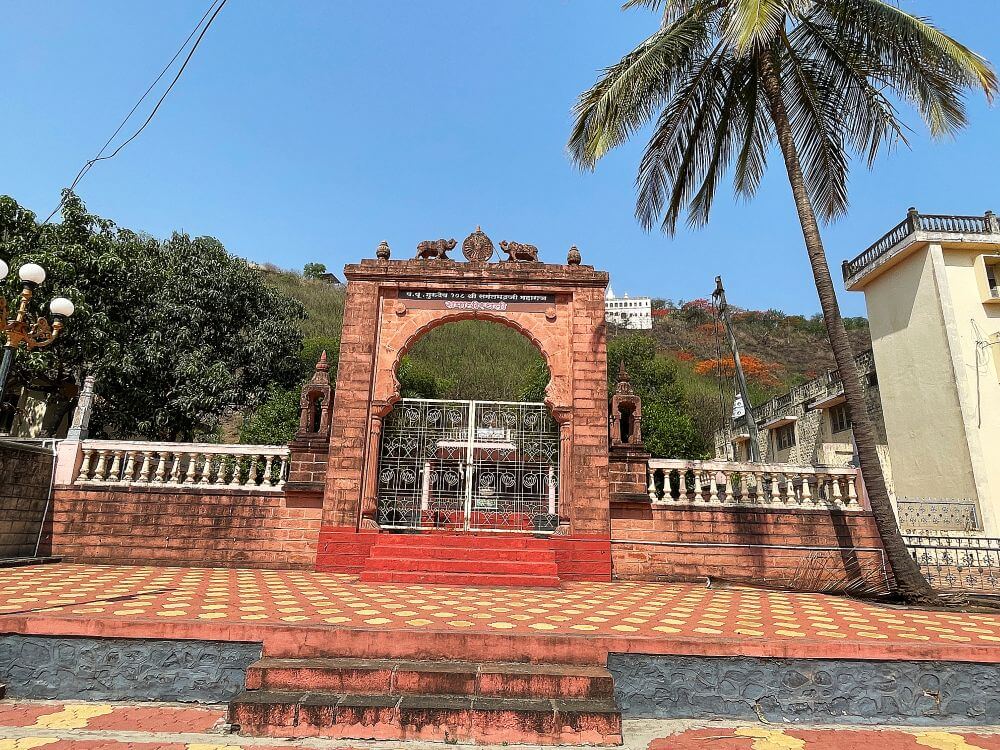
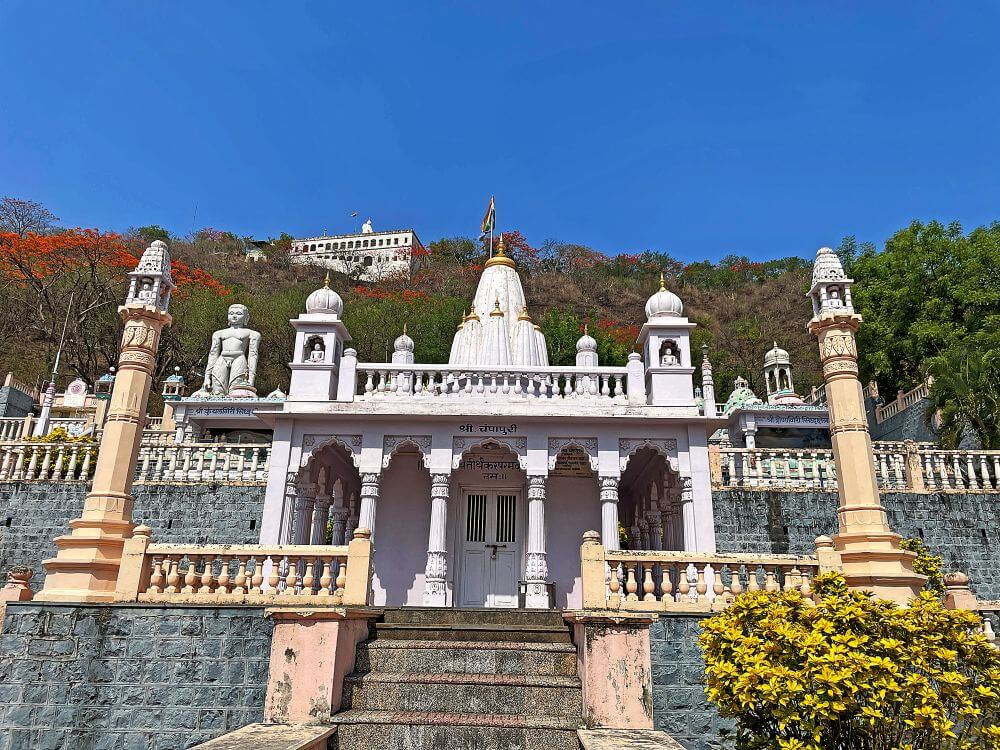
The Bahubali Mandir, approximately आठशे years old, is situated on a hillock at the entrance of Kumbhoj village. Below this temple, on the slope of the hill, the grand idol of Bahubali was consecrated in एकोणीसशे त्रेसष्ट, and the Bahubali Tirthakshetra was established in एकोणीसशे त्र्याऐंशी. One enters this sacred space through the main entrance, which is slightly elevated from the ground. From here, the twenty-आठ-foot-tall idol of Bhagwan Bahubali immediately captivates the gaze. One can reach this idol by ascending approximately पन्नास steps from the entrance. On both sides of this stairway, at the beginning, are sculptures of elephants with raised trunks, welcoming devotees. In the upper section, replicas of many Siddhakshatras have been erected. These include Shri Shatrunjay, Rajagrihi, Siddhavar, Kundalgiri, Kunthalgiri, Badwaniji, Khandgiri Ji, Dronagiri, Mangitungi, Muktagiri, Gajpanth, Taranga, Sonagiri, and Pavagiri.
The grand idol of Bahubali Bhagwan is of a pristine white hue. At the base of the idol, there are distinctive sculptures of a cow and a tigress. In this depiction, the cow is suckling the tigress’s cub, and the tigress is suckling the cow’s calf. Adjacent to this magnificent idol are replicas of Sammed Shikhar Teerthdham, Ashtapad / Kailasgiri Siddha Kshetra, and Shrut Sanvardhak Girnar Siddha Kshetra. In the year एक हजार नऊशे चौऱ्याऐंशी, inspired by Acharya Vidyanand Muniraj, the ancient Jinālayas, or Jain temples, here were renovated. This sacred site at Kumbhojgiri has been honoured by the Government of Maharashtra, which has bestowed upon it the ‘B’ class status of a pilgrimage centre. This is an important religious tourism destination for Jains in Hatkanangale Taluka. Devotees visit here in large numbers every day.
This sacred temple stands as a testament to deep spiritual devotion, ancient architectural grandeur, and rich local cultural traditions.
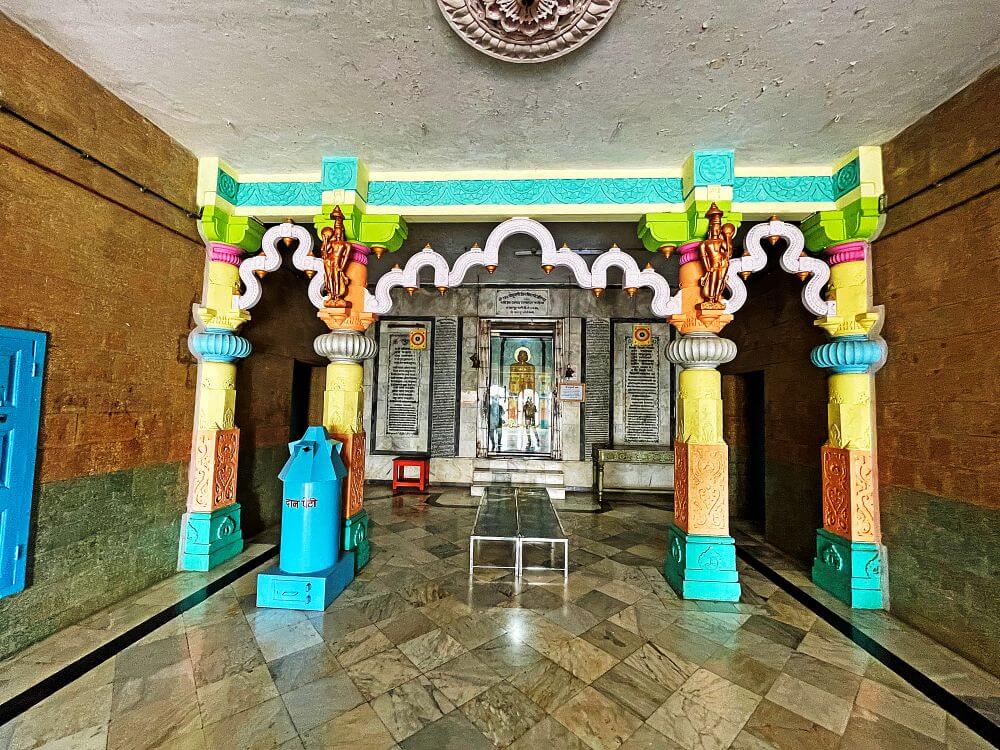
The sanctum sanctorum houses the divine idol consecrated according to ancient Vedic traditions, surrounded by serene courtyards and traditional temple architecture.
Navratri, Maha Shivratri, Annual Temple Jatra & Deepotsav
Compare and book flights, secure top-rated local hotels near the temple, hire reliable guides, and rent cars instantly.
Extend your pilgrimage by visiting other highly sacred temples located nearby.


Add ₹999 more to unlock FREE SHIPPING!
Your sacred cart is currently empty.
Shop Photo FramesFill in your delivery details below to place your order.
Add comment