
Add ₹999 more to unlock FREE SHIPPING!
Your sacred cart is currently empty.
Shop Photo FramesAmong the few sacred shrines of Dattatreya on the Narmada parikrama-route, the renowned pilgrimage centre at Bhalod holds a distinguished place. Situated upon the banks of the Narmada, this temple enshrines an ancient 12th-century idol of Ek-mukhi (single-faced) Dattatreya. Carved from a monolithic shaligram (sacred black stone), the idol’s unique iconography reveals a gomukha (cow’s mouth) upon its chest. This sacred image was discovered in the depths of the Narmada river by a couple during their pilgrimage. A notable chapter of its history is that after residing in Vadodara for many years, the deity returned to its permanent abode on the riverbank after a span of 165 years. Today, it draws hundreds of parikramavasis (circumambulating pilgrims) and devotees of the Datta sampradaya (sect) alike.
On the extensive Narmada parikrama path, temples dedicated to Dattatreya are few enough to be counted on one’s fingers; these include the shrines at Jabalpur, Hoshangabad, Garudeshwar, Rajghat and Bhalod. Of these, the temples at Rajghat in Madhya Pradesh and Bhalod are situated on the southern bank of the river. While the worship of this deity dates back to the Puranic era, the Datta sampradaya witnessed widespread propagation due to the advent of Shri Narasimha Saraswati, the second incarnation of Dattatreya, who lived between 1378 and 1458 CE. In the Guru Charitra, composed around 1548 CE (Shaka 1470) by Saraswati Gangadhar, the Lord is envisioned in a tri-mukhi (three-faced) form. This trinity-based representation is also found in the arati (devotional hymn) ‘Trigunatmaka Traimurti’ composed by Saint Eknath (1523–1599 CE). However, in ancient iconography, Dattatreya is traditionally depicted as Ek-mukhi.
According to the descriptions in the ‘Shandilyopanishad’, Dattatreya, like Vishnu, possesses four arms and a single face. He is described as having a majestic stature with a complexion like the ‘indraneela’ (sapphire), embodying a serene and Shiva-swaroop (auspicious) essence. He is an ‘Avadhuta Digambara’, his body smeared with sacred ash and his hair matted. The ‘Dattatreyopanishad’ similarly describes him as a four-armed, single-faced manifestation of Vishnu. In the ancient ‘Agni Purana’, his form is depicted with the left foot resting on Shesha (the celestial serpent), the right foot on the back of a tortoise, two arms and Goddess Lakshmi (Shri) seated upon his left thigh. Among the earliest historical devotees of Dattatreya, Changdev Raul (1150–1220 CE) worshipped the Ek-mukhi form. The great devotee Dasopant (1551–1615 CE) revered a six-armed Ek-mukhi form, holding a conch, discus, damaru (drum), trident and kamandalu (water pot), adorned with rudraksha beads. This copper idol was famously painted by Dasopant upon a ‘pasodi’ (a long piece of cloth). It measures forty feet in length and four feet in width. Upon this expansive canvas, Dasopant composed a collection of sixteen hundred ovis (devotional verses) on spirituality—rendered through intricate pictorial illustrations. Furthermore, Narayan Maharaj Jalwankar of Jhansi (1793–1868 CE), a disciple of Niranjan Raghunath (the author of ‘Svatmaprachiti’ and ‘Sakshatkara’), received a divine vision of Dattatreya on Mount Girnar. The self-manifested idol he installed at Dewas too is six-armed and single-faced. Both Rajghat and Bhalod on the southern bank of the Narmada continue this tradition of Ek-mukhi Dattatreya worship.
The ancient idol at Bhalod is fashioned from a monolithic shaligram sourced from the Gandaki River in Nepal. Legend has it that approximately 200 years ago, a couple surnamed Nirkhe from Vadodara were performing the Narmada parikrama. While bathing in the river near the Danteshwar Mahadev temple, just before Mandavgad, they discovered this idol. They brought it to Vadodara and ceremoniously installed it in their home in Rokadnath Lane, opposite the Gandhinagar Hall. The couple’s son, Sadashivrao, had a daughter, Kashibai, who remained unmarried solely to serve this holy image throughout her life. However, upon reaching the age of eighty-five, she found herself unable to continue her dedicated service with the same devotion and strength. She therefore decided to offer the image to a worthy devotee of Dattatreya.
One night Dattatreya appeared to Kashibai in a divine vision and said, “Tomorrow, give me to the devotee who arrives from the Narmada bank.” Sharadchandra Pritape Maharaj, a deeply devoted follower of Vasudevanand Saraswati (Tembe Swami) happened to visit Vadodara for some work. There he learnt of this sacred image and went for its darshan. Kashibai asked him first, “Have you come from the bank of the Narmada?” When he replied in the affirmative, she told him reverently, “The Lord wishes to come to you,” and entrusted the idol to his care.
Originally from Karanja village in Amravati, Sharadchandra Pratape Maharaj was a journalist by profession. Educated in Nagpur, he served as the editor for the Nagpur edition of the Dainik Deshdoot and the Solapur edition of Tarun Bharat. Between 1986 and 1989, he completed the Narmada parikrama on foot twice before embracing sannyasa (renunciation). After spending time at the ashram of Rangavadhuta Maharaj in Nareshwar and at Aranyeshwar, he arrived in Bhalod. When he returned to Bhalod carrying the idol given by Kashibai, the question arose as to where and how to consecrate it. At that time, near the present temple, beside the Krishna Temple, four brothers owned land and they willingly offered a portion for the temple. Upon this land, in 1995, the idol of Dattatreya was ceremonially consecrated.
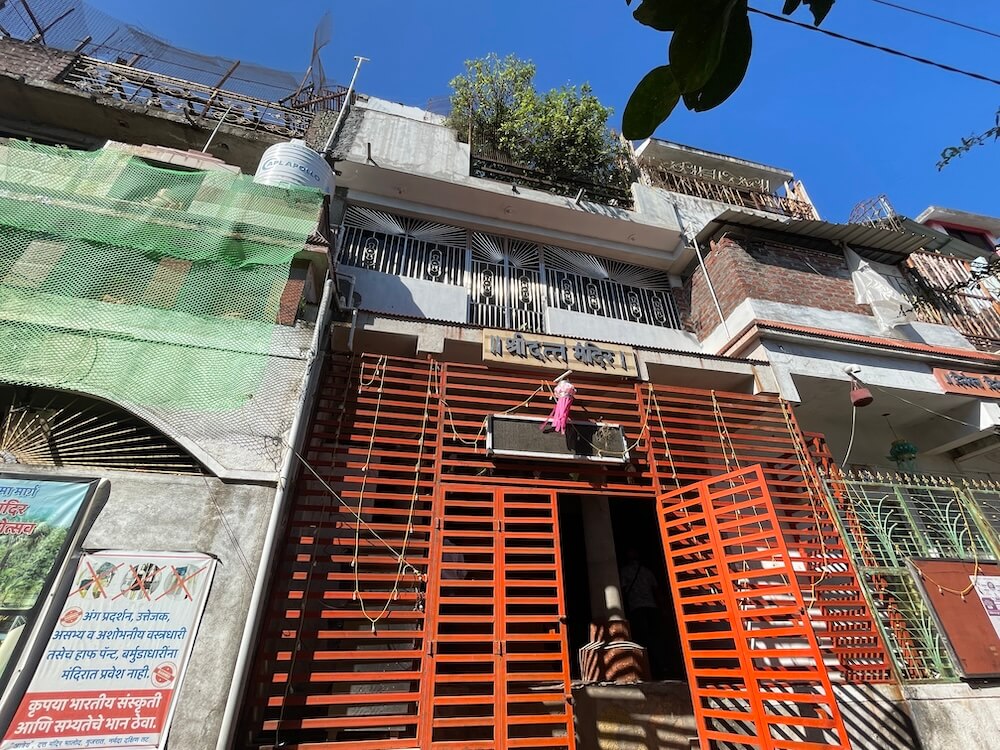
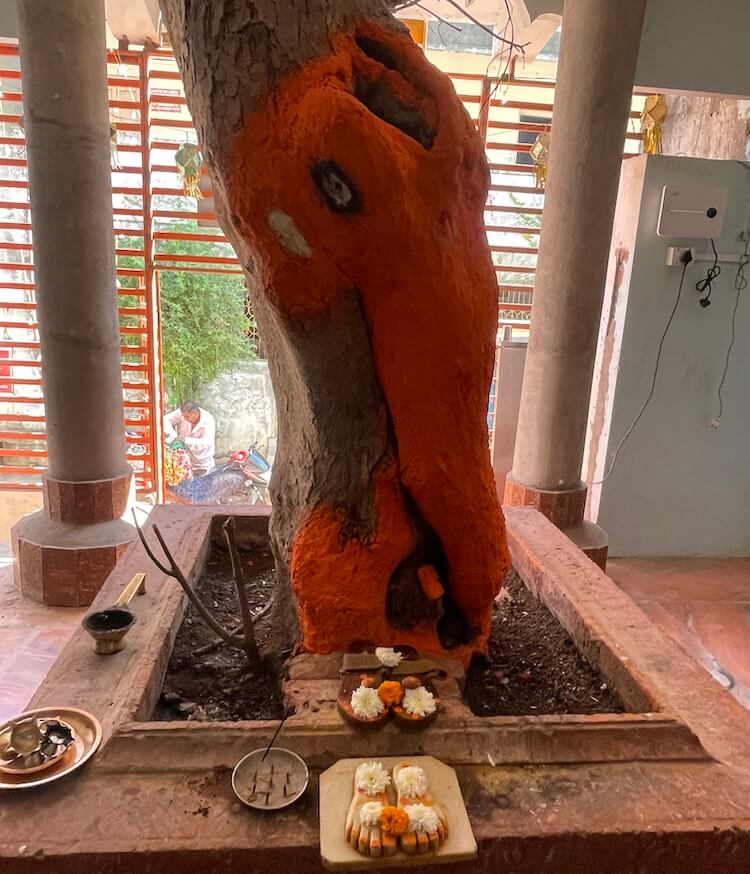
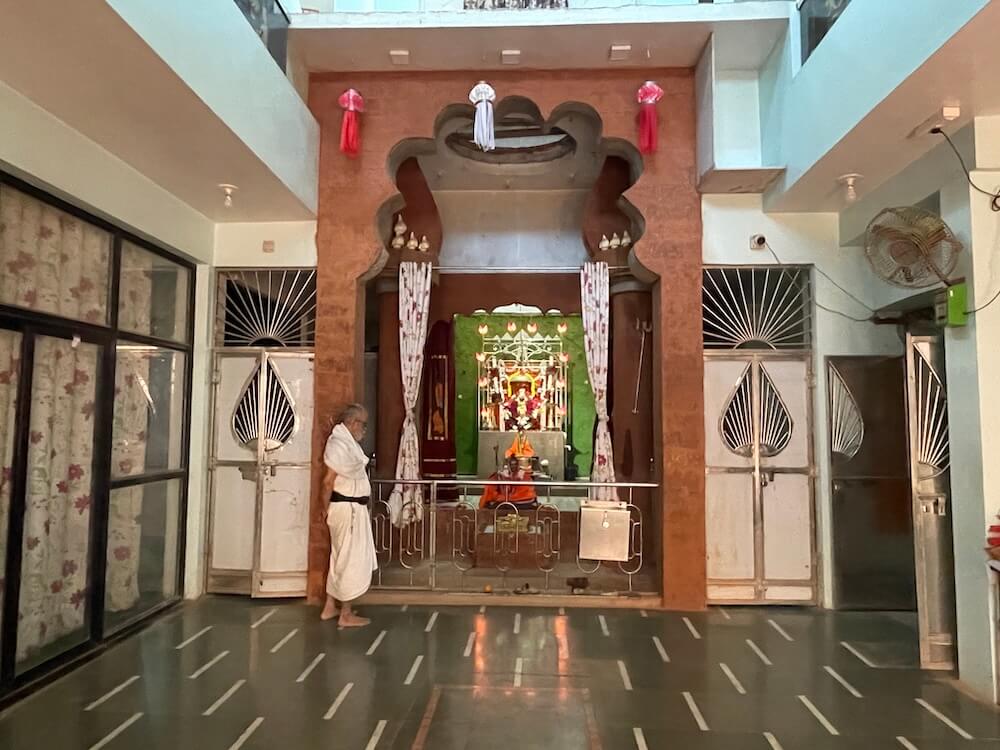
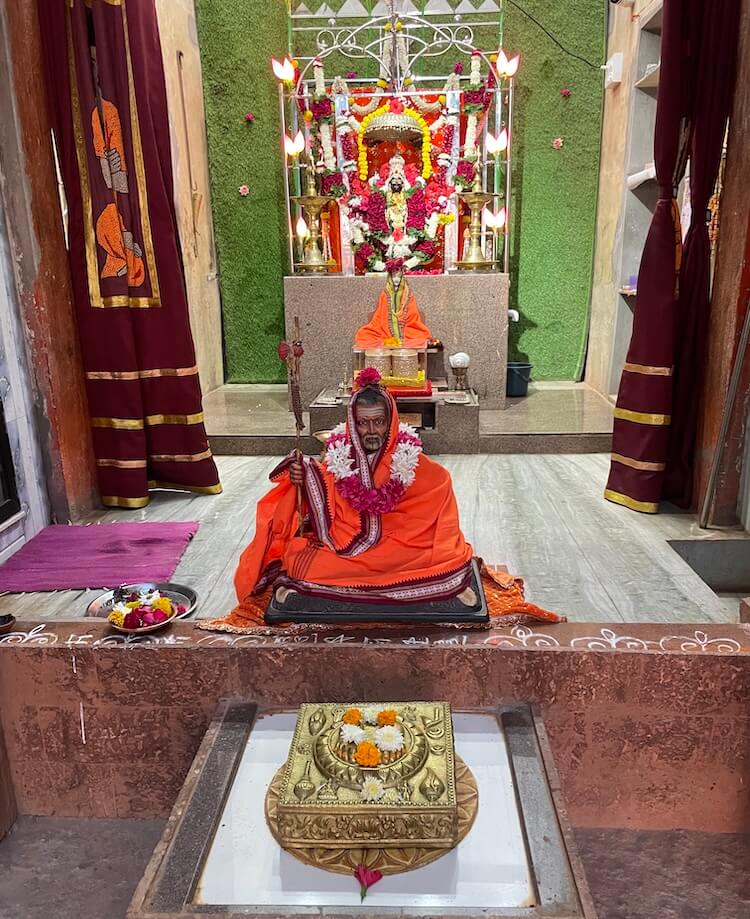
The temple at Bhalod stands within a modest two-storeyed structure. Through the large iron entrance gate one enters the sabhamandap (assembly hall). In this hall stands an ancient Audumbar tree. Upon its trunk appears the natural form of Ganesha with a right-curved trunk. On the platform around the tree rests a marble pair of padukas (holy sandals). Ahead lies an inner space framed by a graceful arch. Upon an elevated platform here are brass padukas and behind them stands the image of Vasudevanand Saraswati (Tembe Swami). Born in 1854 at Mangaon in Sindhudurg district, Maharashtra, Tembe Swami took samadhi in 1914 at Garudeshwar in Narmada district.
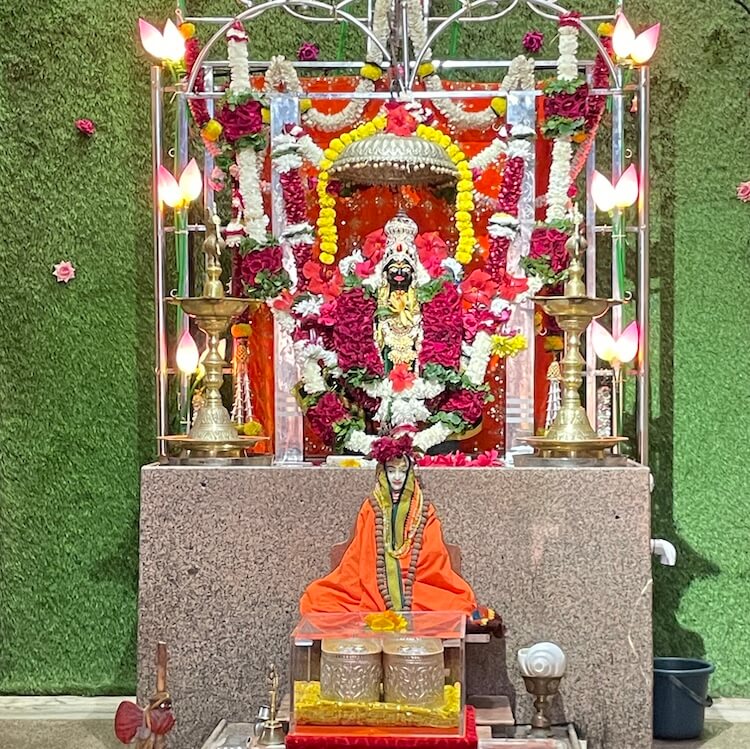
In the garbhagriha (sanctum sanctorum), the ancient Ek-mukhi Datta idol is enshrined upon a high marble pedestal. Adorned with fine garments and floral garlands, the deity wears a silver crown beneath a silver chhatra (canopy). Two large brass lamps flank the idol. It is observed that this six-armed idol features a gomukha near the chest. The various chakras of the subtle body are marked upon the idol: the ‘Ajna chakra’ between the eyes, the ‘Vishuddha chakra’ at the throat, the ‘Manipura chakra’ at the navel and the ‘Muladhara chakra’ at the base. Remarkably, three of the four petals of the lotus associated with the ‘Muladhara chakra’ are clearly visible on the sculpture. A cow stands by the left foot and a dog, representing the Vedas, stands by the right. The silver prabhavali (aureole) behind the deity is intricately carved with vine patterns, peacocks and cows. Below, on the main pedestal, sits a marble idol of Narasimha Saraswati, the 14th-century incarnation of Dattatreya. Before him rest padukas gifted to Pratap Maharaj by a devotee from Miraj. These padukas, kept in a box, are worshipped daily.
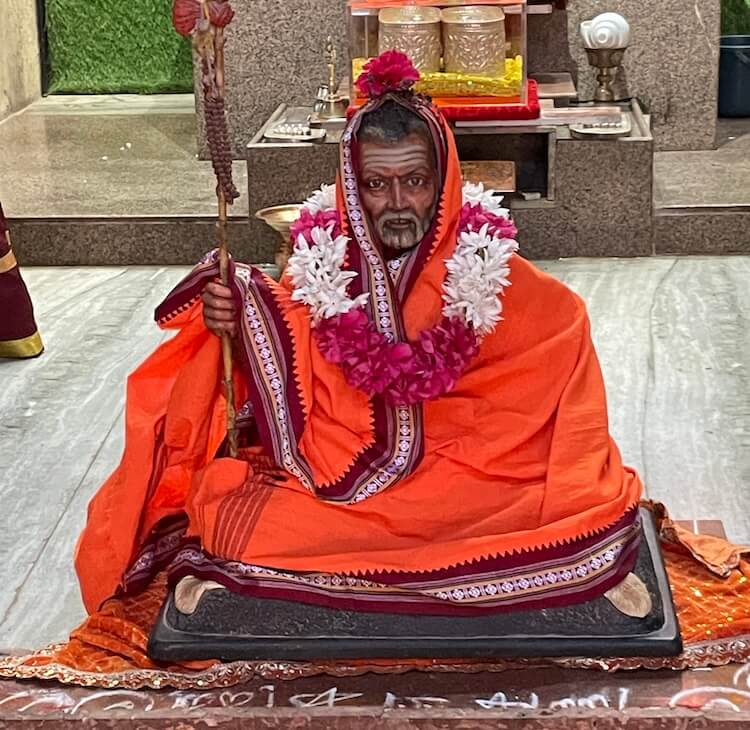
In a space to the right of the assembly hall, there is a strikingly life-like idol of Tembe Maharaj, alongside images of Shripad Shrivallabh, Swami Samarth, Narasimha Saraswati, Bharatmata and Dattatreya. A wooden kuti (hut) nearby provides a serene space for meditation. A short distance from the temple lies the Narmada ghat (riverbank steps), from where the holy site of Nareshwar can be reached in an hour by boat.
Daily rituals and worship are performed here with devotion. Festivals such as Chaitra Navratra, Gurupournima, Dattajayanti and Narmada Jayanti are celebrated with reverence. Devotees may perform the Guru Charitra parayana (ritual reading) and various other services, including the Shri Satyadatta Puja and Datta Yaga (sacred fire ritual). Arrangements for the lodging and boarding of Narmada parikramavasis are also provided.
This sacred temple stands as a testament to deep spiritual devotion, ancient architectural grandeur, and rich local cultural traditions.
The sanctum sanctorum houses the divine idol consecrated according to ancient Vedic traditions, surrounded by serene courtyards and traditional temple architecture.
Navratri, Maha Shivratri, Annual Temple Jatra & Deepotsav
Compare and book flights, secure top-rated local hotels near the temple, hire reliable guides, and rent cars instantly.
Extend your pilgrimage by visiting other highly sacred temples located nearby.


Add ₹999 more to unlock FREE SHIPPING!
Your sacred cart is currently empty.
Shop Photo FramesFill in your delivery details below to place your order.
Add comment