
Add ₹999 more to unlock FREE SHIPPING!
Your sacred cart is currently empty.
Shop Photo FramesAmong the 12 significant places of Khandoba in Maharashtra, Shegud in Karjat taluka is considered of special importance after Jejuri. Devotees believe that Khandoba traveled from Shegud to Jejuri. It is said that Khandoba sleeps on a mattress and uses a horse here; therefore, the villagers of Shegud do not use mattresses for sleeping, nor do they use horses for any occasion. Furthermore, as this Khandoba temple is two-storied, no house in the village is built taller (two-storied) than this temple.
The legend of this temple states that the Shegud area was once a dense forest. Khandoba appeared in a dream to a devotee from the nearby village of Mhalunge, telling him, “I reside in a large sandalwood log in this forest.” Upon searching that log, the idol of Khandoba was found. The devotee performed worship there and built a small temple. Later, the villagers constructed a larger temple at that site, which is the present-day Khandoba temple of Shegud.
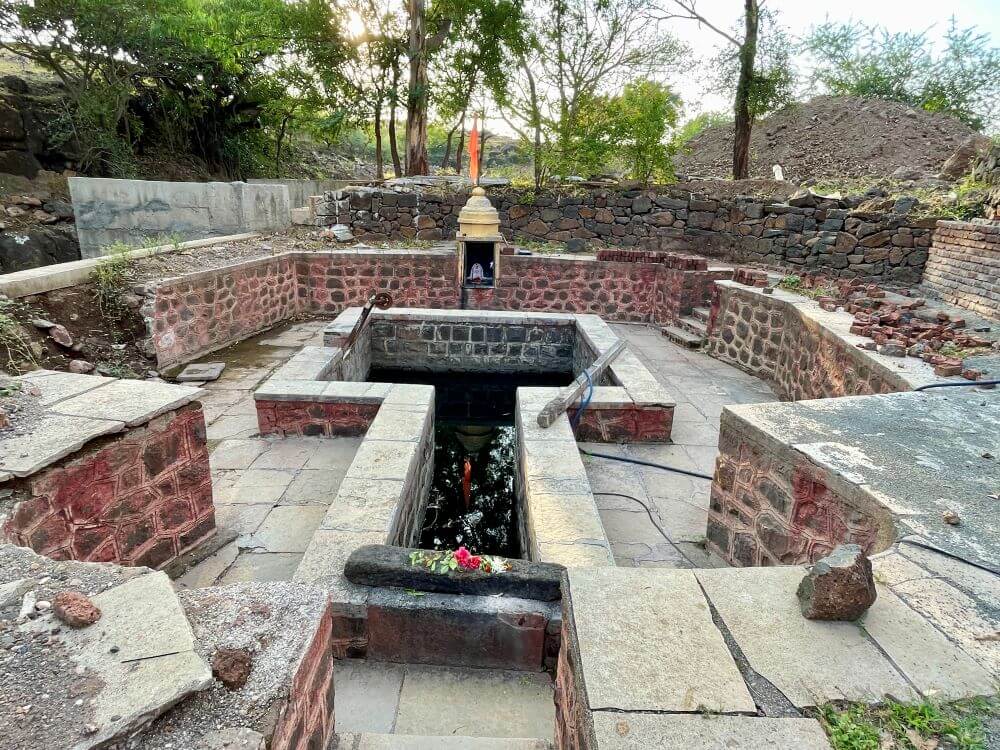
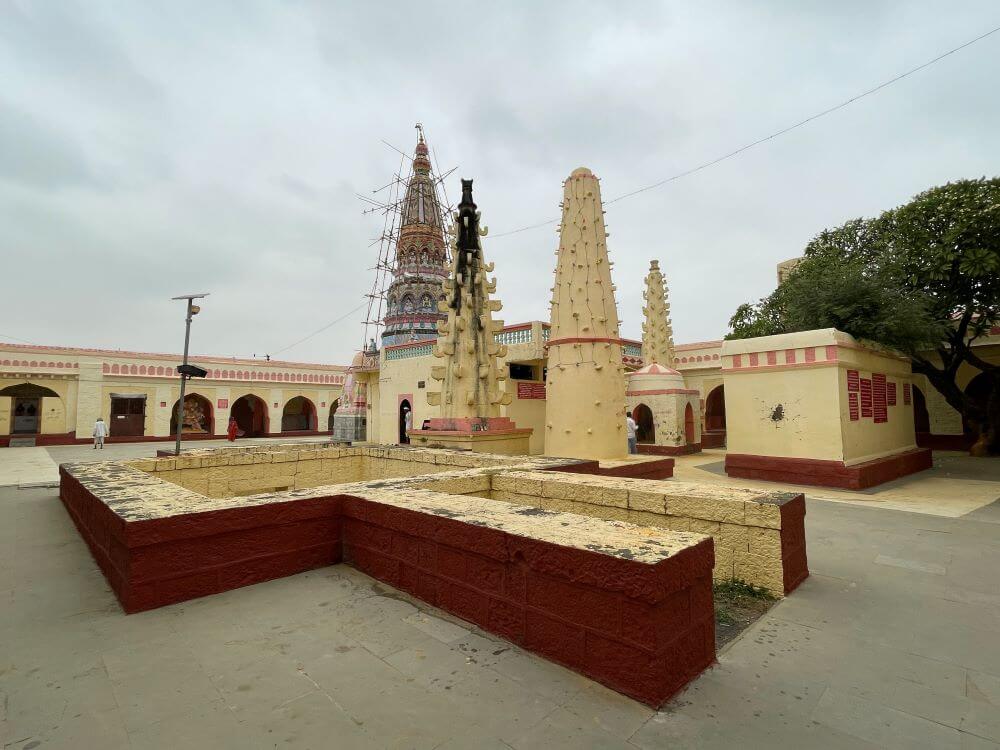
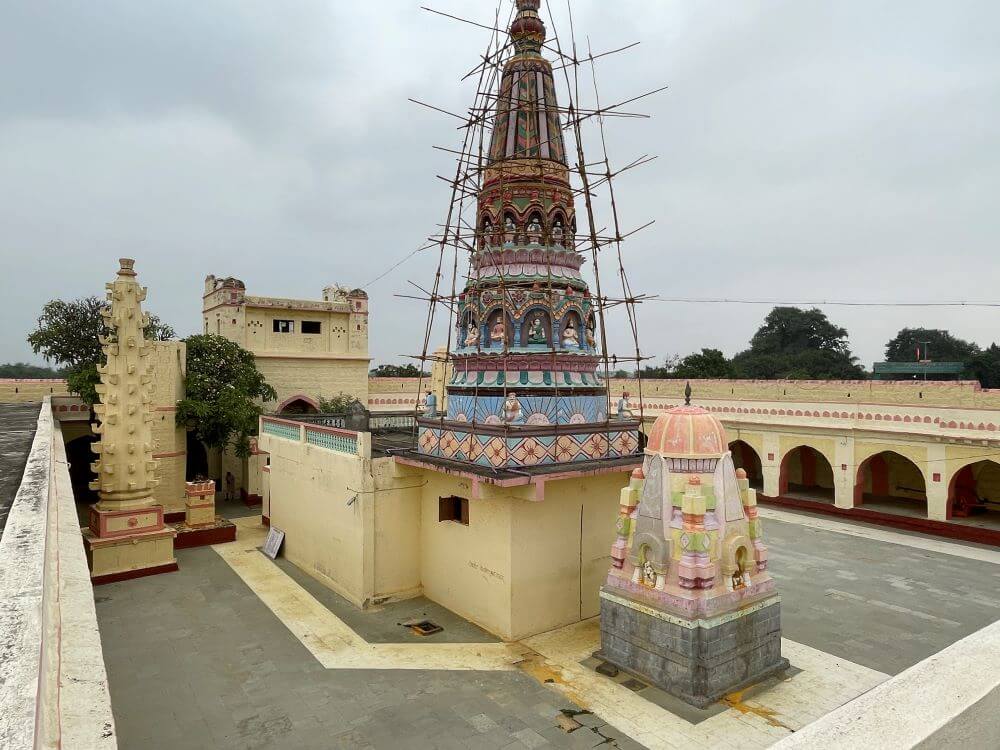
The temple is surrounded by a sturdy and high stone fortification. There are entrances on all four sides of this fortification; the southern and northern doors are relatively smaller, while the eastern and western entrances are larger. One enters the temple courtyard through the eastern entrance. Above this entrance is a *Nagarkhana* (drum house), accessible via a staircase near the eastern gate. An inscription from the year 1773 is found above the entrance, bearing the names Malhari Shankar, Rayaji Mahipat, and Vitthal Mahipat Punde. It is said that they were responsible for the construction of this fortification. Inside the fortification, there are *ovaris* (cloisters) on all four sides. In the temple courtyard, on the left side, there is a unique stone *barav* (stepped well), also known as the ‘Tirthachi Vihir’ (sacred well). It has steps to descend, and its water is used exclusively for the worship of the deity. In front of the main temple, there are two tall *deepmalas* (lamp pillars), which are illuminated during festivals.
On the floor near the *Nandi Mandapa* in front of the main temple, a male figure is carved. It is said to be the image of a person from the *Charmakar* (cobbler) community. When the temple was being built, the *kalash* (pinnacle) would not remain stable. To fix this, the man reportedly removed his own intestines and tied them to the *kalash*, after which it became stable.
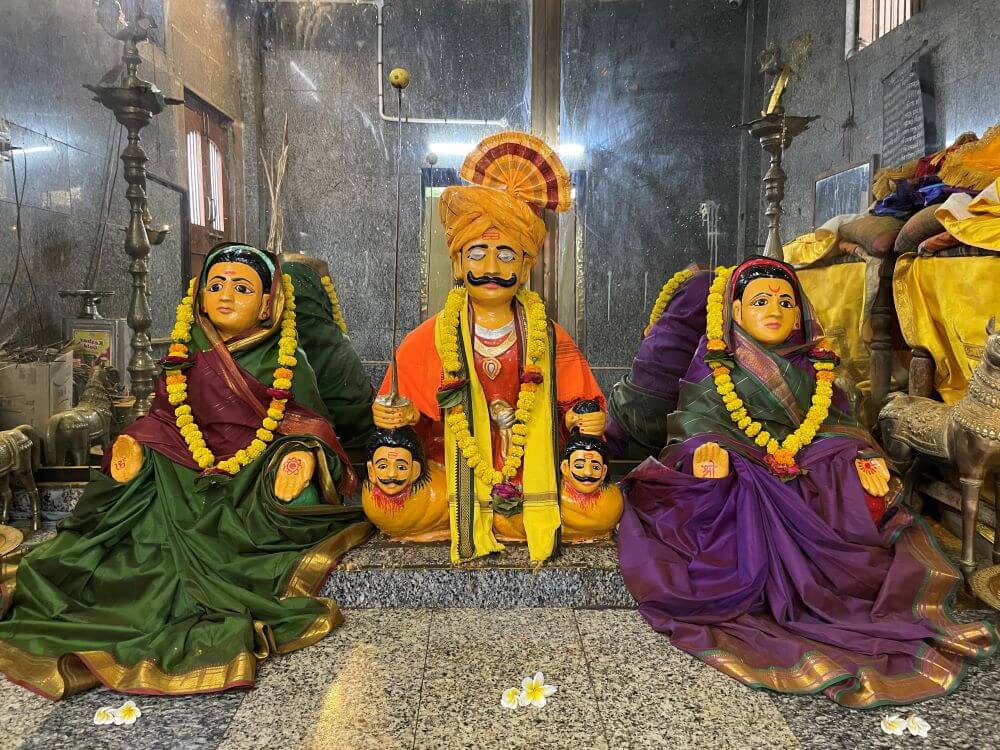
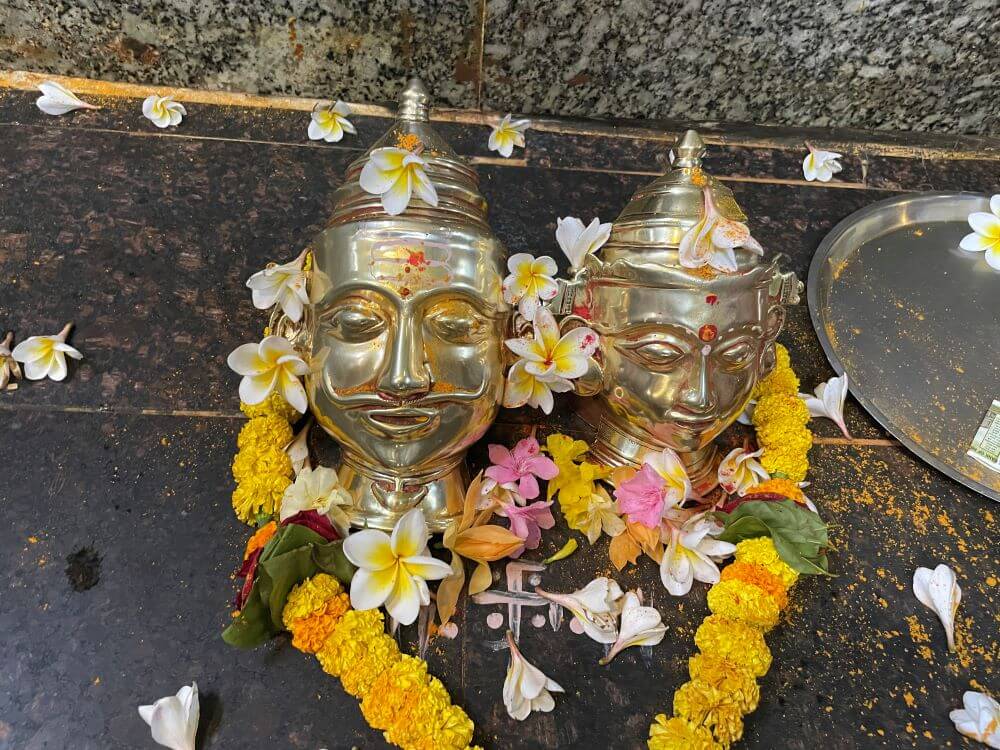
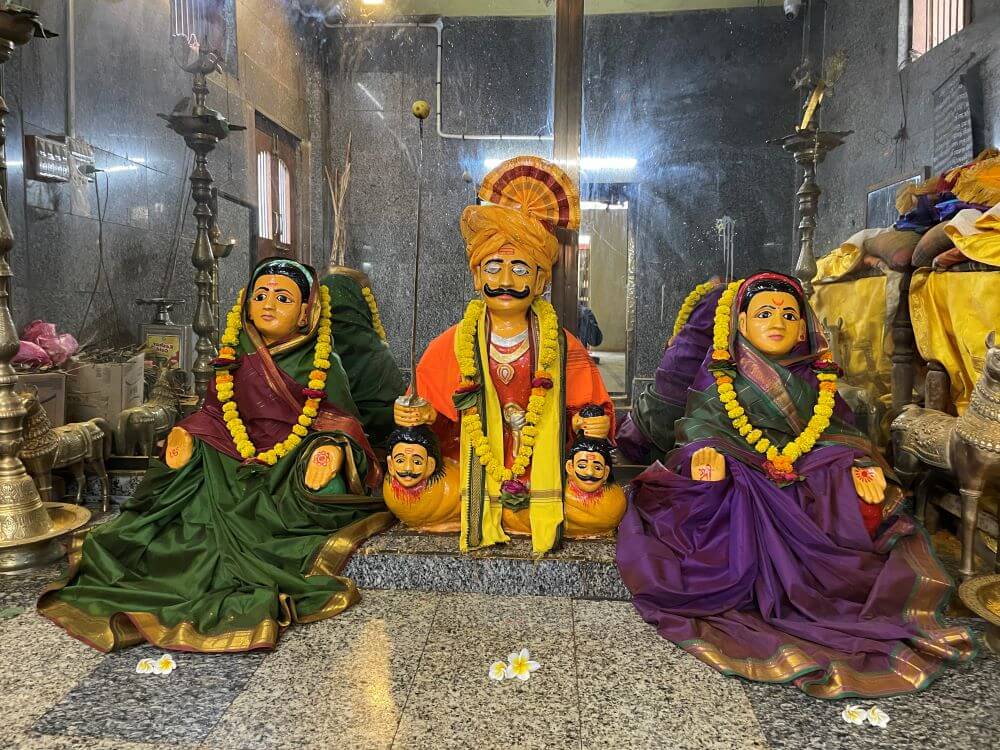
The temple consists of a *Sabhamandapa* (assembly hall) and a *Gabhara* (sanctum sanctorum). One has to descend slightly from the *Sabhamandapa* to enter the *Gabhara*. In this sanctum, the *lingas* of Khandoba and Mhalasa are placed at a lower level, while seated idols of Khandoba, Mhalasa, and Banai are on a raised platform. The *kalash* of this temple is carved with the images of the *Navadurga* and *Navanathas*.
On *Margashirsha Shuddha Pratipada*, the *Ghatasthapana* is performed in the temple, marking the beginning of Khandoba’s *Navaratrotsav*. This festival is celebrated to commemorate the event where Khandoba defeated the two demons, Mani and Malla, and freed the people from fear on *Champashasthi* (*Margashirsha Shuddha Shashthi*). The deity’s wooden horse is taken out of the temple for devotees to see. On this day, the wedding ceremony of Khandoba and Mhalasa takes place. On the night of *Margashirsha Purnima*, the deity’s procession (*Chhabina*) is taken out. Devotees carry the wooden horse on their shoulders, dancing to the sounds of *dhol-tasha* and *halgi*. Fireworks are displayed at night, and devotees shower large amounts of *bhandara* (turmeric powder), bathing the temple premises and the village procession route in yellow. This procession continues throughout the night and returns to the temple at dawn. The next day, a wrestling match featuring renowned wrestlers from the state is held, concluding the two-day fair. The *Aarti* is performed daily at 6:00 AM. Devotees can have *darshan* of Khandoba from 6:00 AM to 6:00 PM.
This sacred temple stands as a testament to deep spiritual devotion, ancient architectural grandeur, and rich local cultural traditions.
The sanctum sanctorum houses the divine idol consecrated according to ancient Vedic traditions, surrounded by serene courtyards and traditional temple architecture.
Navratri, Maha Shivratri, Annual Temple Jatra & Deepotsav
Compare and book flights, secure top-rated local hotels near the temple, hire reliable guides, and rent cars instantly.
Extend your pilgrimage by visiting other highly sacred temples located nearby.


Add ₹999 more to unlock FREE SHIPPING!
Your sacred cart is currently empty.
Shop Photo FramesFill in your delivery details below to place your order.
Add comment