
Add ₹999 more to unlock FREE SHIPPING!
Your sacred cart is currently empty.
Shop Photo Frames. The Potraj, devotees of Mari-aai in Maharashtra, are known as Madgi or Madgud in South India. The word ‘Potraj’ is a derivative of the Dravidian term ‘Potturaju’. ‘Pottu’ means a buffalo or a goat, and the one who performs the sacrificial ritual for it is the Potturaju. There are various types of Potrajs, such as those associated with temples, those who specialize in singing specific songs, and local Potrajs. The tradition of Potrajs continues to this day in some special temples of Maharashtra. The ancient Mahalakshmi Temple at Chivari in Tuljapur Taluka is one of them. Even today, the initiation rituals for new Potrajs are performed in this temple. Devotees firmly believe that the awakened Goddess here grants their prayers.
It is said that this temple is four hundred to five hundred years old. The legend of the temple states that during a severe famine, the children of the village herdsmen brought their cattle to graze here. At that time, a cow died of thirst. Just then, Goddess Mahalakshmi appeared before the children in the form of an old woman and, claiming to be hungry, asked them for food. The children gave the old woman a bhakri (flatbread). After eating the bhakri, she asked for water to drink. The herdsmen told the old woman that they had no water and that the cow had died precisely because of the lack of it. Hearing the herdsmen, the old woman angrily struck her staff on the ground, and fountains of water began to gush out from the earth. Seeing the water, the herdsmen danced with joy, and as the water splashed onto the dead cow, it came back to life. At that very moment, the old woman revealed herself as Goddess Mahalakshmi and disappeared into the stone here. The herdsmen told the villagers about this incident, and over time, the villagers built a temple for the Goddess at this site.
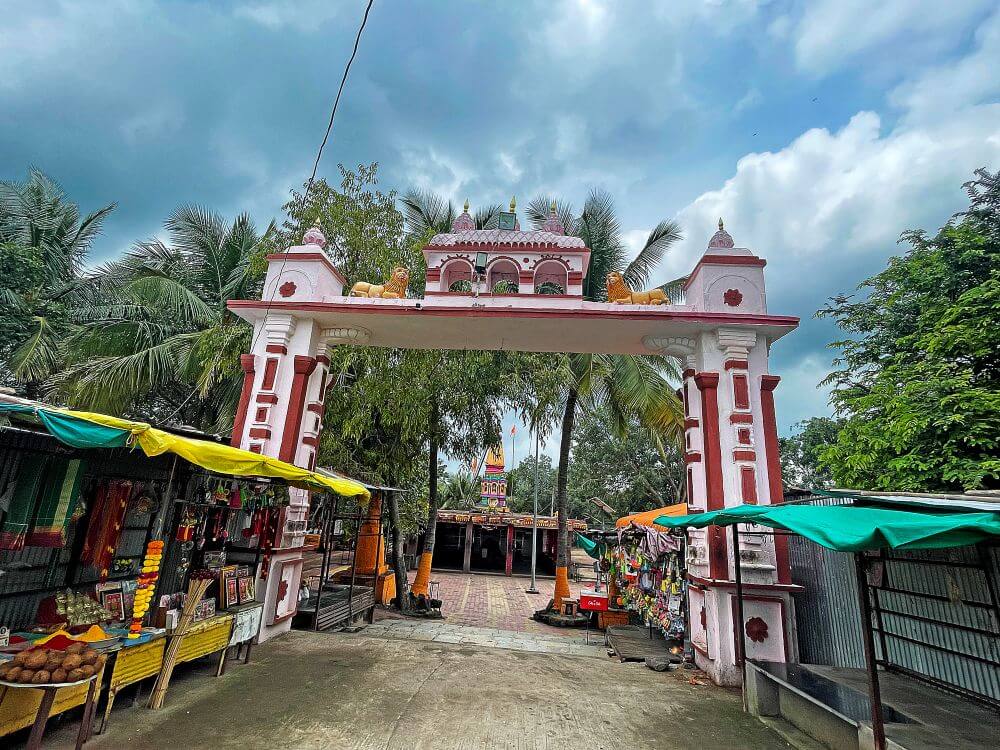
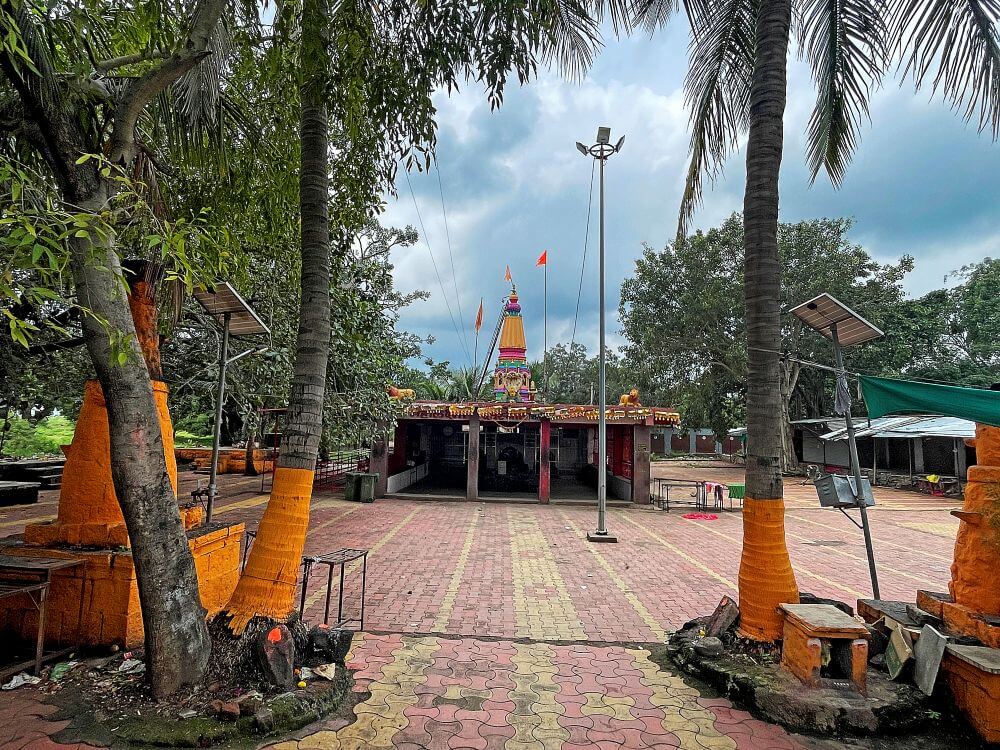
The first welcome arch of the temple is on the road leading from the highway. The temple is about two kilometers away from this arch. There is a spacious parking lot in front of the temple. Around the parking lot, there are many shops selling food items and worship materials. There is a second welcome arch while going from the parking lot towards the temple. One enters the temple courtyard through this arch. In the courtyard, there are two platforms with lamp towers (Deepmala) on both sides in front of the temple. In the center of the courtyard stands an iron flagstaff. Behind the temple is an ancient well. It is a custom to purify oneself with the water from this well before entering the temple for darshan. There are steps to descend into this well, which is built of carved stone.
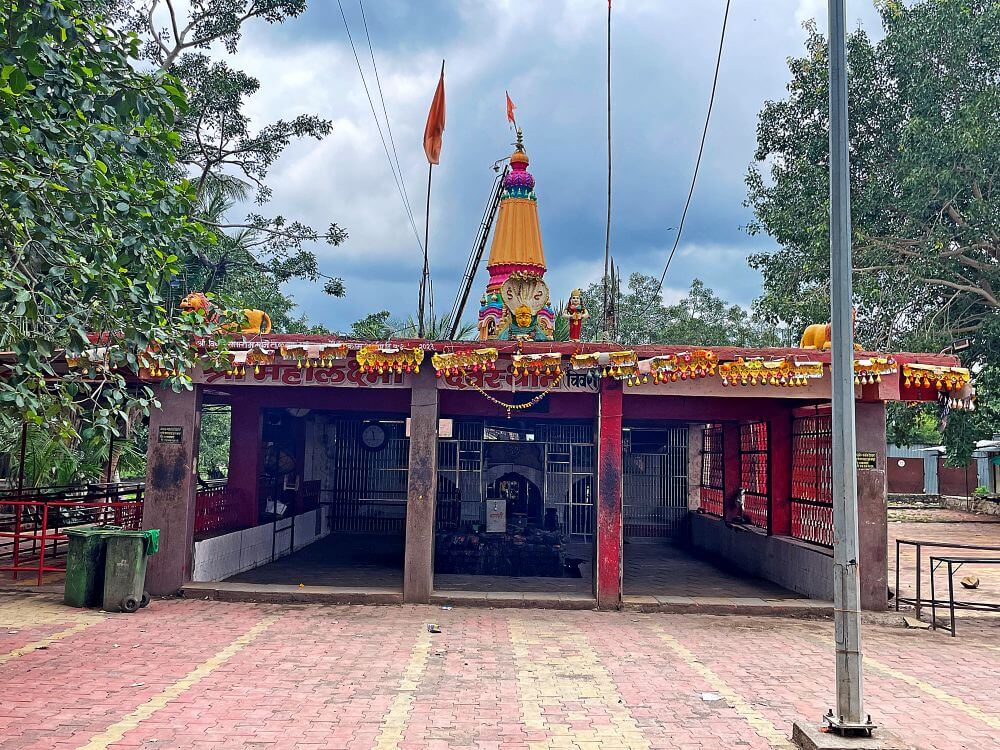
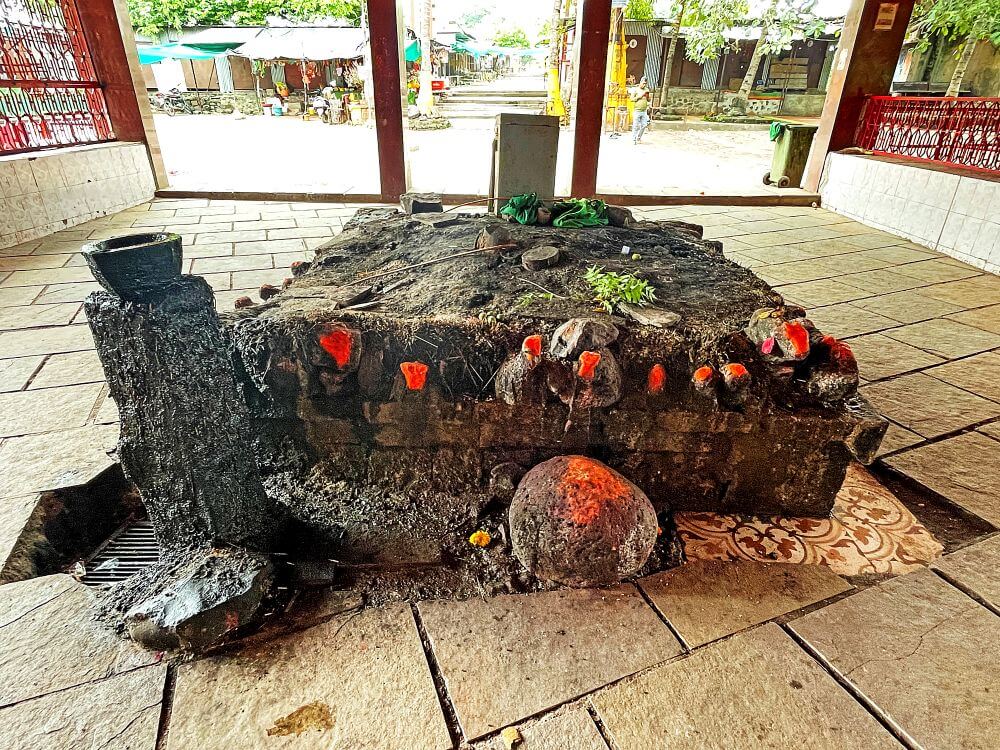
The temple structure consists of a Sabha Mandap (assembly hall), Antaral (vestibule), and Garbhagriha (sanctum sanctorum). The semi-open Sabha Mandap has twelve square pillars on the outer sides. There are railings on the left and right sides of the Sabha Mandap, and the front side is open. Many brass bells offered as vows are hung from the ceiling of the Sabha Mandap. In the center of the floor, there is a platform for the Yajna Kund (sacrificial fire pit) built of carved stone. On the Yajna Kund, there are animal sculptures on all four sides and a stone lamp (Malta) nearby. Paintings of Goddess Mahalakshmi are depicted on the front wall of the Antaral in the Sabha Mandap.
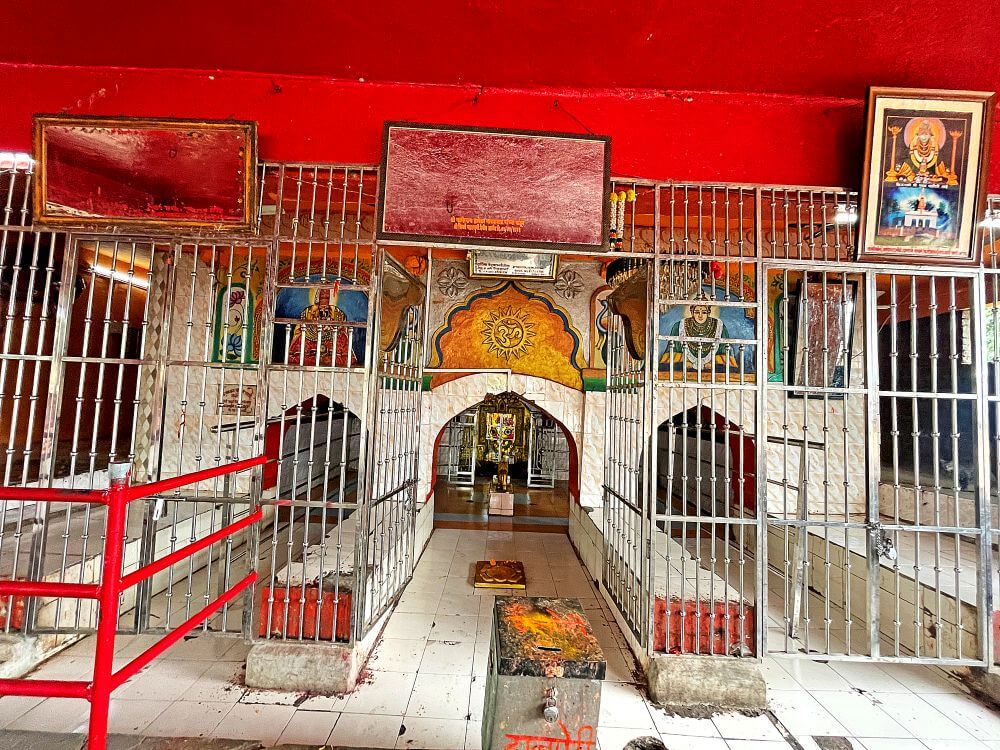
The entrance to the enclosed Antaral consists of three arches supported by four pillars. In the center of the Antaral, there is a lion sculpture on a platform, followed by a tortoise sculpture. The silver-adorned door frames of the Garbhagriha feature carvings of vines, flowers, and guardian sculptures. There is an image of Lord Ganesha on the lintel and deer sculptures on the architrave. Inside the Garbhagriha, the self-manifested (Swayambhu) stone idol of the Goddess rests on a silver-ornamented pedestal. The idol has a silver mask and a silver crown on its head.
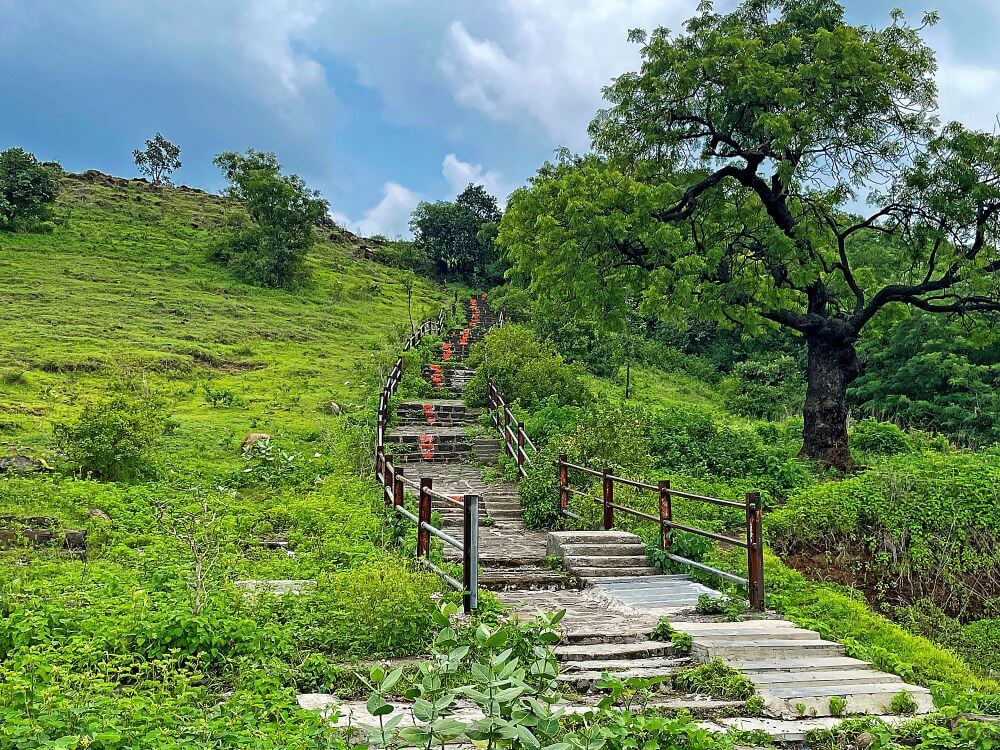
On the ceiling of the Sabha Mandap, near the entrance, there are lion sculptures on both sides. Between the lion sculptures is an image of the Goddess. Above the Garbhagriha, there is a tall, tapering two-tiered Shikhara (spire). From the temple courtyard, there is a path with fifty to sixty steps leading to the hill in front. On this hill is the Goddess’s bathing area. It is said that the Goddess goes here daily for her bath. There is an ancient temple here containing an idol of the Goddess.
The festival (Yatra) of this Goddess is celebrated twice a year. The annual Yatra is celebrated on the first Tuesday of the waning moon (Vadya Paksha) in the month of Magh. This Yatra is called ‘Kayaran’. On this occasion, offerings of curd-rice and Puran Poli are made, and the Goddess is offered a sari and coconut (Oti). It is customary to sweep the road from the village to the temple with neem branches during this time. Programs of devotional singing in praise of the Goddess and honors for village dignitaries are held at the village mansions.
During the Yatra, the Goddess’s palanquin procession moves through the village amidst the sound of drums, the throwing of gulal, and music. After visiting the homes of the village dignitaries, the palanquin turns back towards the temple in the evening. From evening until midnight, the area is illuminated by fireworks. On the second day of the Yatra, grand wrestling matches are organized. Renowned wrestlers from across the district participate in these matches. Thousands of enthusiasts gather here to watch the wrestling. On the day of the Yatra, hundreds of devotees come to the temple for the first hair-cutting ceremony (Jawal) of their children. At this time, it is customary to give alms to the newly initiated Potrajs. The temple premises resonate with the music and singing of the Aradi, Wagya, and Potraj communities. The ‘Akhadbon’ Yatra of the Goddess is held on the last Friday of the month of Ashadh. There is a tradition of animal sacrifice during this Yatra. Thousands of devotees come here for darshan and to fulfill their vows during both Yatras. Devotees can visit for darshan daily from 6 AM to 6 PM.
This sacred temple stands as a testament to deep spiritual devotion, ancient architectural grandeur, and rich local cultural traditions.
The sanctum sanctorum houses the divine idol consecrated according to ancient Vedic traditions, surrounded by serene courtyards and traditional temple architecture.
Navratri, Maha Shivratri, Annual Temple Jatra & Deepotsav
Compare and book flights, secure top-rated local hotels near the temple, hire reliable guides, and rent cars instantly.
Extend your pilgrimage by visiting other highly sacred temples located nearby.


Add ₹999 more to unlock FREE SHIPPING!
Your sacred cart is currently empty.
Shop Photo FramesFill in your delivery details below to place your order.
Add comment