
Add ₹999 more to unlock FREE SHIPPING!
Your sacred cart is currently empty.
Shop Photo FramesLord Hanuman, the quintessential symbol of strength, devotion and sagacity, is one of the ‘Saptachiranjivas’ (seven immortals). In the epics of the Ramayana and Mahabharata, Hanuman is depicted as being replete with supernatural virtues, including mastery of the scriptures, political statesmanship, valour, intelligence, celibacy, unwavering devotion to Rama and eloquence. Hanuman is worshipped in various forms, such as the ‘Veer’ (heroic), ‘Das’ (servant), ‘Chapetdata’ (the striker) and as the bearer of the Veena and books. Amongst these, the shrine at Kukarwada is dedicated to his ‘Panchmukhi’ (five-faced) manifestation. Devotees hold a profound belief that the Hanuman enshrined here is ‘Runmochan’, the one who grants deliverance from all forms of debt and worldly obligations.
The legend regarding the origin of his name recounts that as a child, Hanuman mistook the rising sun for a fruit and leapt towards it. Witnessing this, Indra struck him with the Vajra (thunderbolt), which broke his left Hanu (jaw). From that moment onwards he became known as ‘Hanuman’. According to the renowned Orientalist Frederick Eden Pargiter (1852–1927), the word Hanuman is derived from ‘Hanumant’, which is a Sanskritised version of an original Tamil word. The root Tamil word is ‘Aanmandi’ (Aan = monkey, Mandi = male). It is a common practice when Sanskritising Dravidian words to prefix them with the sound ‘Ha’. Therefore, Pargiter and scholars like Suniti Kumar Chatterji believe that ‘Aanmandi’ likely became Hanamandi and eventually Hanumant in Sanskrit.
According to mythological texts, Hanuman is an Avatar (incarnation) of Rudra. The ‘Skanda Purana’ identifies him as an incarnation of Shiva. The text ‘Anjaneya Samhita’ (or Hanumatsamhita) is attributed to his name. He is also regarded as a pioneer of the science of music. Legend holds that Hanuman assumed his five-faced form to slay the demons Airavan (Ahiravan) and Mairavan (Mahiravan). The mention of the tale of Airavan-Mairavan is not found in the original Valmiki Ramayana but first appear in the ‘Anand Ramayana’ and the ‘Krittivasi Ramayana’. The ‘Krittivasi Ramayana’ was composed in the fifteenth century, a hundred years before Tulsidas’s popular Ramcharitmanas, by the Bengali poet-saint Krittibas Ojha. While traditional belief attributes the ‘Anand Ramayana’ to Sage Valmiki, research by M. R. Yardi in ‘The Ramayana – Its Origin and Growth’ suggests it dates to the fifteenth century AD. According to this text, Airavan and Mairavan were denizens of the netherworld and friends of Ravana. Summoned by Ravana to fight Shri Ram, they arrived at the Ram’s camp by the seashore at night. Shri Ram and Lakshman were sleeping upon a rock within an impenetrable fortress formed by Hanuman’s coiled tail. Airavan-Mairavan lifted the entire rock and secretly abducted them to the netherworld. Upon discovering this, Hanuman travelled to the netherworld to rescue them. The story of Hanuman’s ‘Panchmukhi’ form is linked to this rescue mission. It is said that Hanuman’s son, Makaradhwaja, served as the gatekeeper for Airavan. He informed Hanuman that Airavan could only be slain if five lamps hidden in a secret location were extinguished simultaneously. To achieve this, Hanuman assumed five faces and blew them out at once. The ancient temple at Kukarwada commemorates this five-faced form.
Precise records regarding this temple’s origin are unavailable. As per the local legend, five hundred years ago, Hanuman appeared in a vision to the Sarpanch of the neighbouring village of Hansot, revealing that he resided on a hill in Kukarwada. Following this revelation, the villagers of Kukarwada excavated the hill for six months until they discovered a large stone. Upon this stone were carved five faces. The villagers then consecrated the site. Over the centuries, the temple has undergone several restorations. A recent renovation has bestowed upon it its current architectural splendour.
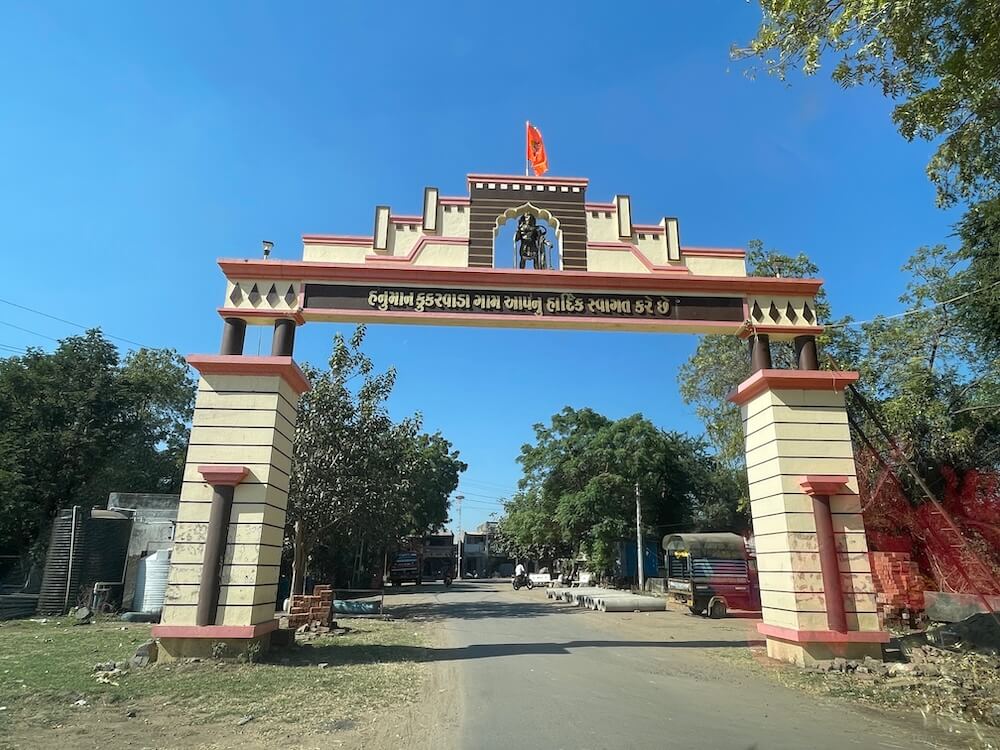
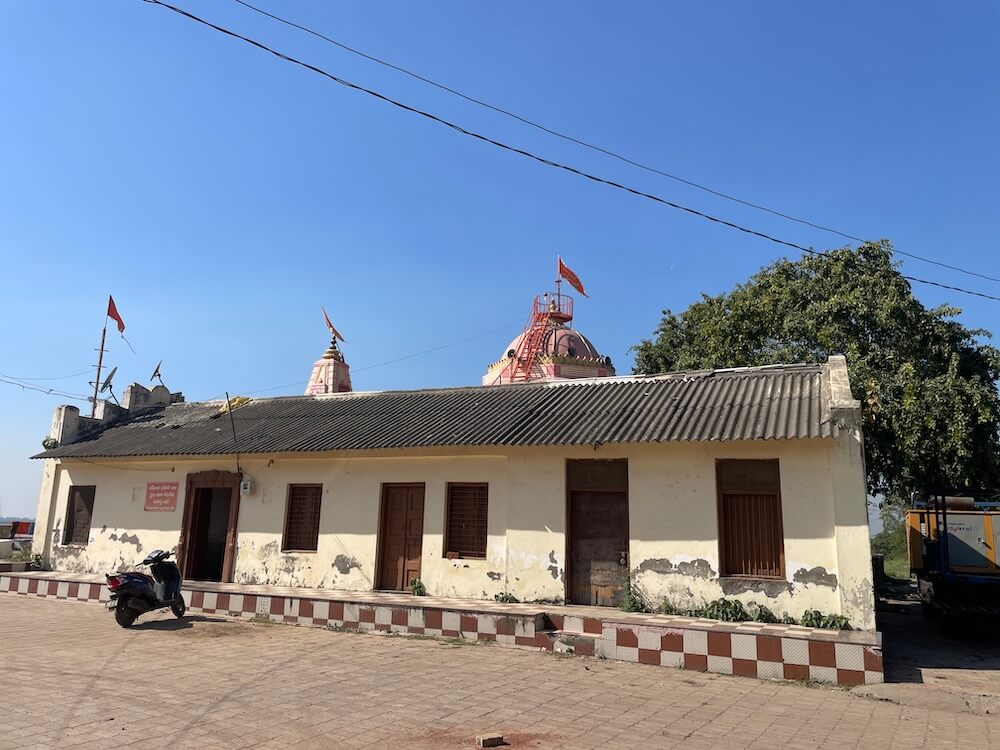
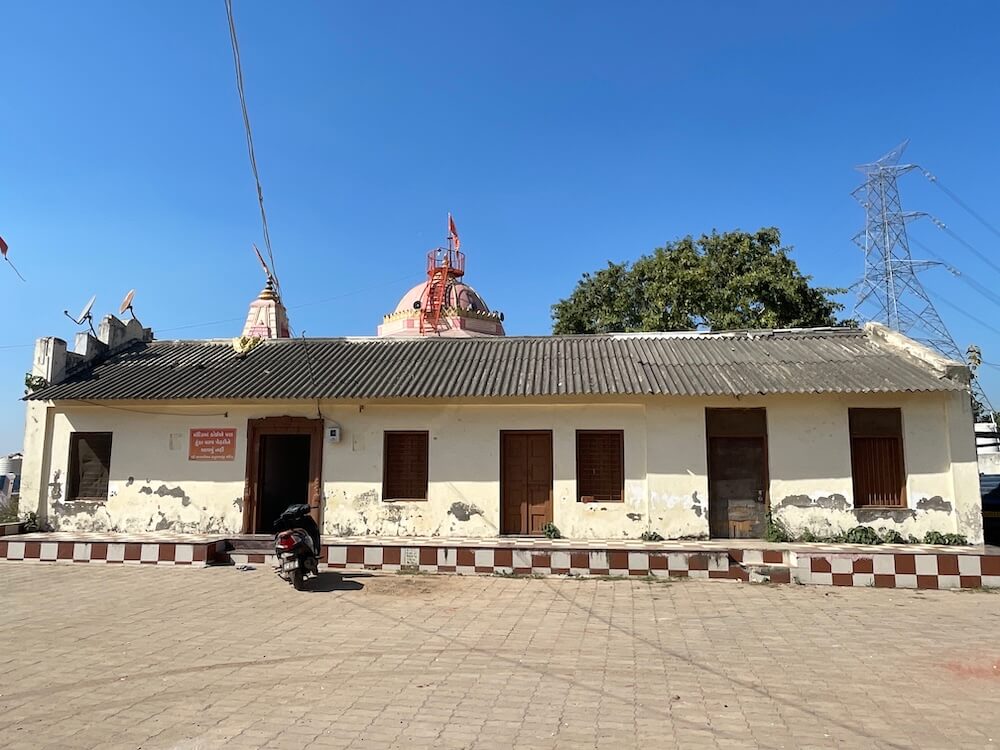
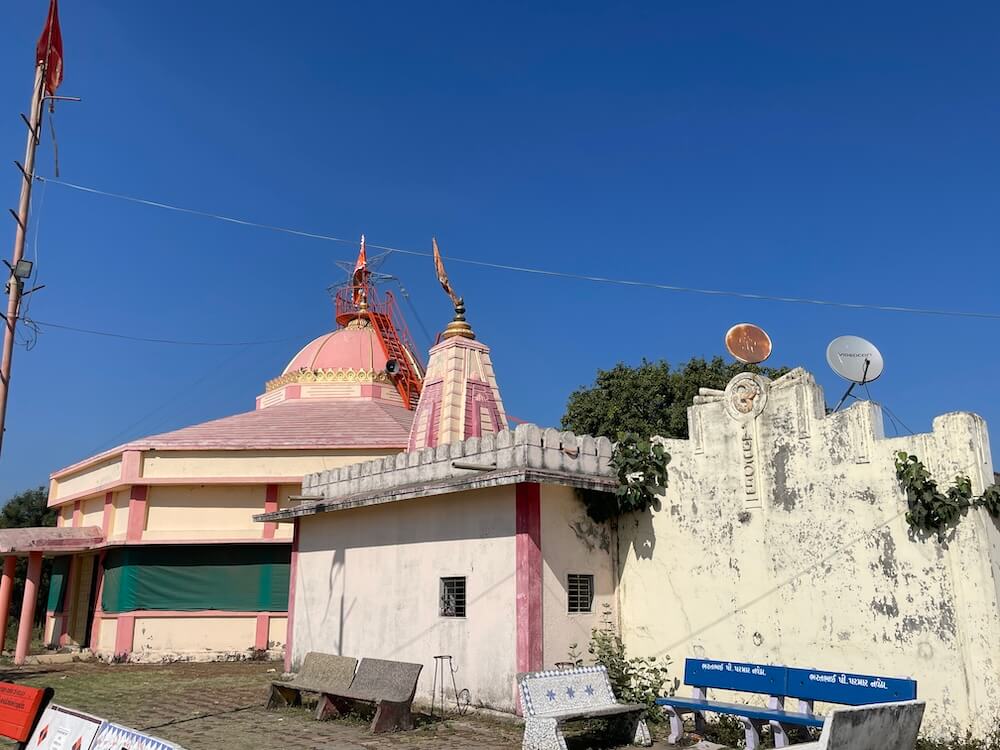
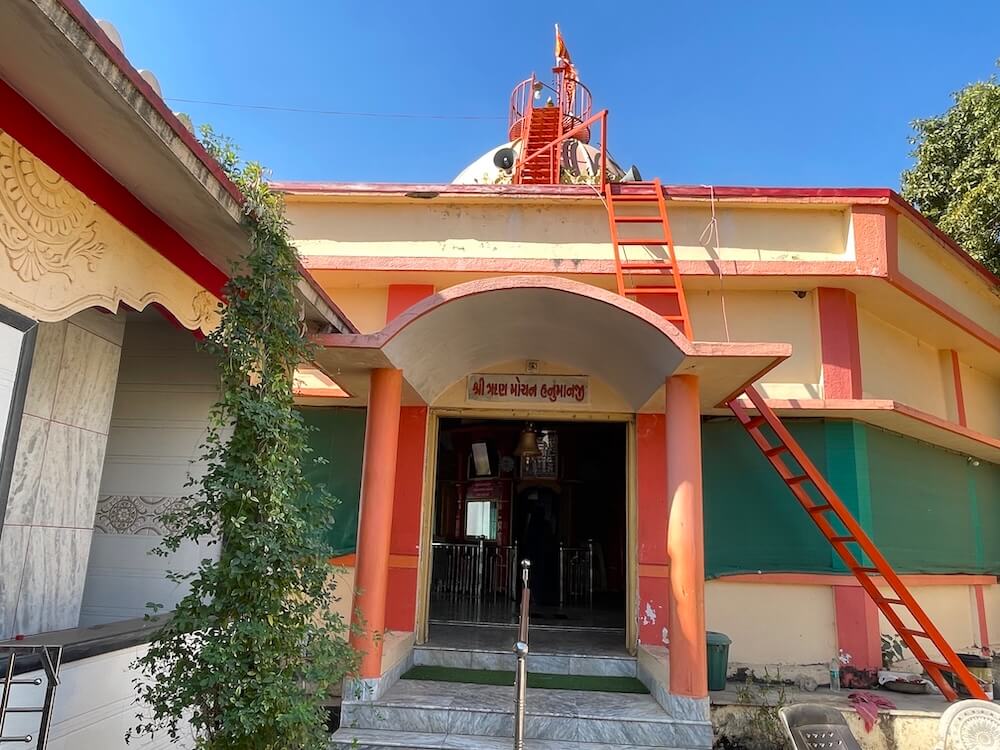
The temple is nestled on the scenic bank of the Narmada river. A grand entrance arch leads to a courtyard paved with stone blocks. An elongated single-storey structure marks the entrance to the inner precincts, where the Runmochan Hanuman temple stands. Built upon a high Jagati (plinth), the temple features a unique architectural design. It possesses a magnificent octagonal Sabhamandap (assembly hall) of a semi-open, modern design. This hall has three entrances and is crowned by a massive domed spire featuring an Amalaka (stone disc) and a Kalasha (pinnacle). Within this assembly hall resides the original, smaller stone temple. This ancient octagonal structure features pillars with intricate carvings and its own domed roof. Notably, a ‘Shivpind’ sits atop this inner roof in place of a pinnacle. Inside, within a marble canopy, is the Panchmukhi Hanuman idol. The vermilion-smeared stone features three faces on the upper section and two on the lower, with eyes, lips, moustaches and sacred markings carefully painted. A crown adorns the top three heads and a mace decorated with colourful paper is placed to the right.
Daily rituals and Aarti are conducted here every morning and evening. Devotees believe that sincere worship of Runmochan Hanuman grants freedom from all kinds of debts and burdens. Consequently, the temple sees large gatherings of the faithful every Tuesday and Saturday. On Hanuman Jayanti, hundreds of pilgrims from surrounding villages visit the shrine. The day is marked by various religious programmes, a Maha Aarti in the evening and the distribution of Mahaprasad (consecrated feast) to all devotees.
The temple complex also houses the shrines of Narmadeshwar Mahadev, Baliyadev and Bhathiji Maharaj. Outside the temple, facing the Narmada, cement benches are provided for visitors to enjoy the view. From this vantage point, the grand cable-stayed bridge over the river can be seen.
This sacred temple stands as a testament to deep spiritual devotion, ancient architectural grandeur, and rich local cultural traditions.
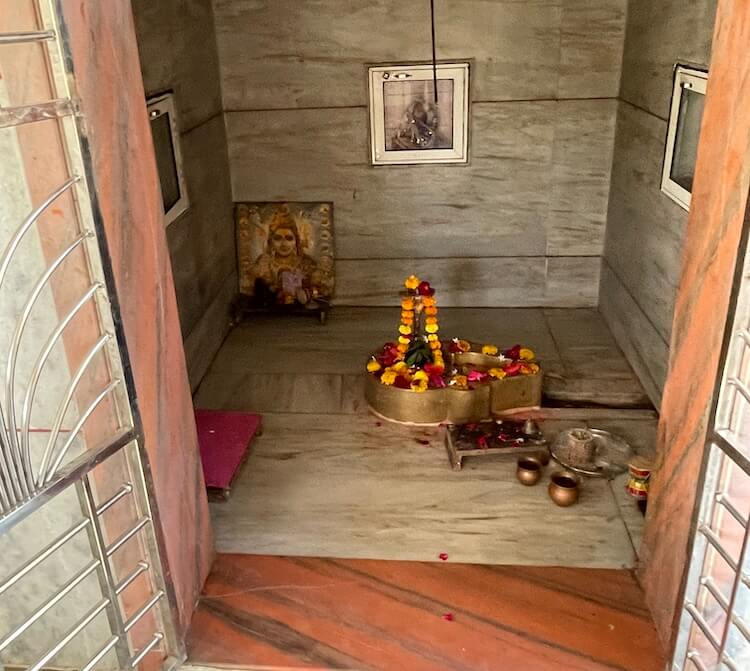
The sanctum sanctorum houses the divine idol consecrated according to ancient Vedic traditions, surrounded by serene courtyards and traditional temple architecture.
Navratri, Maha Shivratri, Annual Temple Jatra & Deepotsav
Compare and book flights, secure top-rated local hotels near the temple, hire reliable guides, and rent cars instantly.
Extend your pilgrimage by visiting other highly sacred temples located nearby.


Add ₹999 more to unlock FREE SHIPPING!
Your sacred cart is currently empty.
Shop Photo FramesFill in your delivery details below to place your order.
Add comment