
Add ₹999 more to unlock FREE SHIPPING!
Your sacred cart is currently empty.
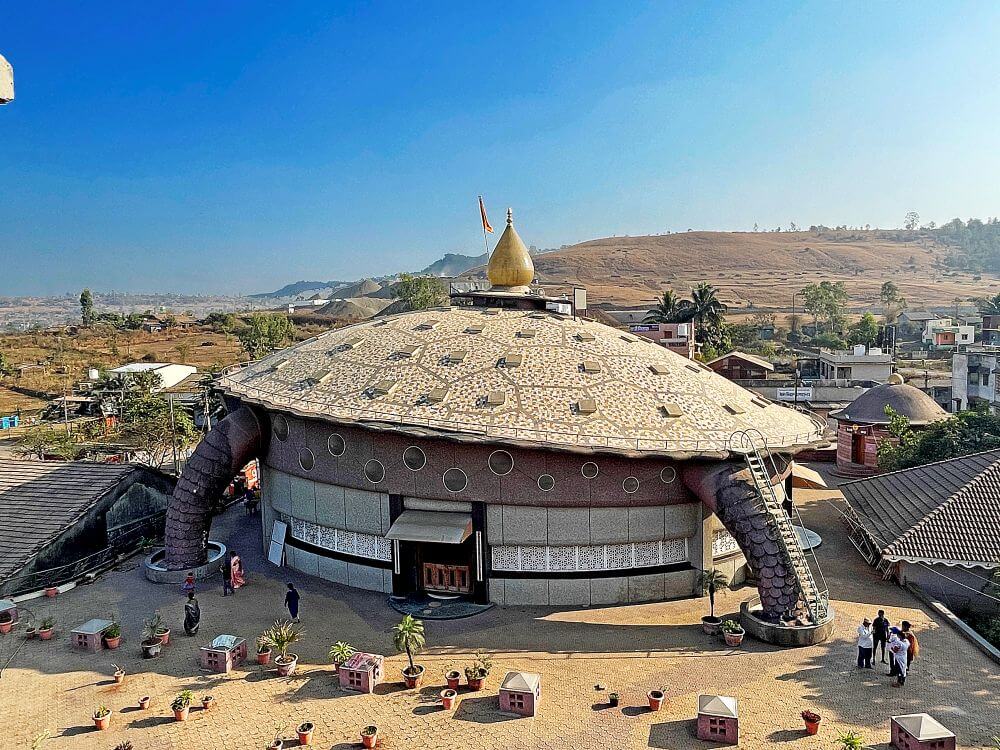
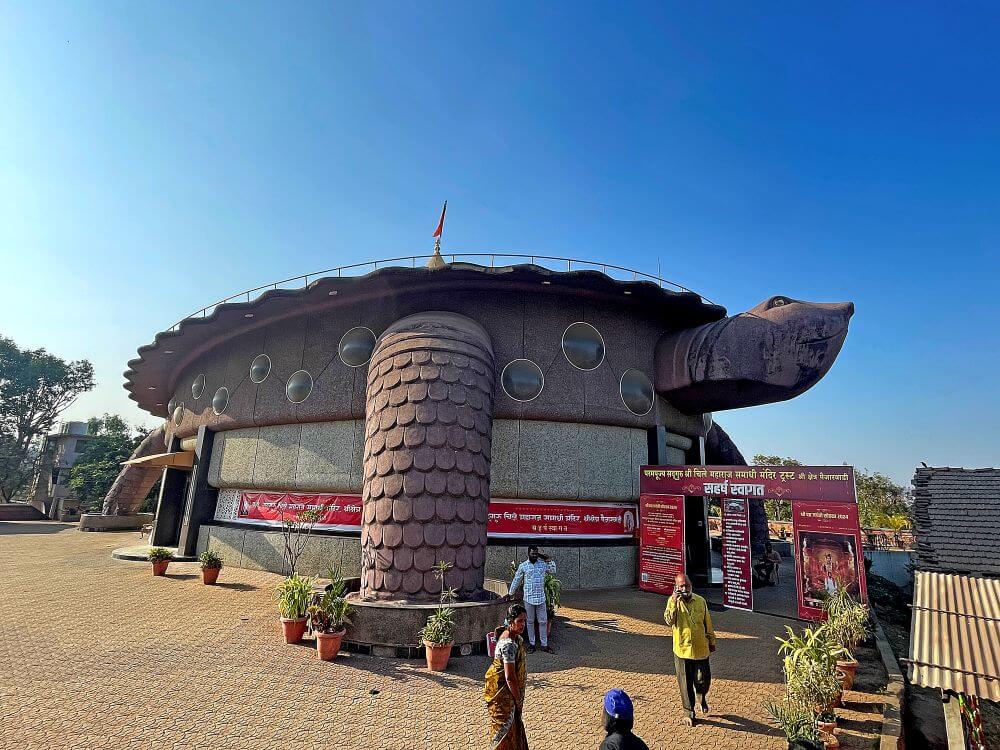
Shop Photo FramesThe Samadhi Mandir of Sadguru Chile Maharaj, about whom it is said, ‘The incarnation of Shri Gurudev Datta has manifested once again in physical form,’ is located at Paijarwadi. Chile Maharaj is considered a great soul in the Dattatreya tradition. Devotees believe that he was a miraculous being and many of his prophecies came true. Because of this, countless devotees still visit Paijarwadi today to seek blessings at his Samadhi. A unique feature of the temple here is its shape. This Samadhi Mandir is built in the shape of a tortoise.
Chile Maharaj was born during the pre-independence era on 15 August 1922 in the village of Jeur in Panhala Taluka. His father had migrated to Kolhapur for work, but Chile Maharaj spent his childhood in his native village of Jeur. His mother passed away a few days after his birth. Thereafter, he went to Kolhapur. While he was pursuing his school education there, his father also passed away. Following this, he left school and began a life of wandering. Later, he met the saint Garade Maharaj, who became Chile Maharaj’s first Guru. Garade Maharaj sent him to Siddheshwar Maharaj and Patil Maharaj of Kolhapur. The Samadhi of Siddheshwar is on one bank of the Panchganga River in Kolhapur, while the Samadhi of Patil Baba is on the other. He performed an Anushthana (ritual observance) of 25 days near the Samadhi of Siddheshwar. From that moment on, his life changed completely.
In his youth, while visiting the Dattatreya Temple in Chikhali, Kolhapur district, he experienced a divine revelation. Thereafter, he began wandering, often reciting phrases like, “My mind, your mind, what shall I tell the people?” He was also deeply influenced by the saint of Dhankawadi, Shankar Maharaj, whom he addressed as ‘Dada’, treating him like an elder brother. Chile Maharaj led an extremely simple life. In the book ‘Chile Maharaj Mahatmya’, written in the nineteen-nineties by Madhukar Thakur, also known as Das Madhu of Gangapur, it is described: “Wearing a white pyjama, adorned in a pristine shirt, sometimes with a cap upon his head, such was his attire.” His nature was spontaneous, following wherever his heart led him. The book further describes him, stating, “Chile Maharaj remained absorbed in his own divine trance, and Goddess Saraswati flowed through his words. What he spoke in public was understood only by his devotees; others could not grasp it.” He guided people toward the path of truth. He would speak to one person, yet the message would reach many. He often declared, “Aham Brahmasmi” (I am Brahman) and “I am Dattatreya Maharaj himself.” His devotees recount that many of his prophecies came true. It was during his final years that people truly realized his greatness. He traveled extensively, particularly in the regions of Kolhapur, Satara, and Nashik.
Teaching the simple philosophy that “one should remember sorrow while in happiness, and face sorrow with a smile to lessen its intensity,” and spreading the glory of devotion to God by singing the bhajan, “Raghupati Raghava Raja Ram, Patita Pavana Sita Ram,” this noble soul passed away at the age of sixty-four in Kolhapur on Wednesday, the fourteenth day of the waning moon of Chaitra in the year nineteen hundred and eight of the Shaka calendar (seventh of May, nineteen eighty-six). Subsequently, his Samadhi temple was built in his native village of Paijarwadi.
Gurudev Datta was always accompanied by Mother Cow and a dog. Chile Maharaj also had immense love for all living beings. He had a special affection for the tortoise. Lord Vishnu had incarnated as a tortoise (Kurma). For this reason, when the trust established by the devotees of Chile Maharaj decided to build his grand Samadhi temple, it was decided that the temple should be shaped like a tortoise. Accordingly, this Samadhi temple was constructed on a spacious plot of land in Paijarwadi. Today, it has become a center of attraction for devotees. Not only this, but this temple has also received the ‘Outstanding Structure of the Year’ award from the American Concrete Institute for its unique architecture.
The design of this Samadhi temple consists of a grand courtyard built on a high platform using pink stone, with circular tower-like structures on all four sides, and the magnificent tortoise-shaped edifice in the center. The temple features a high circular building, shapes resembling tortoise legs on all four sides, a roof like a tortoise shell topped with a small spire, and a large tortoise face above the main entrance. One enters the temple by climbing a few steps. In the temple courtyard, there is a beautiful Tulsi Vrindavan carved in stone. Exquisite idols of Ganesha and Radha Krishna are carved upon it. At the base of the Tulsi Vrindavan, the shape of a tortoise’s head has been given at all four corners.
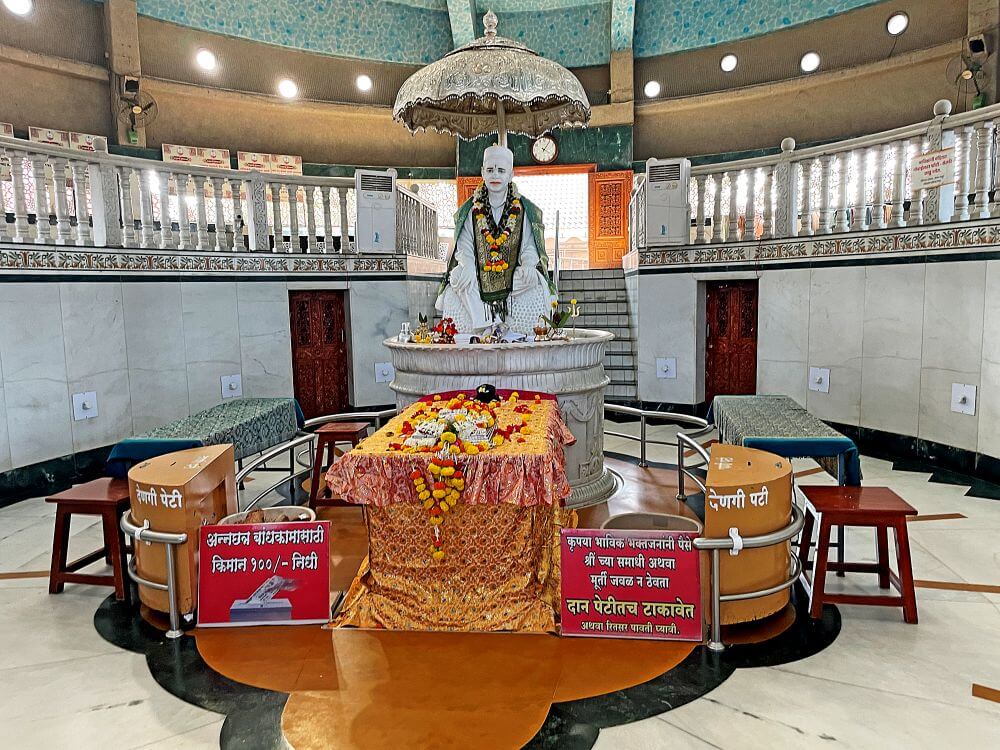
Upon entering the temple, one sees a grand dome-shaped assembly hall. The unique feature of this assembly hall, constructed entirely of marble, is that it is built without the support of pillars. In the center of this hall, there is a sanctum sanctorum that is open from above like a deep well and is enclosed by railings. One enters it by descending a few steps. In the center of this sanctum, upon a high circular pedestal, stands the idol of Chile Maharaj. The idol is depicted wearing a white shirt and pajamas, just as he used to dress in his lifetime. It is carved from white marble. In front of this idol are the padukas (footprints) of Chile Maharaj and a replica of a tortoise, both of which are also crafted from marble. Above the Maharaj’s idol is a large silver canopy.
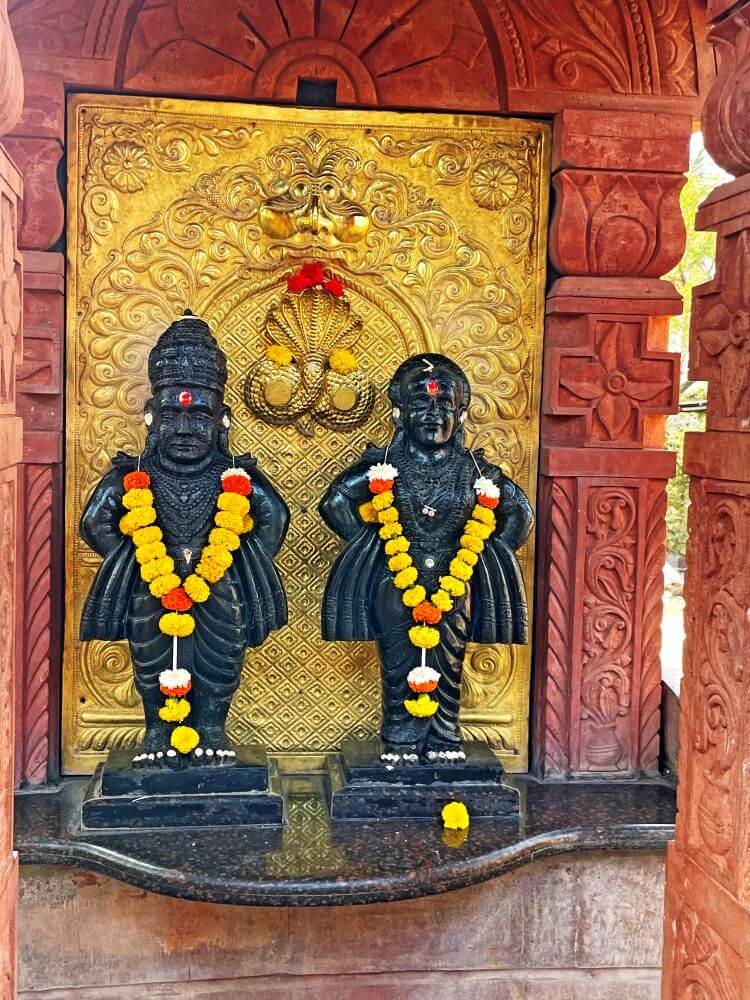
To ensure the temple is filled with bright light, there are marble latticed windows on all sides, as well as intricately carved wooden entrance doors. There are three separate chambers in the Samadhi temple for meditation. In the premises behind the Samadhi temple, there are beautiful small shrines with carvings housing the idols of Lord Dattatreya, Vitthal-Rukmini, and Hanuman. The place of the Maharaj’s padukas is also here. There is also a spacious hall here, where a large portrait of the Maharaj is kept.
Darshan at the Chile Maharaj Samadhi Temple is available from 5 in the morning until 10 at night. Abhishek takes place at 6 in the morning, Aarti at 7 in the morning, Naivedya and Aarti at 12 in the afternoon, Aarti at 5 in the evening, and Shejarti at 9 at night. Every Thursday, Abhishek and special Puja Aarti are performed at 6 in the morning. Similarly, Mahaprasad is distributed here on every Amavasya. Festivals such as Datta Jayanti, Kojagiri Purnima, Mahashivratri, Guru Purnima, and Dussehra are celebrated here with great enthusiasm. Gokulashtami is the appearance day of Chile Maharaj, and a large crowd of devotees gathers here on this day as well.
This sacred temple stands as a testament to deep spiritual devotion, ancient architectural grandeur, and rich local cultural traditions.
The sanctum sanctorum houses the divine idol consecrated according to ancient Vedic traditions, surrounded by serene courtyards and traditional temple architecture.

Navratri, Maha Shivratri, Annual Temple Jatra & Deepotsav
Compare and book flights, secure top-rated local hotels near the temple, hire reliable guides, and rent cars instantly.
Extend your pilgrimage by visiting other highly sacred temples located nearby.


Add ₹999 more to unlock FREE SHIPPING!
Your sacred cart is currently empty.
Shop Photo FramesFill in your delivery details below to place your order.
Add comment