
Add ₹999 more to unlock FREE SHIPPING!
Your sacred cart is currently empty.
Shop Photo FramesLord Ganesh, the beloved deity of Gujarat and all of Asia, holds a significant place in Hindu worship. Revered as the remover of obstacles (Vighnaharta), Ganesh is given the honour of the first prayer in any Hindu ritual. In Gujarat, the grand festival of Ganesh Chaturthi, celebrated from Bhadrapada Shukla Chaturthi (fourth day of the waxing moon in the month of Bhadrapada) to Anant Chaturdashi, brings together people of various communities. Among the numerous temples dedicated to Ganesh, Surat’s Lal Mandir stands out as a unique place of worship.
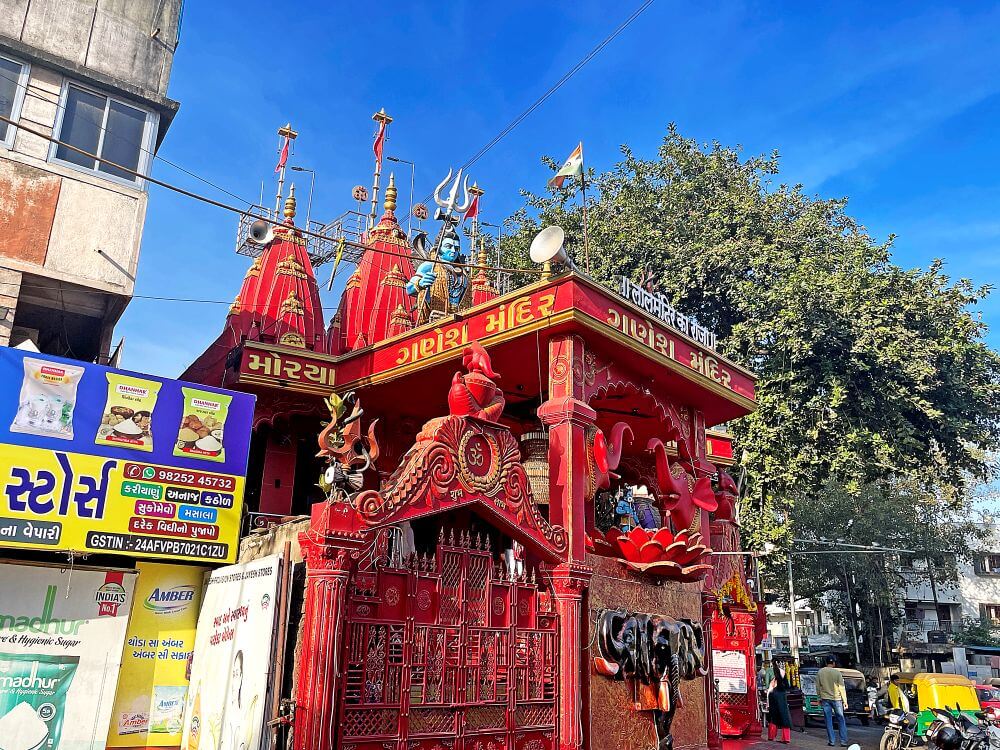
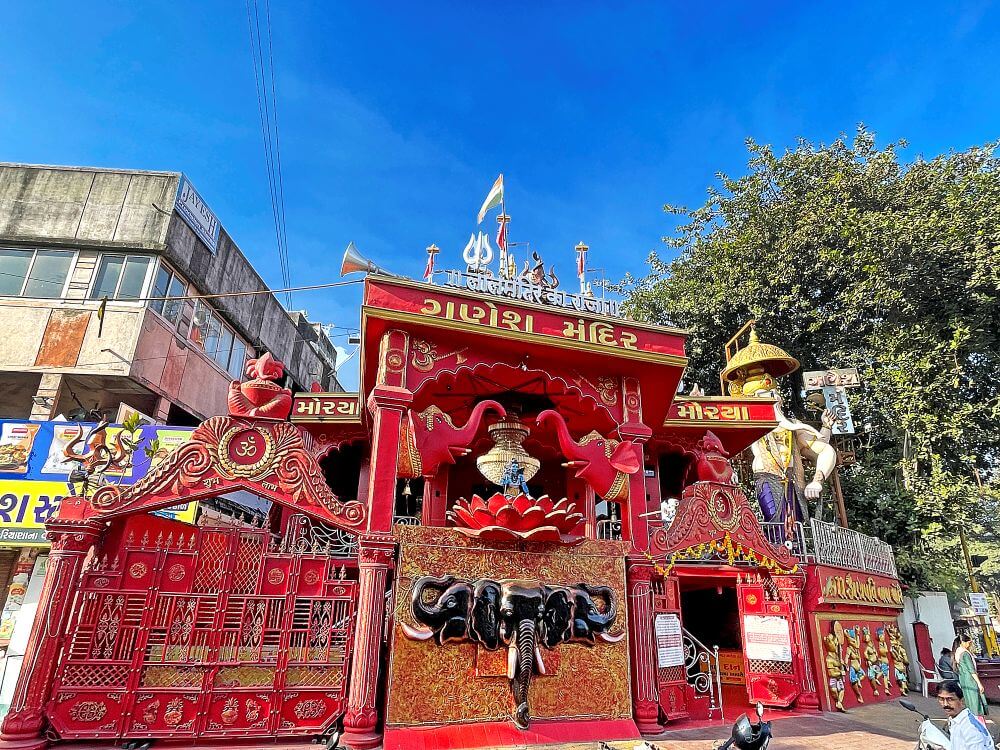
The Lal Mandir is situated in the bustling chauk of Palanpur Patiya, Surat. The temple is dedicated to Harsiddheshwar Ganesh, also referred to as the Lord of All Accomplishments. According to Hindu mythology, Siddhi and Riddhi are considered the consorts of Ganesh, symbolising spiritual and material prosperity. Built in 1995, the temple is entirely painted red, a colour deeply associated with Ganesh, symbolising energy and power.
The use of red colour across the temple stems from the belief that Ganesh was originally a deity of non-Aryan communities. This is reflected in the traditional application of red shendur (vermillion paste) on his idols. According to historians and religious texts, this association signifies his ancient roots. A fascinating legend from the Dwapara Yuga (third epoch in Hindu cosmology) explains Ganesh’s connection to the red colour. According to this story, Lord Brahma, upon waking from his sleep, yawned and from his mouth emerged a fearsome being with a blood-red complexion yet a fragrant body. Pleased with his creation, Brahma named him Sindur and blessed him to rule over the three worlds. Empowered by the boon, Sindur became arrogant and began to torment the universe, earning the name Sindurasura.
Seeking to test his strength, Sindurasura attacked Mount Kailash, forcing Goddess Parvati to flee. It was during this time that Parvati gave birth to Ganesh. Even as a child, Ganesh resolved to defeat Sindurasura. Riding his mouse vehicle (mushak), Ganesh waged a battle and killed Sindurasura, scattering his blood everywhere. The blood turned Ganesh’s body red, leading to his association with the colour.
According to the ‘Mudgala Purana’, a different story explains Ganesh’s association with the red colour. In this version, a figure known as Raktavarna performed intense penance (tapasya). Pleased with his devotion, Ganesh appeared before him. Raktavarna expressed his wish for Ganesh to resemble him. In his benevolence, Ganesh granted his wish and adopted Raktavarna’s red complexion. The ‘Bharatiya Sanskruti Kosha’ (Encyclopaedia of Indian Culture) provides a spiritual explanation for Ganesh’s preference for red garments, red flowers and red sandalwood paste. It states that Ganesh is the ruler of the Muladhara Chakra (the root energy centre in the human body). Both the chakra and the lotus associated with it are red. Additionally, Ganesh is considered the creator, representing the rajo guna (creative energy), which is also symbolised by the colour red. Reflecting this connection, every aspect of the Harsiddheshwar Ganesh Temple—its walls, ceiling, pillars and stairs—is painted in vibrant red. This unique feature has earned the deity the title Lal Ganesh (The Red Ganesh), making the temple famous among devotees.
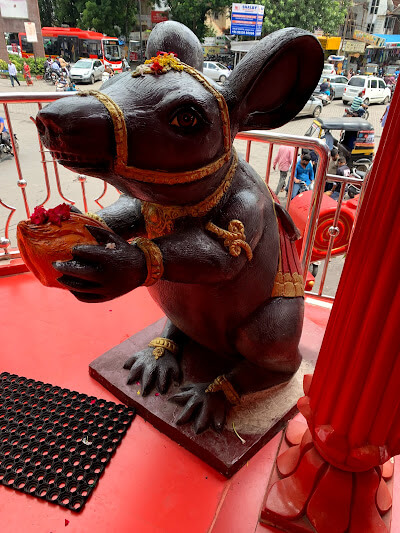
As visitors approach the temple complex, the vibrant red colour of the structure and the imposing 25-foot-tall Ganesh idol immediately draw attention. The Ganesh temple is situated on the second floor, accessed through a grand, intricately carved entrance arch adorned with a Ganesh idol at the top. Right Wall of the Arch features a large bas-relief of a tri-faced elephant. Above it, a standing blue idol of Shiva is set within lotus petals, with gajmukha (elephant-headed carvings) on both supporting pillars. Left Wall of the Arch displays carvings of Ganesh’s vehicle, the mouse (mushak), in various dance poses. The red staircase leads directly to the temple on the upper floor. At the entrance, a marble statue of a mushak is placed on a raised platform, symbolising Ganesh’s loyal vehicle.
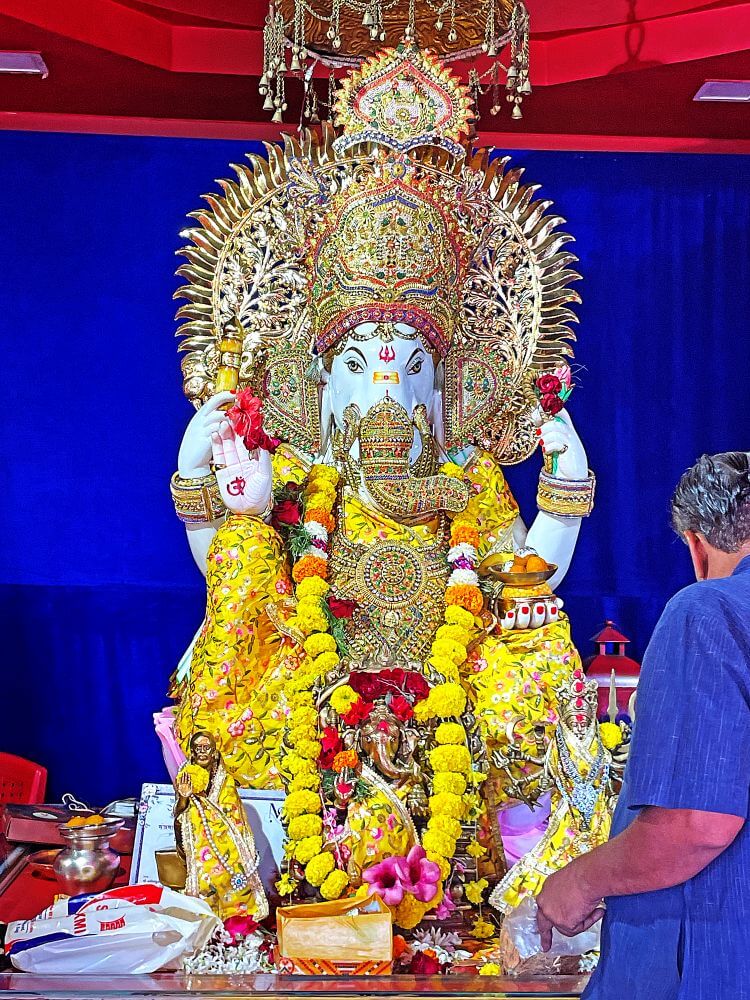
The temple comprises one main sanctum and two subsidiary sanctums. The main sanctum houses a four-armed idol of Harsiddheshwar Ganesh, seated on a tall, ornately carved pedestal. The idol exudes grace, adorned with intricate jewellery, a gem-encrusted crown and a richly embroidered golden robe (pitambar). In front of the main idol is a smaller brass idol of Ganesh seated on a throne.
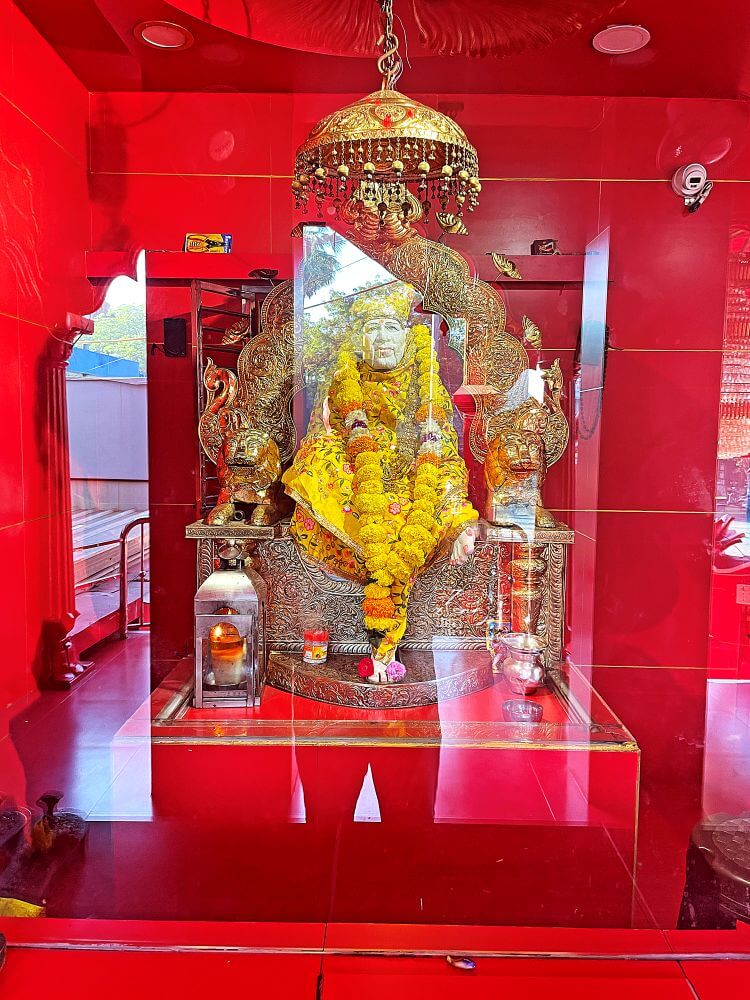
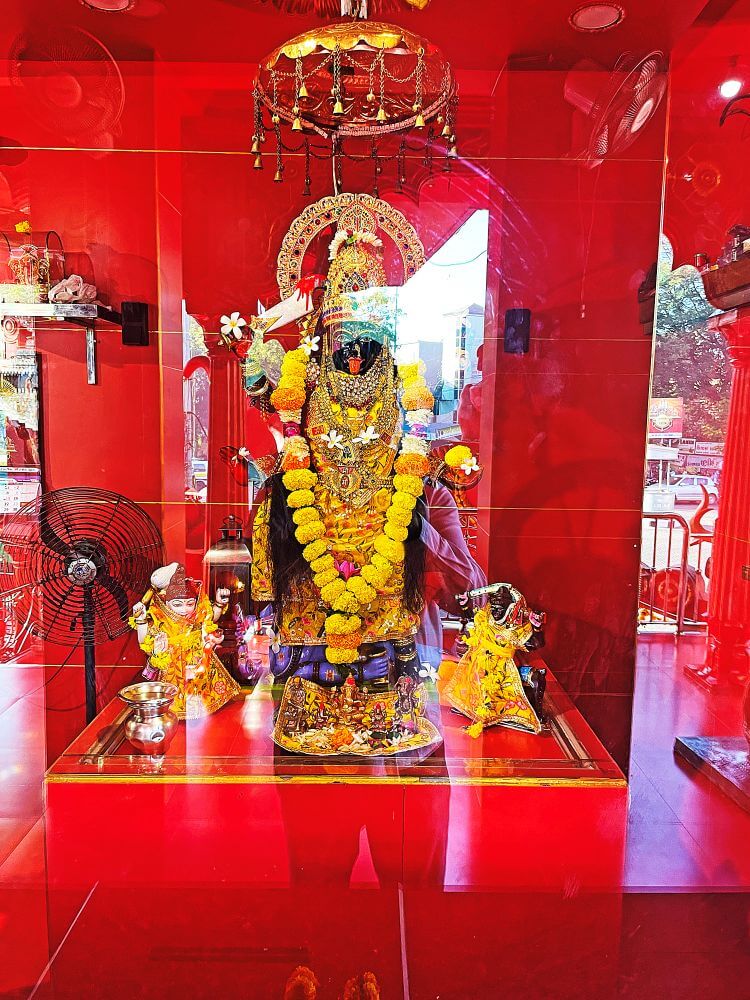
Right Subsidiary Sanctum contains a beautifully crafted idol of Sai Baba. Left Subsidiary Sanctum features a dark-complexioned idol of Goddess Kalika Mata. The temple’s blend of intricate carvings, vibrant colours and reverence for multiple deities adds to its spiritual and architectural grandeur.
In the adjacent courtyard, a massive standing Ganesh idol, 25 feet tall, commands attention. Made of clay and installed in 2022, this idol, known as ‘Lal Mandir’s Raja,’ has a crown, a parasol (chhatra), a battle-axe (parshu) and a mace (gada), with one hand in a protective gesture (abhaya mudra). At the feet of this idol is a statue of Ganesh’s mouse. This Ganesh idol is fondly referred to as ‘Lal Mandircha Raja’ (The King of Lal Mandir). The temple roof features a small dome (ghumta), topped by a blue Shiva idol holding a trident. The main sanctum’s spires follow the Nagara architectural style, adorned with red and golden hues.
The temple attracts a steady stream of devotees, particularly on Tuesdays and during Chaturthi and Angaraki Chaturthi. The grand Ganeshotsav (Ganesh festival) is celebrated with great zeal, featuring elaborate decorations, processions and rituals. Thousands of devotees participate in the immersion procession of the Ganesh idol on the final day of the festival.
This sacred temple stands as a testament to deep spiritual devotion, ancient architectural grandeur, and rich local cultural traditions.
The sanctum sanctorum houses the divine idol consecrated according to ancient Vedic traditions, surrounded by serene courtyards and traditional temple architecture.
Navratri, Maha Shivratri, Annual Temple Jatra & Deepotsav
Compare and book flights, secure top-rated local hotels near the temple, hire reliable guides, and rent cars instantly.
Extend your pilgrimage by visiting other highly sacred temples located nearby.


Add ₹999 more to unlock FREE SHIPPING!
Your sacred cart is currently empty.
Shop Photo FramesFill in your delivery details below to place your order.
Add comment