
Add ₹999 more to unlock FREE SHIPPING!
Your sacred cart is currently empty.
Shop Photo FramesNarayan Bet, situated in the riverbed of the Bhima River at Kedgaon in the Daund Taluka of Pune district, is considered an important pilgrimage site and Shaktipeeth of the Datta Sampradaya. This site was established by Sadguru Narayan Maharaj at the beginning of the twentieth century. The main attraction of the primary temple here is a diamond-studded golden idol of Shri Dattatreya, weighing three and a half kilograms. Every year, on the Thursday preceding Datta Jayanti in the month of Margashirsha, this idol is made available for devotees to have darshan. At that time, thousands of devotees gather at this Narayan Bet to seek the blessings of Shri Datta. Sanctified by the presence of Narayan Maharaj, this place is a center of faith for millions of devotees.
Sadguru Narayan Maharaj was born in eighteen eighty-five into a Brahmin family in Bagalkot, Karnataka. His childhood was marked by extreme struggle. He faced a mountain of sorrow after losing his father at the tender age of two and his mother at the age of five. From a young age, he felt a deep longing for divine devotion. He would sit in meditation for hours at the Venkatesh temple near his home. At the age of nine, he renounced his home. While wandering, he resided in Gangapur between nineteen hundred and nineteen hundred and one. In the holy land of Gangapur, Lord Dattatreya himself appeared before him and initiated him. Thereafter, he dedicated himself to the welfare of the people. Between nineteen hundred and two and nineteen hundred and four, he resided in the Arvi and Supe regions, and finally, in nineteen hundred and five, he arrived in the Kedgaon area of Daund Taluka. At that time, this place was extremely remote and infested with wild animals. Maharaj began searching for a quiet place for his Guru’s, i.e., Shri Datta’s temple. He particularly liked this island-like place surrounded by streams on all four sides. He purchased this land, and in nineteen hundred and thirteen, the construction of the Datta temple began here. In no time, this barren land was transformed into a beautiful ‘Narayan Bet’. During this period, Vasanji Sheth Dasani offered a precious golden idol for the temple. Subsequently, this place became renowned across the entire country as a major center of Datta devotion.
In nineteen hundred and thirty, Maharaj performed the first Atirudra Anushthan in front of the golden idol of Shri Datta installed in the temple. In the same year, a ceremony of one hundred and eight Shri Satyanarayan pujas was held. In nineteen hundred and thirty-three, Maharaj conducted a ceremony of one thousand one hundred and eight Satyanarayan Mahapujas simultaneously at this place. Furthermore, in the month of March nineteen hundred and thirty-six, one hundred and eight Satyanarayan pujas were performed every hour for an entire week, day and night. Thereafter, in nineteen hundred and thirty-seven, Maharaj left for a pilgrimage. He returned to the Bet in nineteen hundred and forty-three. In nineteen hundred and forty-four, Maharaj performed a Mahamrityunjaya Anushthan on this Bet. In nineteen hundred and forty-five, he left Narayan Bet and went to Bengaluru; he never returned to Narayan Bet. There, on Shravan Vadya Dwadashi, September third, nineteen hundred and forty-five, an Atirudra Swahakar Anushthan took place, and at five o’clock in the evening, Sadguru Narayan Maharaj merged into the lotus feet of Lord Datta. His ashes were brought from there and placed at the Samadhi site of Maharaj in Narayan Bet.
Many ancient mythological references and legends are associated with Narayan Bet. According to a famous legend, when Maharaj first came to this place, he heard a conversation between two Pingala birds. Those birds considered this land to be sanctified by the touch of the feet of Shri Rama. Their conversation mentioned that Shri Rama had stayed here for some time during his exile. Upon receiving a sign that this land would provide food and spiritual peace to thousands of people in the future, Maharaj decided to build a temple here. Once, while Maharaj was meditating on a large rock by the riverbank, the river suddenly flooded, and the water level began to rise rapidly. However, the floodwater bypassed the rock without touching Maharaj. Seeing this, the devotees present realized the power of Maharaj’s penance. Similarly, during Maharaj’s stay, a tiger used to visit regularly, pay obeisance to him, and then depart. It is the firm belief of devotees that as soon as one sets foot on this island, the mental ailments and physical sufferings of the devotees are destroyed.
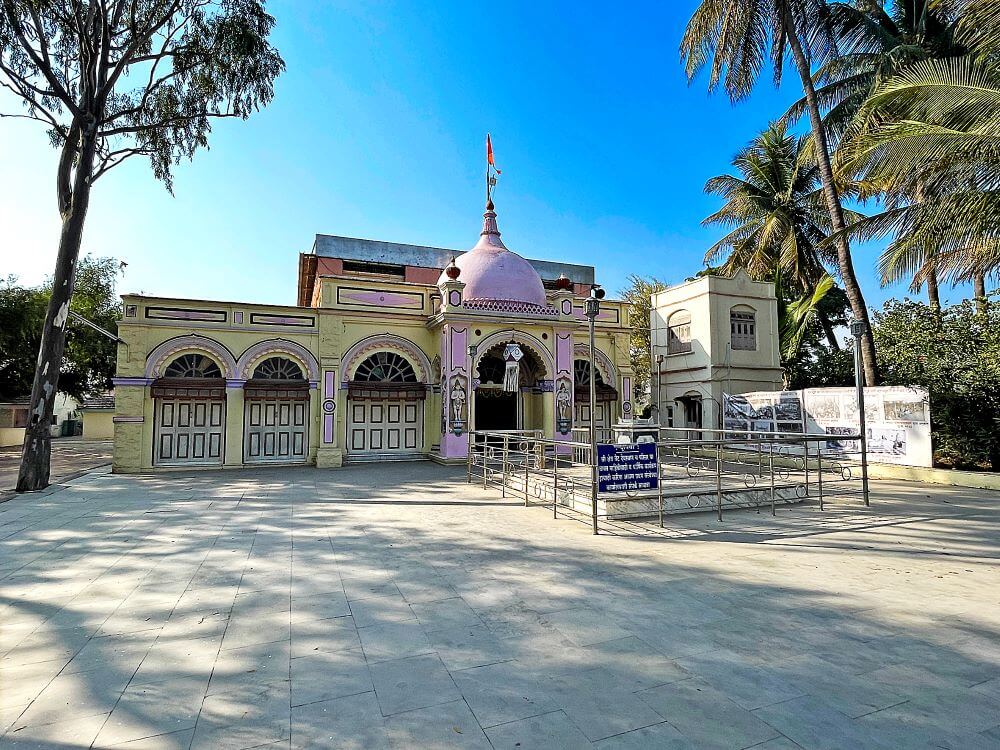
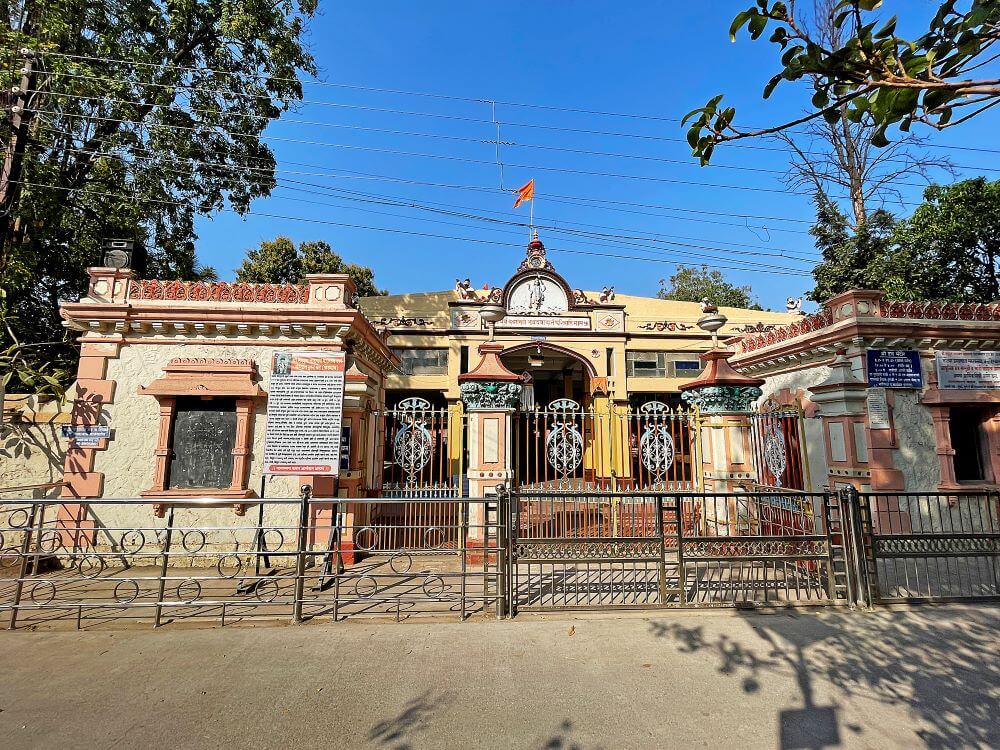
Located at Kedgaon on the Pune-Solapur highway, this island, spread over an area of about eleven acres in the Bhima riverbed, is surrounded by a strong fortification. There is an entrance gate with two bastions to enter through it. From here, one enters the spacious courtyard of the temple. The courtyard is dense with shady trees and houses the temple office, Annachhatra (free food distribution center), and a large hall. The Shri Datta temple is on the right side of the courtyard. In front of it are the residences for guards and storage rooms. During the monsoon, when the river water rises, this place is surrounded by water on all sides.
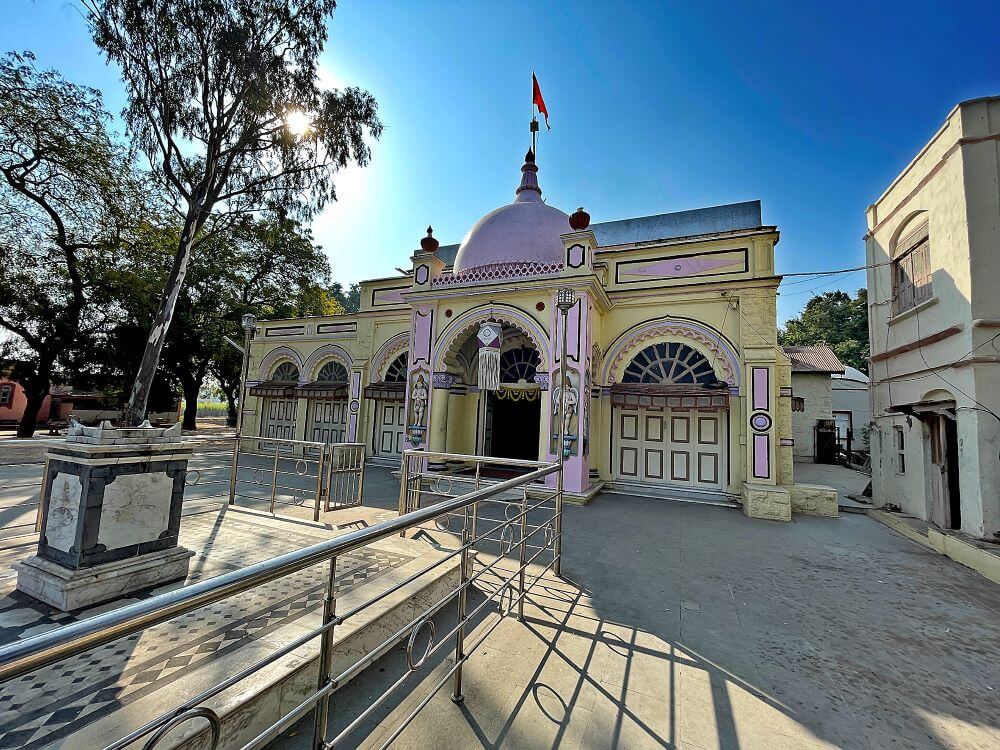
The structure of the Shri Datta temple consists of a Sabha Mandap (assembly hall), Antaral (vestibule), and Garbhagriha (sanctum sanctorum). It is said that the Sabha Mandap was built around the original temple at a later date. The semi-open Sabha Mandap has four rows of square pillars. On the ceiling between every four pillars, there is a circular design in the center. The palanquin used during festivals is kept in the Sabha Mandap. The Guru Gadi (seat of the Guru) is to the side. Further ahead, on a platform about three feet high, is the original temple. The original structure of the temple consists of an Antaral and a Garbhagriha. The Antaral has ornate pillars on the exterior. All the pillars are connected to each other by arched toranas. The brackets, toranas, and the upper parts of the pillars are decorated with carvings. The brackets on the pillars feature sculptures of gods, goddesses, and saints. Further ahead is the entrance to the Garbhagriha. On both sides of the entrance are sculptures of four-armed Dwarapalas (gatekeepers). The Dwarapalas on both sides hold a chauri (fly-whisk) and a whip in their hands. The left Dwarapala holds a staff in his other two hands, while the right Dwarapala holds a drinking vessel and a noose in his other two hands. The entrance has ornate door frames. On the lower side of the door frames are sculptures of the four-armed Vishnu and Lakshmi. There is a sculpture of Ganpati on the Lalatbimba (lintel). There are moonstones near the threshold. Above the entrance are sculptures of Gandharva singers along with Gajalakshmi.
In the sanctum sanctorum, upon the Vajrapitha, reside Brahma, Mahesh, and Vishnu in the form of Shri Dattatreya. In a standard Dattatreya idol, the order is Brahma, Vishnu, and Mahesh; however, as Mahesh is central in this idol, it is said to be a Shaiva-dominant Dattatreya idol. Behind the idol is an ornate silver prabhaval (halo), which features auspicious symbols such as Kirtimukha, flags, lotuses, and conch shells. Outside the sanctum, there is a circumambulation path passing through the antarala. On the outer walls of the sanctum, there are niches on three sides containing sculptures of the deities Yama, Varuna, and Kubera. Above the roof of the sanctum stands a tall, tapering, square-shaped shikhara. The shikhara features lamp niches and smaller urushringi-style spires. At the pinnacle of the shikhara sits the amalaka, topped by a kalasha and a flag.
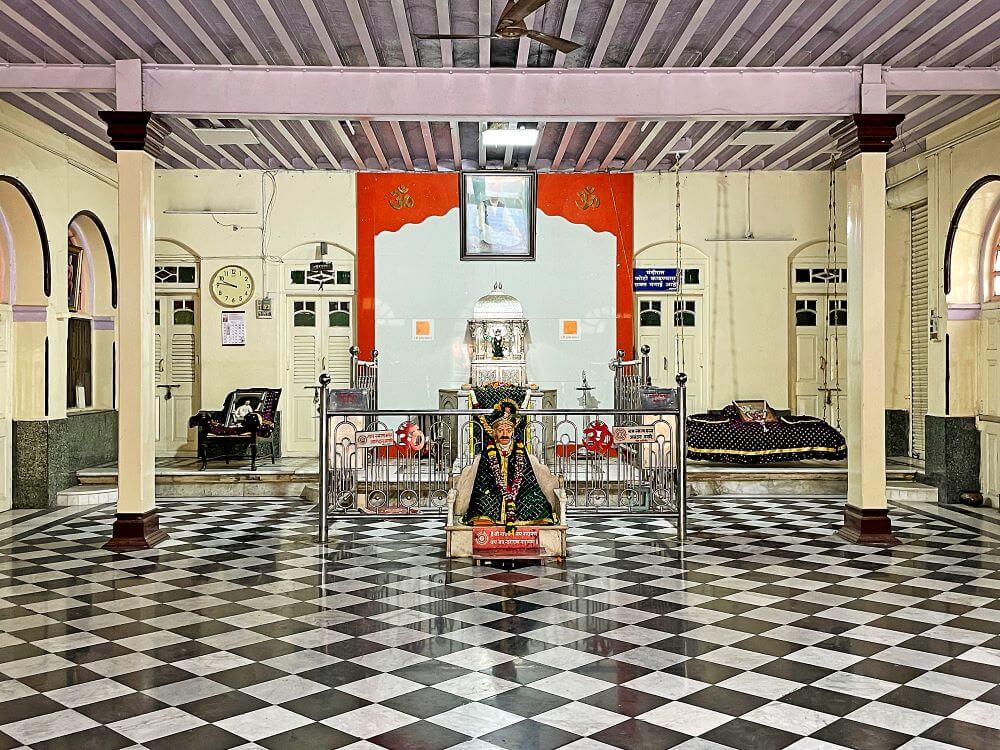
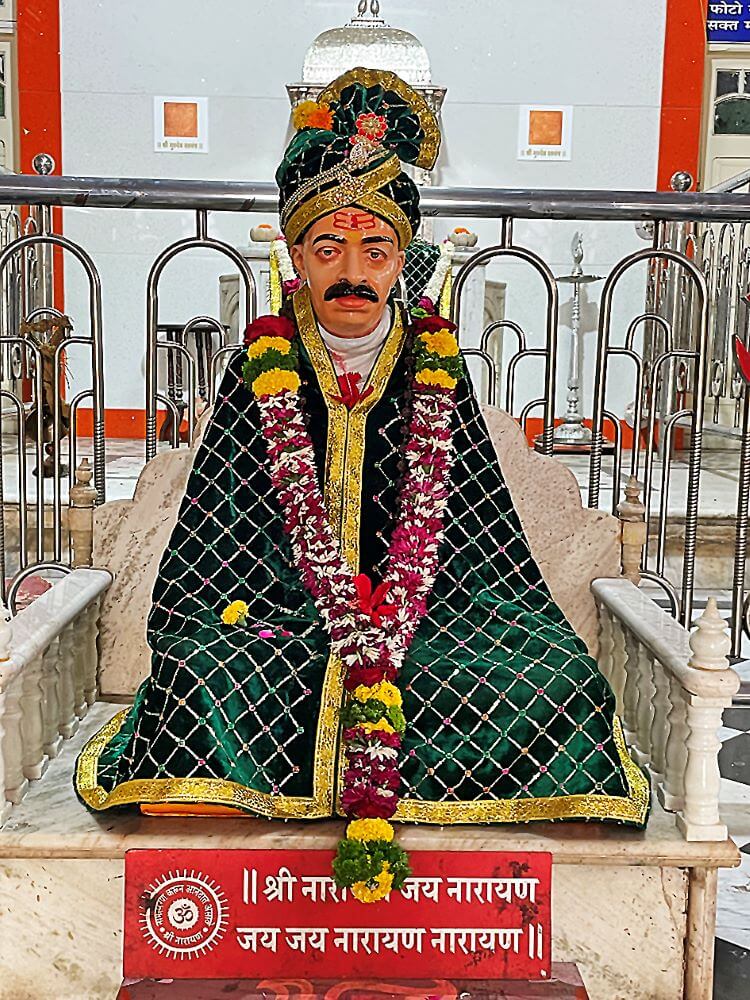
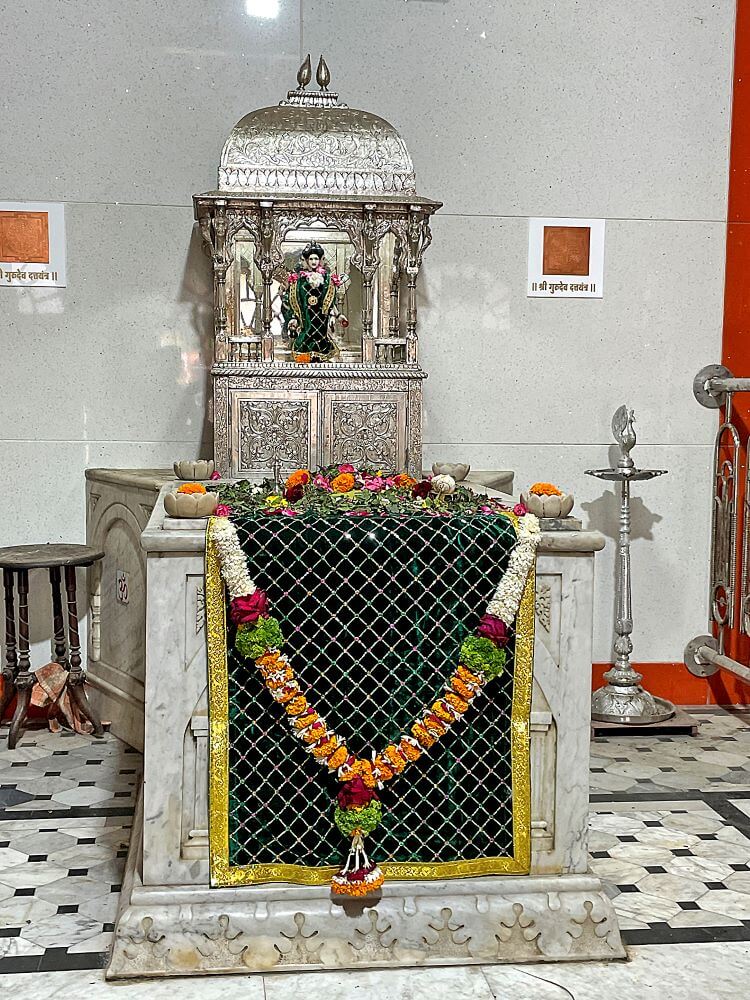
At a short distance from the Dattatreya temple is the Samadhi temple of Narayan Maharaj, which served as his residence. In front of the Samadhi temple stands a Tulsi Vrindavan. The Samadhi temple consists of a mukhamandapa and a sabhamandapa. In the sabhamandapa, a marble statue of Narayan Maharaj rests on a marble seat. Behind the statue is the platform of the Maharaj’s Samadhi, and behind that platform is his silver throne. On both sides of the throne are silver lion sculptures, with a silver arch above. To the right of the platform hangs the Maharaj’s cradle from the ceiling. Devotees believe in the Maharaj’s presence here because this cradle is said to swing continuously.
Throughout the year, various religious festivals are celebrated on Narayan Bet with great enthusiasm and discipline. The Dattatreya Jayanti celebration held on Margashirsha Purnima is considered the grandest festival here. On the Thursday preceding this, a diamond-studded gold idol weighing three and a half kilograms is brought out for darshan; at other times, it is kept in a bank locker for security. Seven days before this festival, the recitation of the Shri Gurucharitra scripture is performed, and the Palkhi procession takes place on the day of the full moon. The Guru Purnima festival on Ashadha Purnima and the special rituals on Mahashivratri are significant for devotees. The day of September 3 is observed as the Maharaj’s Punyatithi, and bhajans and kirtans are organized on this day. The day begins in the temple at 5 o’clock in the morning with the melodious sound of bells, followed by Panchamrit Puja and Rudrabhishek on the Padukas. The tradition of Annadan (offering of food) started by the Maharaj continues to this day, with hundreds of devotees partaking in the Mahaprasad daily. Devotees can have darshan here until 8 o’clock at night.
This sacred temple stands as a testament to deep spiritual devotion, ancient architectural grandeur, and rich local cultural traditions.
The sanctum sanctorum houses the divine idol consecrated according to ancient Vedic traditions, surrounded by serene courtyards and traditional temple architecture.
Navratri, Maha Shivratri, Annual Temple Jatra & Deepotsav
Compare and book flights, secure top-rated local hotels near the temple, hire reliable guides, and rent cars instantly.
Extend your pilgrimage by visiting other highly sacred temples located nearby.


Add ₹999 more to unlock FREE SHIPPING!
Your sacred cart is currently empty.
Shop Photo FramesFill in your delivery details below to place your order.
Add comment