
Add ₹999 more to unlock FREE SHIPPING!
Your sacred cart is currently empty.
Shop Photo FramesThe town of Lunawada in Mahisagar District is renowned for its ancient history and enduring religious traditions. Nestled within the valleys of the Mahi, Panam and Veri rivers, the town is revered as the ‘Kashi of Gujarat’. It was established by the Solanki Rajput King and derives its name from the celebrated Luneshwar Mahadev Temple. The region is also home to the ancient Shiva shrines of Luneshwar Mahadev, Ranmukteshwar Mahadev and Kalbhairav. Among the town’s most distinguished landmarks is the Ramji Temple, held in special reverence by the Lunawada royal family. It remains a cherished place of worship for countless devotees.
According to local historical records, the temple was built in 1804 by Rajmata Kushal Kunwarba, the Queen Mother of Lunawada. Its history is therefore inseparably linked with that of the royal family. The Solanki dynasty, descended from Siddharaj Jaysinh, established its rule at Virpur in 1225, and consequently came to be known as the ‘Virpura Solankis’. In 1434, Rana Bhimsinhji, troubled by increasing incursions from Muslim rulers and seeking a more secure location, founded the town of Lunawada on the opposite bank of the Mahi River and established it as his new capital.
During the eighteenth and nineteenth centuries, the entire Lunawada region experienced considerable political instability. In 1803, a significant agreement was concluded between Major Alexander Walker, the British Resident, and Rana Fattehsinhji, the ruler of Lunawada. Intended to restore peace and order across Gujarat, this agreement became known in history as the ‘Walker Settlement’. Following this settlement, raids and plundering by the armies of the Gaekwads, Holkars, and Scindias in the Solanki territories diminished considerably. Against this backdrop of renewed political stability, Rajmata Kushal Kunwarba undertook the construction of this temple as an offering of gratitude to Lord Shri Ram.
An important milestone in the temple’s history came in 1987, when it underwent an extensive restoration. The passage of time had caused considerable deterioration, and the renovation was carried out under the guidance of the renowned spiritual preacher Ramchandra Dongre Maharaj. Born in Indore in 1926, he spent his childhood and received his education at the Sannyas Ashram in Vadodara and Ahmedabad. He was revered for his austere lifestyle and selfless nature. Every contribution received through his discourses was donated towards the welfare of people experiencing poverty and people in need. He attained his earthly end in 1990. The restoration of the temple was completed under his auspices in 1987. During this work, the temple was remodelled in the South Indian architectural style. The restoration transformed the appearance of the old structure into its present architectural form.
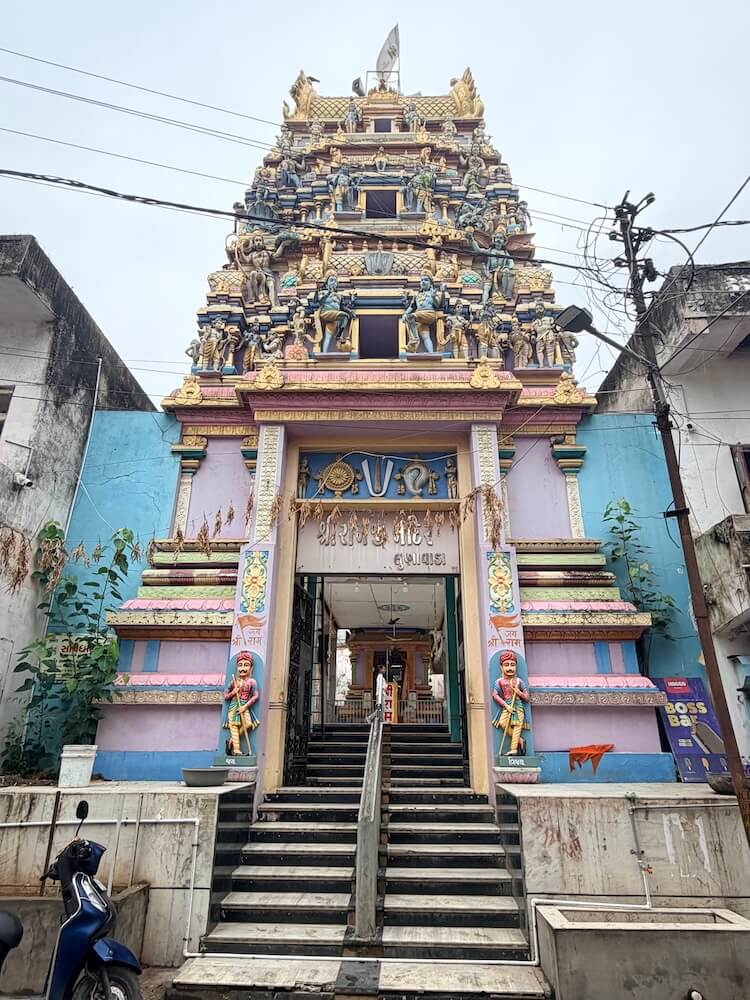
The temple stands beside the main road in the bustling heart of the town. A strong fortified wall encloses the temple complex. The principal entrance is designed in the form of a towering gopuram. As it stands above the road level, fourteen steps lead up to the gateway. Intricate carvings adorn the entrance, while sculptures of guardian deities stand on either side. The ornamental torana above the gateway bears finely carved reliefs of the conch, the discus, and the Vaishnava tilak. The three-storeyed gopuram is richly embellished with sculptures of various deities, the Dashavatara, scenes from Hindu mythology, and elegantly carved pillars. Its summit is crowned by a horizontal ‘shala’-type superstructure, surmounted by three stupikas arranged in a single row, above which rises the finial. Guard rooms are situated on both sides within the entrance.
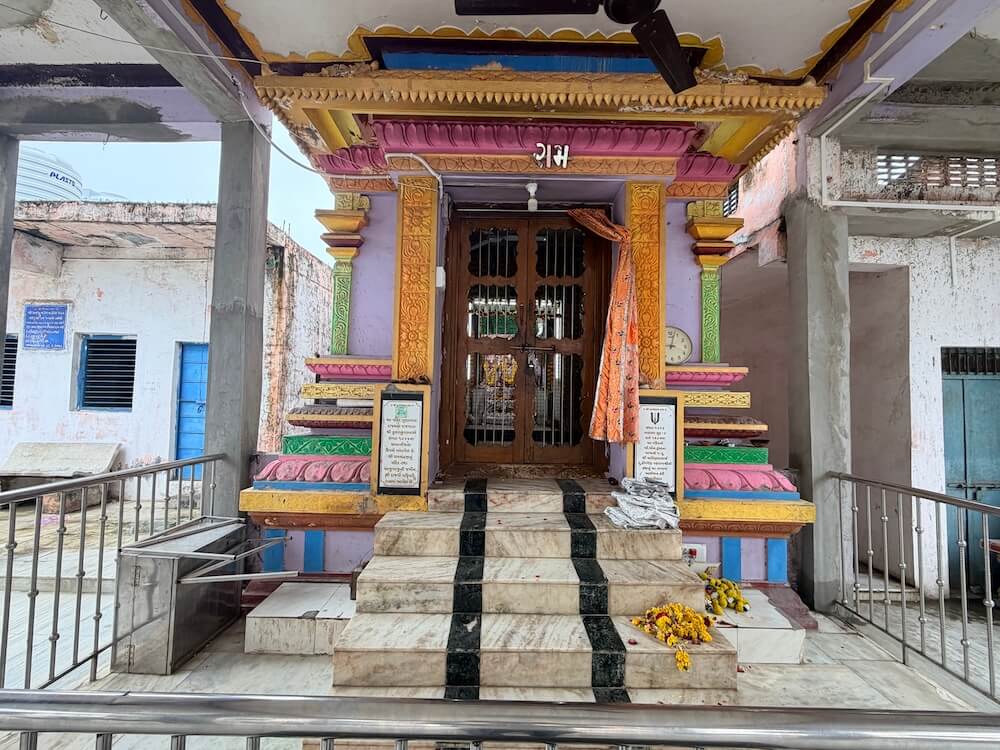
Passing through the gateway, one first notices a Tulsi Vrindavan standing in the courtyard before the temple. Seating has also been provided here for devotees. The temple principally consists of a sabhamandapa (assembly hall) and the sanctum. The semi-open assembly hall is supported externally by eight square pillars, while its ceiling is ornamented with a decorative chakra motif. Seating is available inside for devotees. The sanctum stands at a higher level than the assembly hall, and five steps lead to its entrance. The door jambs and the lintel are adorned with graceful carvings of creepers and floral designs. Within the sanctum, the silver shrine upon the vajrapitha enshrines the sacred images of Lord Shri Ram, Lakshmana, and Janaki. Their eyes are large and finely sculpted. The deities are adorned with elegant garments, ornaments, and crowns. Behind the idols is a finely carved ornamental arch decorated with floral designs, while silver canopies above their heads hang from the ceiling.
The ceiling of the sanctum rises into a circular five-tiered shikhara. Each tier is adorned with sculptures depicting various deities, the Dashavatara, mythological episodes, and birds and animals. Architectural forms of the ‘kuta’ and ‘shala’ types are also incorporated into the design. A stupika crowns the summit, above which are the finial and the temple flag.
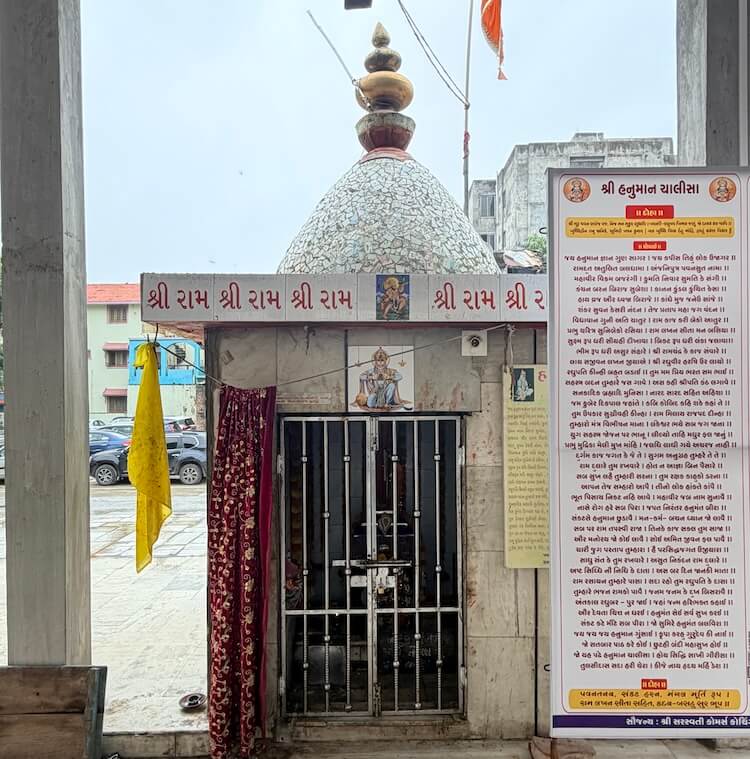
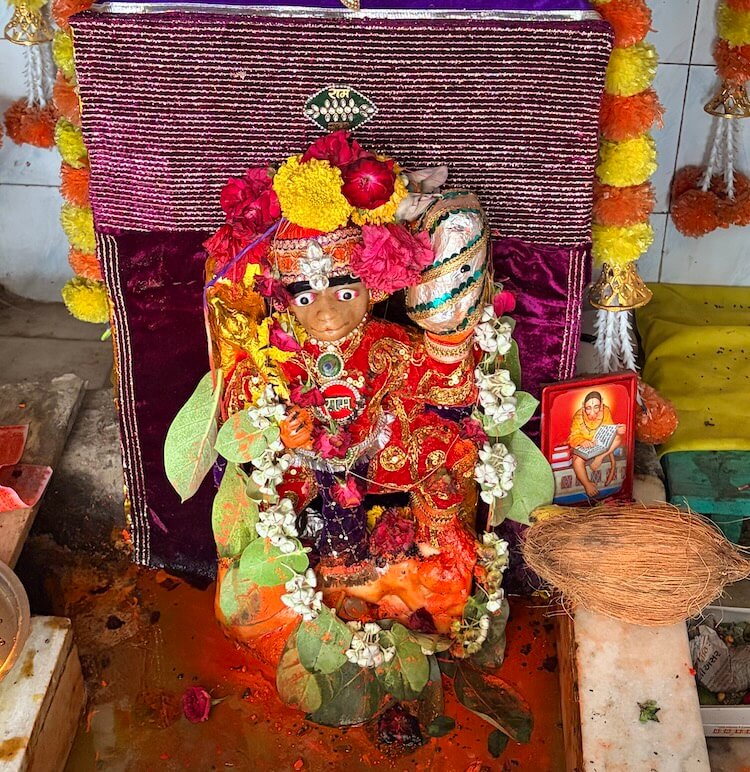
To the right of the Ramji Temple, within the courtyard, stands a shrine dedicated to Hanuman. Consisting solely of a sanctum, it houses a vermilion-anointed stone image of Lord Hanuman installed upon a vajrapitha. The shrine is surmounted by a domed shikhara.
The courtyard also contains storage rooms, residential quarters for the priests and temple attendants, accommodation for devotees, and several other ancillary structures.
Ram Navami is the temple’s principal annual festival. The celebration of Lord Shri Ram’s birth is an occasion of great joy for both the royal family and the local community. On this day, large numbers of devotees gather at the temple. A beautifully decorated cradle is prepared, and the infant image of Lord Shri Ram is placed within it. Women assembled in the temple sing traditional cradle songs. To mark the joyous birth of Lord Shri Ram, devotees are offered sakhar-sunth—a traditional mixture of sugar and dry ginger—while those whose vows have been fulfilled distribute sweets among the worshippers. The entire temple is lavishly decorated with flowers for the occasion. Programmes of devotional singing, kirtan, recitation of the Ramyana, spiritual discourses, devotional music, and the distribution of mahaprasad are organised throughout the celebrations.
Hanuman Jayanti is celebrated with great enthusiasm on Chaitra Purnima. A decorated cradle is prepared, within which the infant image of Hanuman is gently rocked. Devotees sing songs commemorating the birth of Hanuman. The entire temple complex resounds with jubilant chants in praise of Hanuman and Lord Shri Ram. On this occasion, Motichoor laddus are distributed as prasad.
From the first day of the bright fortnight of Ashwin until Dussehra, the temple celebrates the ten-day Shri Ram Vijayotsav. During this period, the story of Lord Shri Ram is narrated daily, while dramtic performances of the Ramlila are staged each evening. The temple witnesses a continuous influx of devotees throughout these ten days. On Dussehra, a ceremonial procession through the town, the traditional exchange and collection of symbolic ‘gold’ leaves, and a grand religious procession are organised. Participants in the procession appear in costumes portraying characters from Hindu mythology.
Besides these major celebrations, the temple also organises religious programmes during Shri Krishna Janmotsav, Dussehra, Diwali, and the holy month of Shravan. Devotees may have the darshan of Lord Ram every day from 6.00 a.m. to 12.00 noon and from 4.00 p.m. to 8.00 p.m.
This sacred temple stands as a testament to deep spiritual devotion, ancient architectural grandeur, and rich local cultural traditions.
The sanctum sanctorum houses the divine idol consecrated according to ancient Vedic traditions, surrounded by serene courtyards and traditional temple architecture.


Navratri, Maha Shivratri, Annual Temple Jatra & Deepotsav
Compare and book flights, secure top-rated local hotels near the temple, hire reliable guides, and rent cars instantly.
Extend your pilgrimage by visiting other highly sacred temples located nearby.


Add ₹999 more to unlock FREE SHIPPING!
Your sacred cart is currently empty.
Shop Photo FramesFill in your delivery details below to place your order.
Add comment