
Add ₹999 more to unlock FREE SHIPPING!
Your sacred cart is currently empty.
Shop Photo FramesAmona, a village in the Bicholim taluka of North Goa, has been a center of agriculture and trade since ancient times. Situated on the banks of the Mandovi River, the village is believed by the Archaeological Department to house an ancient fort buried underground. Historically, this region had well-established means of transport and water navigation. Consequently, since the Aryan era, many rulers attempted to establish their authority over this area. Even today, ancient shields and swords can be seen in the local temples. There is an ancient and famous temple of Goddess Shantadurga in this village. Devotees believe that this Goddess is ‘Jagrut’ (awakened/manifest).
It is said that this temple is about four hundred years old. According to legend, the original temple of the Goddess was in Keloshi village. When many Hindu temples faced threats during the Portuguese regime, the villagers carried the idols of their revered deities on their heads and took refuge in the kingdom of the Hindu kings of Sawantwadi in North Goa. They installed their deities there. As further migrations occurred, each group established temples for their family deities and chosen deities in their respective settlements. The Shantadurga Temple in Amona is one of them.
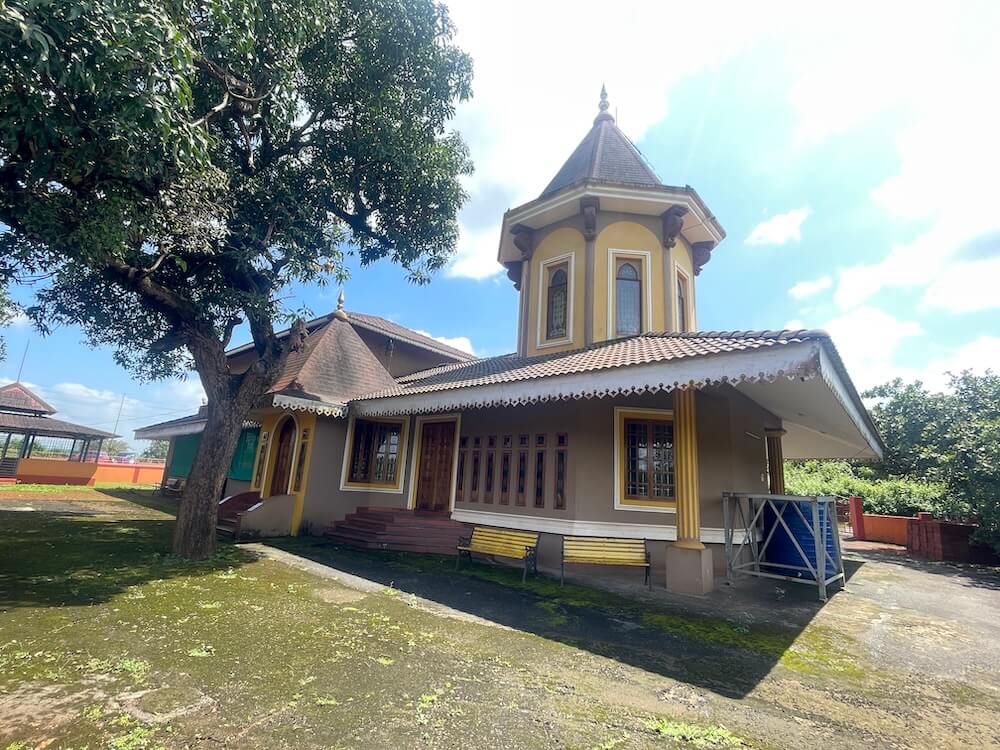
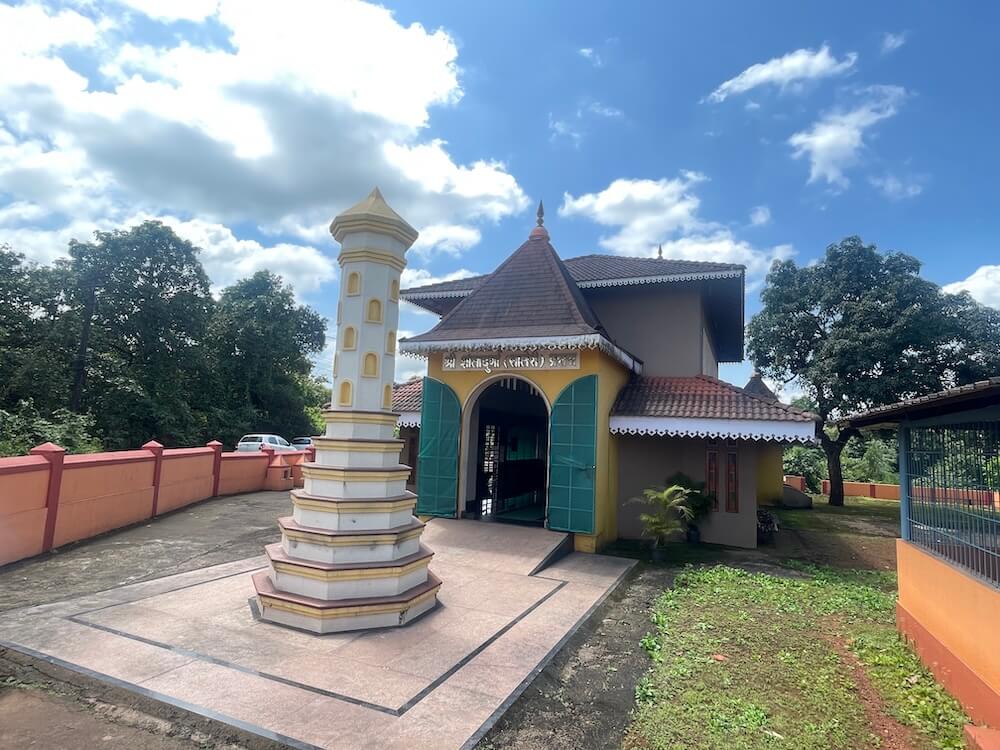
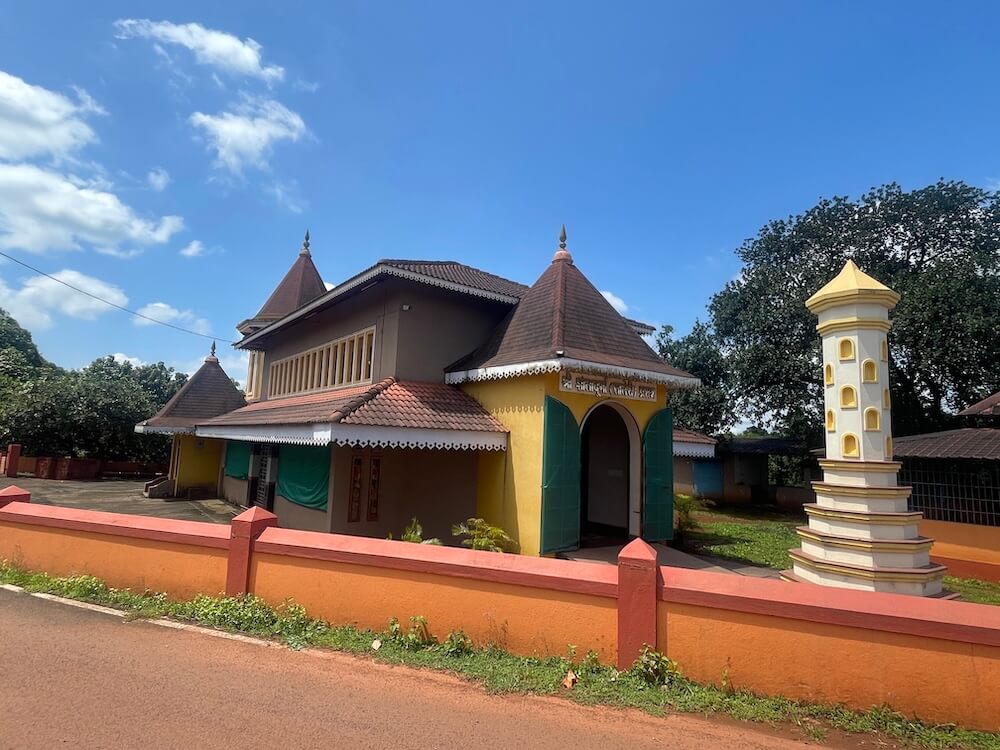
Located near the village, this temple is situated along the roadside. There is a simple entrance gate in the fortification wall surrounding the temple courtyard. After recent renovations, the temple, while retaining its original architectural design, has acquired a fresh luster. In the courtyard in front of the temple, there is a ‘Deepmal’ (lamp tower). The lower half of the Deepmal consists of seven descending steps in an octagonal shape, while the upper half is like an octagonal pillar. The upper half of the Deepmal has twenty lamp niches and a ‘Stupika’ (pinnacle) at the top. Along the fortification wall in the courtyard, there are small shrines containing stone idols of local deities. On the left side of the courtyard, there are other structures, including residences for priests and attendants, the temple office, and a storeroom.
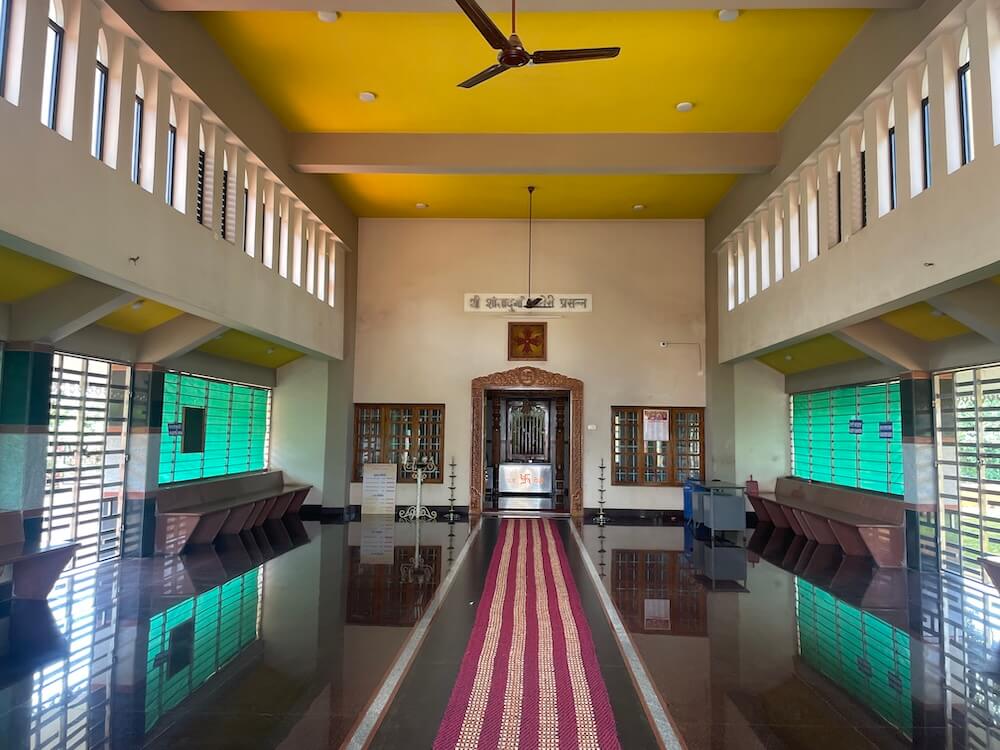
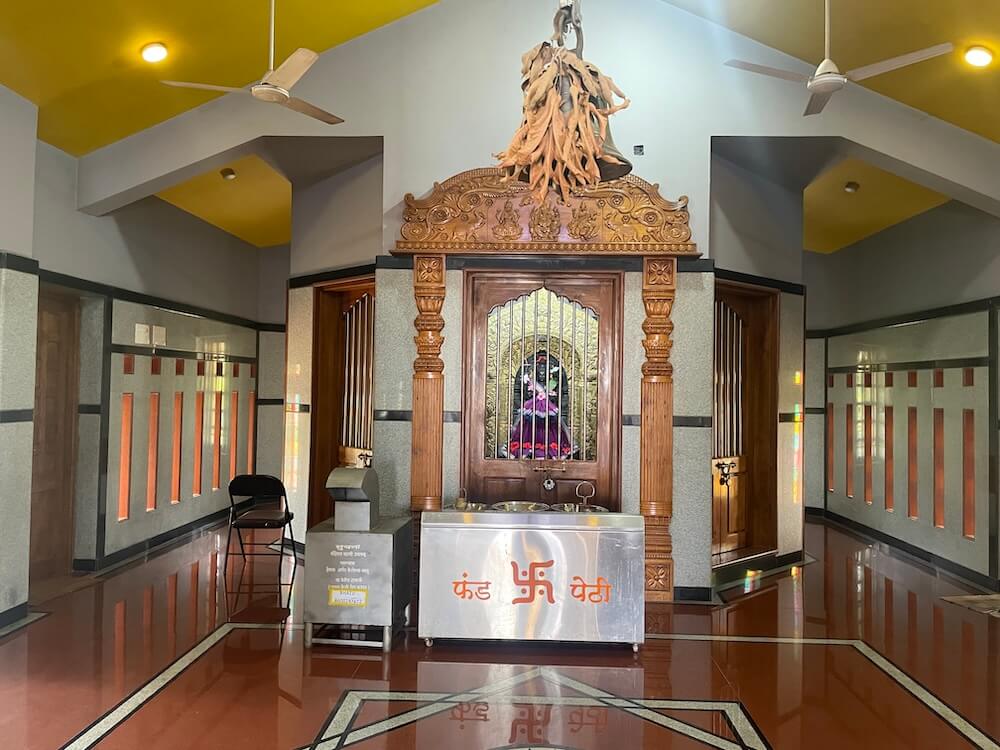
The temple structure consists of a ‘Mukhamandapa’ (front hall), ‘Sabhamandapa’ (main assembly hall), ‘Antarala’ (vestibule), and ‘Garbhagriha’ (sanctum sanctorum). The large entrance of the Mukhamandapa has ornate iron latticed shutters. Further ahead is the entrance to the Sabhamandapa. There are two additional doors on the left and right sides of the Sabhamandapa. The semi-open Sabhamandapa has railings, and adjacent to them are seats for devotees. Beyond this is the entrance to the Antarala. The door frames are carved with floral patterns, and the auspicious Swastika symbol is carved on the ‘Lalatabimba’ (lintel). The entrance has ornate wooden shutters carved with ‘Pratihara’ (gatekeepers) and floral motifs. The Antarala is enclosed, with windows in its walls to allow sufficient light and air. In the center of the Antarala is the octagonal Garbhagriha. The entrance to the Garbhagriha features wooden pillars with an ornate wooden canopy and a ‘Torana’ (arch) above it. Sculptures of Lakshmi, Ganapati, and Saraswati are carved on this Torana. There are two more doors to the left and right of the main entrance of the Garbhagriha.
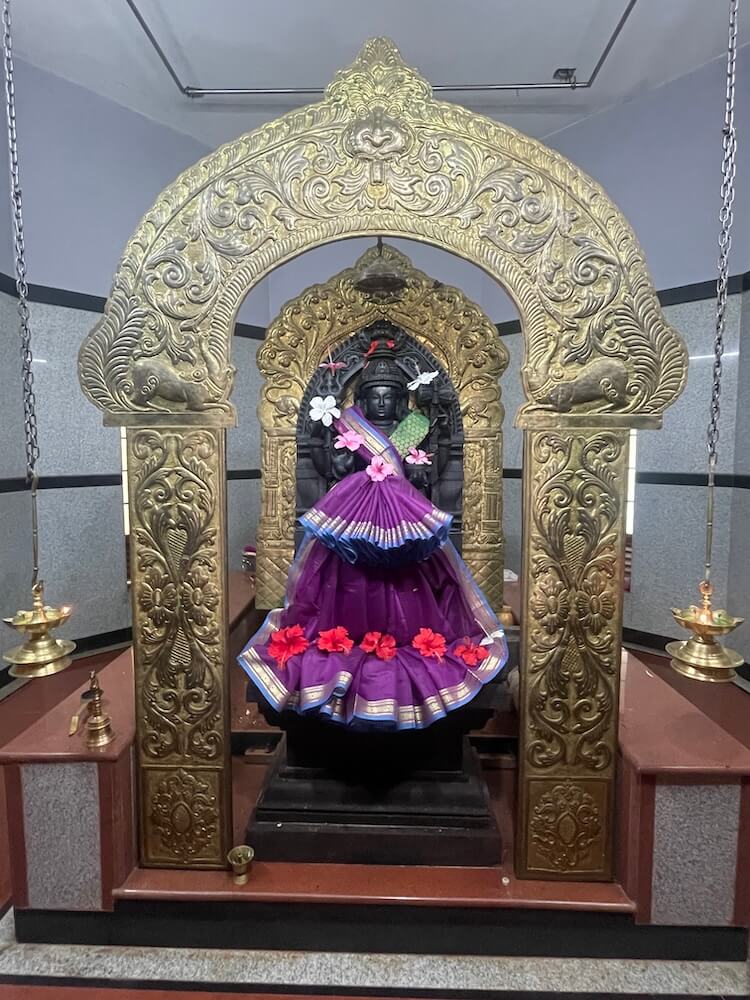
Inside the Garbhagriha, on a ‘Vajrapitha’ (pedestal), stands the four-armed idol of Shantadurga Sateri Devi made of black stone. In the two back hands, the Goddess holds a Trishula (trident) and a Damaru (drum). In one of her front hands, she holds a ‘Panpatra’ (drinking vessel), and the other hand is in a gesture of blessing. On the pillars on either side of the back slab behind the Goddess, a lion and a ‘Shakti’ sculpture are carved. The Torana on the pillars features floral carvings with a ‘Kirtimukha’ in the center. Adorned with various garments and ornaments, the Goddess wears a crown. This idol is placed in a silver ‘Makhar’ (shrine frame). This Makhar features a ‘Gajatorana’ (elephant arch) and floral carvings. The silver ‘Prabhavali’ (halo) behind the idol is also decorated with floral motifs and a Kirtimukha at the top center. There is a circumambulation path around the exterior of the Garbhagriha.
The roof of the Sabhamandapa is divided into two levels. Above the roof of the Garbhagriha, there is a two-tiered octagonal ‘Shikhara’ (spire). The lower tier of the Shikhara has eight windows facing the eight directions. The upper tier tapers towards the top, crowned with a Stupika and a Kalasha. Nearby are the temples of Vetal Dev and Mahadeva.
The Kartik Purnima ‘Diyajyotsav’ (festival of lamps) is one of the most important festivals celebrated here. On this occasion, all the ‘Kulpurush’ (family heads) of the village light lamps in the temple and bring them to the Goddess’s temple. Many newlywed couples come for the Goddess’s darshan, and other married women come to light lamps in the temple. Festivals such as Sharadiya Navratri, Chaitra Padwa, Dussehra, Diwali, Kojagiri Purnima, and Shravan month are all celebrated in the temple. During all these festivals, thousands of devotees visit to seek the Goddess’s blessings and fulfill their vows.
This sacred temple stands as a testament to deep spiritual devotion, ancient architectural grandeur, and rich local cultural traditions.
The sanctum sanctorum houses the divine idol consecrated according to ancient Vedic traditions, surrounded by serene courtyards and traditional temple architecture.
Navratri, Maha Shivratri, Annual Temple Jatra & Deepotsav
Compare and book flights, secure top-rated local hotels near the temple, hire reliable guides, and rent cars instantly.
Add ₹999 more to unlock FREE SHIPPING!
Your sacred cart is currently empty.
Shop Photo FramesFill in your delivery details below to place your order.
Add comment