
Add ₹999 more to unlock FREE SHIPPING!
Your sacred cart is currently empty.
Shop Photo FramesIn the coastal village of Ralej in Khambhat taluka stands the revered Sikotar Mata Temple. For centuries, this goddess has been worshipped as a sea deity. Situated near the shores of the Arabian Sea, the temple is famed for the belief that the goddess protects ships navigating the waters. She is regarded as the divine power who guides merchant vessels safely to their intended destinations, and she is revered as the kuldevi (ancestral tutelary deity) of the Rabari community. Devotees also come here in large numbers to make vows seeking the blessing of progeny. The shrine of Sikotar Mata holds great importance both spiritually and historically. With deep reverence, devotees address the goddess as ‘Vahanvati Mata’, meaning the divine protector of ships and vehicles.
Ralej is situated near the mouth of the Gulf of Khambhat (Cambay), an inlet of the Arabian Sea on India’s western coast. The gulf has historically been a major maritime gateway connecting Gujarat with Arabia, East Africa, and Southeast Asia. In ancient times, the coastal region around Ralej–Khambhat was known as Trambavati Nagari, and the name continues to appear even today in the aarti sung in honour of Sikotar Mata. While excavating Lothal, eminent archaeologist S. R. Rao brought to notice evidence of a strong tradition of worshipping a sea goddess. This goddess is locally known as Vahanvati Mata/Sikotara Mata.
A significant research paper titled ‘Goddess at Sea: Sikotara Mata’ written by Abhijit Ambekar and published in the respected scholarly journal ‘Journal of Indian Ocean Archaeology’ (JIOA) offers an important study exploring the connection between maritime traditions and ancient trade along the coast of Gujarat. According to this research paper, there was some connection between Sikotara Mata and the island of Socotra in the Gulf of Aden. Socotra, or Soqotra, is a Yemeni island in the Indian Ocean to the east of the Horn of Africa. For nearly 2,000 years, this small island was an important halting station for Indian seafarers, especially from Gujarat, on the maritime trading route from India to East Africa and the Middle East. Evidence for this is abundant in the Hoq cave inscriptions on the sea cliffs of Socotra Island.
These inscriptions, written in Brahmi and Kharoshthi as well as Gujarati scripts, contain clear references to sailors from Bharuch and Bhavnagar.
According to Ambekar, when Khambhat was one of the busiest and most important ports in the world, this temple at Ralej functioned as a natural lighthouse for sailors. A lamp placed upon the temple’s ‘Diva-Dandi’ (pillar for holding a sacred lamp) would be lit during the night, serving as a signal of safety for ships approaching from the sea. From this tradition, the goddess gradually came to be known as Vahanvati Mata, the divine guardian who protects ships.
Sikotar Mata is regarded as a manifestation of Adimaya Shakti (the primordial cosmic energy). Her identity is associated with Harsiddhi Mata of the Avanti region, mentioned in the ‘Skanda Purana’. A well-known legend connected with the temple concerns a Jain merchant named Jagdu Shah. During a devastating famine in the Saurashtra region, his trade prospered greatly through the grace of Sikotar Mata. However, when he failed to fulfil his vow of offering a golden chain to the goddess, his ship was caught in a violent storm at sea. Only after he prayed for forgiveness did the goddess spare his life and guide the vessel safely to shore. According to local belief, a lamp would sometimes ignite spontaneously upon the pillar at this site, illuminating the way for ships caught in peril and enabling sailors to reach the coast safely. Because of this protective guidance, the goddess came to be lovingly known as ‘Vahanvati’. In local folklore and songs, she is described as a saviour. Since ancient times, sailors and members of the fishing community have held deep faith in this goddess, and even today, it remains customary to seek her blessings before venturing into the sea.
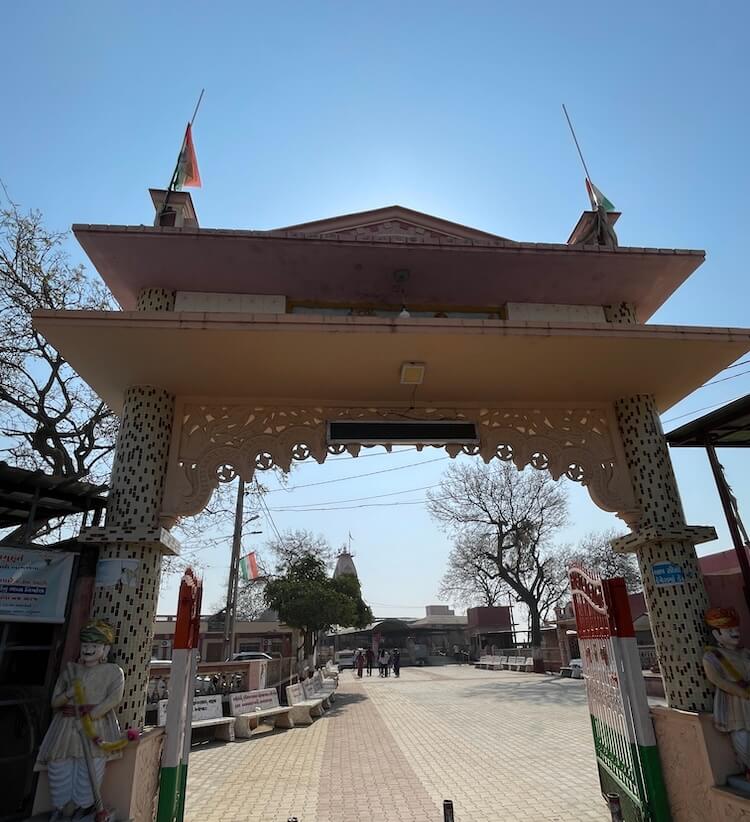
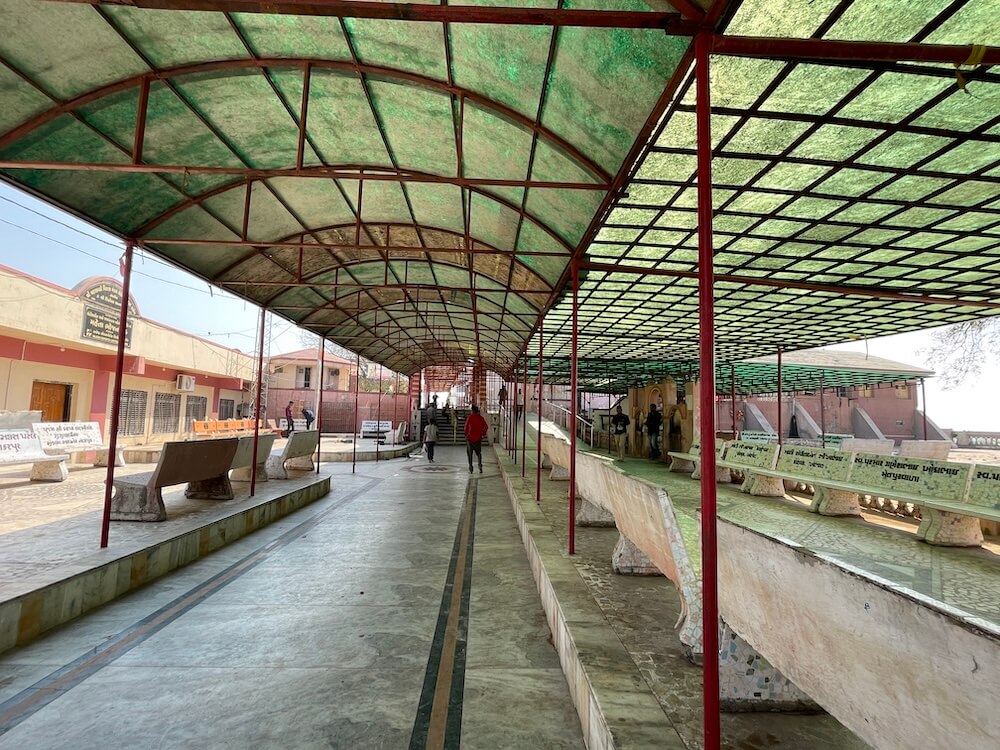
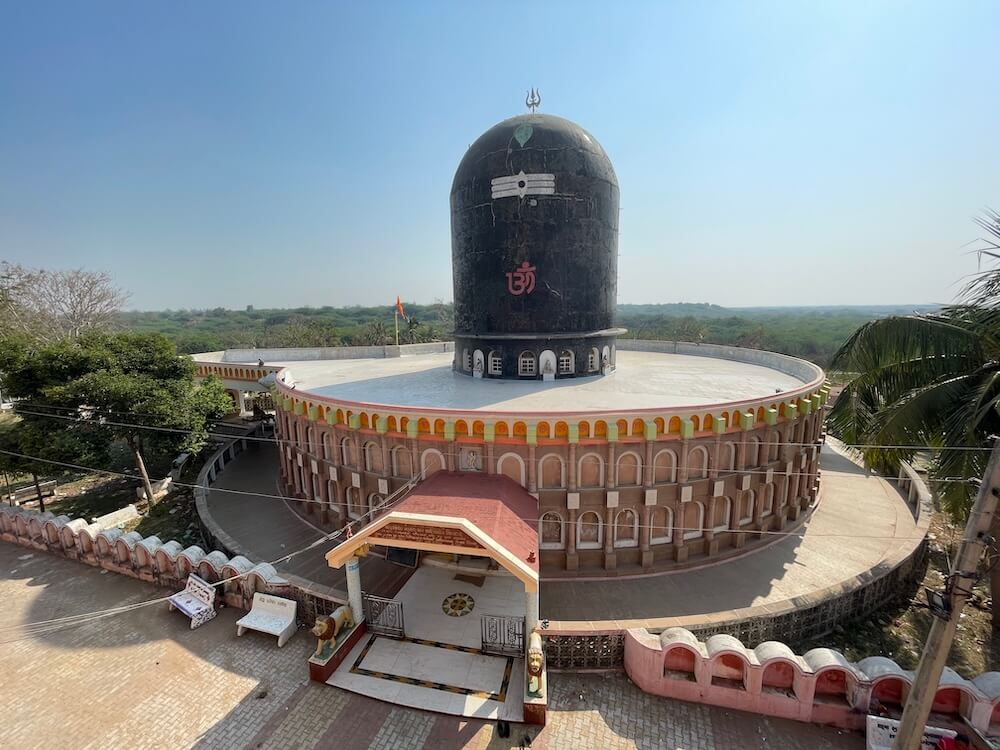
Located near the shore of the Arabian Sea and close to the mouth of the Gulf of Khambhat, the temple stands amidst a picturesque natural landscape. Near the entrance gateway in the fortified boundary surrounding the temple complex, there is a spacious courtyard with a large parking area. Around this parking space, several shops sell materials required for worship. Passing through the gateway, one enters the inner courtyard of the temple. On both sides of the pathway leading towards the temple, seating arrangements have been provided for devotees. Along this approach, a ‘gajprishtha’ shaped metal canopy has been erected to protect visitors from the sun and rain. From this point, eleven steps lead upwards into the main courtyard surrounding the temple. On either side of the staircase, stand sculpted lions. The entire courtyard is paved with marble flooring. In front of the main temple, a magnificent Shiva lingam rising to a height of fifty-four feet has been installed. Within it, representations of the twelve Jyotirlingas may be seen. At the centre of this structure, a map of the country indicates the locations of these sacred Jyotirlinga shrines. In addition to this, there are separate idols of Nandi (sacred bull) and other deities within the complex. A well-equipped rest house has also been provided here for the convenience of devotees.
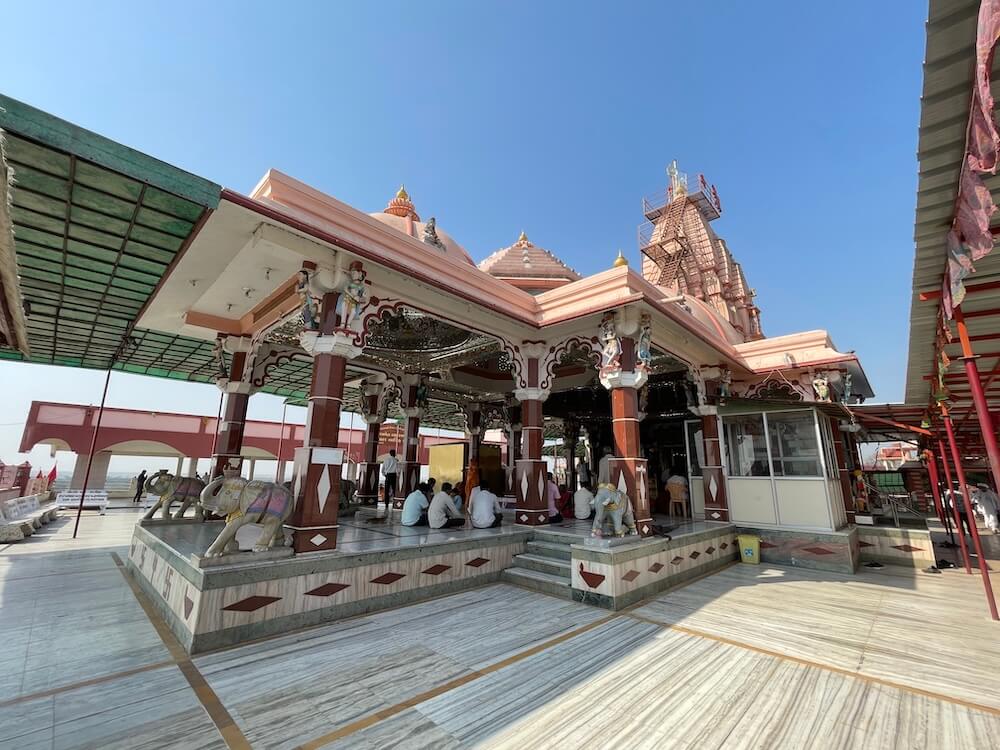
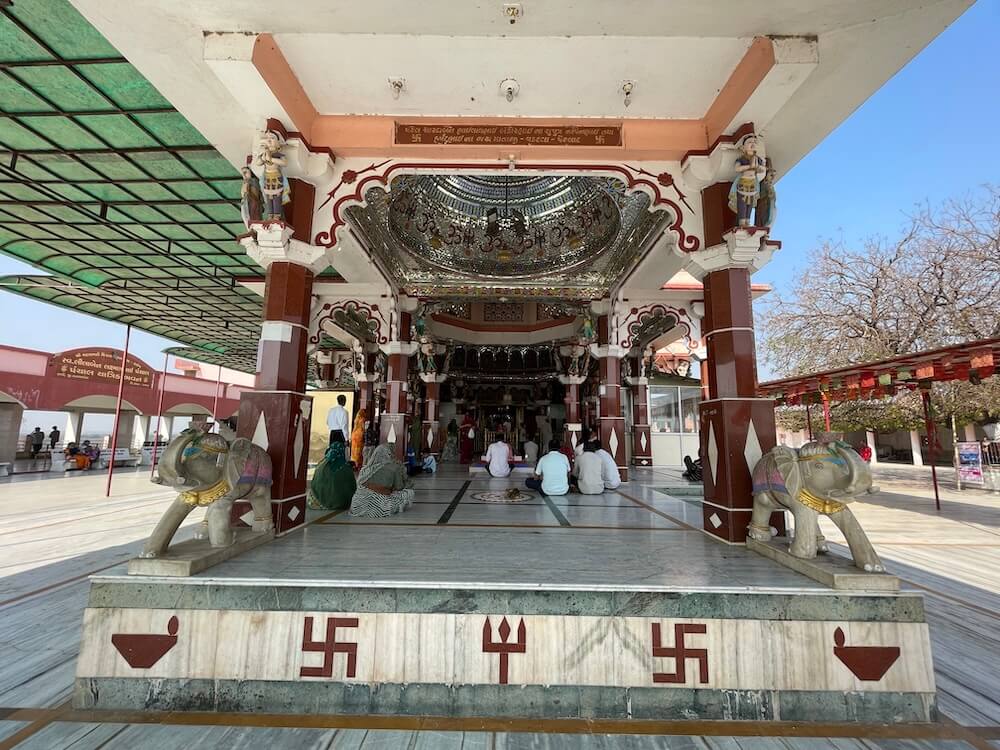
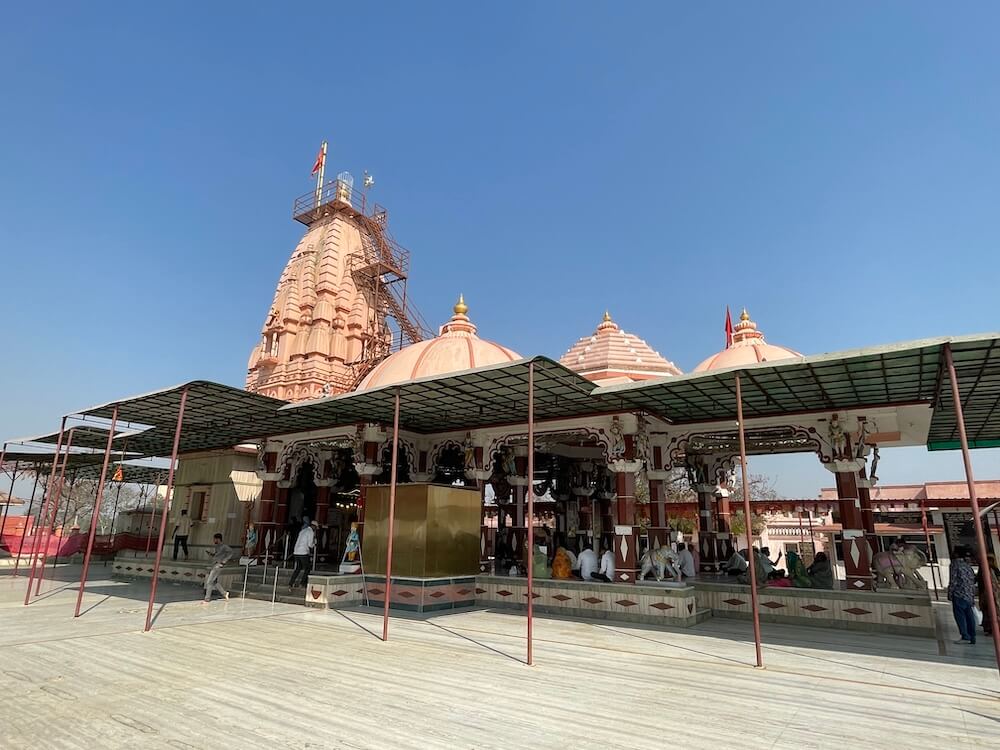
The architectural layout of the temple consists of a mukhamandap (entrance pavilion), sabhamandap (assembly hall), antaral (vestibule), and garbhagriha (sanctum). On both sides of the mukhamandap and sabhamandap stand two sculpted elephants each. The darshan mandap and sabhamandap are designed in a semi-open style. At the centre of the sabhamandap, there is a Havankund (sacrificial fire altar used for ritual offerings). On the upper portions of the pillars in the hall are sculptures of sursundaris. In the sabhamandap facing the antaral, upon a marble pedestal, stands the idol of a lion, which is the vahana (sacred vehicle) of the goddess. In the devkoshtaks (wall niches) within the walls of the antaral are the idols of Ganapati and Hanuman. The doorway and doorframe of the garbhagriha are covered with sheets of silver engraved with delicate ornamentation. In the centre of the sanctum, upon a vajrapith (sacred pedestal), stands the idol of Sikotar Mata. The idol is adorned with a golden mask and crown. In her hands, the goddess holds weapons such as a trident and sword, while one hand is raised in the gesture of blessing. The temple has four shikharas (spire-like towers) in total, one above the mukhamandap, two above the sabhamandap, and one above the garbhagriha. Each of them is crowned with a kalasha (sacred finial). Behind the temple stands a nine-metre-high pillar (Diva-Dandi) covered with copper sheathing, which in earlier times served as a beacon guiding ships at sea.
The festival of Navratri is celebrated in the temple on a grand scale during the months of Ashwin and Chaitra. During these nine days, the temple witnesses an immense gathering of devotees. On Chaitra Purnima, a large pilgrimage fair is held here, and thousands of devotees take the opportunity to bathe in the sea and have darshan of the goddess. The temple trust organises Mahaprasad (sanctified community meal) for devotees every Sunday and on every full moon day. Members of the seafaring and fishing communities offer small wooden boats to the goddess after purchasing a new vessel, seeking her protection for their ships. This tradition has continued for hundreds of years. During Navratri celebrations, Garba and Raas dances are organised, and the entire temple complex is adorned with brilliant electric illumination. In addition to this, the surrounding area also includes a Hanuman temple, a Nataraja statue, and shrines dedicated to Lakshmi-Sheshnarayan. The temple remains open for devotees daily from 6 am to 8 pm.
This sacred temple stands as a testament to deep spiritual devotion, ancient architectural grandeur, and rich local cultural traditions.
The sanctum sanctorum houses the divine idol consecrated according to ancient Vedic traditions, surrounded by serene courtyards and traditional temple architecture.
Navratri, Maha Shivratri, Annual Temple Jatra & Deepotsav
Compare and book flights, secure top-rated local hotels near the temple, hire reliable guides, and rent cars instantly.
Extend your pilgrimage by visiting other highly sacred temples located nearby.


Add ₹999 more to unlock FREE SHIPPING!
Your sacred cart is currently empty.
Shop Photo FramesFill in your delivery details below to place your order.
Add comment