
Add ₹999 more to unlock FREE SHIPPING!
Your sacred cart is currently empty.
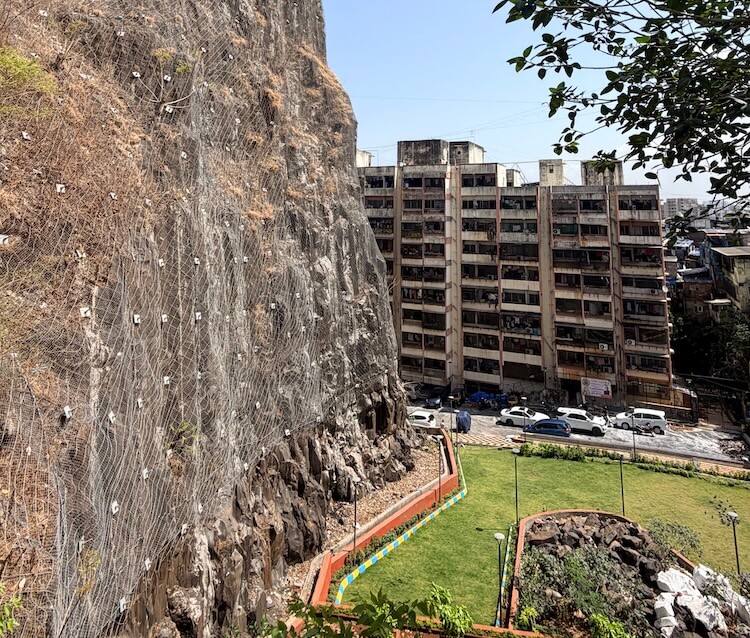
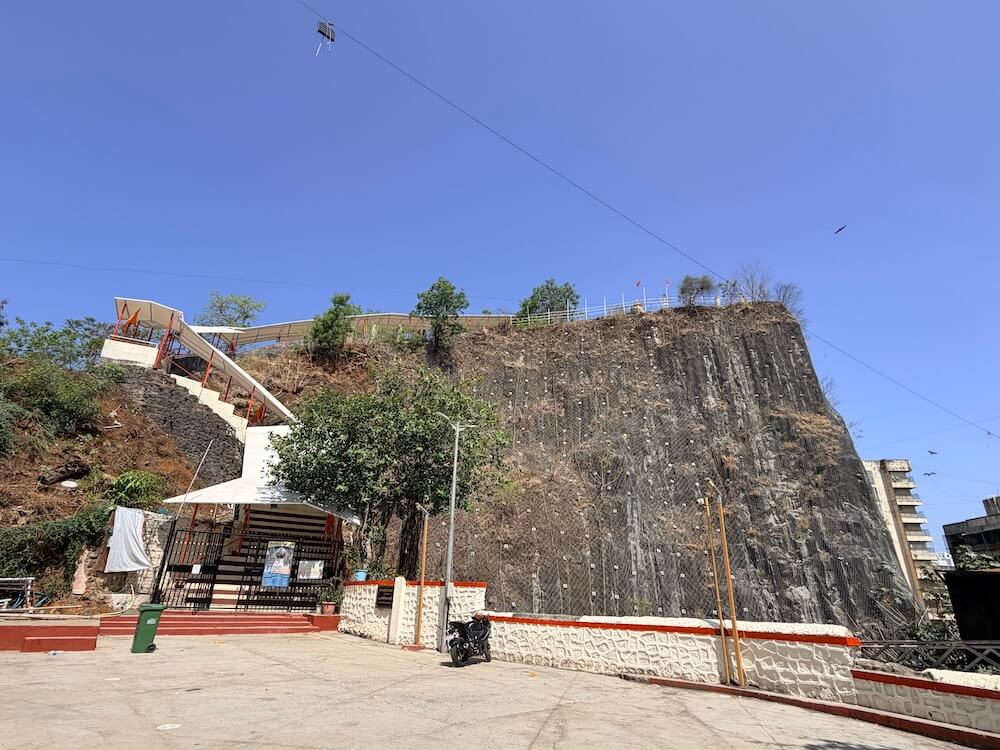
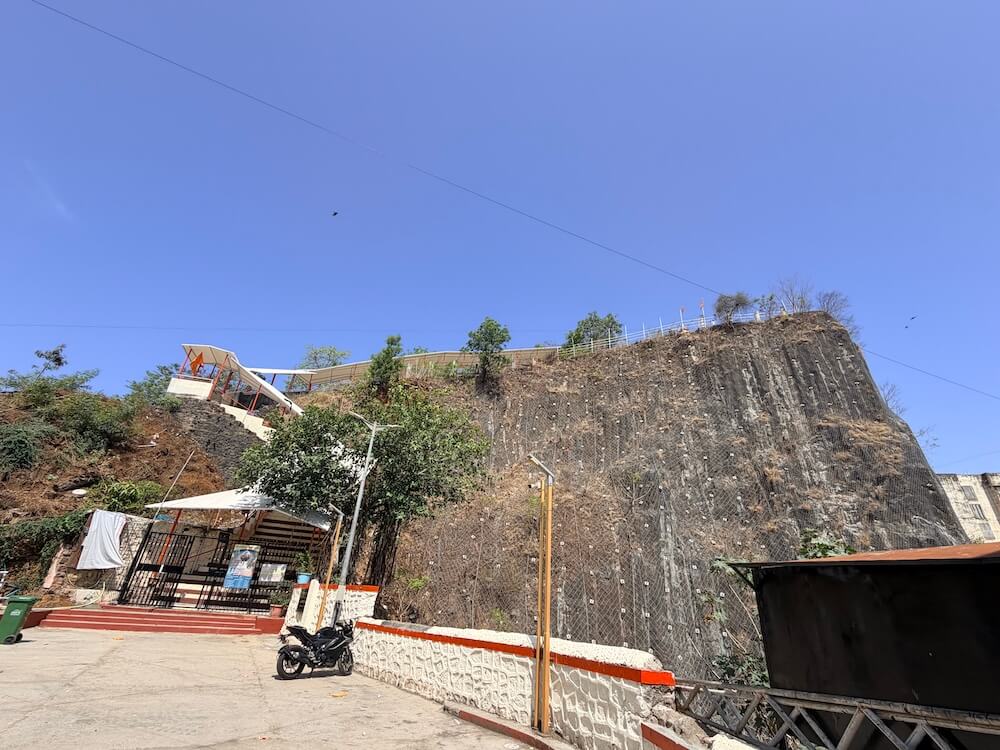
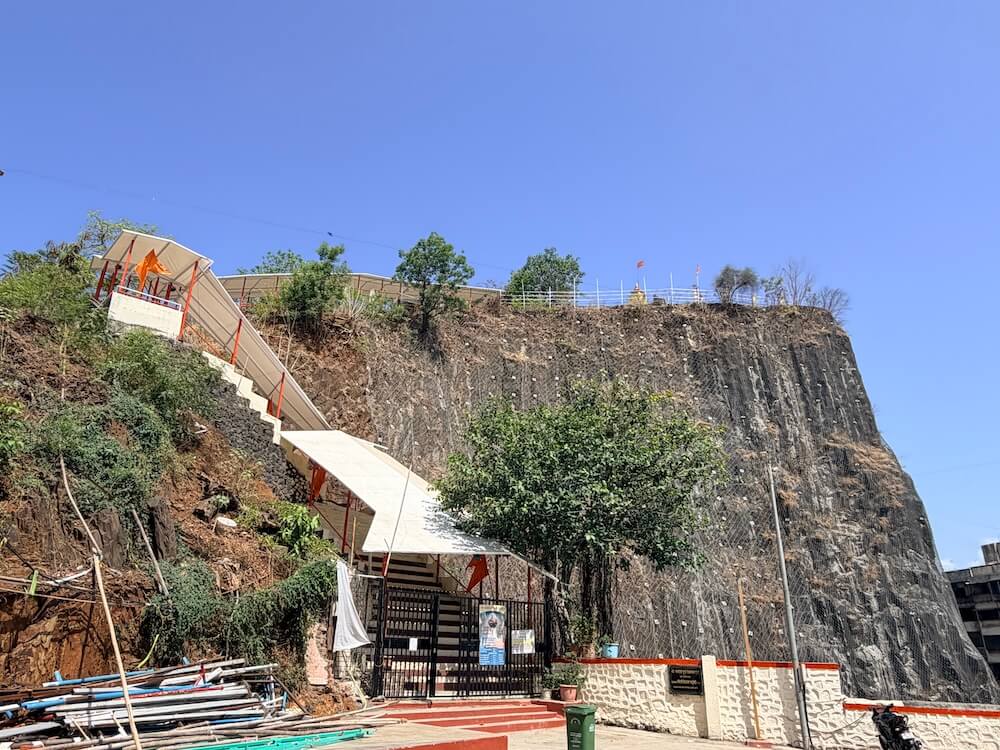
Shop Photo FramesThe temple of Gaodevi Durgamata is situated on the historic hill of Gilbert Hill in the Andheri West area of Mumbai. Known as the ‘Gaodevi of Andheri’, this Goddess is the primary deity and a source of deep faith for local residents and thousands of families from various communities. It is said that the presence of the Goddess here dates back approximately 450 years. The temple is located on this hill, which stands about 60 meters tall and is composed of vertical columns of basalt rock. The memory of a massive volcanic eruption that occurred about 66 million years ago is specially preserved in two places in Mumbai. One is the Ghodapdev, enshrined in the form of lava rock in a temple at Ghodapdev, and the other is Gilbert Hill in Andheri, which is a ‘volcanic vent’. This is considered the oldest existing geological structure in Mumbai.
According to geology, about 66 million years ago, towards the end of the ‘Cretaceous’ period, a volcanic eruption occurred through large fissures in the ground, known as a ‘fissure eruption’. A massive amount of lava flowed out slowly from the depths of the earth and spread over an area of several kilometers. Layers of this lava accumulated one upon another, forming the ‘Deccan Traps’ or the ‘Deccan Volcanic Province’. A large part of Maharashtra is made of basalt rock formed from this volcanic eruption. The islands of Mumbai are also a creation of this eruption. Gilbert Hill is one of the main sites where this lava emerged from the depths of the earth. It is a monolithic hill made of basalt rock columns, spread over an area of about 800 square meters.
The hill has almost vertical cliffs on three sides. Tall, well-joined hexagonal basalt columns are clearly visible there. These columns are about 45 to 60 meters high. There are only three such important places in the world. Two of them are in America, known as ‘Devils Postpile National Monument, California’ and ‘Devils Tower National Monument, Wyoming’. Both these sites have been carefully preserved by their respective governments. In India, Gilbert Hill was declared a national park by the Central Government in 1952 and a ‘heritage structure’ (Grade II) by the Municipal Corporation of Greater Mumbai.
In ancient times, Andheri was an important village in the Salsette islands. In the historical text ‘Mahikavatichi Bakhar’, it is mentioned by the name ‘Andheri’. The structure of this hill is formed by vertical rock columns. In geological terms, this structure is called a ‘laccolith’ or ‘columnar basalt’. It is said that the renowned American geologist Grove Karl Gilbert discovered this specific type of geological structure and proposed the hypothesis explaining the origin of these rocks. Therefore, during the British era, the hill was named ‘Gilbert Hill’ in his honor. Some believe it was named Gilbert Hill after a British officer. However, since the Gaodevi temple has existed on this hill since ancient times, it was known to local residents as ‘Gaodevi’s Hill’.
There is an ancient legend regarding the presence of the Gaodevi here. According to it, Durgamata was the family deity (Kuldevata) of the Diwan of the Vijayanagara Empire. The Diwan’s family had come to this site on the Salsette island and had set up camp at the base of this hill. At that time, a terrible calamity befell a woman in the family. Desperate, she climbed the hill to end her life. At that very moment, Durgamata appeared before her and saved her life. It is said that the woman’s maternal home was in Malkapur, Buldhana district. There is a Durgamata temple along with a Charoli tree on a hill in Malkapur. Interestingly, an ancient Charoli tree can still be seen near the Durgamata temple on Gilbert Hill.
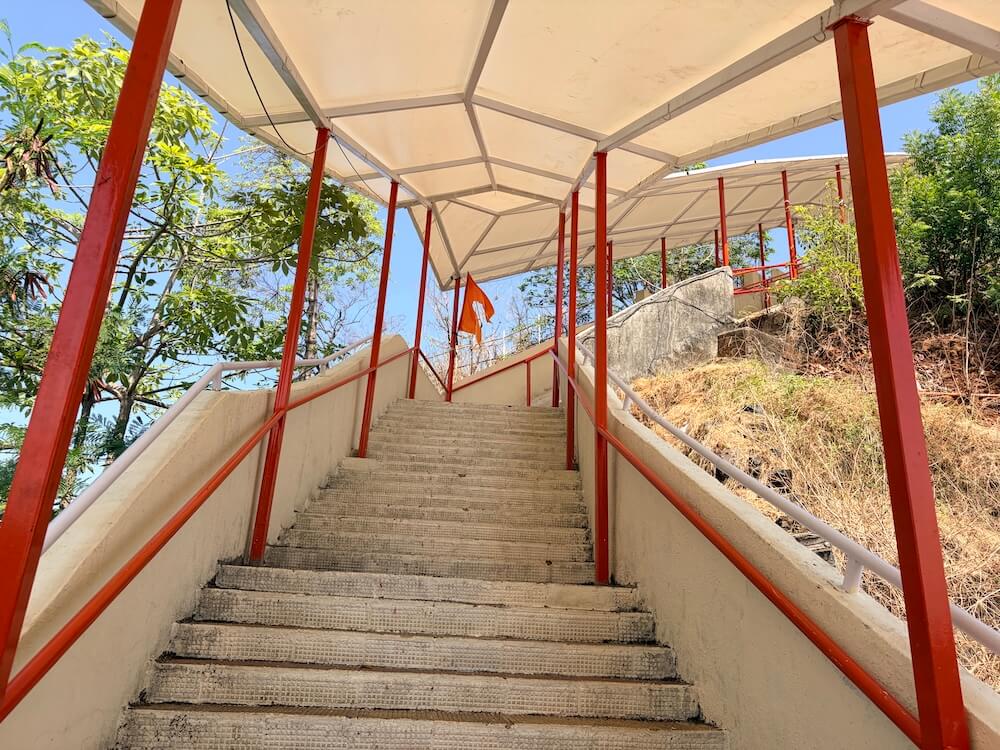
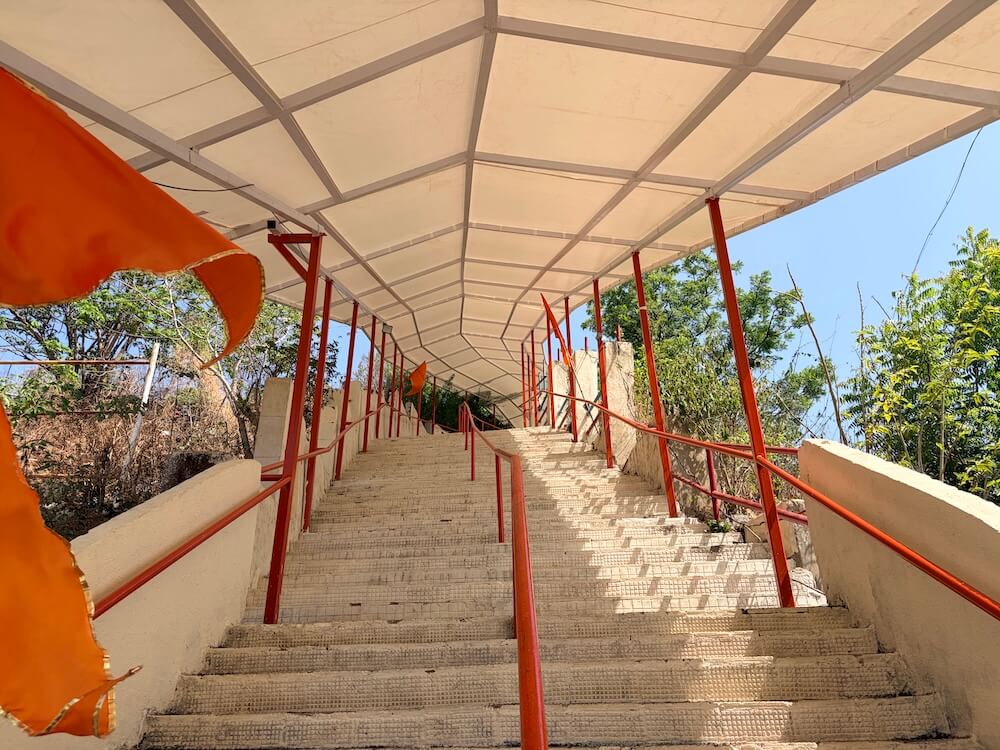
In recent times, the beautification and conservation work of this hill has been carried out. A staircase with a tin shed has been built for devotees to climb the hill. There are a total of 195 steps to reach the top. A grand temple of the Goddess is built on a high pedestal on the flat ground at the summit. One enters the spacious marble-floored courtyard of the temple after climbing seven steps. This temple is of the ‘Sandhara’ type. The structure consists of a Sabha Mandap (assembly hall), the main Garbhagriha (sanctum sanctorum), and a circumambulatory path (Pradakshina Marg) around the sanctum. There is a high triangular Shikhara (spire) over the Garbhagriha. The Sabha Mandap is large and semi-open, with a flat roof. Near the steps of the Mandap, which has side seating (Kakshasana), there is a tortoise sculpture (Kurma). In the center of the Mandap is a Homa Kund (sacrificial fire pit). Nearby is a small shrine of Hanuman. Notably, the original tree at this site has been preserved; its trunk can be seen emerging through the roof. The Garbhagriha is a few feet lower than the Sabha Mandap. The walls of the Garbhagriha are decorated with carved metal sheets. Inside, on a small altar, the idol of Gaodevi Durgamata with a brass mask is installed. The idol, adorned with clothes and ornaments, has a brass umbrella above it. In front of this idol, a brass idol of Durgamata mounted on a lion is enshrined. Similarly, a marble idol of Ganesha is installed to the left and a marble idol of Durgamata to the right in the Garbhagriha.
Devotees can seek darshan at this temple from 7:00 AM to 12:30 PM and from 4:00 PM to 8:30 PM. On the days of religious programs and festivals, the temple remains open for darshan throughout the day. The evening Aarti of the Goddess is performed here daily at 7:00 PM. It is said that the shrine of Lord Hanuman here has existed since ancient times. Therefore, Hanuman Janmotsav is celebrated here with great enthusiasm every Chaitra Purnima. On this day, a grand palanquin procession of the Goddess is taken out from the hill by the ‘Gaodevi Durga Devasthan Trust’. Thousands of devotees from the surrounding areas participate in this palanquin ceremony. During this time, the entire hill area is illuminated with decorative lights. To preserve social harmony, the Muslim brethren of the area offer sherbet to the devotees participating in this procession. Two days before Hanuman Jayanti, the traditional ‘Paradi Utsav’ is celebrated here. During this time, the floral offerings made to the Goddess are collected in a basket (paradi) and immersed in the sea. Festivals like Navratri, Vat Purnima, Hartalika, and Ganesh Chaturthi are also celebrated with great fervor at the temple. Stories are told here of how the Goddess has blessed not only Hindus but also Muslim and Christian brethren. Many Muslim residents of the area still offer coconuts to the Goddess with great reverence. The administration of the temple is managed by the Gaodevi Durga Devasthan Trust.
This sacred temple stands as a testament to deep spiritual devotion, ancient architectural grandeur, and rich local cultural traditions.
The sanctum sanctorum houses the divine idol consecrated according to ancient Vedic traditions, surrounded by serene courtyards and traditional temple architecture.
Navratri, Maha Shivratri, Annual Temple Jatra & Deepotsav
Compare and book flights, secure top-rated local hotels near the temple, hire reliable guides, and rent cars instantly.
Extend your pilgrimage by visiting other highly sacred temples located nearby.


Add ₹999 more to unlock FREE SHIPPING!
Your sacred cart is currently empty.
Shop Photo FramesFill in your delivery details below to place your order.
Add comment