
Add ₹999 more to unlock FREE SHIPPING!
Your sacred cart is currently empty.
Shop Photo FramesThe Kamakshi Temple, which shares a connection with the renowned Kamakhya Devi of Assam, is situated in a very picturesque location in Goa. This temple was built in the latter half of the sixteenth century. The Goddess Kamakshi is enshrined in the temple in the form of Mahishasuramardini. It is said that this Goddess originally belonged to Rai village in Sasashti (Salcete). She is considered a very ‘Jagrut’ (awakened/powerful) deity. Devotees from Goa, as well as from Maharashtra and Karnataka, come here to present their prayers and grievances to her. The temple sees a massive influx of devotees on every Amavasya (new moon day) and during the various festivals celebrated here.
The idol of the Goddess in the Shiroda temple is that of Mahishasuramardini, who is called Kamakshi due to her enchanting eyes. There is varying information available regarding how this Goddess arrived here. According to some experts, her original seat is in the Kamarupa country, that is, present-day Assam. However, some scholars believe her seat is in Kanchipuram, Tamil Nadu. One legend mentions that she was invited to come to Kavoor, while another legend states that a devotee from Goa found this idol while bathing in a river in Assam. It is said that the worship of the Kamakshi avatar of Parvati was initiated in Goa by Jayakeshi (I) of the Kadamba dynasty.
According to one legend, a devotee of Ramanath from Lotli in Salcete taluka had gone on a pilgrimage to Assam. While bathing in a river there, he found the idol of the Goddess. He wrapped it in a cloth, kept it among his belongings, and started his journey home. On his way back, he stayed at his daughter’s marital home in Rai village. While he went for a bath, his daughter, out of curiosity, opened the cloth bundle while organizing his things. Seeing the idol of the Goddess inside, she placed it on the ground. Thereafter, the idol could not be moved from that spot. The villagers of Rai considered this a good omen and installed the Goddess right there.
After arriving in Goa in 1510 A.D., the Portuguese soon unleashed a reign of religious persecution. Many temples were demolished. The eyes of this fanatical Portuguese regime also fell upon the temple in Rai village. To prevent the desecration of the Goddess’s idol, the villagers immediately decided to move it. A potter from the village took on this responsibility, and under the cover of darkness, he crossed the river and brought the idol to Shiroda. It was installed there. Because of this, the potters of Rai village hold a special honor during the festivals at the Shiroda temple. They have been granted the hereditary right to light the first lamp. They also provide the earthen lamps for the Divja festival. The associate deities of the Goddess, namely Raireshwar, Laxminarayan, and Shantadurga, were also brought to Shiroda from their respective temples in Rai.
Regarding this, there is also a story that the idol was first moved between 1564 and 1568 to the house of a family with the surname Raikar in Ponda taluka. However, as that place did not feel safe, the idol was then taken to Barbhat village in Ponda taluka. But as that place also felt dangerous, the Kamakshi temple was finally established at Thal-Shiroda. For this, land was acquired from the Communidade. Communidade is a type of land ownership in Goa where land is held under collective ownership. This is an ancient system. This land is managed for the religious and social work of the village. It is said that this system still exists in some places.
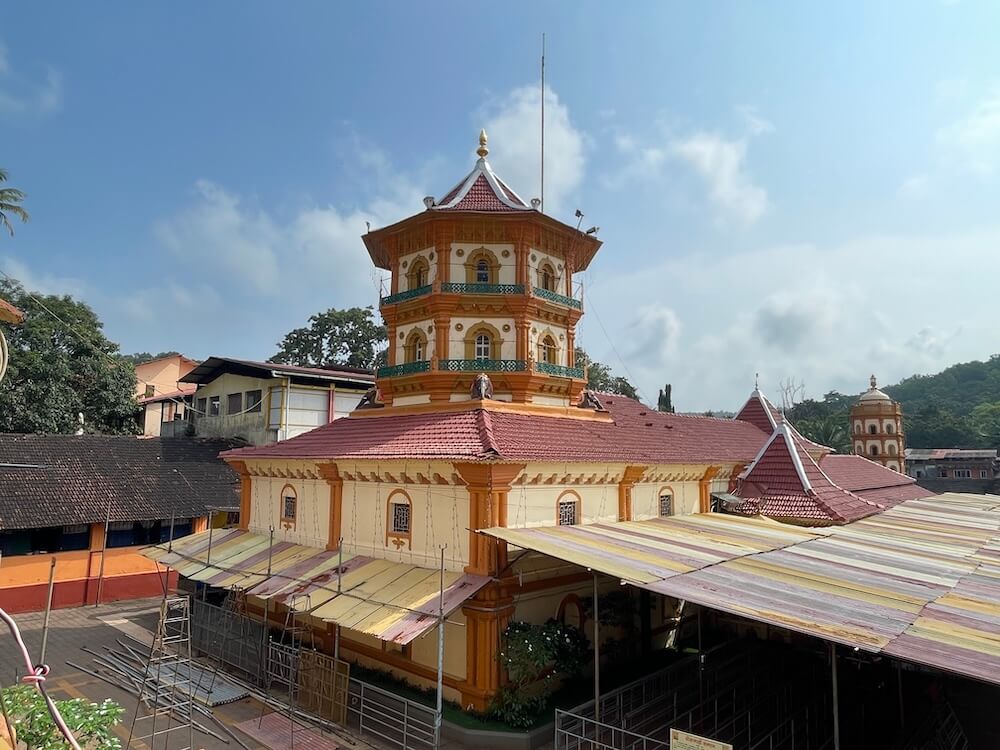
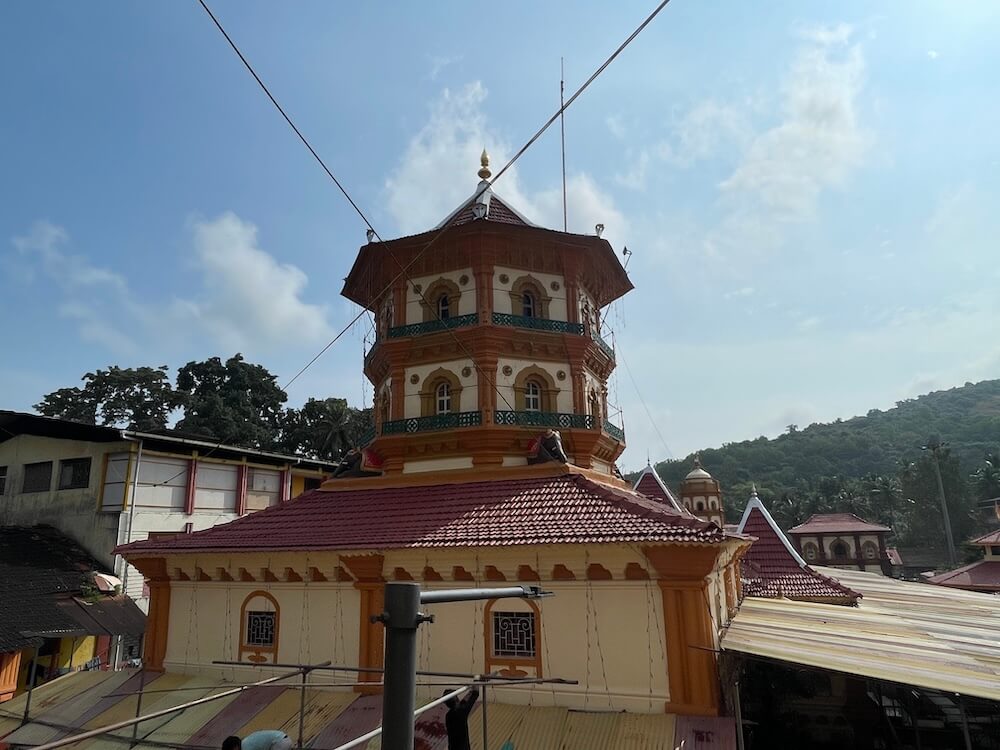
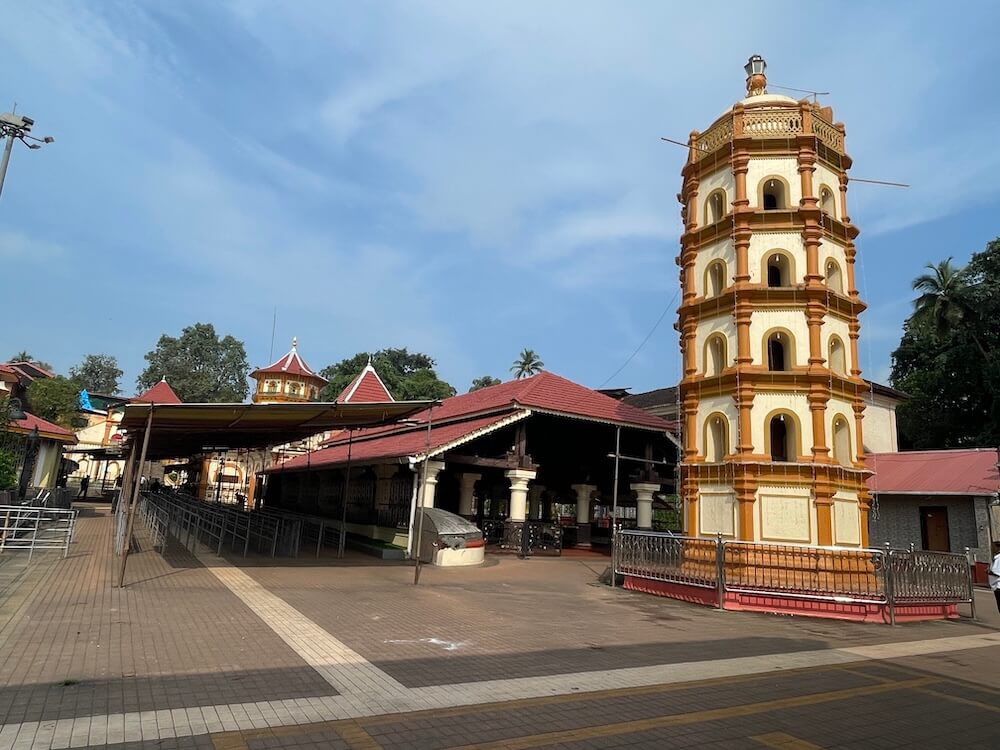
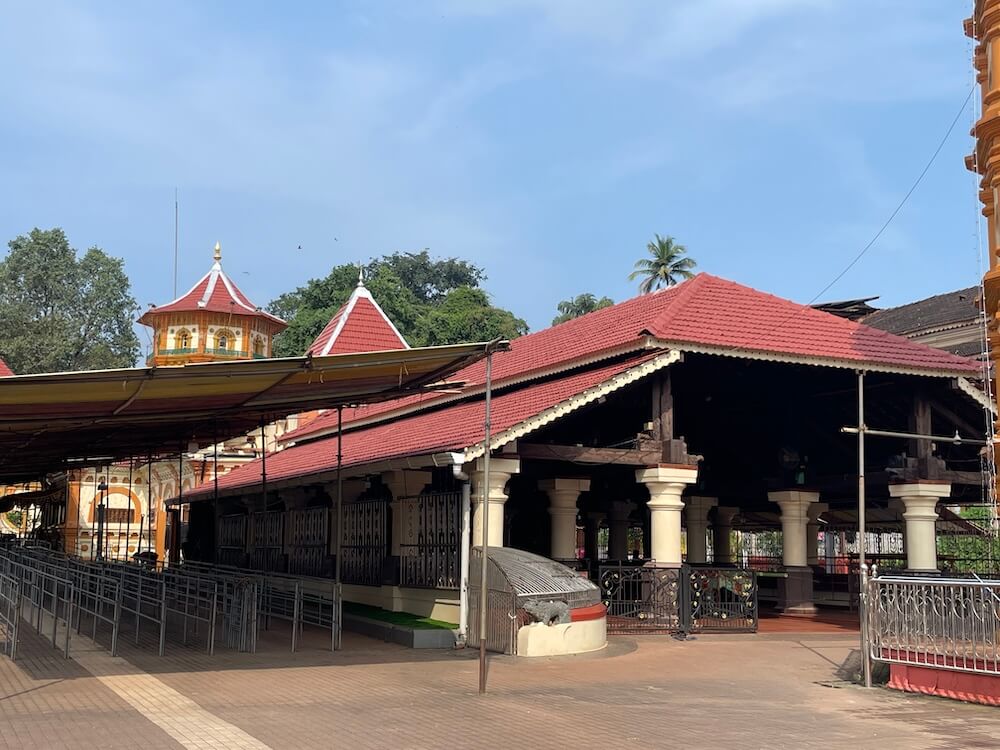
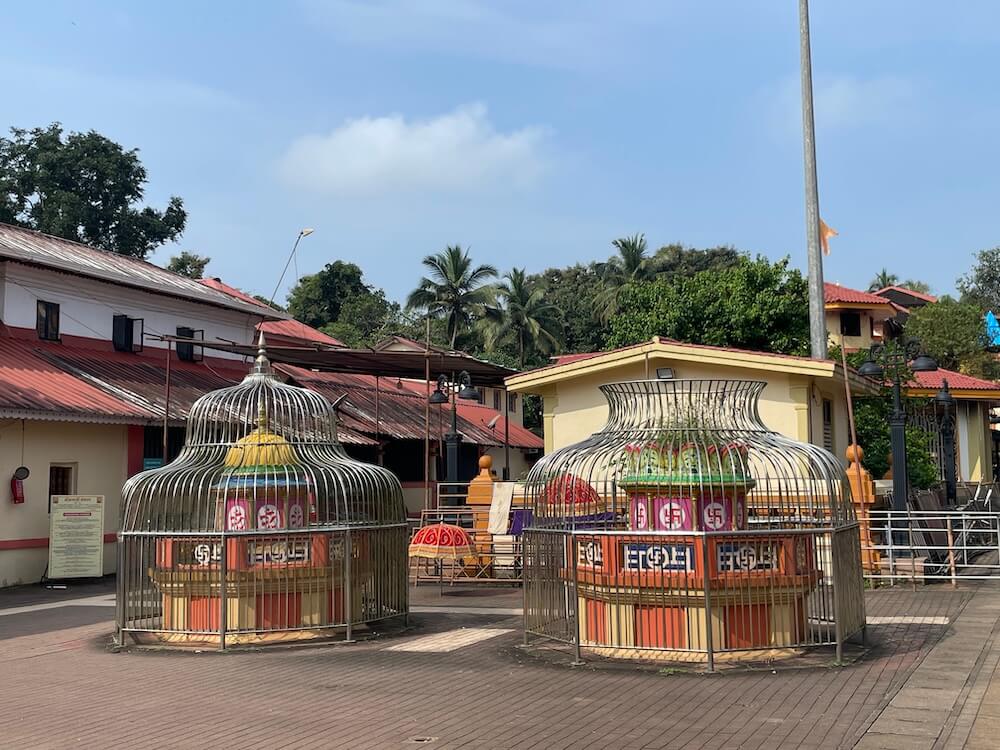
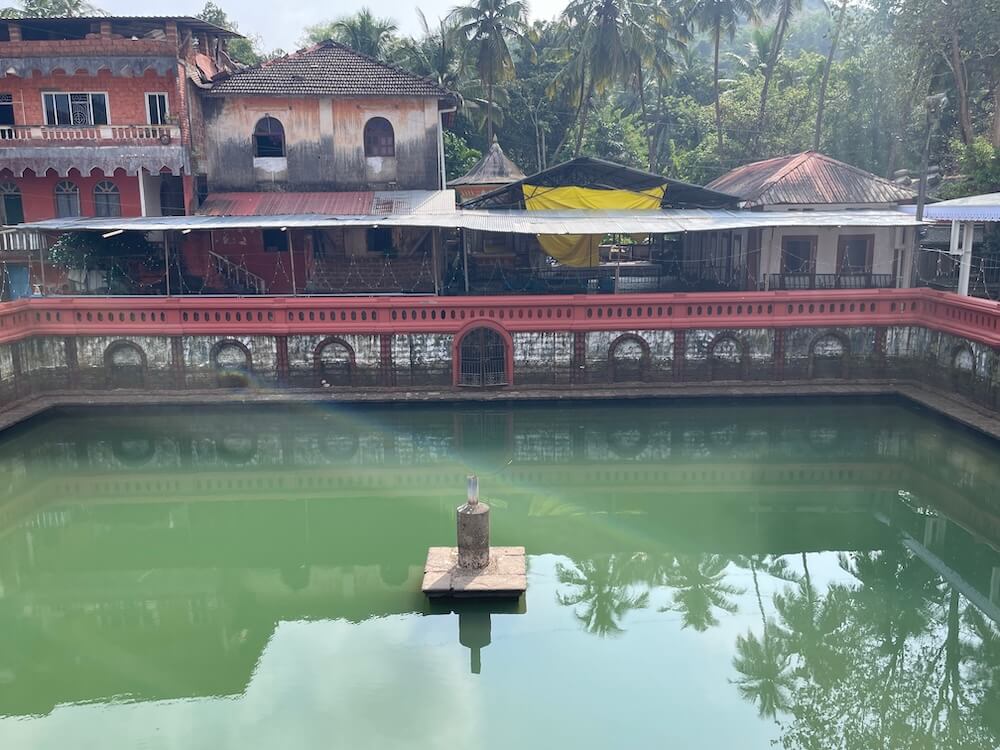
Although the surroundings of this temple, nestled among hills, have gradually become crowded with construction, the original temple complex is vast. The main entrance of the temple faces east. There is a Pushkarini (sacred pond) right there. Inside, to the right of the temple, there is a shrine. The Sabhamandap (assembly hall) of this temple is large. Inside, in different sanctums, the Linga of Raireshwar, the idol of Laxminarayan, the idol of Shantadurga holding a shield and sword, the Grampurush Linga, and the Mahadeshwar Linga are enshrined. Near this temple is a small enclosed stepwell. This well, which appears circular, is square at the base. Near it is the Kamakshi Havan Mandap (fire ritual hall). The Tulsi Vrindavan is also located there. There is also a Bhaktaniwas (pilgrim lodging) and a community hall in the temple courtyard.
In front of the main temple stands a six-story Deepmal (lamp tower) in the Goan style. Upon entering the temple, one first encounters the spacious tiled Sabhamandap of the Goddess. Its roof is supported by wooden construction with balconies. On both sides of the entrance to the next hall are the shrines of deities like Vetal, Kalbhairav, Sati, and Khuti. The entrance is adorned with wooden carvings. The entrance leading from the subsequent Ardhasabhamandap to the main Mahamandap features stone carvings. The main Sabhamandap that follows is supported by ornate pillars. The ceiling, which features hanging chandeliers, also has wooden carvings. Further ahead is the Antaral (vestibule), and its front wall is covered with silver plating. It features delicate carvings. On the same wall, in niches on the left and right sides, are Trimukhi Dattatreya on one side and Ganapati on the other. On the carved door frame, there is a Kirtimukh, and above it is Ganapati. The entrance to the Garbhagriha (sanctum sanctorum) is also decorated with silver plating. Inside the Garbhagriha is the idol of the Goddess in the form of Mahishasuramardini. The Goddess is Chaturbhuj (four-armed), and in her two upper hands, she holds a sword and a shield. With her two lower hands, she is slaying Mahishasura.
Various festivals are celebrated in the temple. These include the Laxminarayan Shibikotsav, Kamakshi Shibikotsav, Raireshwar Rathotsav, and Kamakshi Lalkhotsav. During the festival season, the temple is decorated with lamps, flowers, and electric lights. On Amavasya, palanquin processions (Shibikotsav) of Kamakshi and Laxminarayan are taken out in the temple premises. Hundreds of devotees participate in this. There is a palanquin procession of Raireshwar on Chaturdashi and of Shantadurga on Panchami. The annual festival is celebrated during Navratri. At this time, in the evening, married women carry earthen lamps (Divja) and take out a procession around the temple. Apart from this, festivals like Dussehra, Gokulashtami, Mahashivratri, and Shimgo (Holi) are also celebrated here.
A week-long fair is held here from Magh Krishna Chaturdashi to Falgun Shuddha Shashthi. This fair is a particularly significant festival at this temple. The festival includes events such as Gulalotsav, Shibikotsav, Lalkhotsav, and the Rathotsav (chariot procession) carried on shoulders. On the night of Magh Krishna Chaturdashi, a joint procession of Rayeshwar and Kamakshi is taken out. On Falgun Shuddha Pratipada, a joint procession of Rayeshwar, carried on a shoulder-chariot, and Kamakshi Devi, carried in a Lalkhi (a special type of palanquin), proceeds to the temple of the village deity Ravalnath in Shiroda.
This sacred temple stands as a testament to deep spiritual devotion, ancient architectural grandeur, and rich local cultural traditions.
The sanctum sanctorum houses the divine idol consecrated according to ancient Vedic traditions, surrounded by serene courtyards and traditional temple architecture.
Navratri, Maha Shivratri, Annual Temple Jatra & Deepotsav
Compare and book flights, secure top-rated local hotels near the temple, hire reliable guides, and rent cars instantly.
Extend your pilgrimage by visiting other highly sacred temples located nearby.


Add ₹999 more to unlock FREE SHIPPING!
Your sacred cart is currently empty.
Shop Photo FramesFill in your delivery details below to place your order.
Add comment