
Add ₹999 more to unlock FREE SHIPPING!
Your sacred cart is currently empty.
Shop Photo Frames
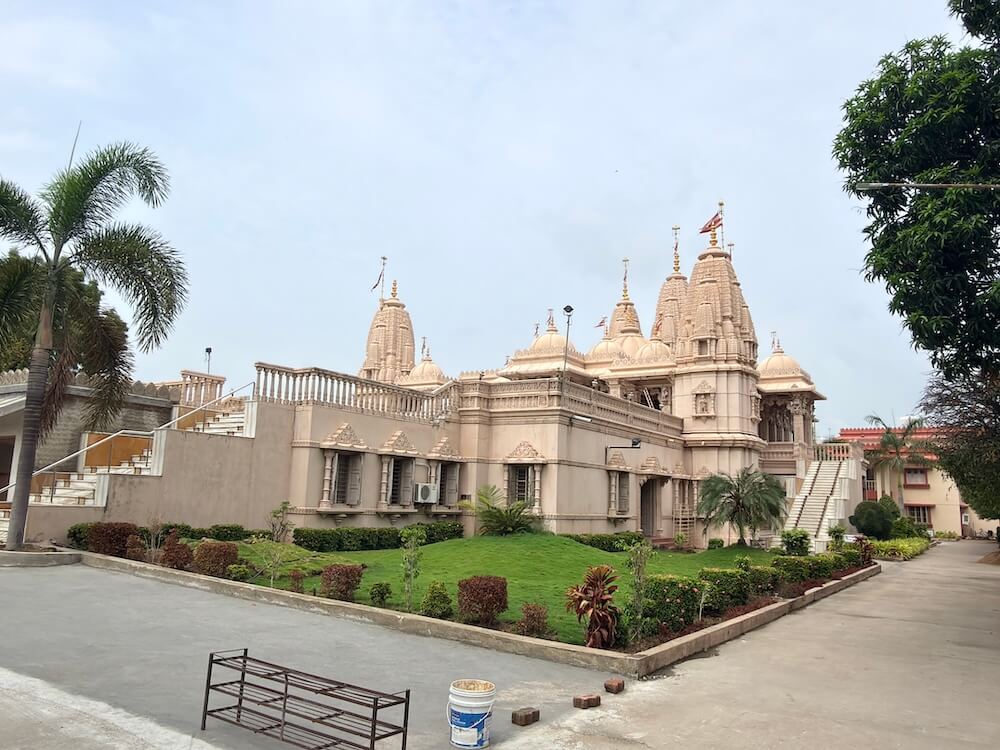
In the Panchmahal district, the name Godhra is traditionally believed to derive from the Sanskrit words Go (cow) and Dhara (land or support), meaning ‘the land of cows’. Historically, Godhra has remained an important religious center for Hindus, Jains and Muslims alike. Inhabited by people of diverse castes and faiths, the city is home to numerous temples and mosques. It is also a sacred place for followers of the Vaishnava tradition, As Saint Vallabhacharya is believed to have resided here for some time. Among the many temples in the city, the BAPS Shri Swaminarayan Mandir is particularly noteworthy. Situated on Ahmedabad Road, this magnificent temple has emerged as one of the city’s prominent landmarks.
The history of the Swaminarayan Sampradaya spans approximately two centuries. The roots of this tradition are deeply embedded in the spiritual reforms initiated by Lord Swaminarayan throughout Gujarat. He was born on 3 April 1781 in the village of Chhapaiya in present-day Uttar Pradesh. His childhood name was Ghanshyam Pandey. During his early years, he acquired a profound knowledge of the Vedas and Dharmashastras. At the age of eleven, he renounced his home and embarked upon a remarkable barefoot pilgrimage across the Indian subcontinent. During these travels, he attained mastery over Ashtanga Yoga and became known as Nilkanth Varni. After travelling on foot for seven years, he met Muktanand Swami at Loj on 21 August 1799. Subsequently, he met Ramanand Swami at Piplana on 18 June 1800. Ramanand Swami formally initiated him into the Uddhava Sampradaya on 28 October 1800, bestowing upon him the names Sahajanand Swami and Narayan Muni. Thereafter, he came into close association with eminent saints of the tradition, including Gunatitanand Swami. In later years, he became universally known as Lord Swaminarayan.
During the following century, the Swaminarayan tradition expanded considerably. In 1907, Brahmaswarup Shastriji Maharaj founded the ‘Bochasanwasi Akshar Purushottam Swaminarayan Sanstha’ (BAPS), marking the beginning of a new chapter in the propagation of the Akshar–Purushottam philosophy. On 5 June 1907, he consecrated the first Shikharbaddha (pinnacled) BAPS mandir at Bochasan in present-day Anand district. Today, BAPS manages thousands of spiritual centres and more than a thousand temples across the world, serving millions of devotees through spiritual, educational, social and humanitarian activities. As part of this tradition, the BAPS Shri Swaminarayan Mandir at Godhra was constructed. The Prana Pratishtha (consecration ceremony) of the idols was performed on 12 March 2011 by Pramukh Swami Maharaj amidst the chanting of Vedic hymns.
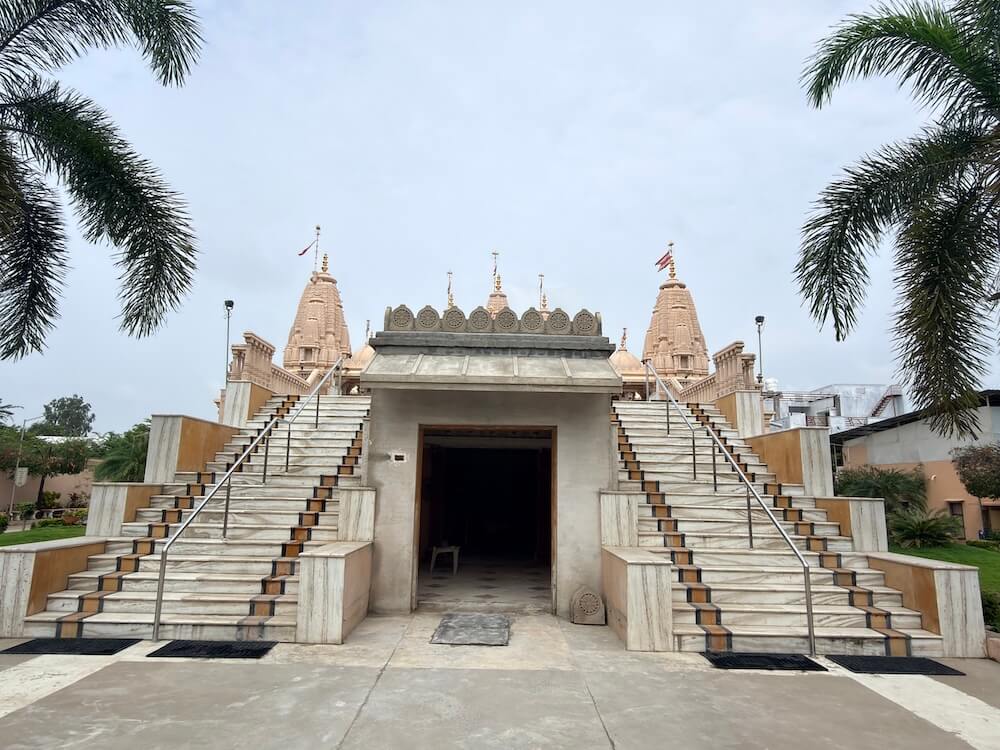
Situated in the Ramnagar Society area at the heart of the city, the temple complex is enclosed by compound walls and entered through an ornamental gateway. The ground floor accommodates a spacious assembly hall where religious discourses, devotional programmes and community gatherings are regularly organised. It also houses the consecrated idol of Nilkanth Varni in his youthful form, before which devotees may personally perform the ritual ablution (abhishek). Ascending about twenty steps from this hall leads to the temple courtyard on the upper level. The main shrine is flanked by two subsidiary shrines. One houses a Shiva Darbar, while the other enshrines a Ram Darbar. Both shrines are crowned with elegant tapering spires surmounted by sacred kalashas.
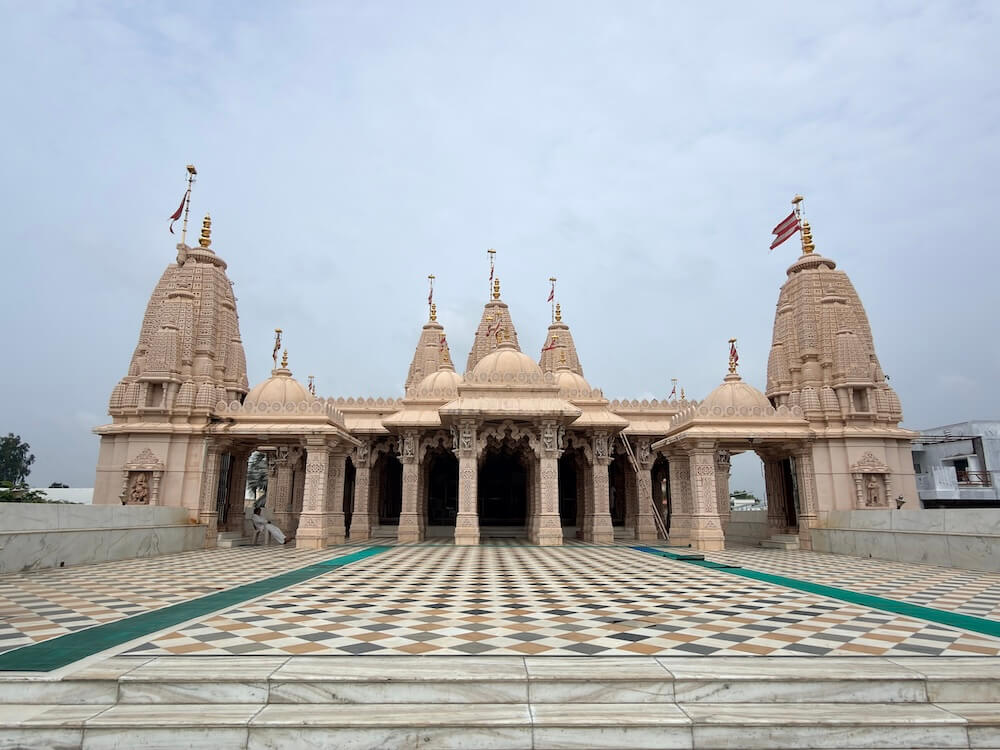
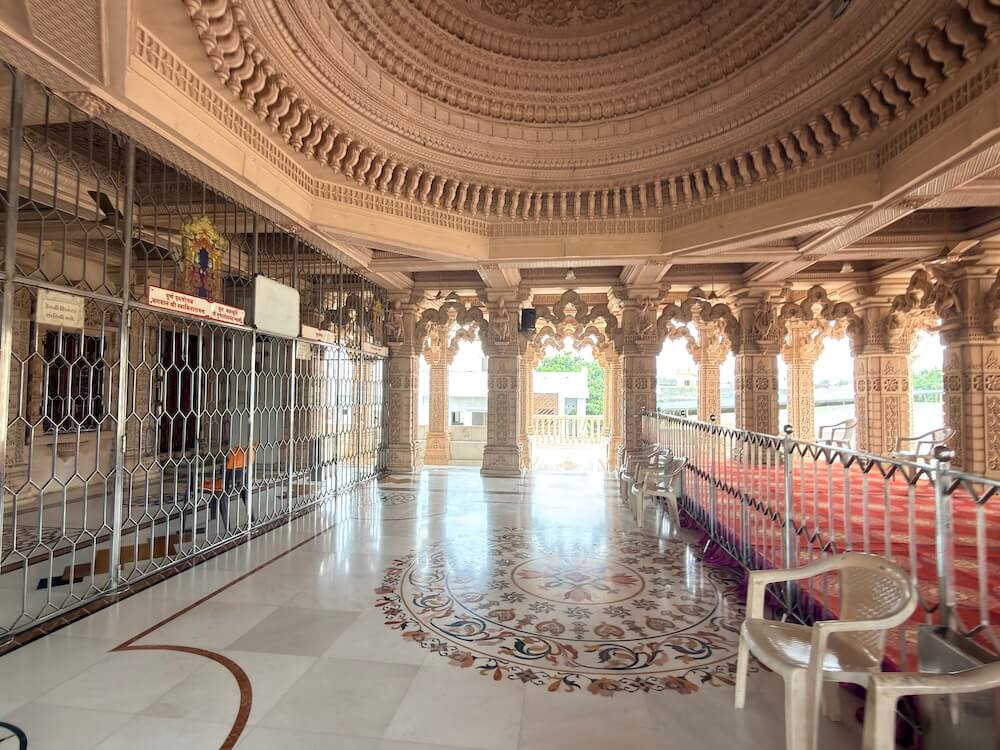
This Shikharbaddha mandir has been constructed in accordance with the principles of traditional Indian temple architecture and sculpture. The temple comprises three entrance porches opening in different directions, a spacious assembly hall and three sanctums. The entrance porches and assembly hall are supported by numerous intricately carved stone pillars interconnected by ornamental toranas. These pillars rest upon moulded bases and are richly decorated with auspicious motifs and intricate carvings along their shafts. Their capitals feature ring mouldings (kani) surmounted by ornamental brackets. Elaborately carved beams and ceilings rest upon these brackets. Intricate carvings adorn both the interior and exterior of the temple. The brackets supporting the domed ceiling of the assembly hall are embellished with sculptures of Surasundaris (celestial maidens), deities and saints. The stone carvings throughout the temple depict lotus flowers, elephants, peacocks, episodes from the life of Lord Swaminarayan and images of devoted followers.
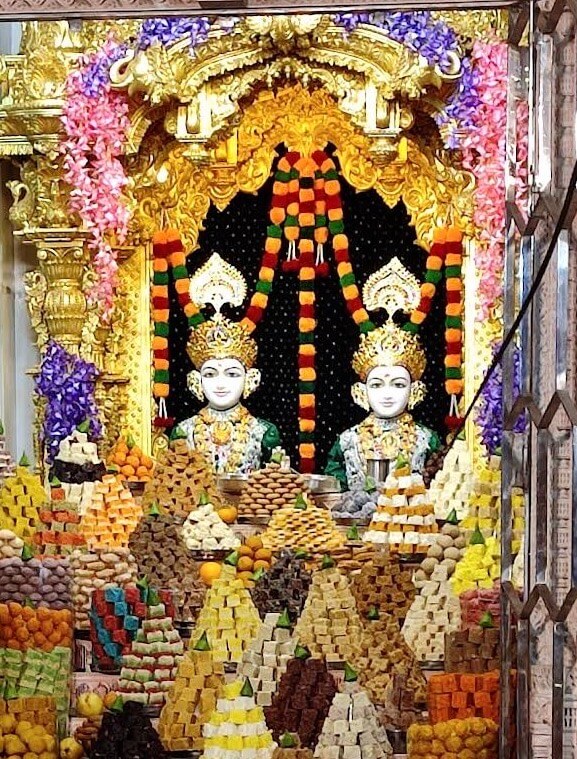
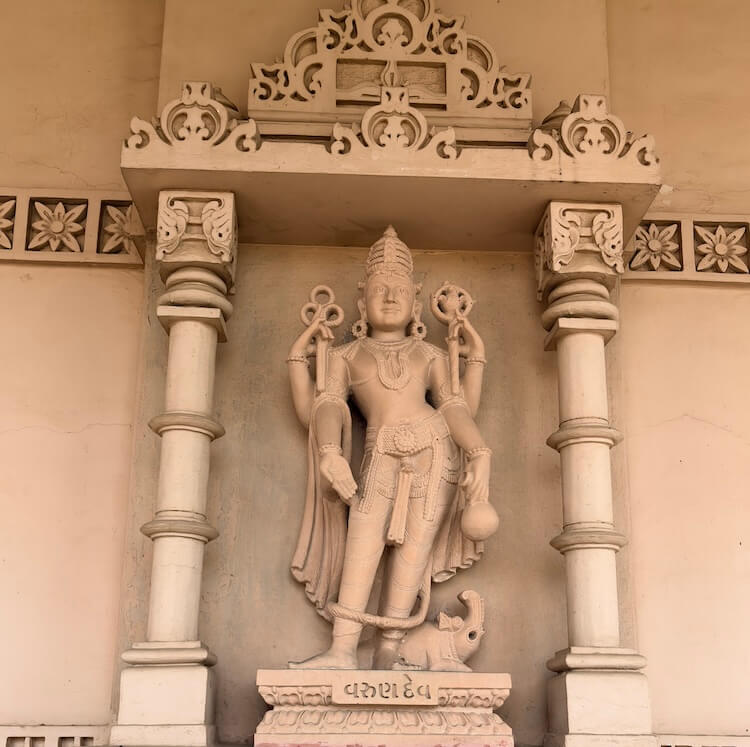
Beyond the assembly hall lies the antarala (antechamber), which leads to the temple’s three sanctums. The doorframes of all three sanctums are ornamented with beautifully carved foliage and floral creepers. Images of the tutelary deities are carved on the central lintels, while a chandrashila (moonstone) is placed at the threshold of each sanctum. Installed beneath the carved canopy of the central sanctum are the idols of Parabrahman Lord Swaminarayan and Gunatitanand Swami. The sanctums on either side enshrine Harikrishna Maharaj, Radha-Krishna and Ghanshyam Maharaj. The exterior walls of the temple are adorned with niches containing finely carved images of various deities, including Vayu, Kubera, Ishana, Indra, Agni, Yama and Nairrita. Each entrance porch is crowned with a domed roof, while a larger central dome surmounts the assembly hall and is topped by a stupika and sacred kalasha. Above the three sanctums rise lofty square shikharas that gradually taper upwards. Each principal spire is further embellished with niches and subsidiary angi shikharas, creating a majestic skyline.
The daily rituals and aartis are performed strictly in accordance with the traditions of the Swaminarayan Sampradaya. Mangala Aarti is performed daily at 6:00 am, followed by Shringar Aarti at 7:30 am. The Rajbhog offering is presented between 10:15 am and 11:15 am, during which the temple remains closed for darshan. Rajbhog Aarti is performed at 11:15 am, after which darshan resumes and continues until 12:00 noon. The temple is open for darshan daily from 6:00 am to 10:15 am, from 11:15 am to 12:00 noon, and from 4:00 pm to 8:15 pm. The evening Thal offering is presented between 6:00 pm and 7:00 pm, followed by Sandhya Aarti at 7:00 pm. The day’s worship concludes with Shayan Aarti at 8:15 pm. A daily morning congregation is conducted from 6:00 am to 7:00 am, while a special Satsang Sabha is held every Sunday from 5:00 pm to 7:00 pm, featuring scriptural discourses, devotional singing and spiritual guidance.
Numerous religious and traditional festivals are celebrated throughout the year. During the summer season, particularly in the month of Vaishakha, the Chandan Vagha Utsav is observed. On this occasion, sandalwood paste is ceremonially applied to the panchadhatu idols of Lord Swaminarayan and Shri Harikrishna Maharaj for several consecutive days to provide relief from the summer heat. Krishna Janmashtami is celebrated with the traditional Hindola Utsav, during which the deity is placed in a beautifully decorated swing, gently rocked by devotees and honoured with devotional music. Diwali and Annakut are celebrated on a grand scale. On Diwali Padva, Chhappan Bhog (an offering of fifty-six delicacies) is presented to Lord Swaminarayan, after which prasad is distributed among devotees. Swaminarayan Jayanti is celebrated on the same day as Rama Navami. Other important observances include Holi, Guru Purnima, Kojagiri Purnima, Dussehra, the holy month of Shravan and both Ashadhi and Kartiki Ekadashi. During these festivals, the temple hosts devotional singing, scriptural recitations, religious discourses, yajnas and community feasts.
This sacred temple stands as a testament to deep spiritual devotion, ancient architectural grandeur, and rich local cultural traditions.
The sanctum sanctorum houses the divine idol consecrated according to ancient Vedic traditions, surrounded by serene courtyards and traditional temple architecture.
Navratri, Maha Shivratri, Annual Temple Jatra & Deepotsav
Compare and book flights, secure top-rated local hotels near the temple, hire reliable guides, and rent cars instantly.
Extend your pilgrimage by visiting other highly sacred temples located nearby.


Add ₹999 more to unlock FREE SHIPPING!
Your sacred cart is currently empty.
Shop Photo FramesFill in your delivery details below to place your order.
Add comment