
Add ₹999 more to unlock FREE SHIPPING!
Your sacred cart is currently empty.
Shop Photo FramesThe Gaurishankar Mahadev Temple in the village of Gondhankheda, located in the Jafrabad taluka of Jalna district, is a revered place of faith for devotees in the region. In Indian culture and temple architecture, the concept of Gaurishankar Mahadev is considered a symbol of the non-dual principle of Shiva and Shakti, as well as universal equilibrium. According to iconography and mythological references, this form represents the union of Nature (Prakriti) and the Cosmic Being (Purusha). From the perspective of Shilpa Shastra (the science of sculpture), the design of this temple and the craftsmanship of its idols are considered unique. This four to five-hundred-year-old temple, which signifies the confluence of the Shaiva and Shakta sects, is also famous as the Tapobhumi (land of penance) of Rashtrasant Janardan Swami.
Mahadev and Parvati are considered the principal deities of the Shaiva and Shakta sects. Although these two sects are distinct, they are complementary to each other. Based on this concept, temples named Gaurishankar have been built in various places across India. The Gaurishankar Temple in Chandni Chowk, Delhi, was established by the Maratha Sardar Gangaji Rao in 1761 AD. A twelfth-century Gaurishankar Mahadev Temple is situated in the town of Manali in Himachal Pradesh. In archaeology, this form is primarily referred to as ‘Uma-Maheshwar’ or ‘Parvati-Parameshwar’. The texts of Shilpa Shastra provide rules for the creation of these idols. The marriage of Gauri and Shankar is described in the Rudra Samhita of the Shiva Purana. In this text, Shiva is called the Supreme Being (Paramapurusha) and Gauri is called the primordial energy (Adimaya Prakriti). The 260th chapter of the Matsya Purana describes the installation of the Uma-Maheshwar idol and its physical characteristics. It provides information about Gauri seated on Shankar’s left thigh and the weapons held in their various hands. Furthermore, the Kashi Khanda of the Skanda Purana and the Linga Purana clarify that Shiva and Shakti are parts of the same principle. The book ‘Rupamandan’, a treatise on Shilpa Shastra, explains the various types of Gaurishankar idols and provides historical context for the trident (trishul), matulunga (citron), and other symbols held in their hands. Studies of architecture and inscriptions reveal that Gaurishankar temples were built on a large scale during the reigns of the Kalachuri, Chandela, and Rashtrakuta kings. The temple complex at Bhedaghat in Madhya Pradesh is an example of this, and it is recorded in the ‘Central Provinces Gazetteer’. Inscriptions in and around these temples mention the traditions of the Shaiva sect and contain references to the worship of Gaurishankar.
This temple in Gondhankheda is approximately four to five hundred years old. It is known as the Tapobhumi of Rashtrasant Janardan Swami. Born in 1914 AD in Dahigaon (Taluka Vaijapur, District Chhatrapati Sambhajinagar), Janardan Godse had a deep interest in spirituality from a young age. People in the area recognized his spiritual inclination. Renouncing his home and family in his childhood, Janardan Swami embarked on a journey in search of the Divine. While wandering, he arrived at the Gaurishankar Mahadev Temple in Gondhankheda. Here, he performed meditation and penance. He established a cowshed (Gaushala) and an ashram to serve the cattle in the area. He also started a study center for the education of local children. On December 10, 1989, Swami took Sanjeevan Samadhi on an island near Kopargaon in Nashik district.
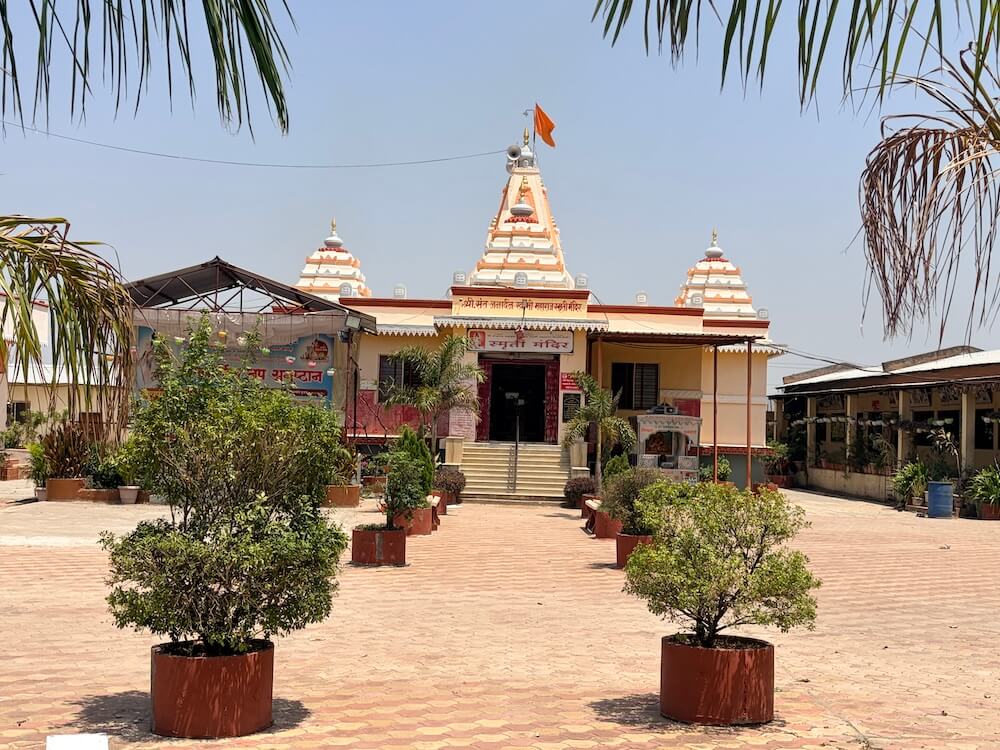
There is a paved road leading to the entrance of this temple near the village. The entrance is located within the boundary wall surrounding the temple. The courtyard, laid with paver blocks, features various trees and seating for devotees. There is a Yajna Mandap (sacrificial pavilion) in the courtyard. Additionally, the premises include a Bhakta Niwas (pilgrim lodging), Annachhatra (free food distribution center), residences for priests and attendants, a student hostel, and a Gaushala. The Gaurishankar Mahadev Temple is located at the front of the courtyard. The temple structure consists of three semi-pavilions (ardha-mandapas) on three sides, a main assembly hall (sabha-mandap), and the sanctum sanctorum (garbhagriha). The temple stands on a platform about three feet high. There are four steps leading to the entrance of the semi-pavilions, which are elevated above the courtyard level. In the front semi-pavilion, there is a marble idol of Nandi on a pedestal. In the center of the floor of the assembly hall, a tortoise sculpture is carved. The ceiling of the assembly hall features circular geometric carvings. On both sides of the entrance to the sanctum, there are five niches (dev-koshtakas) each, containing idols of the Navagrahas (the nine planets: Sun, Moon, Mars, Mercury, Jupiter, Venus, Saturn, Rahu, and Ketu) as well as an idol of Goddess Narmada.
The sanctum is located at a lower level than the assembly hall, with steps leading down into it. In the center of the sanctum floor, the Shiva Linga is installed. A copper replica of a serpent sheltering the Shiva Linga with its hood is present. An Abhishek-patra (vessel for ritual bathing) is hung from the ceiling for the flow of water. In the niches on the left and right walls of the sanctum are idols of Ganesha and Hanuman. An idol of Parvati is installed in the niche on the back wall of the sanctum. There is a circumambulation path (pradakshina marg) around the exterior of the temple. The roof of the sanctum features a two-tiered spire (shikhara). The lower tier of the spire is square-shaped and tapers upwards. In this tier, there are three niches stacked one above the other in the walls on all four sides, containing idols of various deities. The second, circular tier of the spire has eight niches arranged in a circular pattern, also containing idols of deities. The top of the spire is crowned with an Amalaka and a Kalasha.
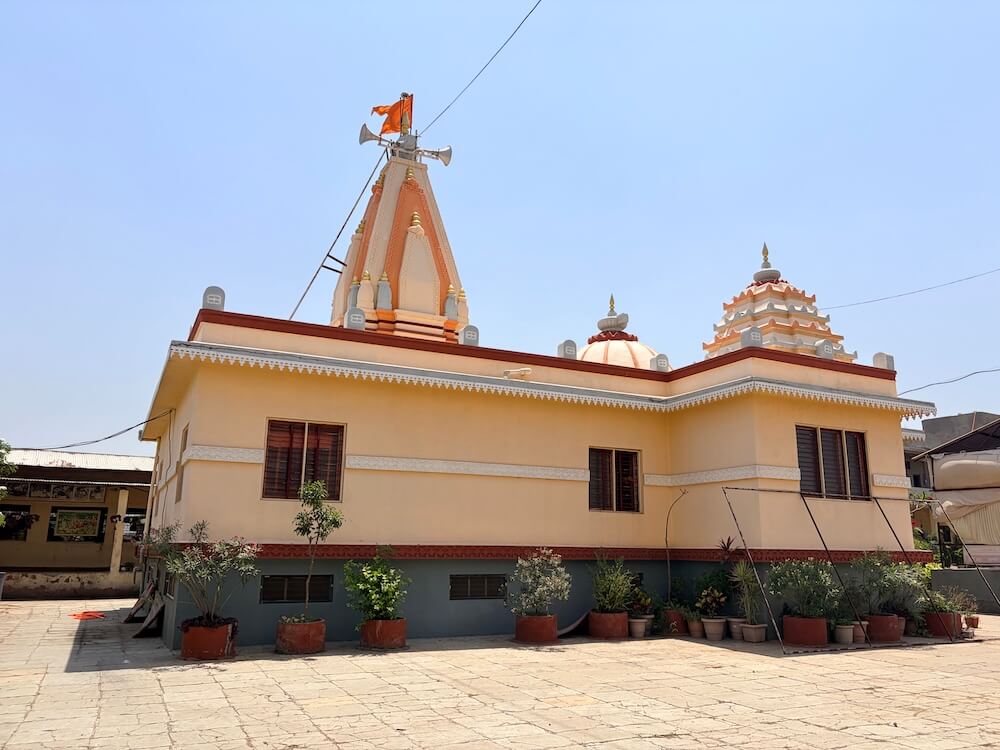
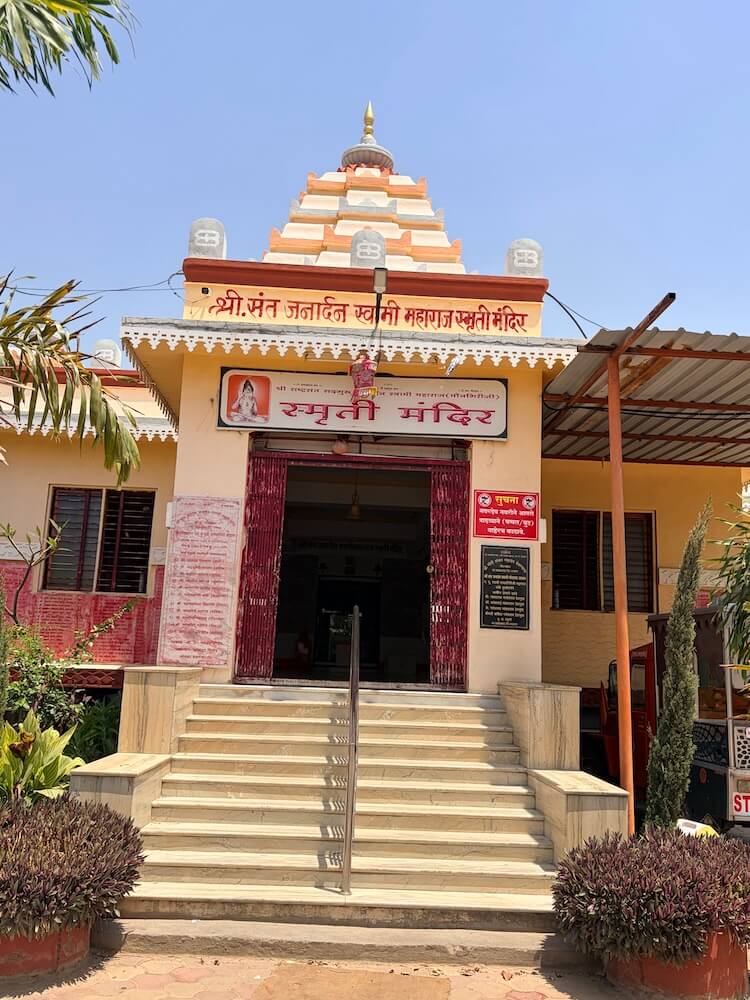
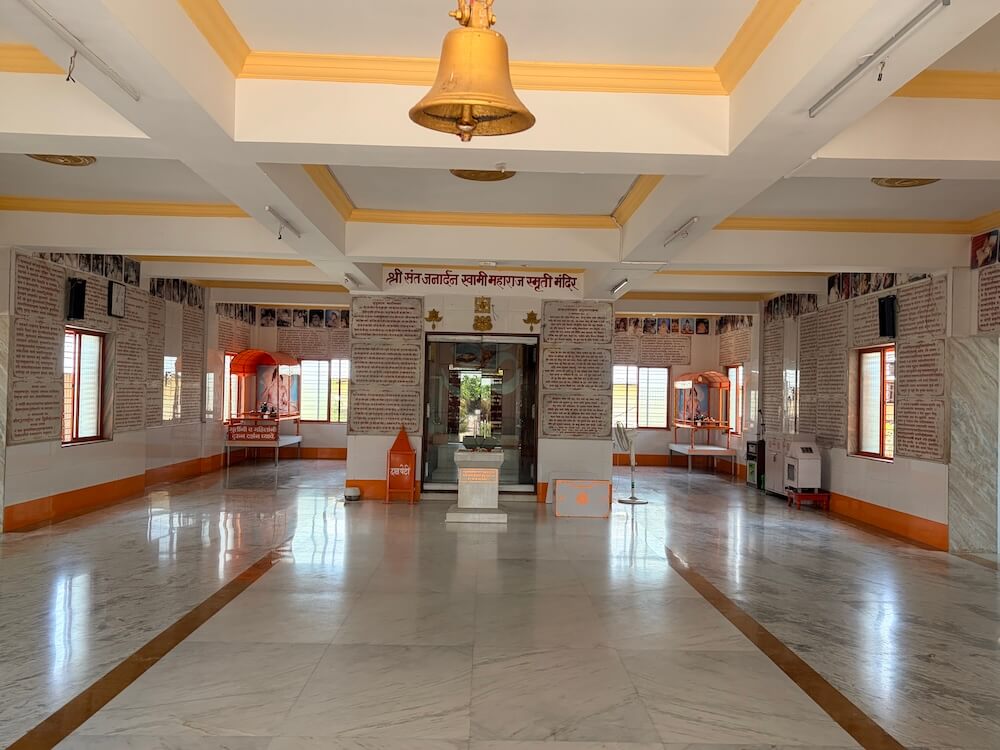
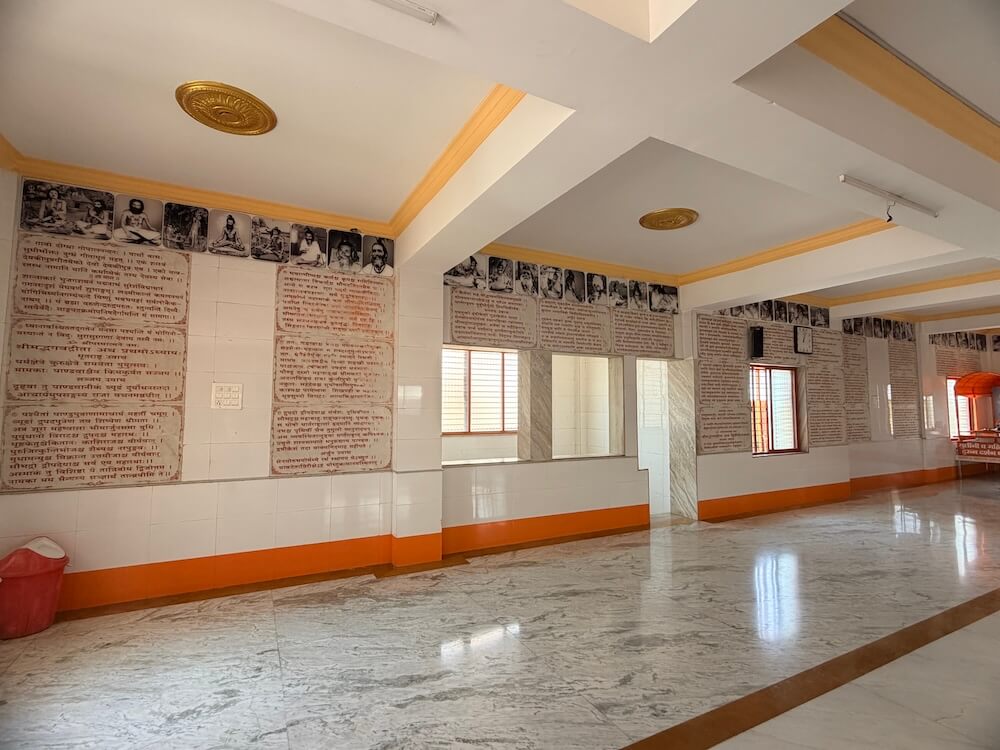
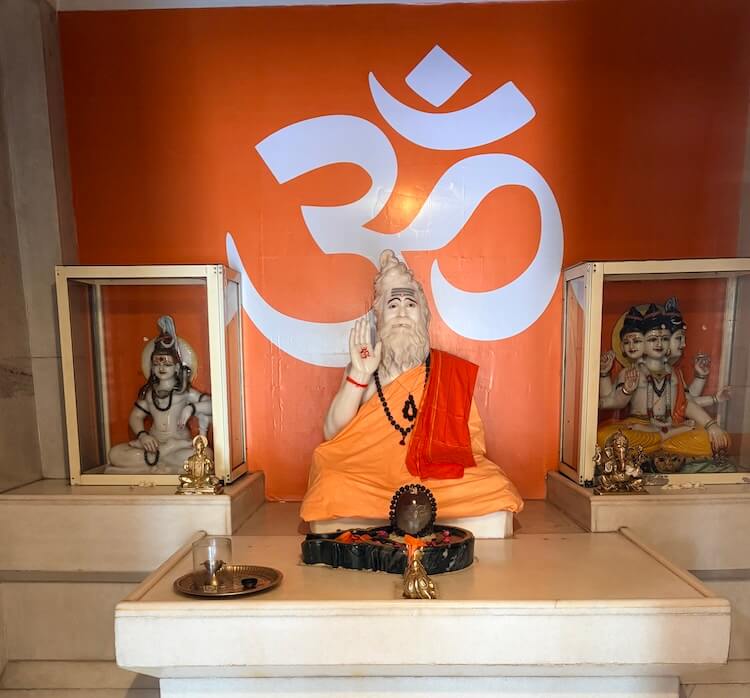
Beside the Mahadev temple is the Janardan Swami Smriti Mandir (Memorial Temple). This temple is situated on a platform about three feet high. The structure consists of a semi-pavilion, an assembly hall, and a sanctum. There are four steps leading to the entrance of the semi-pavilion, which is elevated above the courtyard. Beyond the semi-pavilion is the assembly hall. This enclosed assembly hall has windows for light and ventilation. In the assembly hall, facing the entrance of the sanctum, are the Padukas (footprints) of Janardan Swami on a pedestal. Inside the sanctum, an idol of Janardan Swami in a meditative posture is installed on a pedestal. A circumambulation path is built around the exterior of the sanctum. On this path, there is a ceremonial chariot (utsav rath). The chariot contains an idol of Janardan Swami in a meditative posture. In front of the Swami’s idol, a Shiva Linga and an idol of Nandi are installed. There are steps leading from the assembly hall of the memorial temple to the basement. The layout of the basement is identical to the floor above. In the assembly hall here, the Padukas of the Swami are placed on a pedestal facing the sanctum entrance. In the sanctum, an idol of Janardan Swami in a meditative posture is also placed on a pedestal. Along the circumambulation path here, one can see paintings depicting episodes from the life of the Swami.
A protective railing is built around the roof of the temple. Replicas of Shivlingas are installed on this railing. On the roof of the Sabhamandapa (assembly hall), there are three square-shaped spires (shikharas) with a pyramid-like structure and descending steps on three sides. At the apex of these spires, Amalakas are placed, topped with Kalashas. The roof of the sanctum sanctorum (Garbhagriha) features a square-based spire that tapers as it rises. In the courtyard in front of the temple, near the entrance, stands a Maruti temple. In front of the main temple, there is a Sabhamandapa with a corrugated metal roof. Inside the sanctum sanctorum, an idol of Lord Hanuman carved from black stone is consecrated on a Vajrapitha.
Mahashivratri is considered the main festival here. Additionally, a fair is held at the temple on the occasion of the death anniversary (Punyatithi) of Janardan Swami. Many devotees visit for darshan on all Mondays of the holy month of Shravan and on Guru Purnima. Festivals such as Nag Panchami, Vijayadashami, and Deepavali are celebrated in the temple. During festivals, religious programs like Laghurudra, Mahabhishek, Bhajans, Kirtans, and Mahaprasad are organized in the temple. Devotees are present for darshan on Mondays, Thursdays, Purnima (full moon), and Amavasya (new moon). Devotees can have darshan of Gauri Shankar Mahadev in this temple every day from 5:00 AM to 9:00 PM.
This sacred temple stands as a testament to deep spiritual devotion, ancient architectural grandeur, and rich local cultural traditions.
The sanctum sanctorum houses the divine idol consecrated according to ancient Vedic traditions, surrounded by serene courtyards and traditional temple architecture.
Navratri, Maha Shivratri, Annual Temple Jatra & Deepotsav
Compare and book flights, secure top-rated local hotels near the temple, hire reliable guides, and rent cars instantly.
Extend your pilgrimage by visiting other highly sacred temples located nearby.


Add ₹999 more to unlock FREE SHIPPING!
Your sacred cart is currently empty.
Shop Photo FramesFill in your delivery details below to place your order.
Add comment