
Add ₹999 more to unlock FREE SHIPPING!
Your sacred cart is currently empty.
Shop Photo FramesAbout a thousand years ago, Machindranath renounced his previous life’s conventions and established the Nath Sampradaya, which is free from the barriers of caste and creed. Gorakshanath, a disciple of Machindranath, elevated this tradition to a high level of excellence. Consequently, many ancient and famous temples of Gorakshanath can be seen in various parts of the country. Many of these temples are in the form of caves or forts, while some are an integral part of the village landscape. One such temple is situated in the village of Wai in Basmat taluka. The Bail Pola fair held here is very famous.
Historians estimate that this temple was likely established about two to three hundred years ago. According to the villagers, the Bail Pola fair here has an ancient tradition. The legend associated with this temple is that Panasaheb, an ascetic born into the Deshmukh family of Pirmangalur in Akola district, received initiation into the Nath Sampradaya. He lived a wandering life, eating only enough to satisfy his hunger, sleeping wherever he found space, and accumulating nothing. While living this life, he came to this village and stayed. He first built a small temple and installed an idol of Gorakshanath carved from the wood of a Bael tree. Later, in the year 1951, Rambhau Maharaj Shinde, a disciple of Gadge Baba from Zhadgaon in Yavatmal district, built a Maruti temple in Kurundwad village and stayed there until 1957. The villagers of Wai were captivated by his saintliness and requested Shinde Maharaj to come to Wai. Consequently, Shinde Maharaj made this his next residence. In 1964, Shinde Maharaj organized a Vishwashanti Yajna (World Peace Sacrifice) at this temple. On that occasion, he installed a four-foot-tall stone idol of Gorakshanath in the temple. It is said that he was the one who truly brought about the development of this Gorakshanath temple.
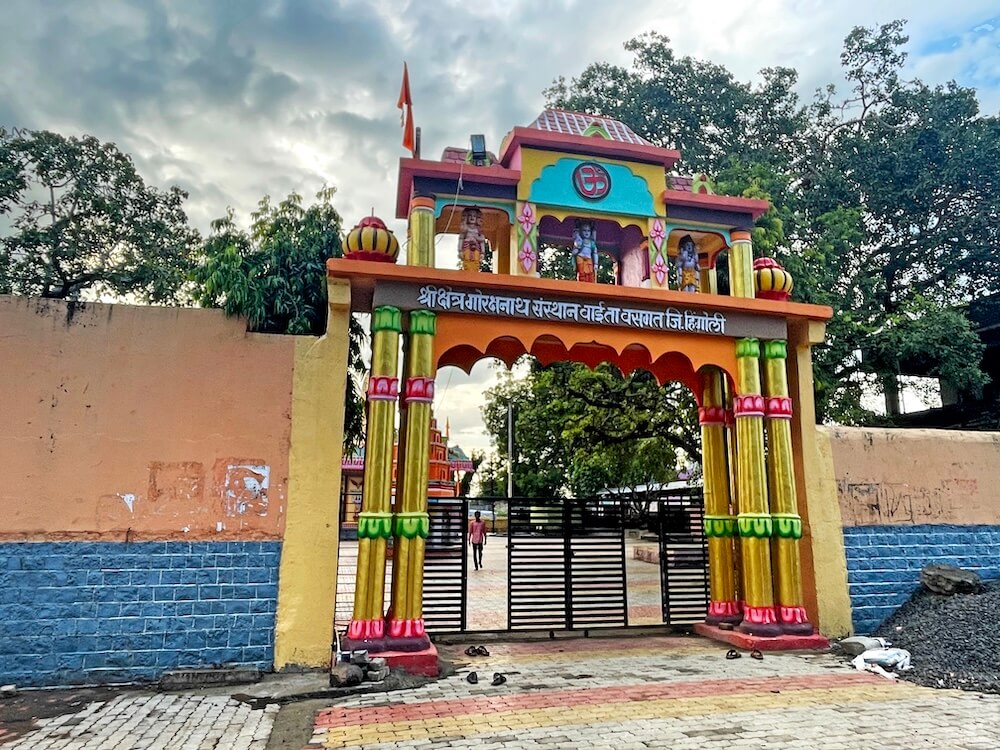
This temple, located near the village, has strong fortifications. In the entrance of these fortifications, there are two platforms on the left and right sides. Each of these platforms has four ornate pillars. The pillars on both sides are connected by arched gateways, and there are balconies (sajje) above these pillars. On these balconies, there are two amalakas on the left and right sides. Between these two amalakas, there are three continuous Meghadambaris (canopies), which house the idols of Brahma, Vishnu, and Mahadev. The spacious courtyard of the temple contains various types of trees. Also, at the back, there is an ancient well built of carved stone. There is an old tradition of purifying oneself here before proceeding for Darshan.
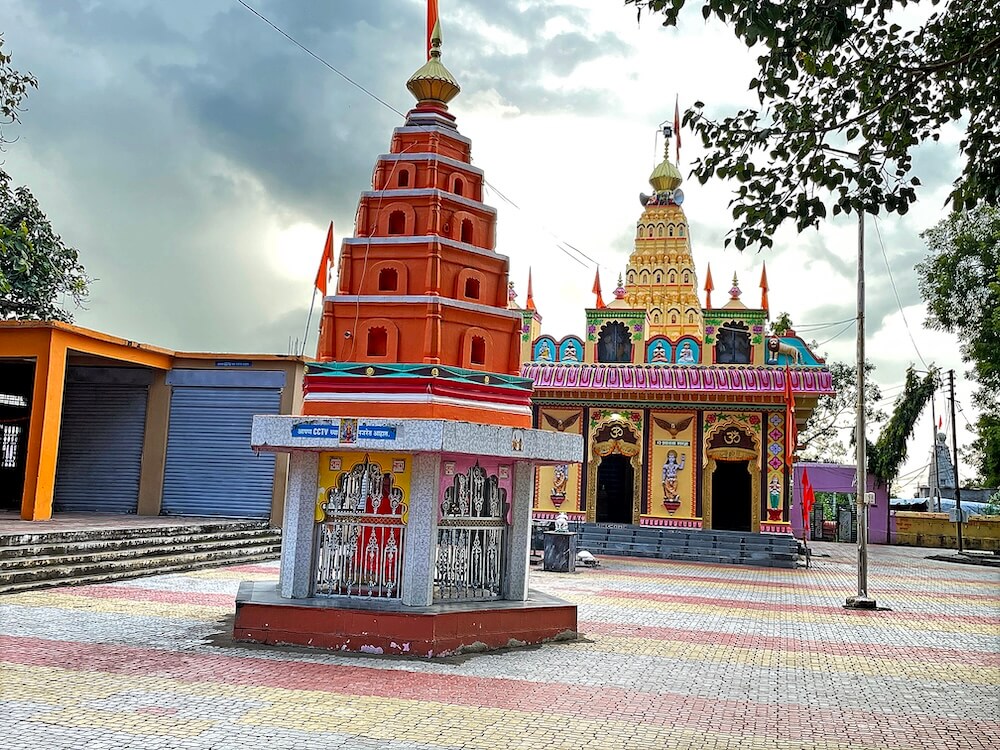
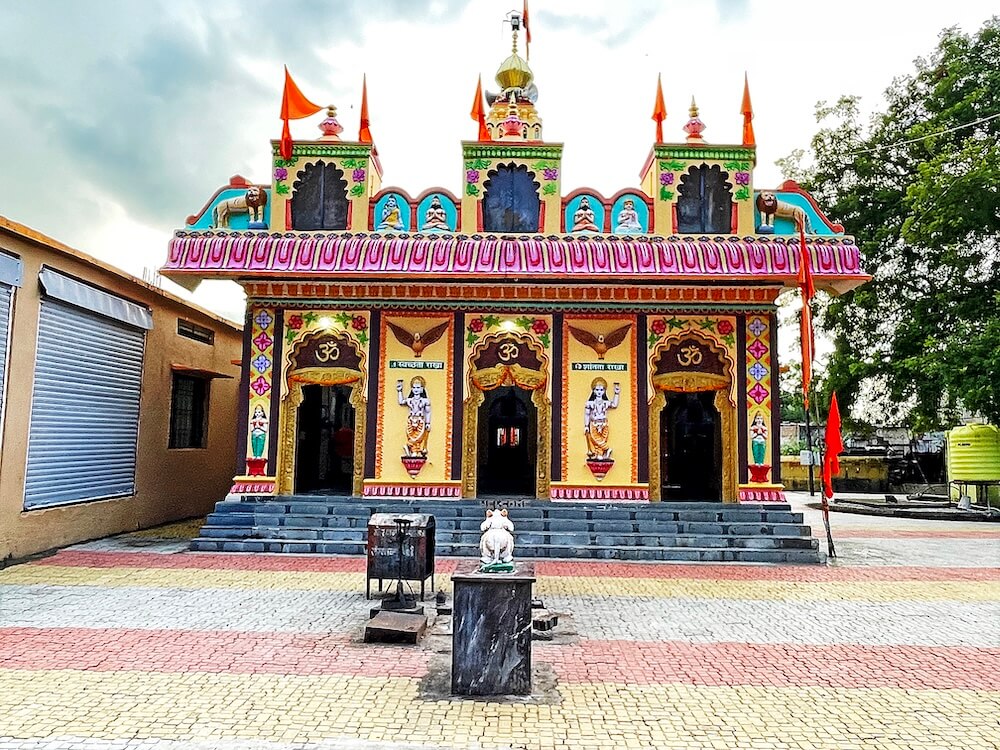
The temple structure consists of a Sabhamandap (assembly hall) and a Garbhagriha (sanctum sanctorum). In the courtyard in front of the temple, there is an idol of Nandi on a Vajrapitha (diamond pedestal). In front of this Nandi idol, there is a tortoise sculpture on the ground. The Sabhamandap is slightly elevated compared to the courtyard. It has three entrances on the front side. All three entrances share five common steps. On the front wall of the Sabhamandap, on both sides of the central entrance, there are four-armed guardian deities (Dwarapalas). Additionally, welcoming female figures (Swagatasundari) are painted on the sides of the left and right entrances. The door frames and the lintel of all three entrances are decorated with floral motifs, while the central lintel (Lalatabimba) features Ganesha sculptures. There are arched toranas over the entrances. The Sabhamandap has two more entrances in the left and right walls.
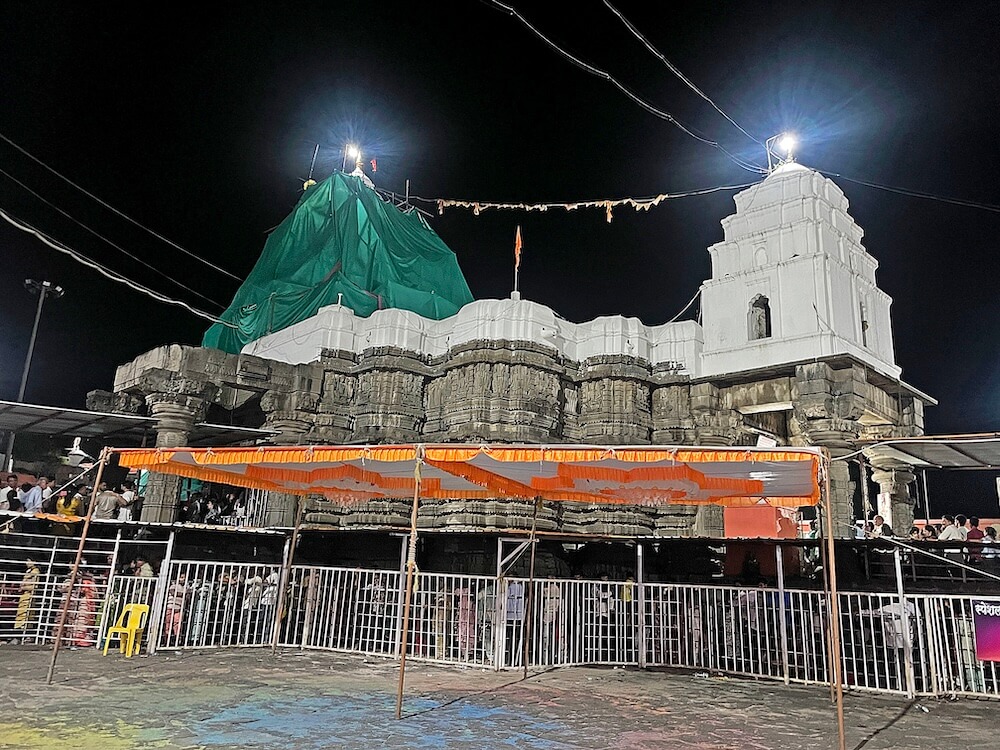
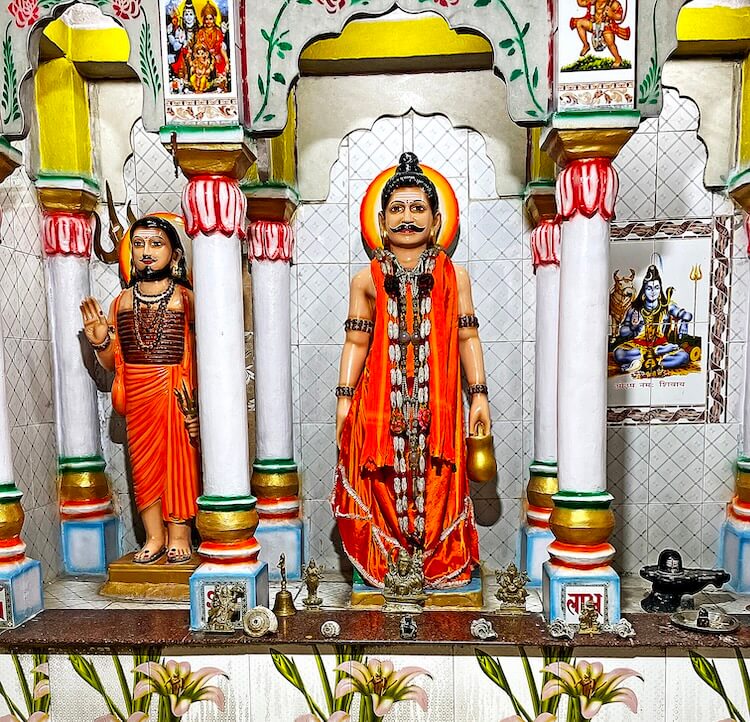
This enclosed Sabhamandap has ventilators for light and air. In the center of the Sabhamandap, there are two hexagonal pillars, and on both sides of the Garbhagriha, there are two square pillars. All four of these pillars stand on pedestals. These pillars feature relief-style floral carvings and peacock sculptures. All four pillars have lotus-petal mandalas at the base and the top. The ceiling features a circular design. The door frames of the Garbhagriha have vertical edge carvings. The arched torana there features a Ganesha sculpture. Inside the Garbhagriha, on a Vajrapitha, there are three shrines (makhar) with eight pillars connected by arched curves. The right shrine contains two Shiva Lingas, and the other two shrines contain two idols of Gorakshanath. One of these idols is ancient and made of wood, while the other is made of stone. There is a circumambulation path (pradakshina marg) around the exterior of the Garbhagriha.
The roof of the Sabhamandap has a safety railing on all four sides. It includes three Meghadambaris and decorative crests (bashinge) on the front side. The Meghadambaris and crests feature divine idols and sculptures. The roof of the Garbhagriha has a four-tiered square Shikhara (spire). Each tier of the Shikhara has five niches on all four sides, containing idols of various deities. At the top of the Shikhara, there is an amalaka and a kalasha.
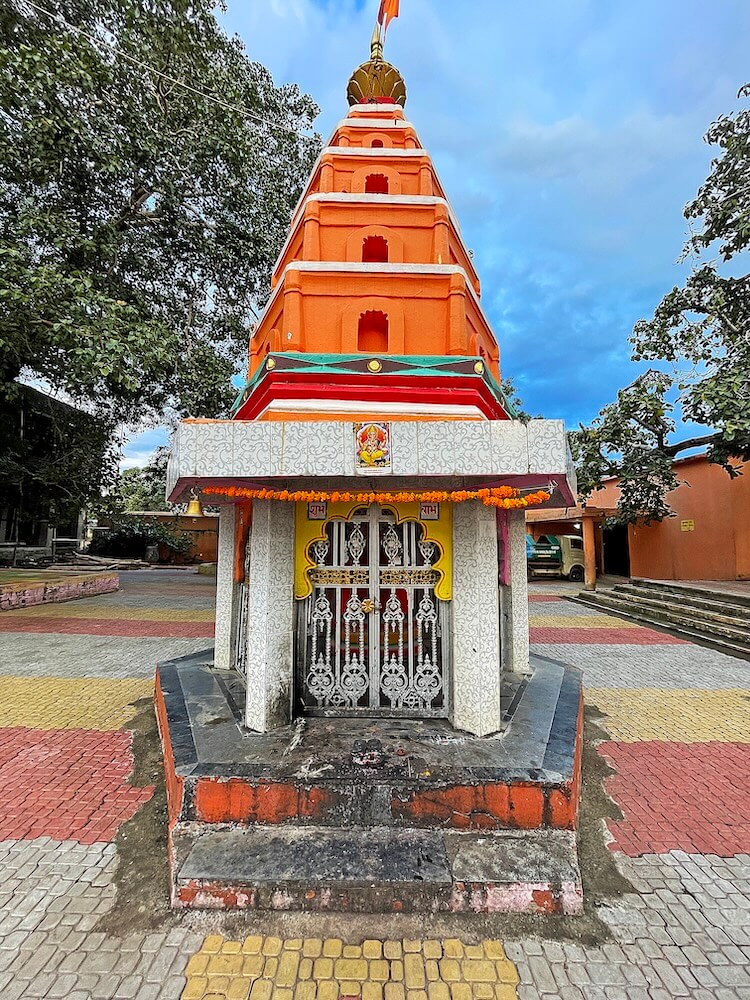
In the courtyard, in front of the temple, is the Samadhi temple of the late Mahants. In this pentagonal temple, there is an idol of the Mahant in a meditative posture. The roof of the temple has a four-tiered pentagonal Shikhara. The lower four tiers of the Shikhara each have five niches. At the top, there is an amalaka and a kalasha. Beside the temple, there are buildings such as a spacious hall for cultural programs and a wedding hall, residences for servants and priests, a kitchen, and a chariot house.
The ‘Bail Jatra’ (Bull Fair) is the main annual festival here. This fair is held on the day after Bail Pola, known as the Kari day. At this time, farmers from districts like Latur, Hingoli, Parbhani, and Nanded come with their cattle for the Darshan of Gorakshanath. Devotees believe that by performing circumambulation around the temple, their bulls remain healthy and fit throughout the year. Every year, more than fifty thousand bulls are brought for the Darshan of Gorakshanath. On this occasion, sports like bullock cart racing and wrestling are organized. Apart from this, a seven-day fair is held from Paush Purnima to Vadya Panchami. During both festivals, a temporary market is set up in the area with various shops. During the fair, there is buying and selling of various entertainment items, household goods, agricultural tools and products, clothes, electronic goods, etc., resulting in a turnover of lakhs of rupees.
Additionally, Harinam Saptah and other festivals throughout the year are organized in the temple. During all festivals, Bhajans, Kirtans, discourses, Mahaprasad, chariot processions, and Palkhi ceremonies are held at the temple. On the occasion of these festivals, many devotees from across the state come for the Darshan of the deity and to fulfill their vows.
This sacred temple stands as a testament to deep spiritual devotion, ancient architectural grandeur, and rich local cultural traditions.
The sanctum sanctorum houses the divine idol consecrated according to ancient Vedic traditions, surrounded by serene courtyards and traditional temple architecture.
Navratri, Maha Shivratri, Annual Temple Jatra & Deepotsav
Compare and book flights, secure top-rated local hotels near the temple, hire reliable guides, and rent cars instantly.
Extend your pilgrimage by visiting other highly sacred temples located nearby.


Add ₹999 more to unlock FREE SHIPPING!
Your sacred cart is currently empty.
Shop Photo FramesFill in your delivery details below to place your order.
Add comment