
Add ₹999 more to unlock FREE SHIPPING!
Your sacred cart is currently empty.
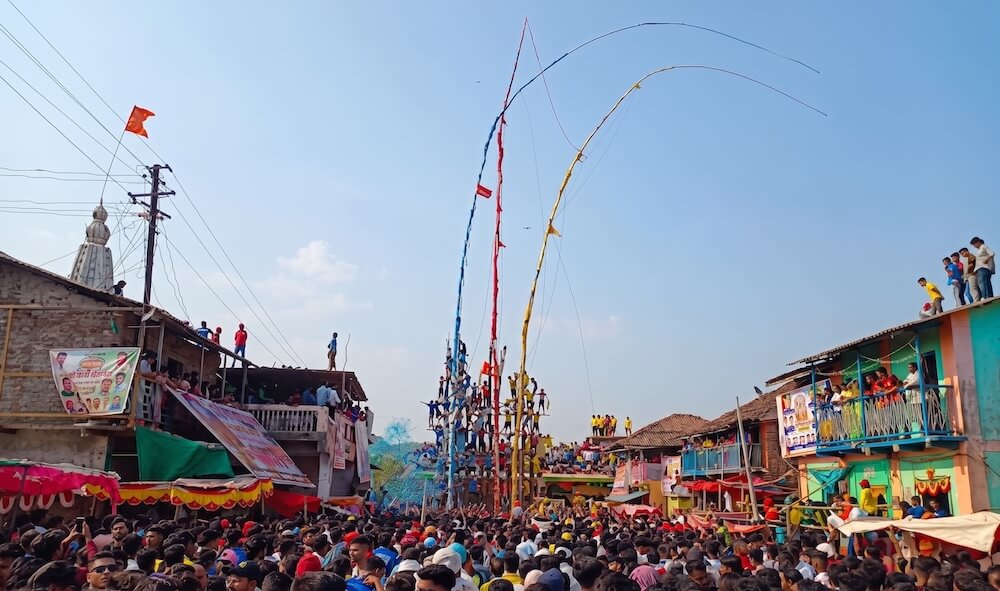
Shop Photo FramesWhile traveling from Panvel towards Pen, before crossing the famous Kharpada bridge, there is a route that leads to the village of Rave. It is in this village that the temple of Raybadevi, the presiding village deity famous throughout the surrounding region, is situated. In the local dialect, the name of this village is pronounced as ‘Rayve’, and the single-syllable word ‘Ba’ means ‘Mother’. Therefore, the Goddess is addressed as Raybadevi, meaning the Mother of Rayve village. Devotees firmly believe that this Goddess is highly sentient and grants the wishes of those who pray to her with devotion. Rave village and the Raybadevi temple here are famous throughout the district for the two hundred to three hundred feet tall ceremonial poles (Devkathis) erected during the festival period and their magnificent decorations.
Although there is no definitive information available regarding exactly how ancient this temple is, it is estimated that the establishment of this shrine dates back to the founding of the village. According to this reasoning, this sacred place is believed to be hundreds of years old. Before the year 1950, this temple was very small and had a simple tiled roof. In the olden days, there used to be many disputes and conflicts in this village. However, the villagers state that after everyone came together to serve this Goddess, the disputes in the village stopped completely. The temple attained its current form after the renovation that took place a few years ago.
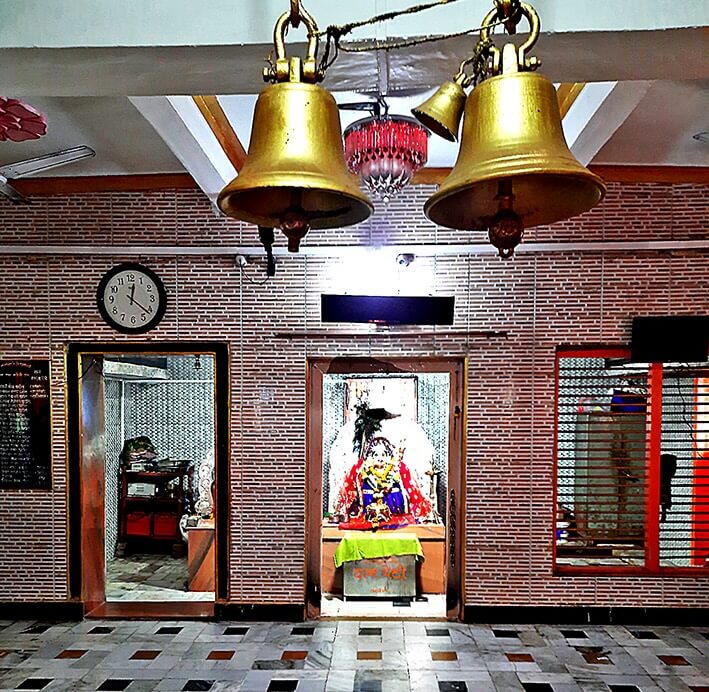
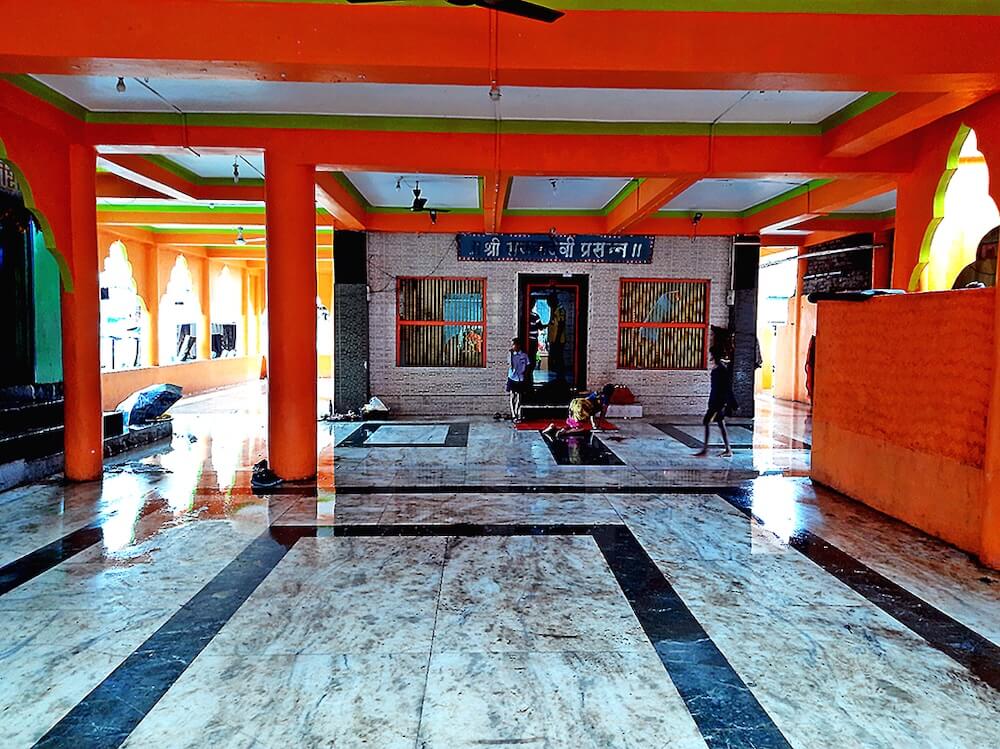
The temple is structured with an open pavilion, a main assembly hall, and a circumambulatory path surrounding the inner sanctum. One enters the assembly hall of the temple, which stands on a high plinth, by climbing five steps from the courtyard. Facing this newly constructed assembly hall, There are also entrances on the left and right sides. The main assembly hall features circular pillars that support the beams and the ceiling. All these pillars are interconnected by arched gateways. Further ahead lies the entrance to the sanctum sanctorum. The enclosed sanctum sanctorum is equipped with windows to allow for the circulation of air and the entry of sunlight.
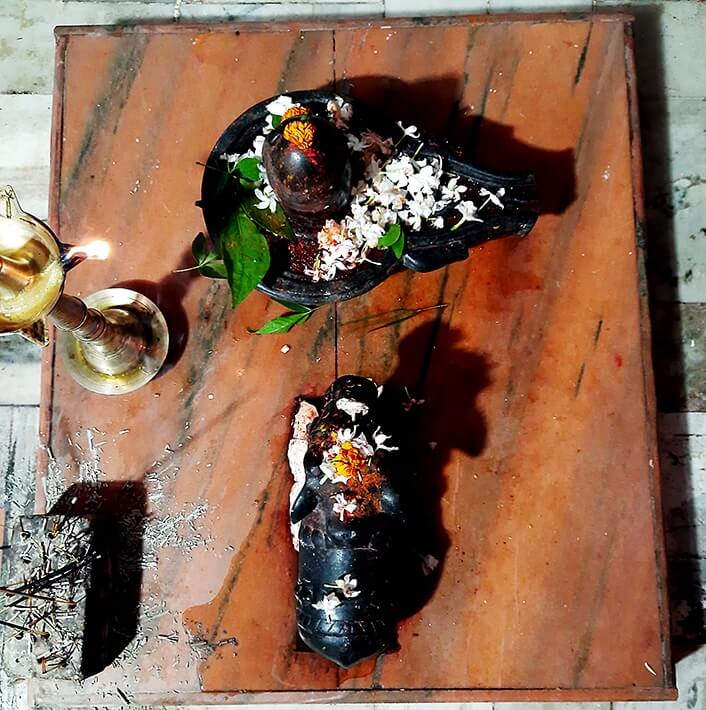
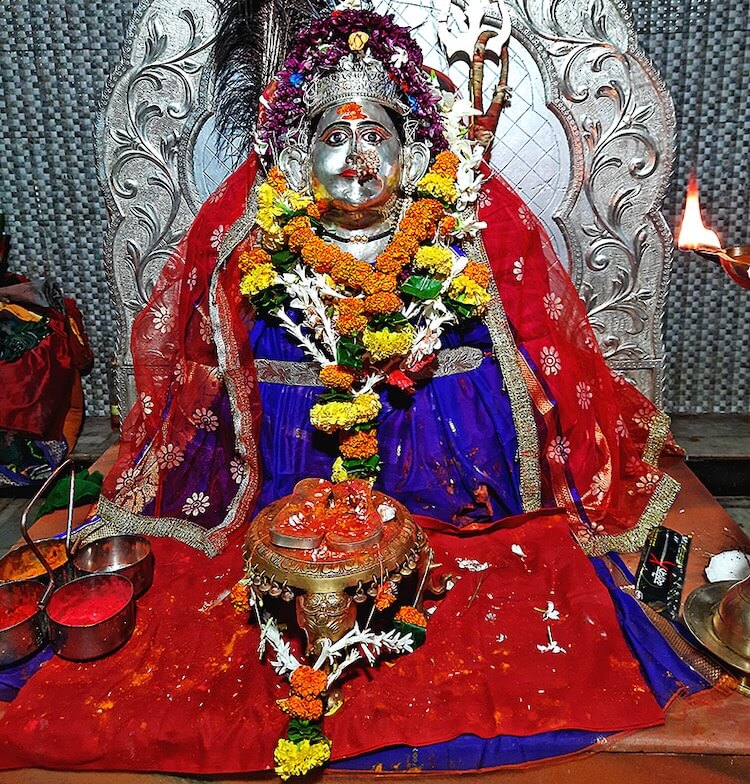
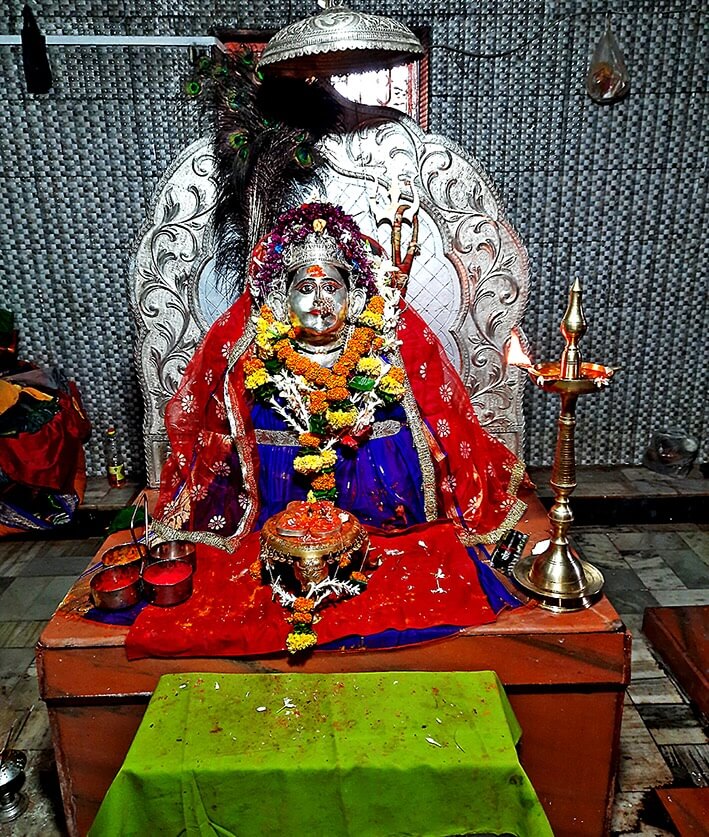
The ancient and serene idol of Goddess Raibadevi is enshrined in the center of the sanctum sanctorum on the Vajrapitha. Adorned with various garments and ornaments, the Goddess wears a silver mask. There is a silver crown on the head of the Goddess. In the silver halo behind the idol, there is a lotus flower in the center and leaf-vine carvings on both sides. A bunch of peacock feathers is kept beside the idol, and in front, there is an Utsava mask and silver footprints. On the Vajrapitha, to the left, is the Shivpinda, and to the right, there is an idol of Shri Ganesha carved in stone. The Ganesha idol is also adorned with garments and ornaments, and the idol has a silver mask. Behind this idol is an ornate silver halo. On the ceiling of the sanctum sanctorum, there is a square-shaped Shikhara. The four corners of this Shikhara have vertical edge carvings, and there are sub-shikharas on all four walls. At the apex of the main Shikhara is the Amalaka, topped with a Kalasha and a flag.
Every year, on Chaitra Amavasya, the main annual fair of the Goddess is celebrated with great enthusiasm at the temple. The primary highlights of this pilgrimage are the two hundred to three hundred feet tall Devkathis (sacred poles) erected during the festival, their magnificent decorations, and the traditional attire of the youth who raise them. During this time, devotees from the six alleys of the village are divided into three groups. Each group brings the honored Devkathis of the three deities—Mhasoba, Khandoba, and Shriram, whose shrines are located within or near the village—to the Rayba Devi temple in a grand procession accompanied by the thunderous beats of drums and the showering of gulal. These poles are erected using large ropes on a specially constructed structure within the temple. The decoration of each of these three poles is unique. There is a silent competition among the youth to ensure their group’s pole appears the tallest and most attractive. The group whose pole stands the tallest is declared the winner. For this occasion, each group wears clothes of a single color as a symbol of their unity, creating a mesmerizing display of three colors across the entire temple premises. During this festival, devotees dressed in traditional Agri-Koli attire and adorned with abundant gold jewelry capture everyone’s attention. Thousands of devotees from Versova, Bandra, and Khar in Mumbai, as well as from Thane, Pune, and the surrounding areas of Alibaug and Pen, arrive to witness this fair of the Devkathis, seek the blessings of the Goddess, and fulfill their vows. Arrangements for the meals of all these devotees are made by the villagers. Apart from this main fair, a nine-day Navratri festival is also celebrated in the temple with deep devotion. People travel from far and wide to witness the radiant form of the Goddess during Navratri and to participate in the Garba. Additionally, there is a large influx of devotees seeking the Goddess’s blessings on every Purnima, Amavasya, Tuesday, and Friday. Devotees can have the darshan of Rayba Devi here daily from six in the morning until eight in the evening.
This sacred temple stands as a testament to deep spiritual devotion, ancient architectural grandeur, and rich local cultural traditions.
The sanctum sanctorum houses the divine idol consecrated according to ancient Vedic traditions, surrounded by serene courtyards and traditional temple architecture.
Navratri, Maha Shivratri, Annual Temple Jatra & Deepotsav
Compare and book flights, secure top-rated local hotels near the temple, hire reliable guides, and rent cars instantly.
Extend your pilgrimage by visiting other highly sacred temples located nearby.


Add ₹999 more to unlock FREE SHIPPING!
Your sacred cart is currently empty.
Shop Photo FramesFill in your delivery details below to place your order.
Add comment