
Add ₹999 more to unlock FREE SHIPPING!
Your sacred cart is currently empty.
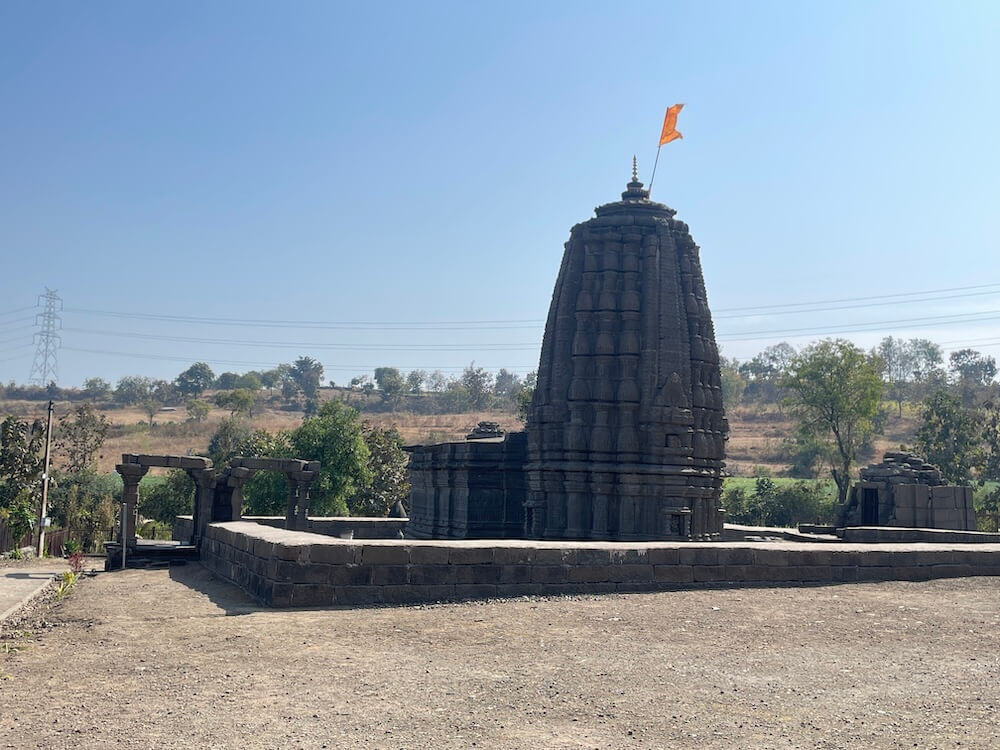
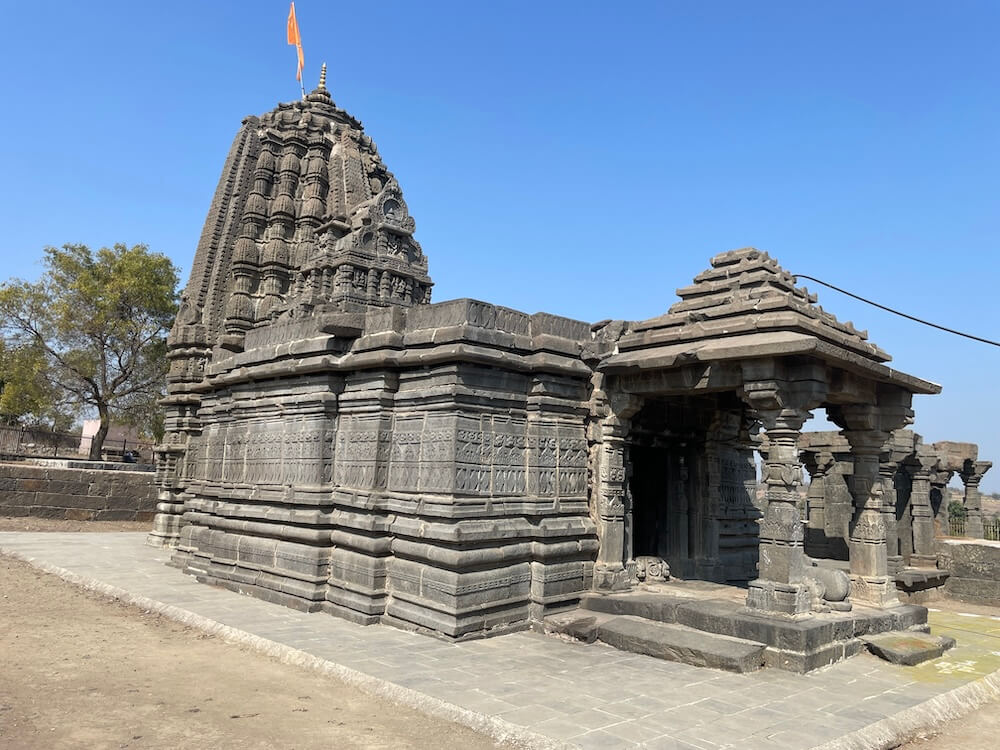
Shop Photo FramesThe Sakeshwar Mahadev Temple, located in the Chikhli taluka of Buldana district, is an important heritage of ancient Indian architecture. This temple was constructed during the twelfth or thirteenth century under the reign of the Yadava kings of Devagiri. Locally, this temple is considered to be of the ‘Hemadpanti’ style; however, in architectural terminology, its design belongs to the ‘Bhumija’ style. Situated at the foothills of a quiet hill to the west of Sakegaon, this temple is exquisitely carved out of black stone. The historical and spiritual heritage of this temple is invaluable, not only at the local level but also from the perspective of the Archaeological Department.
A special mention of this temple is found in the ‘Central Provinces and Berar District Gazetteers’ published in 1910. Furthermore, the renowned British archaeologist Henry Cousens provided detailed information about this temple and photographs of its then-collapsed spire in his 1931 work, ‘The Medieval Temples of the Deccan’. This book written by Cousens is still considered a highly authoritative guide for scholars of medieval architecture. In this book, he has presented the historical and architectural significance of the Sakeshwar Mahadev Temple in very precise terms. According to Cousens’ observations, this temple dates back to approximately the twelfth or thirteenth century and stands as a testament to the glory of the Yadava kings of Devagiri. The design of the Sakeshwar Temple is primarily in the ‘Bhumija’ style. This structure matches exactly with the design of the Vishnu temple at Satgaon Bhusare, also in Chikhli taluka. While comparing these two temples in his book, Cousens particularly praised the intricate carvings of the Sakeshwar Temple.
In his book, he recorded the state of the Sakeshwar Temple’s spire at that time with photographs. In those days, the temple’s spire was in a partially collapsed state. However, the records made by Cousens clarified what the original structure of the spire looked like. Using this reference, it later became possible for the Archaeological Department to successfully reconstruct this spire. He specifically noted that the design of the pillars in the temple’s assembly hall (Sabhamandapa) and the ‘Ghatapallava’ (full vase and leaves) carvings upon them are a major characteristic of Yadava-era architecture. The load-bearing ‘Kichaka’ figures on these pillars and their sculptures in various postures reveal the profound imagination of the artisans of that time. Cousens considered the image of Ganesha carved on the lintel of the temple entrance and the beauty of the five-branched doorway as a whole to be architecturally very significant. Cousens’ writing also refers to an inscription on the exterior of the Sakeshwar Temple and the ‘Gaddhegal’ (donkey curse) symbol upon it. This inscription serves as important evidence of the temple’s antiquity and the socio-political patronage of that era. Due to this documentation by Henry Cousens, the Sakeshwar Temple gained historical recognition on a global level.
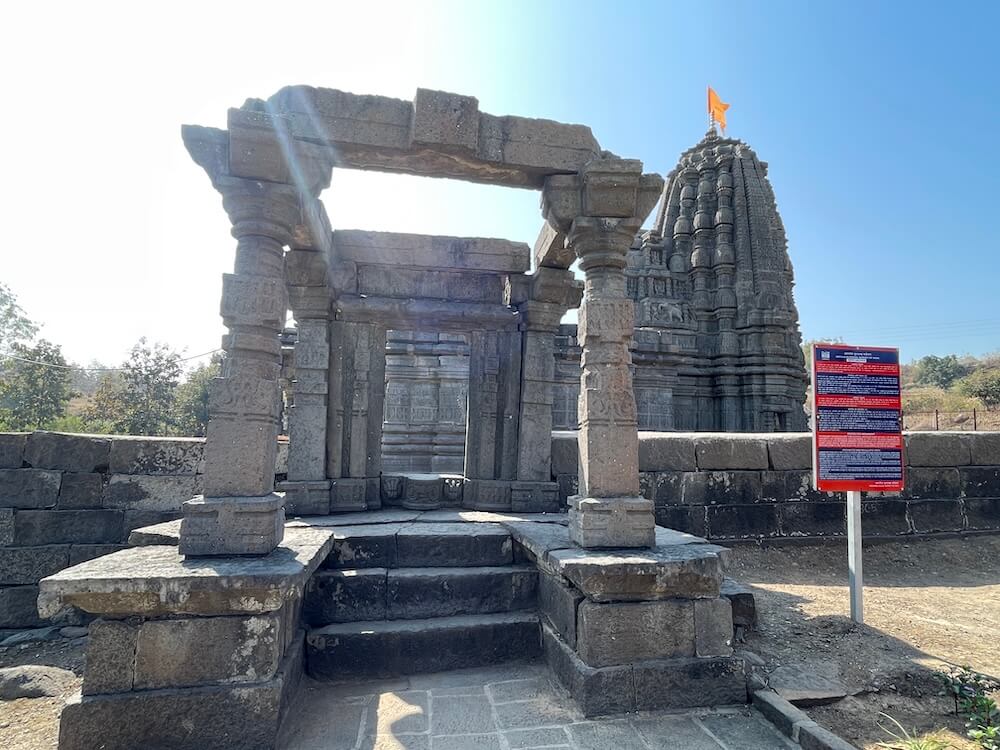
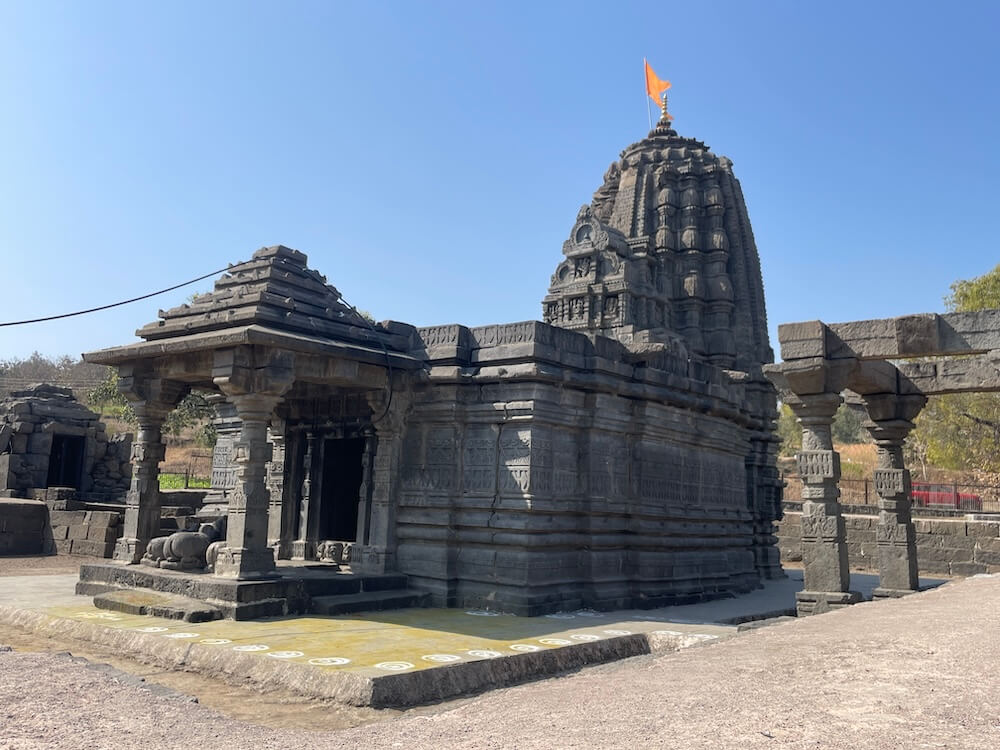
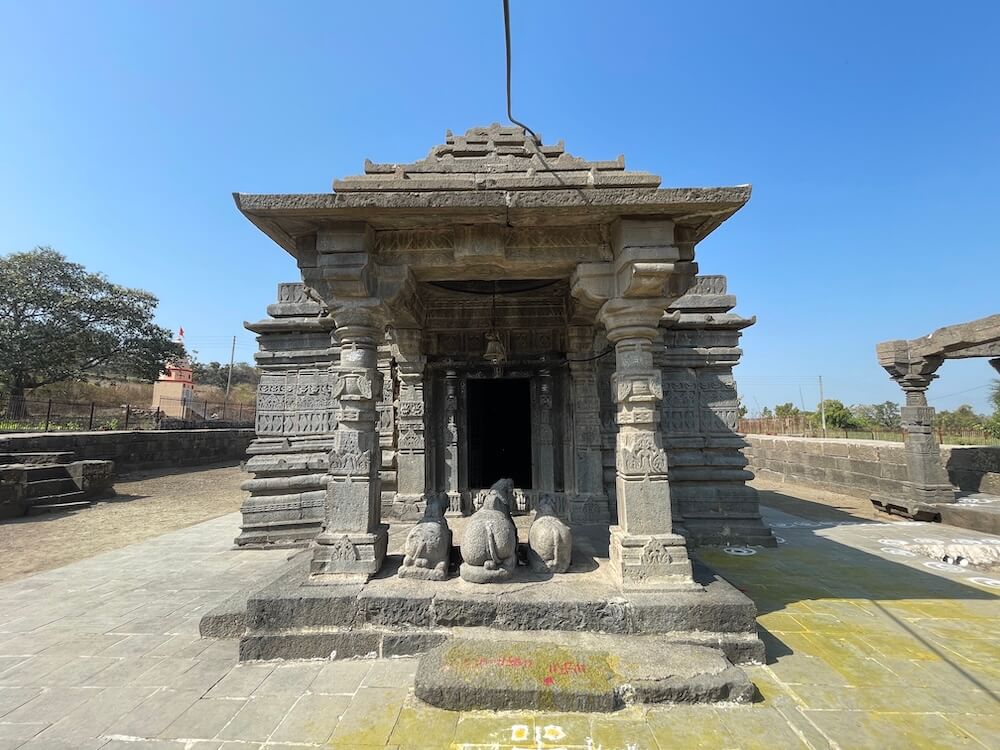
The temple is situated at the foothills of a small hill to the west of the village. There is farmland surrounding the temple, and the Archaeological Department has installed an iron fence around it for security. There is a stone pathway to reach the temple. The entrance of the temple faces north. The main structure consists of a porch (Mukhamandapa), an assembly hall (Sabhamandapa), a vestibule (Antarala), and the sanctum sanctorum (Garbhagriha). This temple faces east, and its design is such that on certain days of the year, the rays of the rising sun fall directly upon the Shiva Linga in the sanctum sanctorum. In the porch at the temple entrance, there are three statues of Nandi. One of them is the original ancient statue. Beside these Nandis, a sculpture of a lion is carved, and there is an attractive lotus design on the ceiling of the porch. The serpent carvings on the pillars here and the various shapes on the stone pillar bases testify to the skill of the artisans. From the porch, one enters the assembly hall. In the center of the assembly hall, between four pillars, there is a raised platform (Rangashila) and circular carvings on the ceiling. On the four main pillars here, Kirtimukhas and sculptures of load-bearing Kichakas in various postures are carved. These include a female Kichaka, a Kichaka blowing a conch, a Kichaka in a greeting posture, and on the fourth pillar, instead of a Kichaka, there is a four-armed statue of Ganapati. This statue holds a broken tusk, a lotus, an axe, and a modaka. In the lower parts of the pillars, sculptures of various gods and goddesses are carved. On the front wall of the vestibule, there are niches (Devakoshthakas) containing statues of Ganapati and Kubera. Since the main sanctum sanctorum of the temple is in a slightly sunken area, one has to descend two steps to enter. On the entrance of the sanctum sanctorum, there are five ornate door frames and a sculpture of Ganesha on the lintel. In the center of the sanctum sanctorum is the Sakeshwar Mahadev Linga.
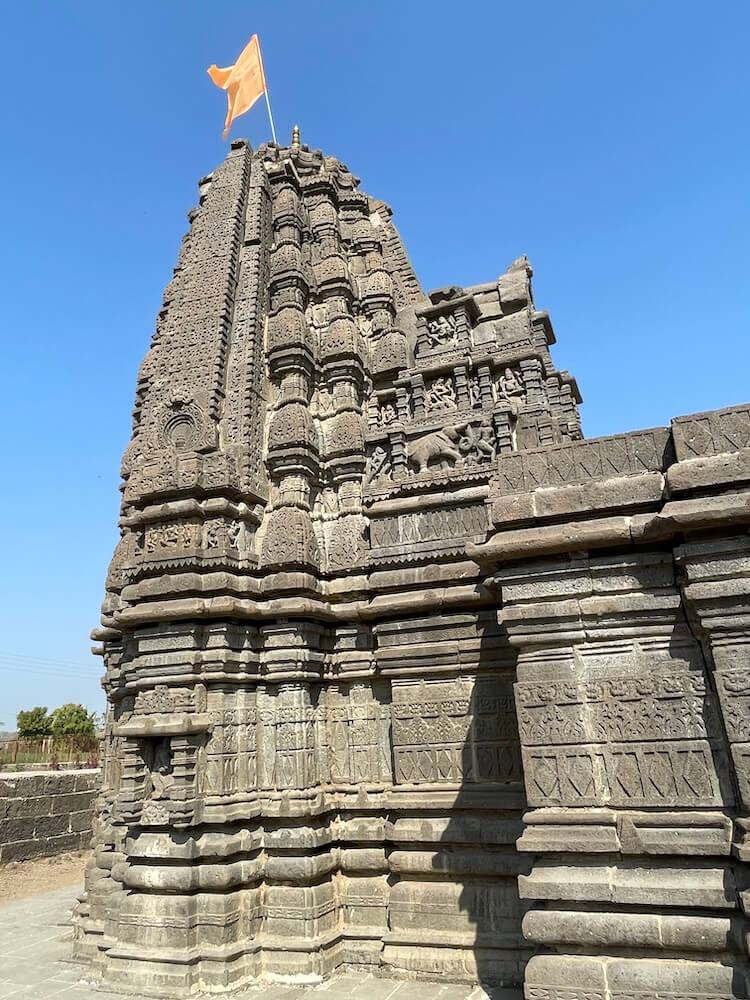
The design of the temple’s outer walls is distinctive. The base (Adhishthana) of the temple is made of various horizontal layers such as the Khura, Padma, Upana, and Kani. These layers give the temple a sturdy and grand appearance. There are niches at regular intervals on the outer walls. Inside them are carved statues of Nataraja, Mahishasuramardini, and other deities. The carvings on the outer walls include rows of elephants (Gajathara) and sculptures depicting various scenes from human life. The sculptures on the temple walls are still largely in good condition, and the small details upon them are clearly visible. Although some parts have eroded over time, the grandeur of the spire and the beauty of the carvings on the walls remain intact today.
The spire of this temple is built primarily in the ‘Bhumija’ style. The structure of the spire appears very proportionate and rhythmic from bottom to top. On this spire, there are several rows of smaller spires that taper towards the top. On each side of the spire, there is a vertical band in the center with very fine and geometric carvings. At the very top of this spire is an Amalaka and a Kalasha upon it. Each layer of the spire is skillfully carved in black stone and includes figures of various gods and goddesses. Various mythological sculptures are also clearly visible on the Shukanasika (ante-fix) part located in the lower section of the spire.
There is an ancient inscription in the temple premises. Text is carved on it in the Devanagari script. A ‘Gaddhegal’ is also carved on this stone. Around the temple, there are small shrines dedicated to Shri Ram, Lakshman, Sita, and Sati.
Preserving ancient heritage and intricate craftsmanship, this temple maintains its historical significance even today. Currently, the temple is under the supervision of the State Archaeology Department.
The grandest festival celebrated at this temple is Mahashivratri. On this day, queues of devotees form for darshan from the early hours of the morning. There is a special tradition of observing a vigil (jagar) in the temple on the night of Mahashivratri.
During this time, bhajans, kirtans, and the continuous chanting of ‘Om Namah Shivaya’ resonate throughout the night. Apart from Mahashivratri, the temple sees a large influx of devotees for darshan every Monday during the holy month of Shravan.
This sacred temple stands as a testament to deep spiritual devotion, ancient architectural grandeur, and rich local cultural traditions.
The sanctum sanctorum houses the divine idol consecrated according to ancient Vedic traditions, surrounded by serene courtyards and traditional temple architecture.
Navratri, Maha Shivratri, Annual Temple Jatra & Deepotsav
Compare and book flights, secure top-rated local hotels near the temple, hire reliable guides, and rent cars instantly.
Extend your pilgrimage by visiting other highly sacred temples located nearby.


Add ₹999 more to unlock FREE SHIPPING!
Your sacred cart is currently empty.
Shop Photo FramesFill in your delivery details below to place your order.
Add comment