
Add ₹999 more to unlock FREE SHIPPING!
Your sacred cart is currently empty.
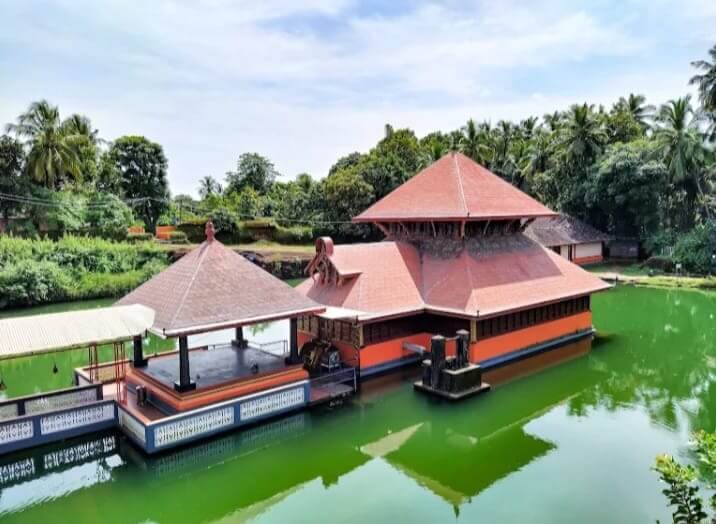
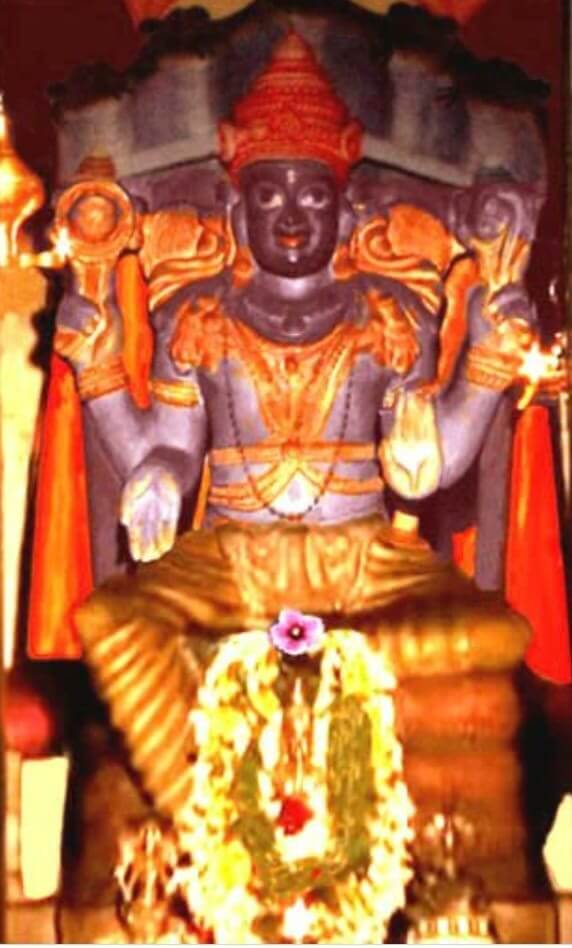
Shop Photo FramesSri Ananthapadmanabha Swamy Temple, popularly known as Ananthapura Lake Tem-ple, is an ancient Hindu temple dedicated to Lord Mahavishnu. Lord Mahavishnu, the foremost among the Trimurti, is the presiding deity of the temple and is worshipped in a seated posture. Renowned as Kerala’s only lake temple, it is believed to be the original abode and source shrine of the deity worshipped at Sree Padmanabhaswamy Temple in Thiruvananthapuram. The temple is situated about 5 km from Kumbla town in Kasaragod district. According to local tradition, Lord Ananthapadmanabha originally resided here. The idol of Mahavishnu is made in the ancient Kadu Sarkara Yogam style. Built in the middle of a picturesque lake with distinctive architecture, the temple attracts both devotees and visitors alike.
Ananthapadmanabha Swamy Temple is one of the oldest Vaishnavite temples in North Kerala. The temple was established in the 9th century AD. According to the records of the Kerala Department of Archaeology, the existing sanctum sanctorum and the main structure of the temple date back to the 14th century AD. The oldest mural paintings in the temple also belong to the same period. The temple was founded by a local Tulu Brahmin family. Ancient inscriptions in the Tulu language, written in the Malayalam script, can still be seen on a granite stone in front of the Ganapathi sub-shrine. These inscriptions are evidence of the cultural influence of the Tulu rulers and the Brahmin community in the region.
During the 16th century, when this region was under the Vijayanagara Empire, the temple received special importance. The Vijayanagara rulers made significant contributions to the development and renovation of the temple. The influence of Vijayanagara architecture can still be clearly seen in the temple’s gopuram and stone carvings. In 1972, after the original idol was damaged, Sri Jayendra Saraswati Swamigal, the head of the Kanchi Kamakoti Peetham, donated Panchaloha idols to the temple. Later, under the supervision of the Department of Archaeology, the idol was restored in the traditional Kadu Sarkara Yogam style.
One of the most famous legends associated with the temple is that of the crocodile known as ’Babiya’. It is said that in 1945, a British soldier shot and killed the crocodile living in the temple lake, after which another crocodile appeared. Babiya later became one of the unique features of the temple. After living in the temple pond for more than 70 years, Babiya died in October 2022. A year later, in November 2023, a new young crocodile was discovered near the cave in the lake. According to local belief, whenever one crocodile dies, another appears on its own. Historical records indicate that the present crocodile is the fourth to have appeared in the lake. Owing to its historical and architectural significance, the temple complex has been declared a protected monument by the Department of Archaeology, Government of Kerala.
The principal legend associated with the temple relates to the penance of Divakara Muni, also known as Vilwamangalam Swamiyar. Lord Vishnu appeared before the sage in the form of a young boy and stayed with him on the condition that he should never be scolded. One day, when the sage lost his temper, the boy disappeared through a nearby cave. Realising that the boy was none other than Lord Mahavishnu, the sage followed him through the cave and eventually reached Ananthankadu in Thiruvananthapuram.There, the Lord is believed to have appeared before him in the Anantha Sayana (re-clining) posture. Based on this legend, Ananthapura Temple is regarded as the original source shrine of the Ananthapadmanabhaswamy Temple in Thiruvananthapuram. It is therefore believed that the Lord is enshrined in a seated posture at Ananthapura and in the Anantha Sayana posture at Thiruvananthapuram.
Another well-known legend associated with the temple lake states that Anantha, the divine Naga, appointed a crocodile to guard the entrance of the cave through which the Lord disappeared. It is believed that only one crocodile lives in the lake at a time, and that whenever one dies, another mysteriously appears. Another remarkable belief is that these crocodiles are completely vegetarian, living only on the offerings made at the temple and never harming the fish or other creatures in the lake.
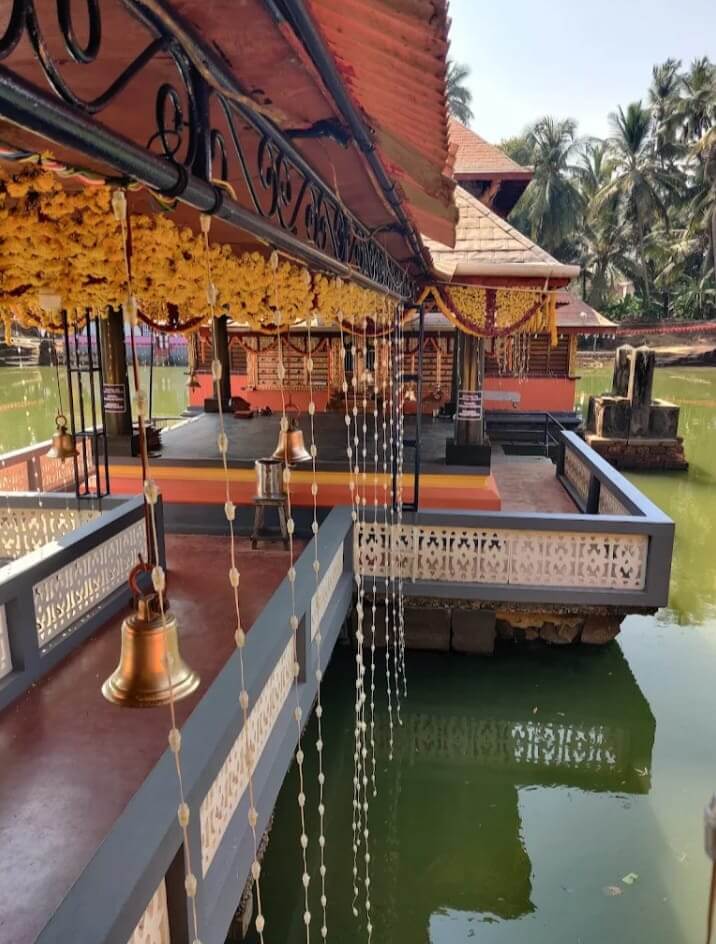
Situated in the middle of a picturesque lake, the temple is renowned for its unique ar-chitectural design. The foundation of the temple has been built on granite pillars firmly fixed in the lake. Ancient temple ruins can also be seen around the lake, which is fed by perennial natural springs. The sanctum sanctorum, Namaskara Mandapam, Thidappalli, Jaladurga shrines and the cave entrance are all located within the lake. The sanctum is reached through the Namaskara Mandapam, which is connected to the eastern rock by a walkway. The main deity is Lord Ananthapadmanabha (Mahavishnu), who faces east. The idol, made using the rare Kadu Sarkara Yogam composition, is depicted seated on the five-headed Nagaraja Anantha. Bhudevi is enshrined on the right side of the Lord and Mahalakshmi on the left. Images of Hanuman and Garuda standing in reverence to the Lord can also be seen. The ceiling of the temple mandapam is adorned with exquisite wooden carvings and paintings depicting scenes from the Dashavatara stories. The Navagraha paintings in the Mukhamandapam and the beautifully carved figures of the Dwarapalakas, Jaya and Vijaya, on either side of the sanctum further enhance the temple’s artistic heritage.
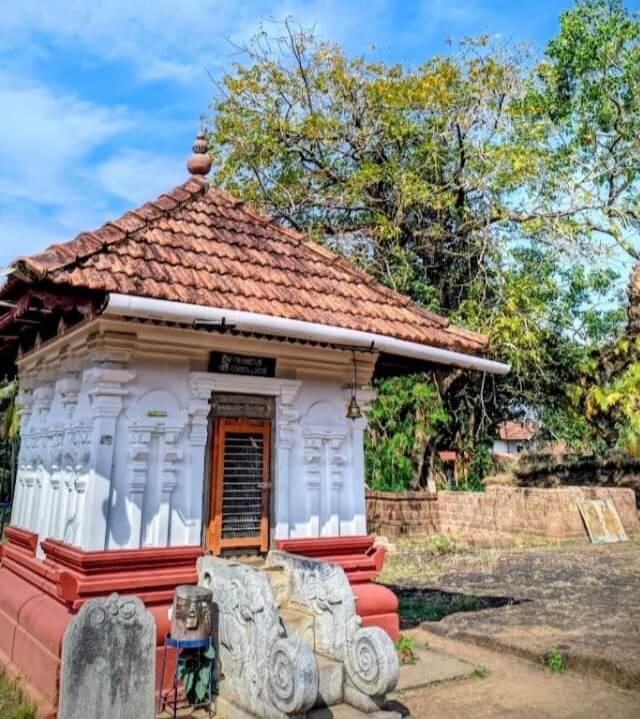
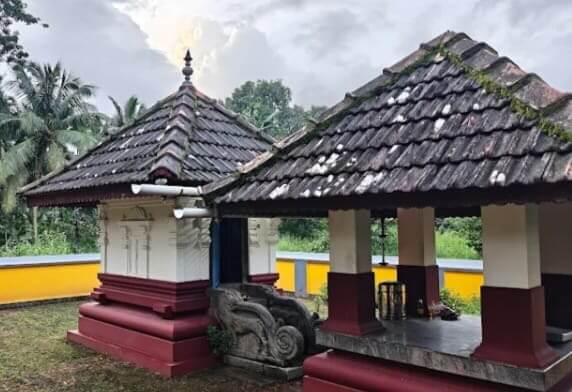
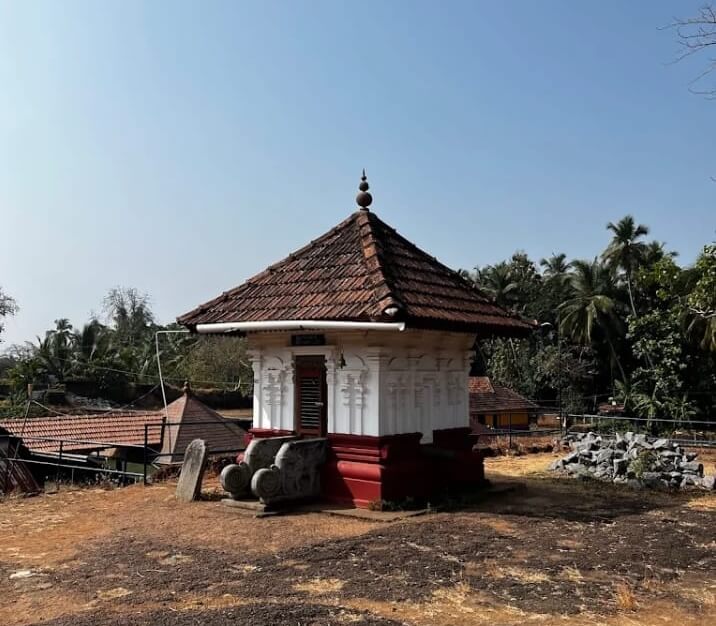
In addition to the main deity, the temple complex houses several other shrines. A shrine dedicated to Lord Krishna in a seated posture is situated in the south-western part of the complex, while Lord Ganapathi is enshrined in a separate sub-sanctum built of dressed stone within the Chuttambalam. The shrine of Goddess Jaladurga is located within the lake itself. Another notable feature is the natural cave in a large rock formation on the northern side of the temple, which, according to legend, is the place where Vilwaman-galam Swamiyar performed his penance.
Various festivals and special observances are celebrated at the temple throughout the year with great devotion. The main annual festival is held on the 14th day of the Malayalam month of Kumbham. The highlight of the festival is the rare procession of the festival idol through the temple lake. The Theppotsavam (float festival), celebrated during the Malayalam month of Medam, is another important festival of the temple. During the festival season, Yakshagana, the traditional dance-drama form of Karnataka and special Sopana Sangeetham performances are held. Vaikuntha Ekadashi in the month of Dhanu, Sri Krishna Janmashtami in the month of Chingam, Vishu, Nagapanchami, Muppattu Saturdays and Velutha Vavu are also observed as important occasions at the temple.
Devotees offer a variety of rituals and offerings at the temple. The most important among them is Sarvaseva, in which all the poojas of a day are performed in the name of a devotee. Karthika Pooja, Vishnu Sahasranamarchana, Pushpanjali and Swayamvara Pushpanjaliare also important offerings. Vishnu Sahasranamarchana is performed for prosperity and good health, while Pushpanjali is offered for the fulfilment of wishes and the removal of obstacles. Panchakajjaya, a special offering popular in the Kasaragod–Tulu Nadu region, is offered to Lord Vishnu and Lord Ganapathi. Other important offerings include Palpayasam, Panappayasam, Thrimadhuram and Panchamritham. Kumkumarchana is performed for Goddess Jaladurga, whose shrine is situated within the lake and Ganapathi Homam is performed for the removal of obstacles and difficulties.
The temple is open to devotees every day from 05:30 AM to 12:30 PM and from 05:30 PM to 07:30 PM. Usha Pooja is performed at 07:30 AM, followed by Ucha Pooja at 12:30 PM. Prasadam distribution and annadanam take place after the Ucha Pooja. Athazha Pooja is conducted at 07:30 PM, after which the temple closes for the day. On special occasions, the darshan timings may be extended until 08:00 PM.
This sacred temple stands as a testament to deep spiritual devotion, ancient architectural grandeur, and rich local cultural traditions.
The sanctum sanctorum houses the divine idol consecrated according to ancient Vedic traditions, surrounded by serene courtyards and traditional temple architecture.
Navratri, Maha Shivratri, Annual Temple Jatra & Deepotsav
Compare and book flights, secure top-rated local hotels near the temple, hire reliable guides, and rent cars instantly.
Extend your pilgrimage by visiting other highly sacred temples located nearby.


Add ₹999 more to unlock FREE SHIPPING!
Your sacred cart is currently empty.
Shop Photo FramesFill in your delivery details below to place your order.
Add comment