
Add ₹999 more to unlock FREE SHIPPING!
Your sacred cart is currently empty.
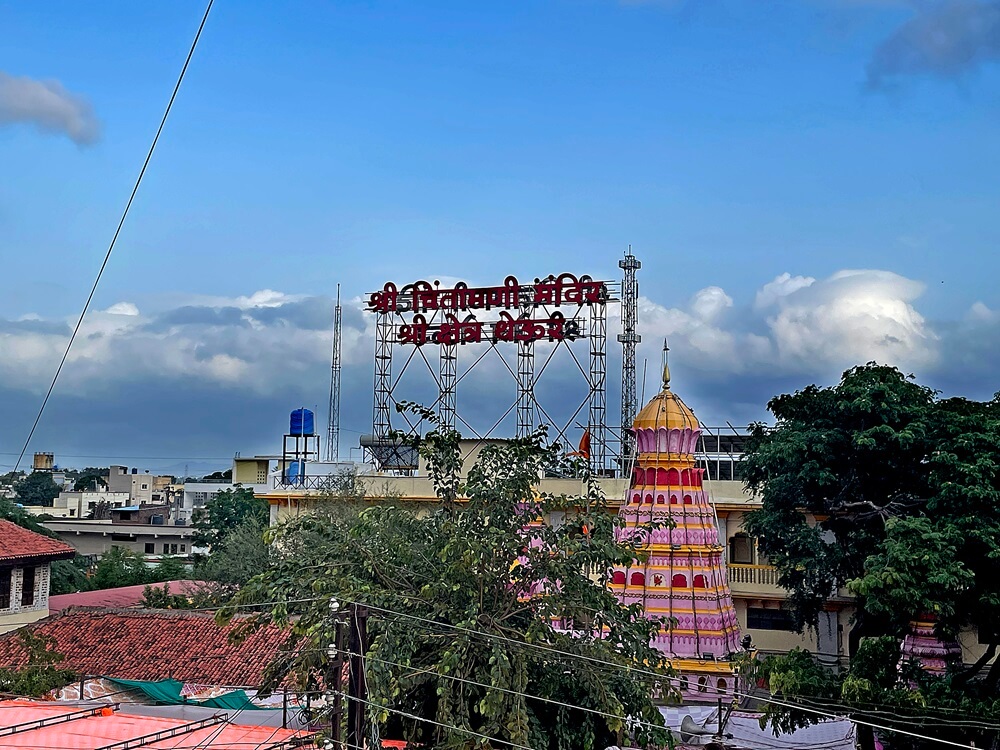
Shop Photo FramesThe fifth of the Ashtavinayaka, the Shri Chintamani Temple, is located at Theur in the Haveli taluka of Pune district. This place of worship, which removes worries and stabilizes the mind, is very dear to the devotees. This region is situated on the banks of the Mula and Mutha rivers. According to mythology, Lord Brahma worshipped Shri Ganesha here to steady his mind, and it is said that this is how the village got the name ‘Theur’. Millions of devotees visit this place, which possesses a rich historical and mythological heritage, for darshan every year. This place is also known as ‘Sthavar Kshetra’. It is considered a vibrant and awakened site that removes the worries of the devotees.
During the Peshwa era, this temple attained special political and social significance. Dharanidhar Maharaj Dev, from the family of the great Ganesha devotee Morya Gosavi of Chinchwad, first performed the original construction of this temple. Approximately one hundred years later, Shrimant Thorle Madhavrao Peshwa undertook a large-scale renovation of the temple. As the family deity of the Peshwas, this site was the supreme center of their devotion. Afflicted by tuberculosis at the young age of twenty-seven, Madhavrao Peshwa spent the final period of his life at this very place. On the eighteenth of November, seventeen seventy-two, on the day of Kartik Vadya Ashtami, he breathed his last while praying at the feet of Chintamani. Following his passing, his wife Ramabai decided to perform Sati alongside her husband. The Vrindavan of this virtuous lady, Ramabai, who attained Sati on the banks of the Mula-Mutha river, still stands today as a testament to that sacrifice. Recognizing the importance of this holy site, the Mughal Emperor Aurangzeb had also granted a royal decree to the village. The renowned Peshwa-era general Haripant Phadke and other devotees of Ganesha periodically repaired the temple and kept it in good condition. During the Panshet dam burst in nineteen sixty-one, the temple spire was damaged by the floodwaters. Subsequently, Ranjit Desai, the author of the highly acclaimed novel ‘Swami’, along with his associates, restored the spire.
According to references in the ancient texts ‘Mudgala Purana’ and ‘Ganesha Purana’, Ganasura, the valiant son of King Abhijit and Queen Gunavati of the Asura lineage, saw the divine ‘Chintamani’ gem while at the ashram of Sage Kapila. This gem had been gifted to Sage Kapila by Lord Indra himself, and through it, any desired object could be obtained. Due to the power of this gem, the Sage provided a feast of five delicacies to Ganasura’s entire army. Seeing this miracle of the gem, Ganasura, driven by greed, forcibly snatched it from Sage Kapila. Distressed, Sage Kapila worshipped Lord Ganesha as per the instructions of Goddess Durga. Lord Ganesha manifested in person and slew Ganasura under a Kadamba tree, restoring the gem to Sage Kapila. Out of gratitude, Sage Kapila offered the gem around Lord Ganesha’s neck, which is how the Lord came to be known as ‘Chintamani’. According to another legend, Lord Indra, suffering from bodily ailments due to the curse of Sage Gautama, performed penance under this very Kadamba tree and attained liberation from the curse. The lake in which Indra bathed to cure his ailment is still known today as Chintamani Sarovar. At the beginning of creation, Lord Brahma also performed rituals here to steady his mind. Due to the presence of Kadamba trees here, this region was also referred to as Kadambanagara in ancient times.
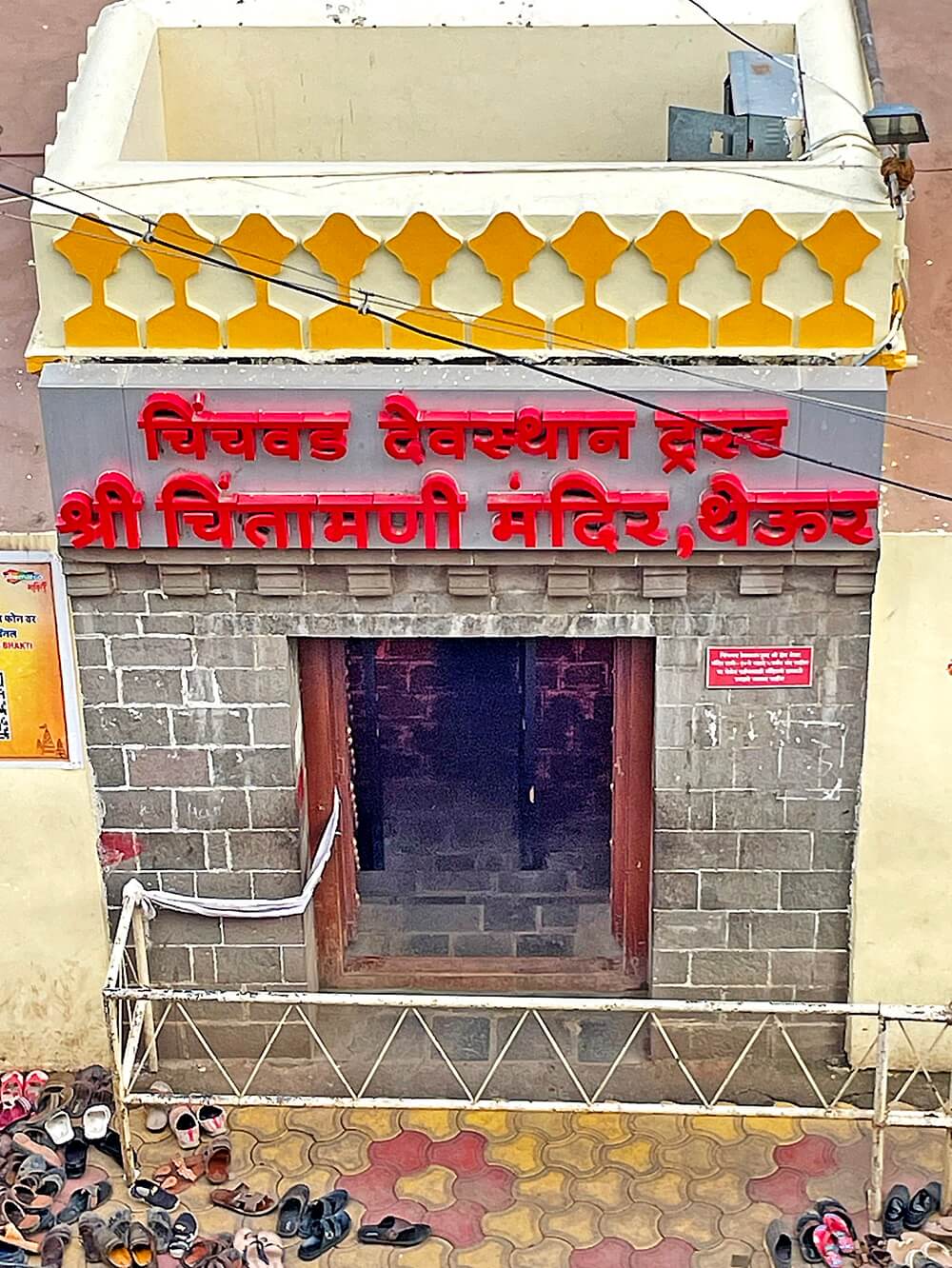
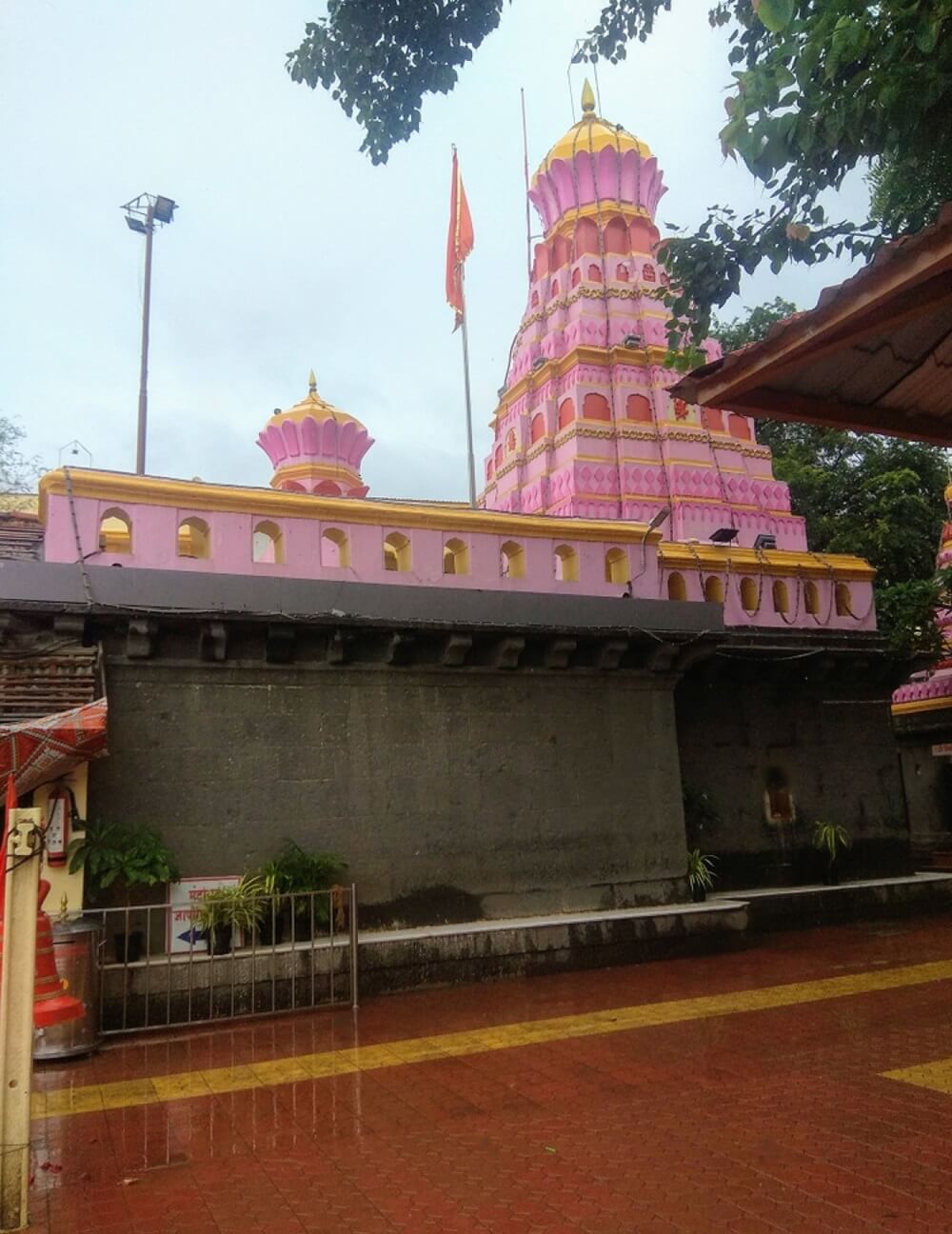
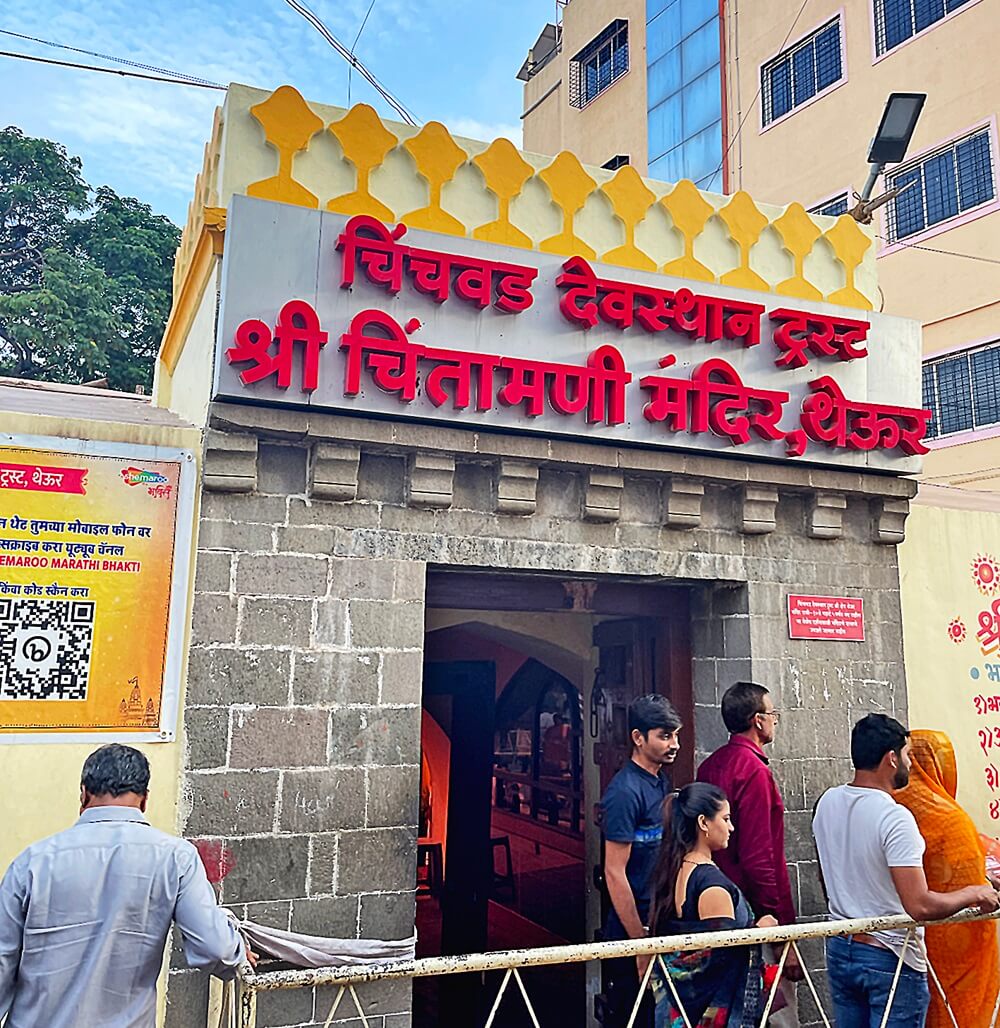
There is a spacious parking area a short distance from the Chintamani Ganapati Temple in Theur. On both sides of the road leading from the parking lot to the main entrance of the temple, there are shops selling worship materials. On this same route, the temple trust’s ‘Chintamani Ganesh Replica Museum’ is located. This museum houses many rare idols of Ganapati made from rice, betel nuts, and various metals. The temple is surrounded by a sturdy fortification. The wooden shutters of its entrance gate are covered with brass sheets. From here, one enters a spacious courtyard adorned with paver blocks. In front of the temple, there is a large brass bell. It is said that the Peshwas received this from the Portuguese.
In the courtyard, there are ancient stone-carved lamp pillars (Deepmalas), and a Shiva Linga and Nandi situated on a Pipal tree platform. Here, there is also a south-facing Hanuman temple, and further ahead, a Mahadev temple. In this vicinity, there are various structures such as a Vishnu-Lakshmi temple, a free food distribution center (Annachhatra), and the temple trust’s office. The legendary Madhavrao Peshwa had an unbreakable bond with this temple. In the courtyard, there is a memorial shrine dedicated to him, where his statue and palanquin are preserved. Behind the temple lies his mansion (Wada), and a short distance from here, on the riverbank, is the memorial of his wife, Ramabai. It is the same place where she performed Sati.
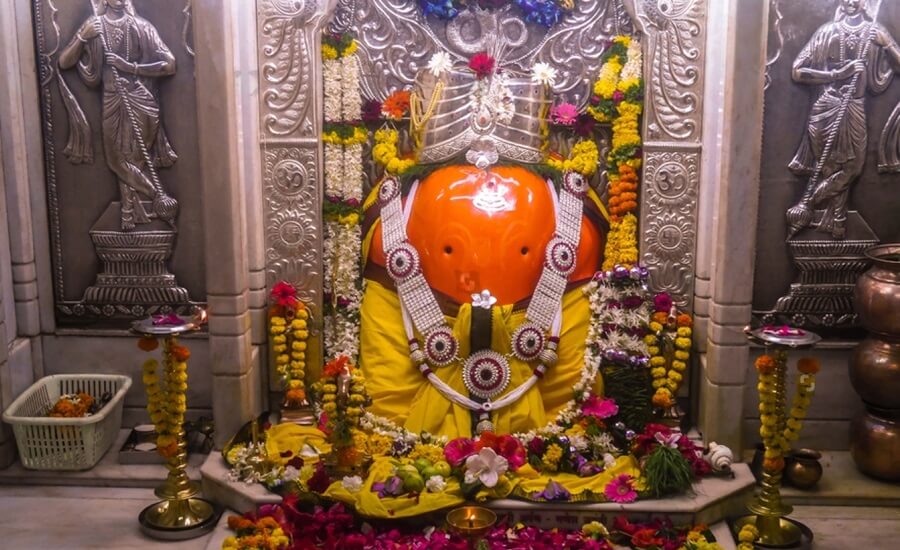
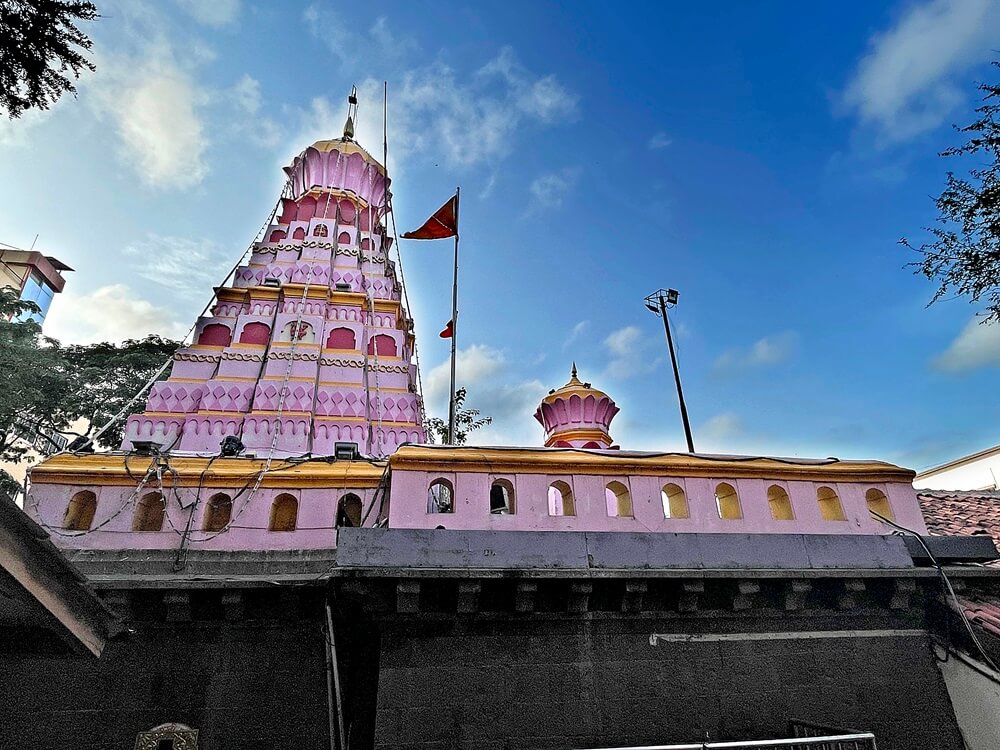
The temple structure consists of a Sabhamandapa (assembly hall), Antarala (vestibule), and Garbhagriha (sanctum sanctorum). The wooden Sabhamandapa here is a fine example of Peshwa-era architecture. Built by Shrimant Madhavrao Peshwa at a cost of approximately ๔๐,००० rupees, this wooden hall stands to this day with its original beauty intact. Despite being made of wood, this structure has remained in a very sturdy condition for hundreds of years. There is an ancient Yajnakunda in the Sabhamandapa, where fire is kindled during religious rituals. Further ahead, on a high platform, lie the stone-built Antarala and Garbhagriha. Upon entering through the intricately carved, silver-plated doorway of the sanctum, one beholds the Swayambhu (self-manifested) stone idol of Chintamani Ganesha. This idol, with its trunk turned to the left, has precious gems embedded in its eyes. Behind the idol is an ornate silver Prabhaval (halo). The temple roof features a six-tiered, square, and dome-shaped Shikhara. This Shikhara is constructed of brick and lime mortar and is gold-plated.
Various religious festivals are celebrated in the temple throughout the year. Bhadrapada Shuddha Chaturthi and Magha Shuddha Chaturthi are the two main annual festivals here. During these times, special Mahapuja, Abhisheka, and Dvaryatras are organized in the temple. A large fair is held in the temple premises during the festivals. In the month of Kartika, the ‘Rama-Madhav Punyotsava’ is celebrated with great devotion in memory of Shrimant Madhavrao Peshwa and Sadhvi Ramabai. During this period, Bhajans, Kirtans, and cultural programs are held in the temple. On every Sankashti Chaturthi, and especially on Angarki Chaturthi, a large crowd of devotees gathers here from early dawn. Chaughada music is played here every morning and evening. During festival periods, free Mahaprasada is organized for the devotees.
The daily rituals of the temple commence at 5 o’clock in the morning with the Kakad Aarti and Prakshal Puja. Following this, Panchopachar Puja, Naivedya, and Dhuparati are performed at 7:30 in the morning. At 12 o’clock in the afternoon, Panchopachar Puja is performed again, and Mahanaivedya is offered. At 3 o’clock in the afternoon, the rituals of Prakshal Puja and Poshakh (adornment) are conducted. At 8 o’clock in the evening, Dhuparati and the Aarti of the Avaran Devatas take place, while at 8:30 in the evening, the Maha-Aarti and Mantrapushpanjali are offered. The day’s schedule concludes with the Shejarti at 10:30 at night. Devotees can have the Darshan of Chintamani Ganesha at this temple every day from 5 o’clock in the morning until 10:30 at night.
This sacred temple stands as a testament to deep spiritual devotion, ancient architectural grandeur, and rich local cultural traditions.
The sanctum sanctorum houses the divine idol consecrated according to ancient Vedic traditions, surrounded by serene courtyards and traditional temple architecture.
Navratri, Maha Shivratri, Annual Temple Jatra & Deepotsav
Compare and book flights, secure top-rated local hotels near the temple, hire reliable guides, and rent cars instantly.
Extend your pilgrimage by visiting other highly sacred temples located nearby.


Add ₹999 more to unlock FREE SHIPPING!
Your sacred cart is currently empty.
Shop Photo FramesFill in your delivery details below to place your order.
Add comment