
Add ₹999 more to unlock FREE SHIPPING!
Your sacred cart is currently empty.
Shop Photo FramesThe renowned temple of Lord Shri Ram, established by the ‘Shri Samsthan Gokarn Partagali Jeevottam Math’, which is recognized as a symbol of the identity and unity of the GSB community, is located in Wadala. This temple is famous for the Ram Navami festival, which is celebrated with great religious fervor and enthusiasm. Due to these celebrations, this temple is also referred to as the ‘Ayodhya of Maharashtra’. In every Ram temple, an idol of Hanuman is installed. The unique feature of this temple is that there is no idol of Hanuman inside; instead, there is a separate temple dedicated to Hanuman, known as Albela, right in front of the main temple.
The Gokarn Partagali Jeevottam Math, which preserves the intellectual heritage of the ‘Dvaita’ philosophy established by Jagadguru Madhvacharya in the thirteenth century, is considered a major pillar of the Vaishnava tradition. Shri Narayan Tirtha was the founder of this Math tradition. His original name was Madhav. In the year १४७५, at Badarikashrama, Shri Ramchandra Tirtha, the tenth pontiff of the Shri Palimaru Math of Udupi, initiated the young brahmachari named Madhav into Sannyasa and named him Narayan Tirtha. Carrying the idol of Lord Shri Ram as a blessing from his Guru, Narayan Tirtha began his journey to propagate the faith towards the south and laid the foundation for this great tradition.
That was a period of great political turmoil. The religious persecution by the Bahmani Sultans and the subsequent Portuguese invaders posed a grave threat to the Gaud Saraswat Brahmin community in Goa. Consequently, this Math performed the task of binding this scattered community together socially, culturally, and religiously. Narayan Tirtha established the first Math in Kashi on the banks of the Ganga with the help of the then-king. Subsequently, a second Math was built in Bhatkal in the Uttara Kannada district of Karnataka. At that time, the Keladi Nayakas ruled this region. According to the text ‘Guruparamparamrutam’, the rulers of Keladi bestowed the title of ‘Vader’ upon Narayan Tirtha Swami. Since then, this Math has also come to be known as the ‘Vader Math’. Later, in the year १५४५, the headquarters of this Math were shifted to Gokarn. The Math attained unprecedented prestige during the time of the third Swami in this tradition, Shrimad Jeevottam Tirtha Shripad Vader Swami. Jeevottam Tirtha Swami led the community for a long period of ७० years, from १५१८ to १५८८. Today, this Math is world-renowned by the name ‘Shri Samsthan Gokarn Partagali Jeevottam Math’. Currently, the main center of this Math is in the small town of Partagali, situated on the banks of the Kushavati River in South Goa. Today, a total of ३३ branches of this Math are operational from Badrinath to Rameswaram.
The Supreme Being (Paramatma), the individual soul (Jivatma), and the inanimate world are inherently and fundamentally distinct from one another. The fundamental principle of Dvaita philosophy is that there is a distinction between the soul and God, God and the world, the world and the soul, one soul and another, and between various objects in the world. This is called the Vaishnava Dvaita philosophy of Madhvacharya. The primary meaning of the Vedas is Lord Vishnu himself. If the worship of God, that is, Vishnu, is performed along with his consciousness-power, Lakshmi, then liberation (Moksha) is attained quickly. Moksha means freedom from the cycle of birth and death. Madhvacharya’s Vaishnava Dvaita philosophy asserts that for quick liberation, Vishnu along with Lakshmi should be the subject of worship and meditation.
With the intention of supporting the members of the GSB community, a plot of land was acquired in Wadala by the Math, and a building was constructed on it in the year १९५५. The inauguration of this building was performed by Shrimad Sudhindra Tirtha Swami of the Kashi Math. Within a decade after this, the Shri Ram temple was built at this location. On Magh Shuddha Shashthi, ७ February १९६५, the idols of Shri Ram, Sita, and Lakshman were consecrated in this temple by the then-pontiff, Param Pujya Shrimad Dwarkanath Tirtha Shripad Vader Swami. An idol of Hanuman was also to be installed in this temple. However, it is said that before the inauguration of the temple, the thought occurred to Dwarkanath Tirtha that there was already a Hanuman temple in front of the site. He felt that the Hanuman there must be overjoyed at the thought that Lord Shri Ram was about to arrive before him. He might have felt that another idol of Hanuman was not needed in this Ram temple. With this thought, the idol of Hanuman was not installed here.
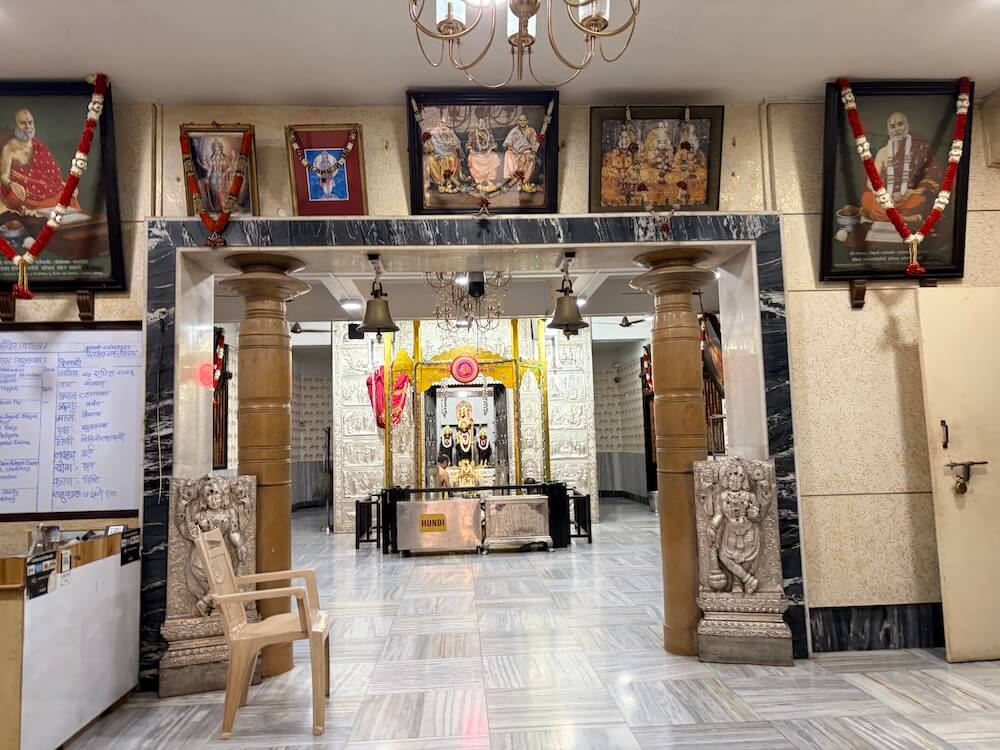
This temple is situated on a large plot of land along the Katrak Road in Wadala. There is a large courtyard in front of the temple. A high tin shed has been erected over it. The structure of the temple consists of a Mukhamandapa (entrance hall), Ardhasabhamandapa (semi-assembly hall), Sabhamandapa (assembly hall), and Garbhagriha (sanctum sanctorum). The Mukhamandapa of the temple is of an open type. It has two grand pillars clad in brass sheets. On the roof of the mandapa, there is a small shrine similar to those found on South Indian Gopurams. In the center of it, in a niche, are the idols of Shri Ram, Lakshman, and Sita. On one side of the niche sits the idol of Lakshmi, and on the other, the idol of Ganapati. In front of the Ganesh idol is a conch shell, which is dear to Vishnu, and in front of the Lakshmi idol, a large floral sculpture is placed. In the center of the Mukhamandapa is a Tulsi Vrindavan, which is dear to Lord Vishnu. A lamp is burning here. A glass chandelier is hung above. The Ardhasabhamandapa has a square-shaped marble entrance. Large idols of Vaishnava gatekeepers (Dvarapalas) are seated on both sides of it.
From here, one enters the semi-hall, which resembles a corridor (ovari). Here, on the front wall, portraits of the Math pontiffs as well as deities like Lord Vishnu are displayed. The entrance to the semi-hall has two circular brass pillars. Next to them, on both sides, are two beautiful carved idols of gatekeepers. The Sabhamandapa of the temple is square and spacious. From there, there is a circumambulation path (pradakshina marg) around the Garbhagriha. Chandeliers are hung from the ceiling of the Sabhamandapa. Portraits of various pontiffs of the Gokarn Partagali Jeevottam Math are displayed on the side walls.
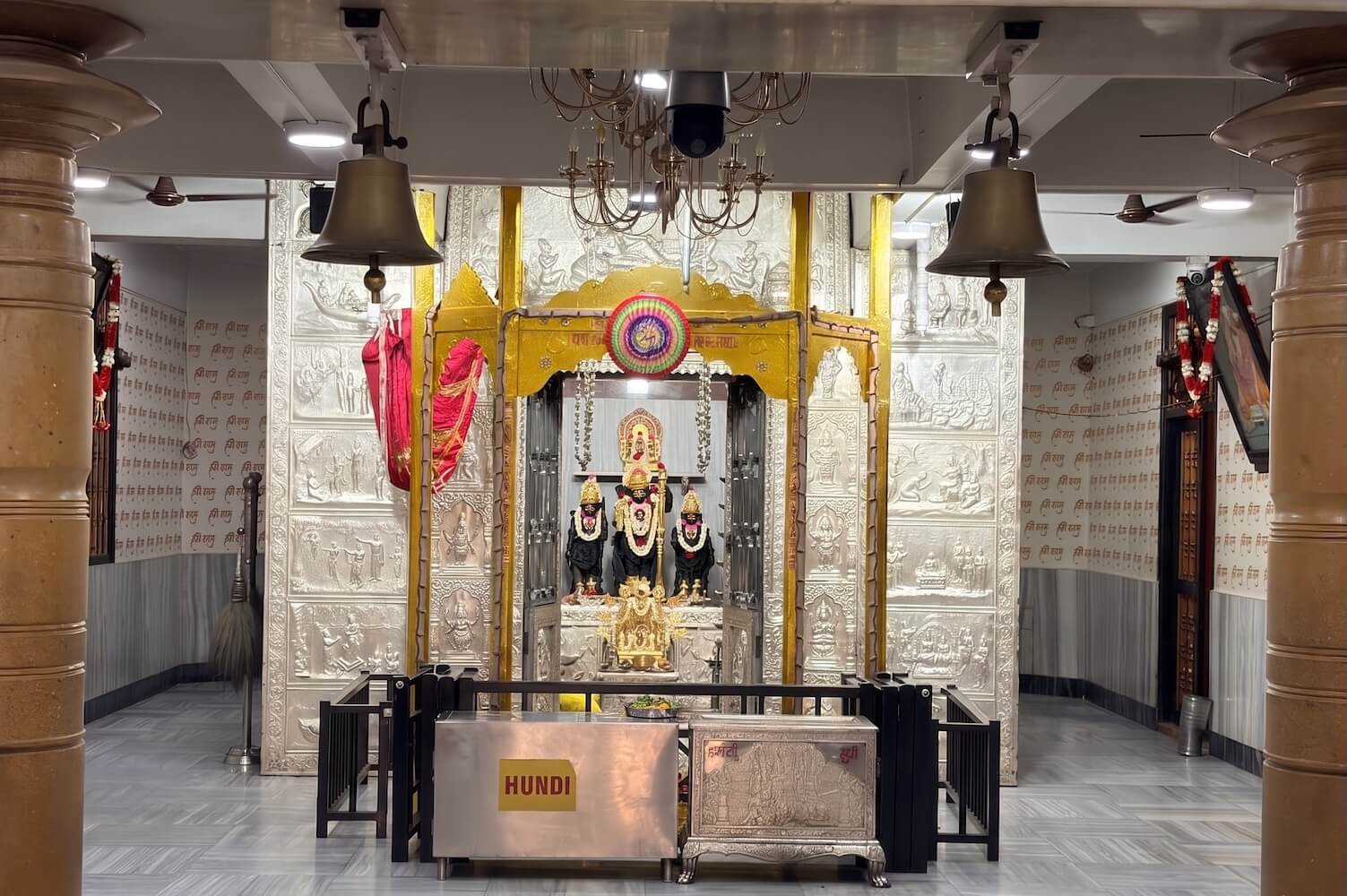
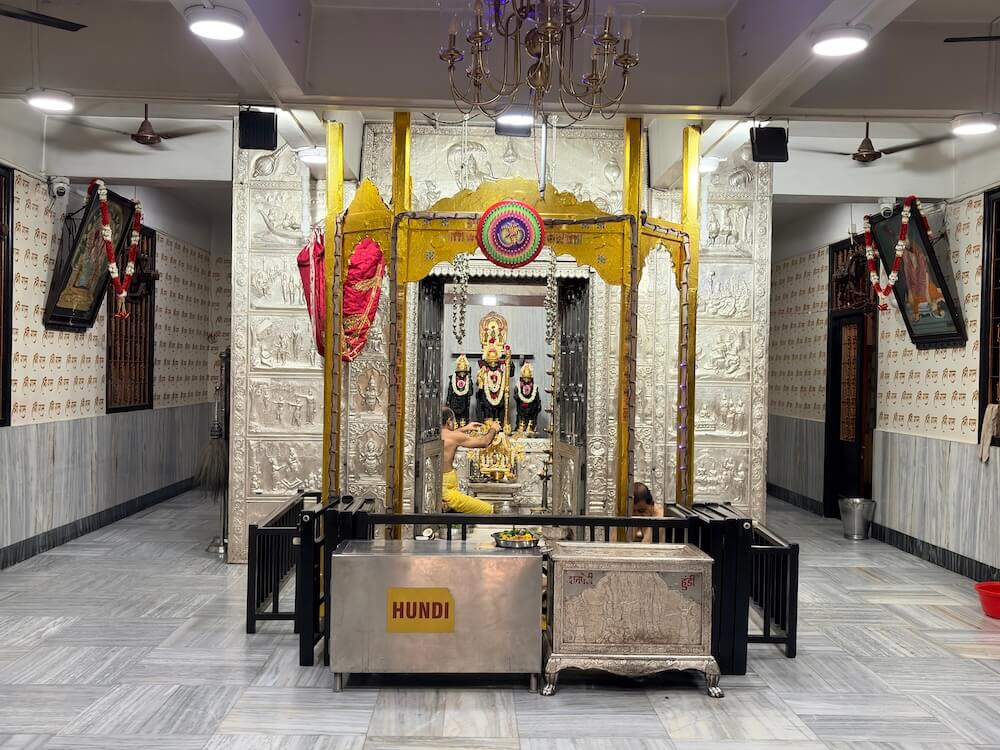
In front is the main Garbhagriha of the temple. A silver canopy (makhar) is placed in front of this square sanctum. The outer walls of the Garbhagriha are covered with silver sheets. Embossed sculptures of the Dashavatara (ten incarnations) of Lord Vishnu are carved upon them. In the upper part of the door frame of the Garbhagriha, there is a large embossed sculpture of Sheshashayi Narayan. On a high altar inlaid with silver sheets, the exquisitely carved black stone idols of Shri Rama, Sita, and Lakshmana are consecrated. The lotus feet of these idols, as well as the crowns upon their heads, are made of gold. The bow and arrow held in Shri Rama’s hands are also made of gold. Behind the idols, on the wall, metal idols of Shri Rama, Lakshmana, and Sita are also enshrined. In the front part of the altar, there are idols of Shri Rama, Lakshmana, and Sita placed within a silver shrine.
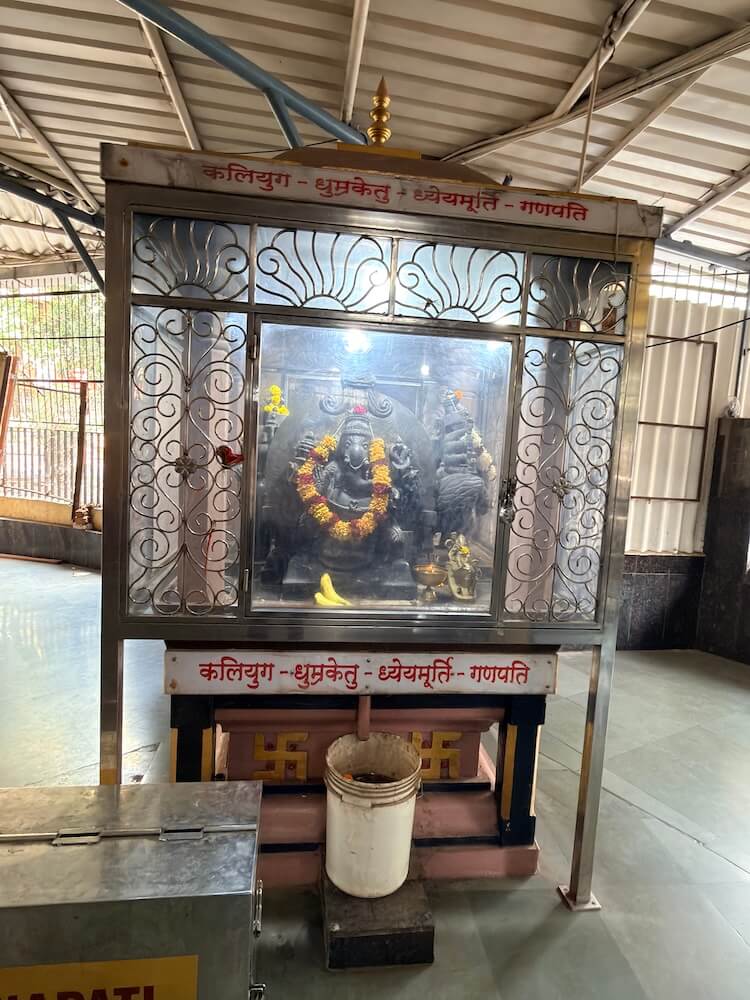
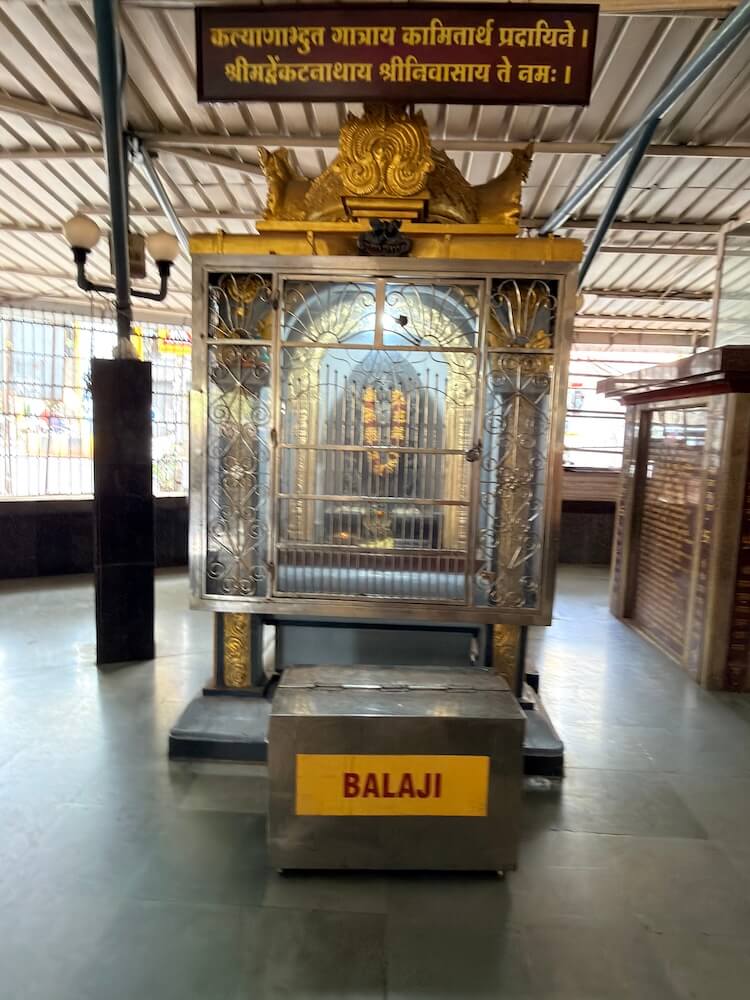
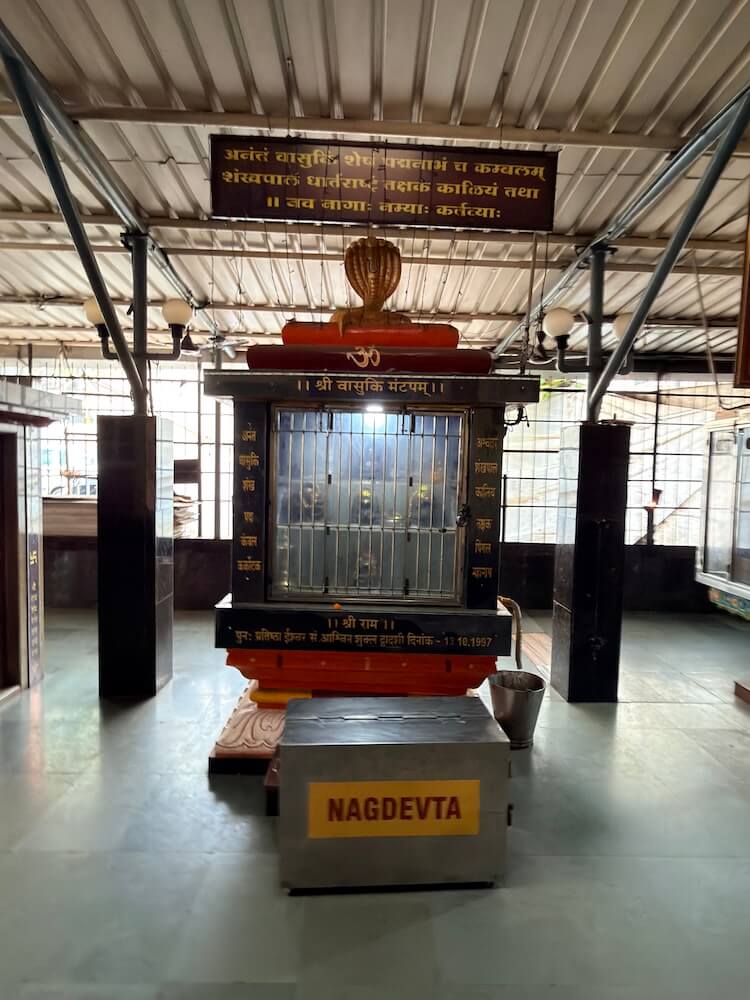
To the right of this temple, in shrines built within a large metal pavilion, the idols of Ganesha representing all four yugas—‘Kaliyuga-Dhumraketu-Dhyeyamurti-Ganapati’—as well as Balaji, the serpent deity Vasuki, and the Navagraha are enshrined. In a stupa-like structure here, notebooks containing the written Ram-mantra twenty-three crore times are preserved. On the occasion of the golden jubilee year of Indian independence, on the auspicious day of Vijayadashami in १९९७, Shrimad Vidyadhiraj Teerth Shripad Vader Swami organized a series of Mahayagnas at the temple. At that time, a vow was taken to compile the mantra ‘Shri Rama Jaya Rama Jaya Jaya Rama’ by writing it one crore times. For this, everyone from small children and students to the elderly was encouraged. The response was so overwhelming that devotees wrote the mantra a staggering twenty-three crore times. Those mantras are contained within this stupa. The temple premises feature three air-conditioned community halls. Various festivals, as well as events like weddings and Brahmopadesha (Upanayana), are conducted here.
Devotees can have darshan at the temple from Sunday to Friday between ७:०० AM and १:३० PM and in the evening from ५:०० PM to ८:३० PM, and every Saturday from ७:०० AM to ८:३० AM. During the spring season, festivals such as the daily Palkhi Utsav, Vasant Puja, and the Ashtavandan Seva of Lord Shri Rama are organized here. On Shravani (Narali) Purnima, the Suttapunaka ceremony, which involves changing the sacred thread (Yajnopavita), takes place. A Yagna is organized in the temple on this occasion. At that time, a new sacred thread is offered to Lord Shri Rama. Similarly, Ganeshotsav and Nag Panchami are also celebrated here with great enthusiasm. Ram Navami is the grandest festival at the temple. This nine-day festival begins on Gudi Padwa. During these nine days, the name of Rama is chanted continuously in the temple. On the day of Ram Navami, the celebration of the birth of Lord Rama is observed in the presence of five to six thousand devotees. On that day, food prasad is arranged for the devotees. In the evening, a Palkhi procession of Lord Shri Rama is taken out from the temple to Dadar TT. Thousands of Rama devotees participate in this procession.
This sacred temple stands as a testament to deep spiritual devotion, ancient architectural grandeur, and rich local cultural traditions.
The sanctum sanctorum houses the divine idol consecrated according to ancient Vedic traditions, surrounded by serene courtyards and traditional temple architecture.
Navratri, Maha Shivratri, Annual Temple Jatra & Deepotsav
Compare and book flights, secure top-rated local hotels near the temple, hire reliable guides, and rent cars instantly.
Extend your pilgrimage by visiting other highly sacred temples located nearby.


Add ₹999 more to unlock FREE SHIPPING!
Your sacred cart is currently empty.
Shop Photo FramesFill in your delivery details below to place your order.
Add comment