
Add ₹999 more to unlock FREE SHIPPING!
Your sacred cart is currently empty.
Shop Photo FramesThe site of the Sadguru Sakharam Maharaj Vitthal-Rukmini Temple, situated on the banks of the Bori River in Amalner, is renowned as the Pandharpur of Khandesh. Sadguru Sakharam Maharaj performed the monumental task of establishing the Warkari tradition throughout Khandesh. It is for this reason that Amalner earned the identity of ‘Shri Kshetra Amalner’. The lineage of disciples of Sakharam Maharaj is also vast. It is the firm faith of devotees that once a year, on Vaishakh Shuddha Ekadashi, Lord Pandurang himself comes to Amalner to meet Sakharam Maharaj. Consequently, this Ekadashi is celebrated here on a grand scale.
According to the text ‘Sakharam Maharaj Charitra Lilamrut’, Sakharam Maharaj was born in the year 1757, on the seventh day of the bright fortnight of the month of Margashirsha, in the village of Pimpli near Amalner. His mother’s name was Sitabai and his father’s name was Rambhat. Having lost the protection of his parents at a young age, Sakharam came to Amalner to take shelter with his cousin Ranganath. From his childhood, he was deeply influenced by the Warkari tradition. Therefore, Ranganath sent Sakharam to Tatya Pantoji of Amalner for his education. The conditions were to provide a handful of grain (phaski) per week, a remuneration of two sanna (3 dhabu), and to perform all kinds of household chores. While his studies were underway, Tatya Pantoji had his first realization regarding Sakharam and understood his extraordinary nature. While bidding farewell to Sakharam, Tatya Pantoji said –
You cannot be called a child; the world is merely under an illusion.
You were born as a Great Yogi. The testimony has come to me. Ch. 8/117
Thereafter, Sakharam Maharaj came to Shridharpant for further education. Shridharpant imparted to him the knowledge of the four Vedas, Upanishads, Sutras, Bhashyas, Richas, Shodasha Samskaras, and the Varnasrama system.
Thinking that Sakharam should be married to Gangadevi, the daughter of Muraribhat of Chopda, Shridharpant approached Muraribhat with a proposal for Gangadevi on behalf of Sakharam. At that time, Sakharam was sixteen years old. Preparations for the wedding began, and it is said that Pandurang, accompanied by Rukmini, appeared in the form of Vitthalpant, an old friend of Rambhat, to participate in the ceremony. Regarding this, the Leelamrut states that after the wedding rituals were completed, when Vitthalpant prepared to depart with Rukmini, Pandurang himself said to Sakharam –
At least do this much for Sakharam: undertake the pilgrimage to Pandharpur.
Come to our temple and grant us your divine audience.
You shall attain the meeting with the Sadguru; the struggle of births and deaths shall cease.
Having said this much, Pandurang placed His hand on Sakharam’s head and took His leave.
The teachings of Panduranga left a profound impact on Sakharam’s mind. His heart no longer found joy in worldly life. Six years passed in this manner. He had a son, but both his wife and son had short lives. Thereafter, he began his pilgrimage to Pandharpur. It is said that to ensure he felt no longing to return while embarking on the pilgrimage, he would set his own house on fire.
It is said that Pandurang comes to Amalner to meet Sakharam Maharaj; regarding this, a legend is told that Belapurkar Maharaj was a supreme devotee of Vitthal. He used to visit Pandharpur on every Ekadashi. Once, Lord Vitthal appeared to him in a vision and said, “You come to meet Me on every Ekadashi, but we do not meet on Vaishakh Shuddha Ekadashi, because on that day, I go to Amalner to visit My supreme devotee, Sakharam. You should go to Amalner on that Ekadashi, so that we may continue to meet during the pilgrimage there.” Following this instruction, the disciples of Belapurkar Maharaj continue to observe this tradition to this day. It is said that there is a resemblance between the Vitthal Temple in Pandharpur and the Sakharam Maharaj Temple in Amalner. Just as there is a temple of the devotee Pundalik in the riverbed of the Chandrabhaga in Pandharpur, there is the Samadhi shrine of Sakharam Maharaj in the riverbed of the Bori River in Amalner. Sakharam Maharaj attained Samadhi on the date of Vaishakh Shuddha 14, in the year 1818. Adjacent to this Samadhi site are the Samadhi shrines of Sakharam Maharaj’s disciples, Govind Maharaj and Prahlad Maharaj. To the east of the Samadhi is the Ram Panchayatan, to the south is the Shiv Panchayatan, to the west is the Dattatreya Panchayatan, and to the north is the Vishnu Panchayatan. is.
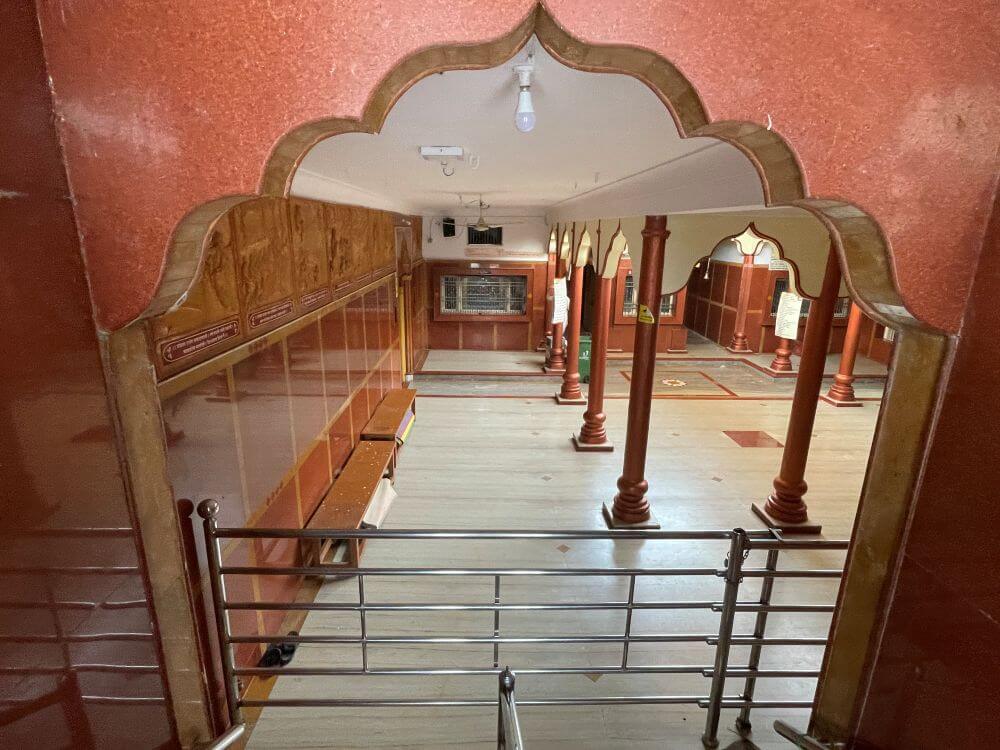
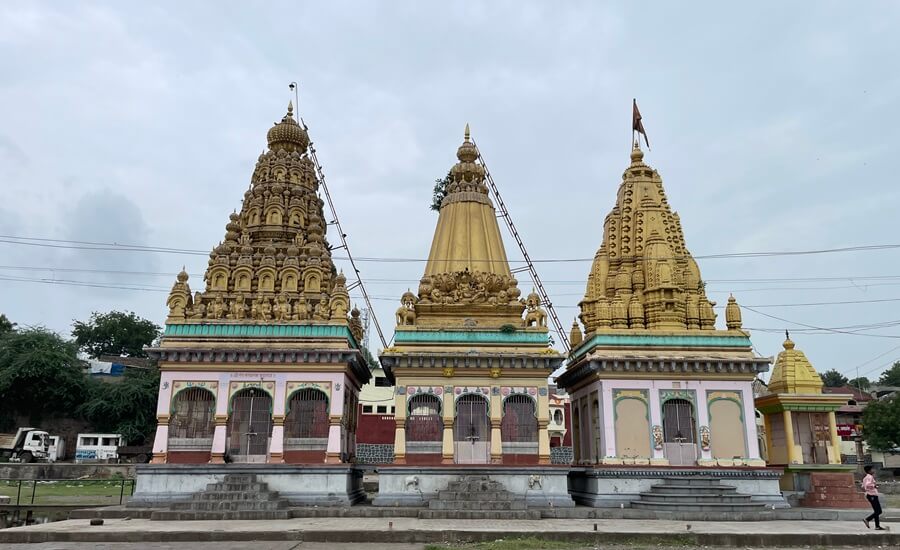
Adjacent to the riverbed stands the Sadguru Sakharam Maharaj Vitthal-Rukmini Temple. One enters the enclosed assembly hall of the temple through a carved wooden gateway. On the upper sections of the assembly hall walls are relief sculptures of the saints from the Guru-Shishya lineage who carried forward the Warkari tradition of Sakharam Maharaj. The wooden pillars in this assembly hall are connected to each other by arched gateways. For the convenience of the devotees, a queue system for Darshan has been arranged around this assembly hall. From the assembly hall, one enters the Antarala. The entire structure of this two-story Antarala is made of wood. Images of various saints are placed on the pillars of the Antarala. The floor between the two rows of pillars in front of the sanctum sanctorum in the Antarala is recessed by a few inches. A queue system for Darshan has been provided here as well.
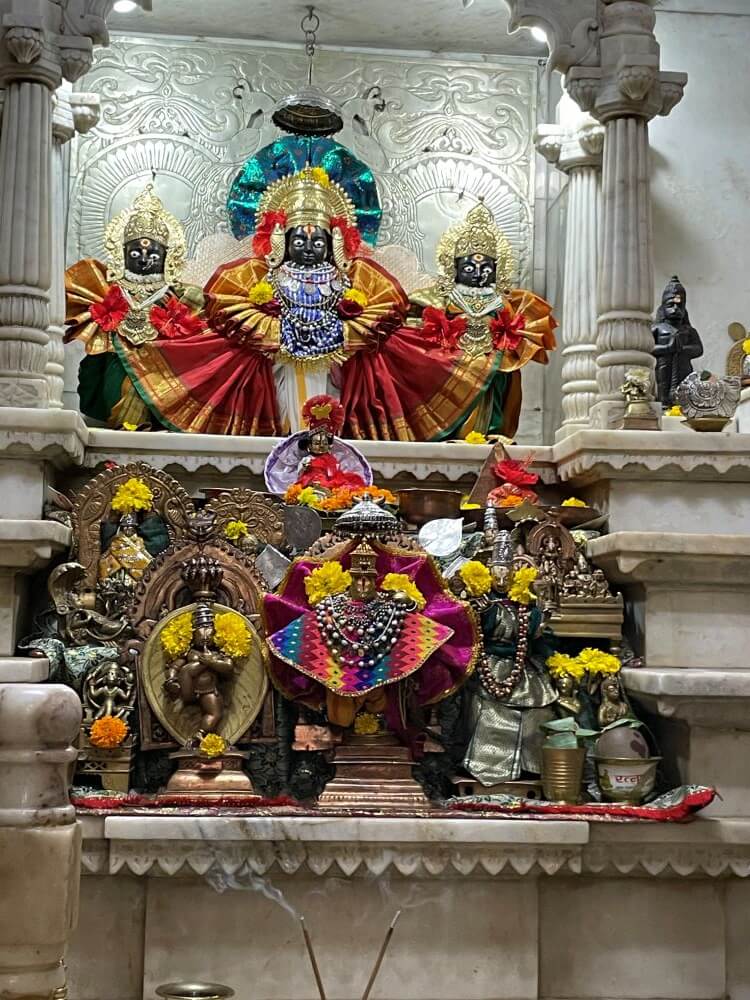
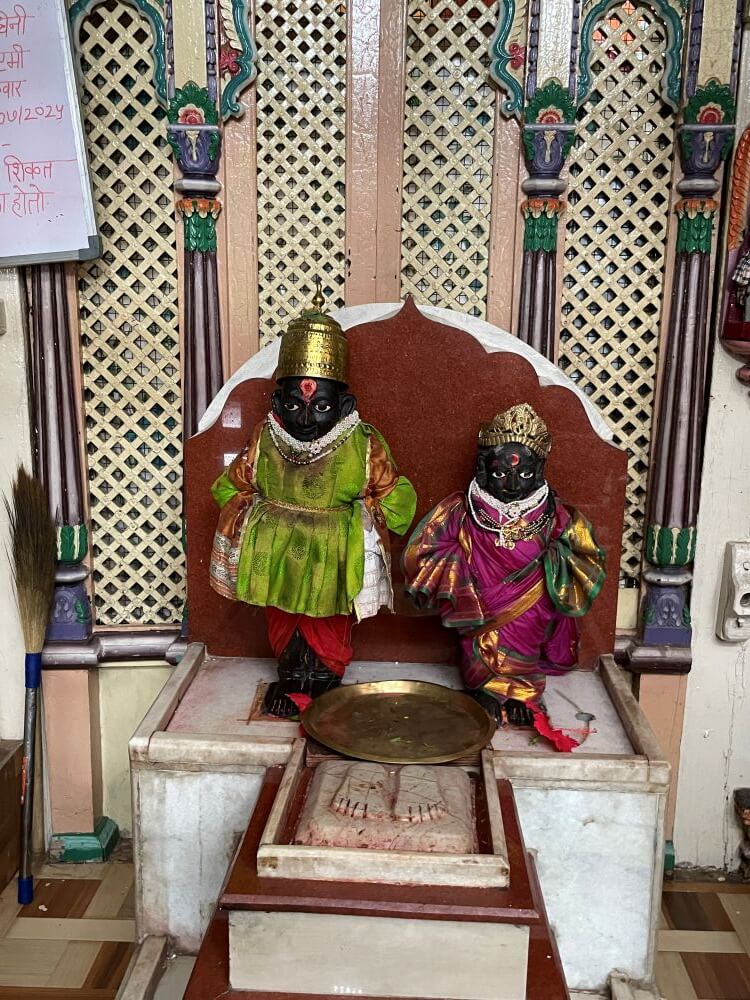
The design of the sanctum sanctorum here is separate from the circumambulatory path. Inside the sanctum, Sakharam Maharaj has installed the deities in the form of a panchayatana within a marble shrine. In the center is the idol of Vitthal, with the idol of Radhika Mata to the right and Rukmini Mata to the left. To the right side of Radhika Mata is Garuda, and beside Rukmini Devi is Hanuman. At the base, on both sides, are small idols of elephants made of five metals. Additionally, the padukas used by Sakharam Maharaj have been placed in the sanctum for darshan. Right behind this, there are idols of Vitthal-Rukmini made of black stone.
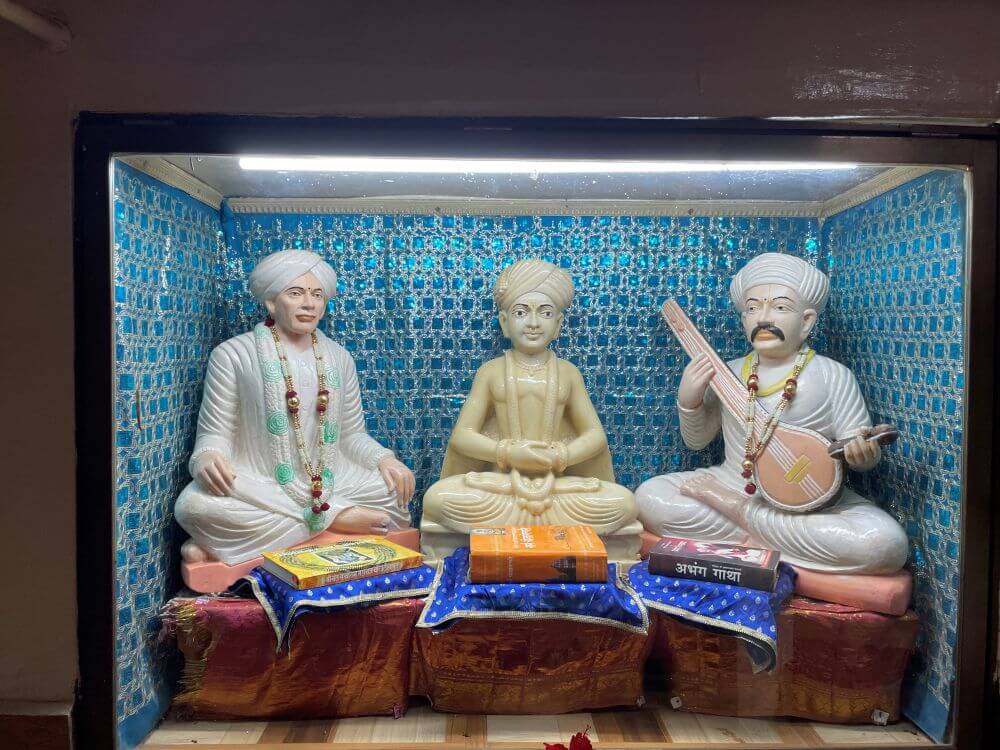
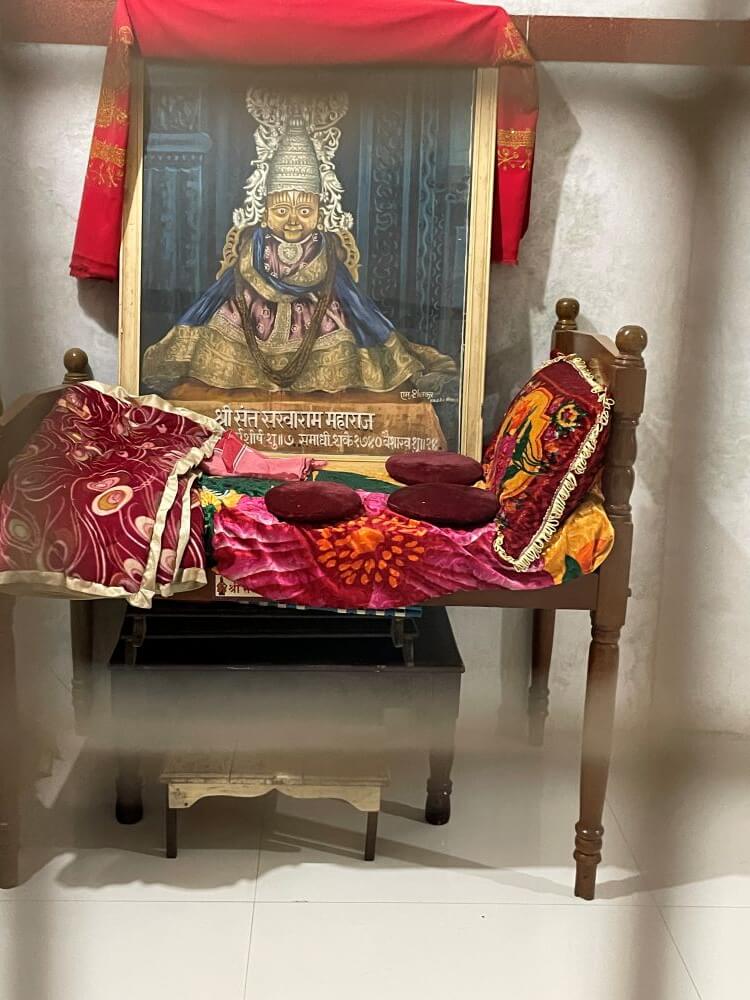
The hut where Sakharam Maharaj resided, located next to the main assembly hall, along with the articles he used, have been carefully preserved. Items such as a wooden seat, a copper water vessel, a water jug, a dining plate, bronze utensils, and wooden sandals are kept here. An idol of Sakharam Maharaj is placed on a silver pedestal. In addition to this, there are idols of Ganpati and Shri Dattatreya in the temple. Adjacent to this main temple is the temple of Gangadevi and Ashtabhuja Mata. Within it, the goddess Ashtabhuja is enshrined on a pedestal. Below her, there is an idol of Gangadevi. It is said that Gangadevi was the consort of Sakharam Maharaj.
Every year, festivals such as Gudi Padwa, Ram Navami on Chaitra Shuddha Navami, the Yatra festival on Vaishakh Shuddha Tritiya, the Ratha Utsav on Vaishakh Shuddha Ekadashi, the Punyatithi of Sakharam Maharaj on Vaishakh Shuddha Chaturdashi, the departure for the Pandharpur Wari on Jyeshtha Vadya Pratipada, Janmashtami, Vijayadashami, and Dattajayanti are celebrated in this temple. This temple is renowned as Prati-Pandharpur. Devotees firmly believe that Sadguru Sakharam Maharaj still resides here.
This sacred temple stands as a testament to deep spiritual devotion, ancient architectural grandeur, and rich local cultural traditions.
The sanctum sanctorum houses the divine idol consecrated according to ancient Vedic traditions, surrounded by serene courtyards and traditional temple architecture.
Navratri, Maha Shivratri, Annual Temple Jatra & Deepotsav
Compare and book flights, secure top-rated local hotels near the temple, hire reliable guides, and rent cars instantly.
Extend your pilgrimage by visiting other highly sacred temples located nearby.


Add ₹999 more to unlock FREE SHIPPING!
Your sacred cart is currently empty.
Shop Photo FramesFill in your delivery details below to place your order.
Add comment