
Add ₹999 more to unlock FREE SHIPPING!
Your sacred cart is currently empty.
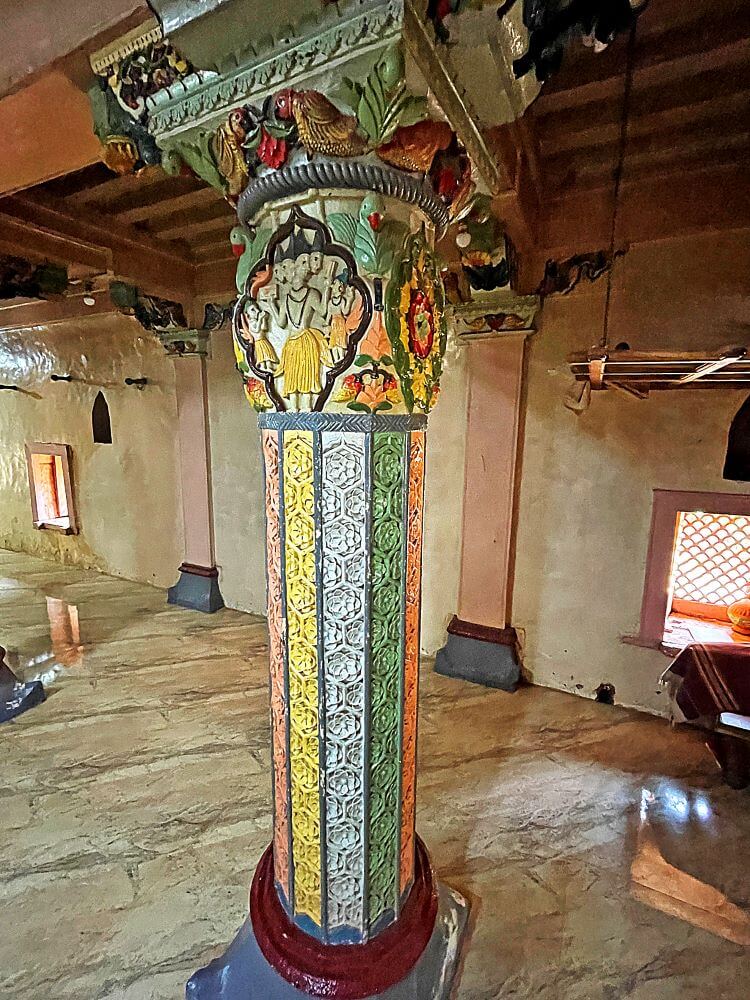
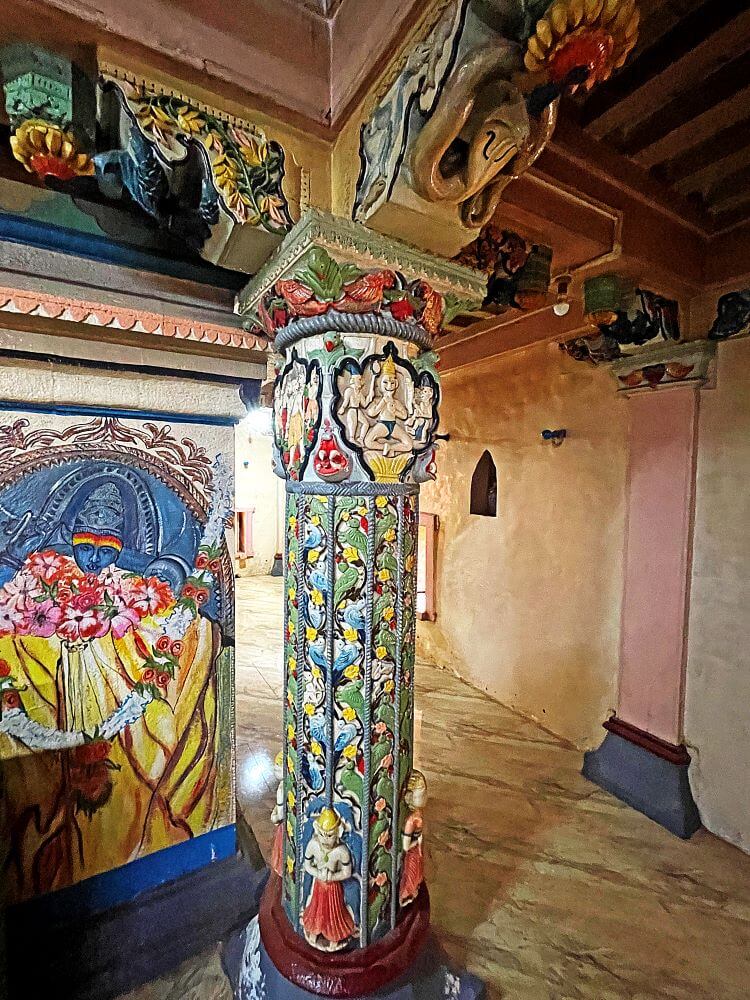
Shop Photo FramesMurud village in Dapoli Taluka, which is the birthplace of the social reformer and ‘Bharat Ratna’ Maharshi Dhondo Keshav Karve, holds rich historical, social, and religious significance. The 300-year-old ancient and divine (*Jagrut*) temple of Goddess Durgamata, the presiding deity (*Gramdaivat*) of this village, is a sacred place of deep faith for thousands of devotees. A unique feature of the temple is the magnificent wood carving on the pillars of its assembly hall (*Sabhamandap*). It is considered to be the only temple in the Konkan region featuring such distinctively intricate wooden carving.
According to temple legend, a king named Jalandhar ruled this region in the 12th century. During his reign, three Nagar Brahmins—Gangadhar, Divakar, and Padmakarbhat—came to meet the king. They brought with them three holy idols of Goddess Durgadevi. Recognizing them as pious souls, the king received them with great respect and granted them the fiefdoms (*Jahagirs*) of three villages: Murud, Guhagar, and Diveagar (District Raigad). Upon receiving the fiefdoms, they consecrated the idols of the Goddess at these respective places. Gangadhar Bhat built the original Durgadevi temple at Murud. Over time, Murud faced several natural calamities, causing damage to the ancient temple on multiple occasions. Records indicate that the present temple structure was built in 1763 by members of the Vaishampayan, Datar, Joshi, Karve, and Bal families. The Goddess is also the revered family deity (*Kuldevi*) for many Datar families of this region.
The Durgadevi Temple is situated in the main central square of the town-like village of Murud. The temple premises are adorned with lush greenery and present a picturesque view, surrounded by dense coconut and betel nut groves. Within the complex itself, there is a small wooden shrine dedicated to Lord Ganesha as well as the original sacred seat of the Goddess (*Swayambhuva Devi*). The double-storied main entrance gate along the road houses a traditional drum house (*Nagarkhana*) on its upper floor. To the right side of the entrance stands a tall stone lamp-tower (*Deepmal*), while the left side has a passageway leading up to the Nagarkhana. Passing through the entrance gate into the courtyard, one beholds this two-storied temple built in classic Konkani architecture with tiled roofing, resting on a sturdy three-foot-high stone platform.
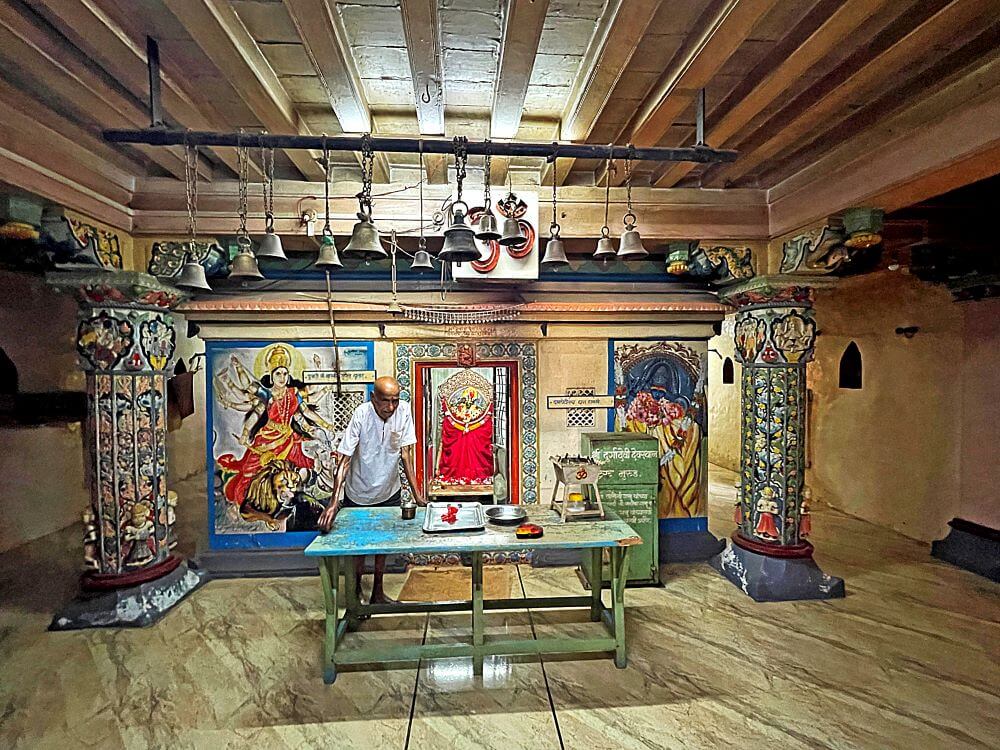
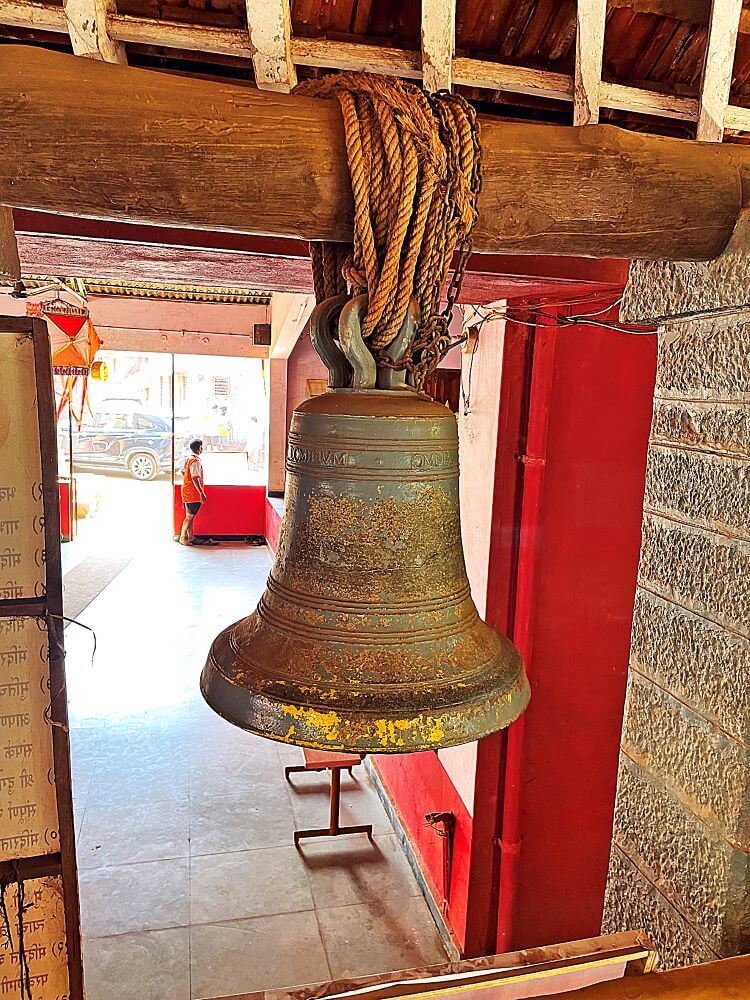
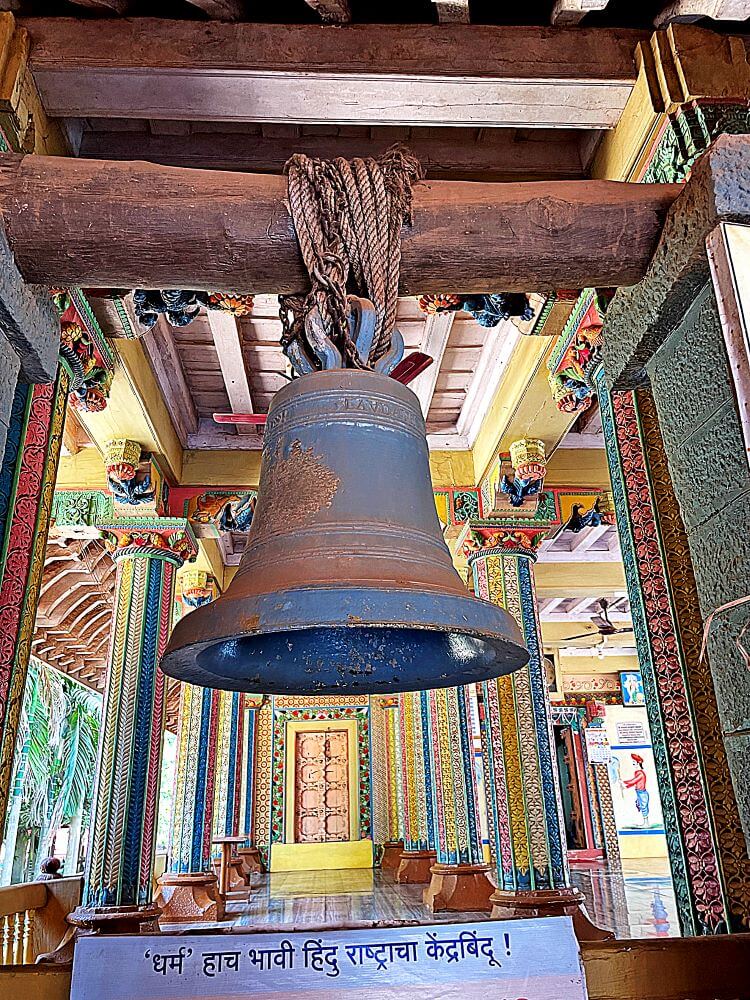
The temple architecture consists of an outer assembly hall (*Sabhamandap*), an inner vestibule (*Antaral*), and the sanctum sanctorum (*Garbhagriha*). A few steps from the courtyard lead into the open-style Sabhamandap. The wooden pillars in the hall display remarkable carvings, and the intricate floral creepers adorned on them enhance the hall’s aesthetic beauty. Seating arrangements for devotees are provided on both sides of the hall. Suspended between two pillars here is a massive bell, similar in design to the large bells found in Portuguese places of worship. An inscription in Latin is engraved upon it, which translates to ‘Let all people praise the Lord’. However, no definite information is available regarding how this bell came to be in the temple.
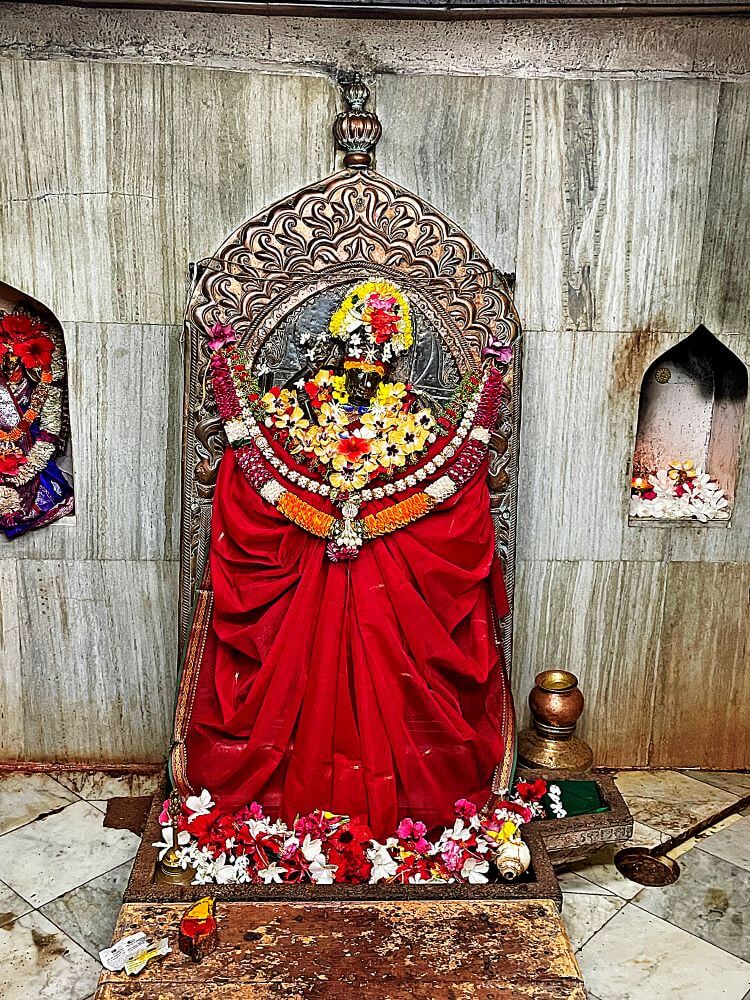
In the vestibule (*Antaral*), on the left and right sides of the sanctum sanctorum, stand four massive pillars, larger than those in the Sabhamandap. The sculptures carved on these four pillars are considered rare artistic treasures among the temples of Konkan. The pillars feature detailed depictions of various gods and goddesses, the *Dashavatara* (ten avatars of Lord Vishnu), dynamic battle scenes on horseback, a battle scene showing three warriors riding an elephant wielding different weapons, as well as various animals like lions, tigers, and serpents. The wooden support beams above the pillars also feature beautiful carvings of parrots, peacocks, and flowers. Remarkably, no iron or nails were used in this entire construction; the entire wooden structure was assembled using complex interlocking technique. The main idol of Goddess Durgadevi in the sanctum sanctorum is carved from sacred Shaligram stone, standing four feet tall, eight-armed (*Ashtabhuja*), and exquisitely detailed. In a niche to the left side, there is a second smaller idol of the Goddess.
The festival of Goddess Durgadevi is celebrated on a grand scale during the period of Chaitra Shuddha Pratipada to Navami, as well as during the Ashwin Navratri festival starting from Ashwin Shuddha Pratipada. In ancient times, the holy idol of the Goddess was carried in a palanquin to the Sonar Wada (goldsmiths’ quarter) on Chaitra Shuddha Saptami and brought back on Ashtami. At present, a sacred replica of the Goddess is taken in the palanquin instead of the main idol. In earlier days, historical records called *Bakhar* were written to document village traditions and history. The traditional arrangements for the palanquin procession are detailed in this historical Bakhar. According to these records, the chariot of the Goddess should have four palanquin bearers (*Bhois*) and four main pillars. It specifies that the front right pole should be carried by Brahmins, the front left by Sonars (goldsmiths), the rear right by Marathas, and the rear left by members of the Kunbi and Maratha communities. The local deities of Anjarle, Vagharan, Vyas, and Murud are traditionally believed to be four divine sisters. A magnificent Chariot Festival (*Rathotsav*) is also celebrated here on Ram Navami, where the Sonar community holds the primary honor (*Mankari*).
Apart from the annual festivals, various religious rituals and offerings are conducted at the temple for the convenience of devotees. These include Durgadevi Abhishek, Naivedya offerings, sacred scripture recitations (*Patha Vachan*), Khan-Naral Oti, Saree Oti, Nandadeep (lamp offerings for nine days or permanently), Navchandi Yajna, offerings to Brahmins, married women (*Suvasini*), and young girls (*Kumarika*), Sahasra Avartana, Dudhabhishek (milk bath ritual), and Kunkumarchan. Nominal fees are charged by the temple committee for these religious services. (Contact: Durgadevi Devasthan Trust – 9225870582, 9422754390)
This sacred temple stands as a testament to deep spiritual devotion, ancient architectural grandeur, and rich local cultural traditions.
The sanctum sanctorum houses the divine idol consecrated according to ancient Vedic traditions, surrounded by serene courtyards and traditional temple architecture.
Navratri, Maha Shivratri, Annual Temple Jatra & Deepotsav
Compare and book flights, secure top-rated local hotels near the temple, hire reliable guides, and rent cars instantly.
Extend your pilgrimage by visiting other highly sacred temples located nearby.


Add ₹999 more to unlock FREE SHIPPING!
Your sacred cart is currently empty.
Shop Photo FramesFill in your delivery details below to place your order.
Add comment