
Add ₹999 more to unlock FREE SHIPPING!
Your sacred cart is currently empty.
Shop Photo FramesThe Vyadeshwar Temple in Guhagar, located in the Ratnagiri district, is considered the presiding deity not only of Guhagar but of the entire district. This temple, which is the ancestral deity of the Chitpavan Brahmin families of this region, is a place of deep faith for millions of devotees across the state. The writings in Sanskrit regarding this temple, composed by the poet Vishwanath Mahadev Pitre of Guhagar in the year 1637, have been preserved at the Asiatic Society in Kolkata. According to the information contained therein, this temple of Vyadeshwar was built in the 12th century, and the Shiva Linga here is even more ancient than the temple itself.
The legend of this sacred site states that after Lord Parashurama created the Konkan land, many sages and ascetics came to reside in this region. Among them was Sage Vyad Muni. He installed a Shiva Linga at this spot to perform his daily worship. Later, in the Kali Yuga, this area was ruled by a valiant king named Sakurana. At that time, the entire region was covered with bamboo thickets and dense forests. The royal horse stables were located right next to where the Vyadeshwar Temple stands today. There were also some cows kept there to provide milk for the foals. One of these cows gave very little milk. However, the cowherd once saw the same cow performing an abhishek of milk over a rock hidden within a bamboo thicket. Enraged by this sight, the cowherd not only beat the cow but also struck the rock forcefully with an axe. As soon as the blow was struck, blood began to flow from the rock.
The news that blood had begun to flow from the rock reached the King. He then arrived at that place along with his ministers. He ordered his servants to dig all around the rock. However, no matter how much they dug, the rock did not budge from its place, and furthermore, many snakes began to emerge from there. Because of this, the pit was filled back up. While discussions regarding this were underway in the royal court, a The priest stated that this rock must be the Shiva Linga established by Sage Vyad. Everyone reached a consensus on this; however, the King was in a dilemma as to whether a temple should be built over a broken Shiva Linga. That same night, Lord Mahadeva appeared to the King in a dream and instructed him to let the Linga remain as it was, and to build a temple there the size of the footprints of the first man he saw the next morning, adding that doing so would bring him prosperity. The King decided to follow this divine instruction.
Accordingly, while looking out of the palace window in the morning, the King first saw a short youth named Gangadak. Because of this, the King could not figure out how to reconcile the size of this youth’s foot with the magnificent Shiva Linga. The King took the short youth to the Shiva Linga and recounted the entire story that had unfolded until then. Without a moment’s delay, the youth took out a knife and peeled back the skin of his foot. When he stretched that skin with all his might in every direction, its size became equal to that of the current temple. Thereafter, he told the King to build a temple of this size. However, due to the blood loss that occurred during this process, Gangadak fainted and breathed his last right there. On this spot, King Sankurana ordered a minister named Trikam to build the temple. Since this Linga was found near the Vad, which means a stable, it was named Vyadeshwar.
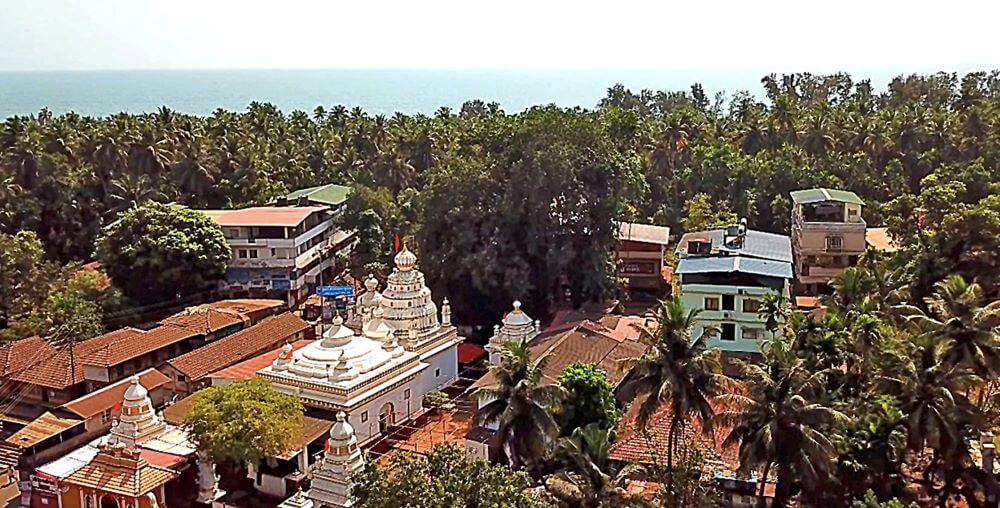
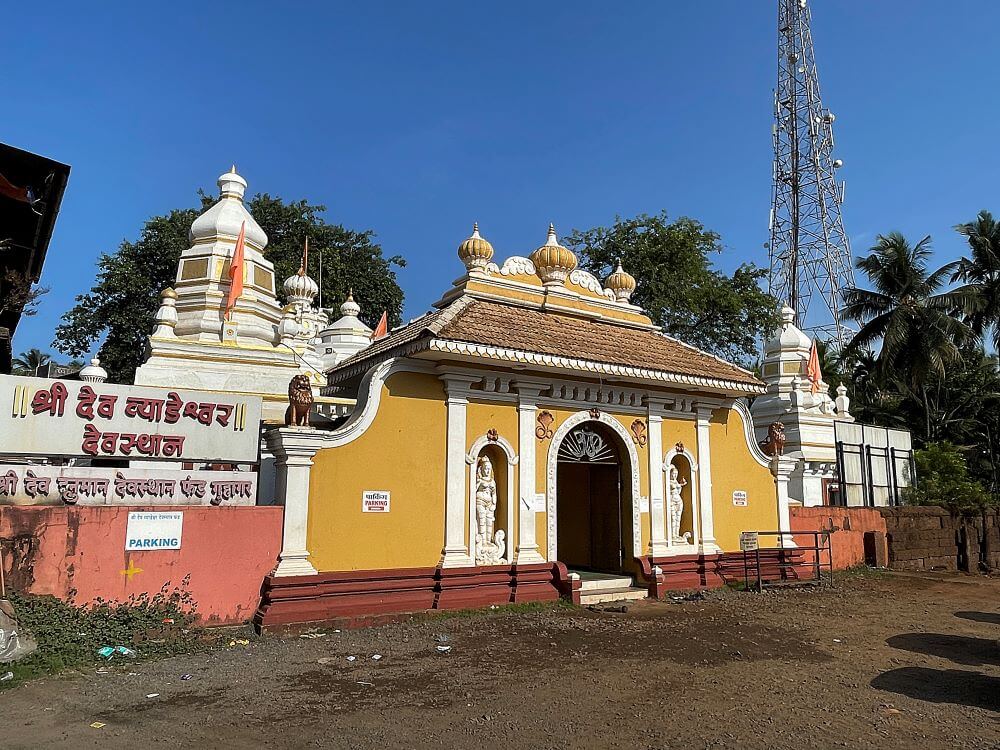
Although this site of Vyadeshwar is ancient, the current temple is said to be approximately 350 years old. The temple is situated amidst coconut and betel nut groves along the seashore. The temple, which is enclosed by a fortified wall, features an attractive main entrance facing the east. On both sides of the entrance, there are sculptures of lions and dancers, while the door frame is adorned with carvings of serpents. Above the entrance, There are three small shikhara. Apart from this, the fortification wall also has entrance gates on the north and south sides. In the two large niches on the inner side of the eastern entrance gate, there are distinct four-foot-tall idols of Hanuman and Garuda. It is said that the idol of Garuda here is new, and in its place, there was an idol of Chandesha since ancient times. The form of Chandesha is depicted with a trident in his folded arms and two hands joined in prayer. Chandesha is considered a beloved attendant of the Lord. It is believed that he keeps a record of the devotees visiting the temple. Idols of Chandesha are found in Shiva temples in states like Tamil Nadu, but it is rare to find such idols in Maharashtra. Since the original idol of Chandesha here was damaged, it was immersed, and an idol of Garuda has been installed in its place.
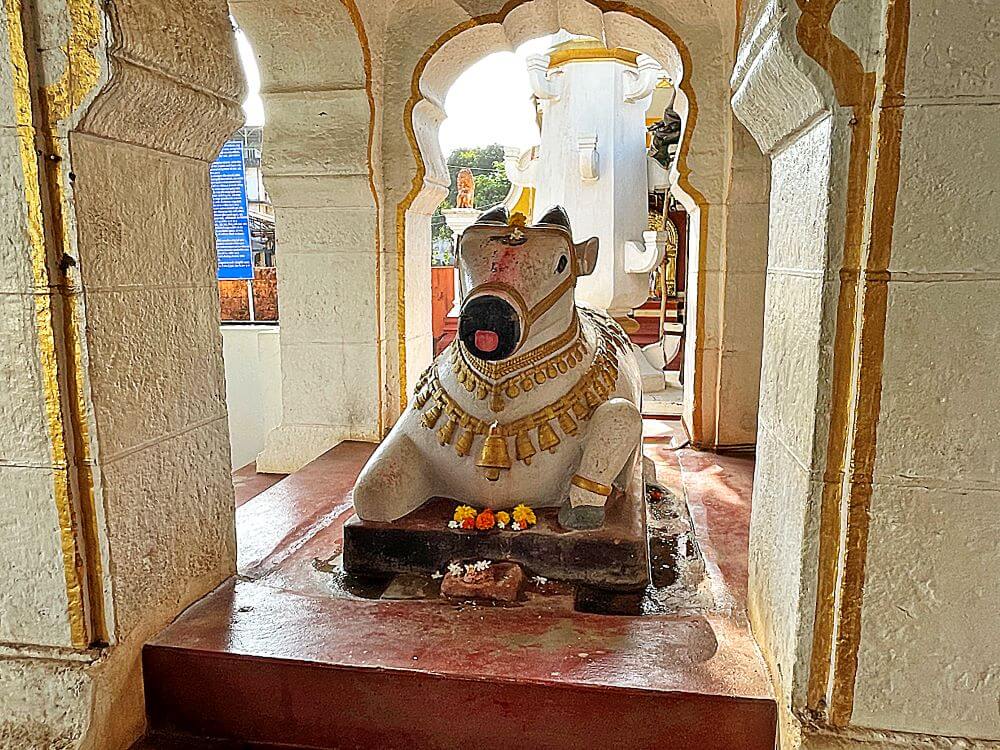
In the temple courtyard, along with the main temple of Vyadeshwara, there are shrines dedicated to Surya, Ganapati, Ambika, and Vishnu. Because of this, the temple complex is known as Shivapanchayatan. Additionally, there are two wells in the courtyard. In front of the east-facing main temple stands the Nandimandapa, which houses a large Nandi carved from a single stone. Due to the painting, the string of bells and various ornaments carved on this Nandi are clearly visible. Beside the Nandimandapa stands a Deepamala. The temple structure consists of a Nandimandapa, Sabhamandapa, Antarala, and Garbhagriha. In a small room adjacent to the southern wall of the Sabhamandapa, there is a triangular-shaped well. The water from this well is used for worship within the temple. Such a location, having a well inside the temple itself, is rarely found elsewhere. The construction of this Sabhamandapa and its roof is made of stone, featuring four vents, four large niches, and four small niches. Furthermore, throughout the Sabhamandapa, exquisite craftsmanship of stone arched doorways can be seen on all sides.
On a small elevated platform in the antarala (vestibule), there is a marble tortoise. The door frame of the garbhagriha (sanctum sanctorum) here features intricate carvings, with an image of Lord Ganesha on the lalata-bimba (lintel) and a kirtimukha carved at the base. The garbhagriha is situated at a slightly lower level and houses an ancient, swayambhu (self-manifested) Shiva Linga. Upon observing the structure of this Shiva Linga, marks resembling wounds can be seen. A brass serpent with seven hoods encircles the Shiva Linga. The outer walls of the garbhagriha are adorned with carvings of various serpents, peacocks, and flowers. Additionally, numerous wheels and lotuses are carved onto the jagati (platform).
Festivals such as Ashadhi Ekadashi, Shravani Somvar, Nag Panchami, Pitru Paksha, Vijayadashami, Kartiki Ekadashi, Tripurari Purnima, Mahashivratri, and Holi are celebrated at the temple. It is a local belief that if the rains are delayed or there is a dry spell, the sanctum sanctorum of Vyadeshwar is filled with water to submerge the deity, which is followed by rainfall. For devotees, rituals such as Abhishek, Shodashopachara Puja, and Laghurudra Abhishek are performed here. For these, one must contact the temple committee or the local priests in advance. (Contact: Sanjeev Gondhalekar, Prashant Kanade, Chandrashekhar Bhave (all priests): Mobile: ٩١٦٨٢٤٠٩٠١
This sacred temple stands as a testament to deep spiritual devotion, ancient architectural grandeur, and rich local cultural traditions.
The sanctum sanctorum houses the divine idol consecrated according to ancient Vedic traditions, surrounded by serene courtyards and traditional temple architecture.



Navratri, Maha Shivratri, Annual Temple Jatra & Deepotsav
Compare and book flights, secure top-rated local hotels near the temple, hire reliable guides, and rent cars instantly.
Extend your pilgrimage by visiting other highly sacred temples located nearby.


Add ₹999 more to unlock FREE SHIPPING!
Your sacred cart is currently empty.
Shop Photo FramesFill in your delivery details below to place your order.
Add comment