
Add ₹999 more to unlock FREE SHIPPING!
Your sacred cart is currently empty.
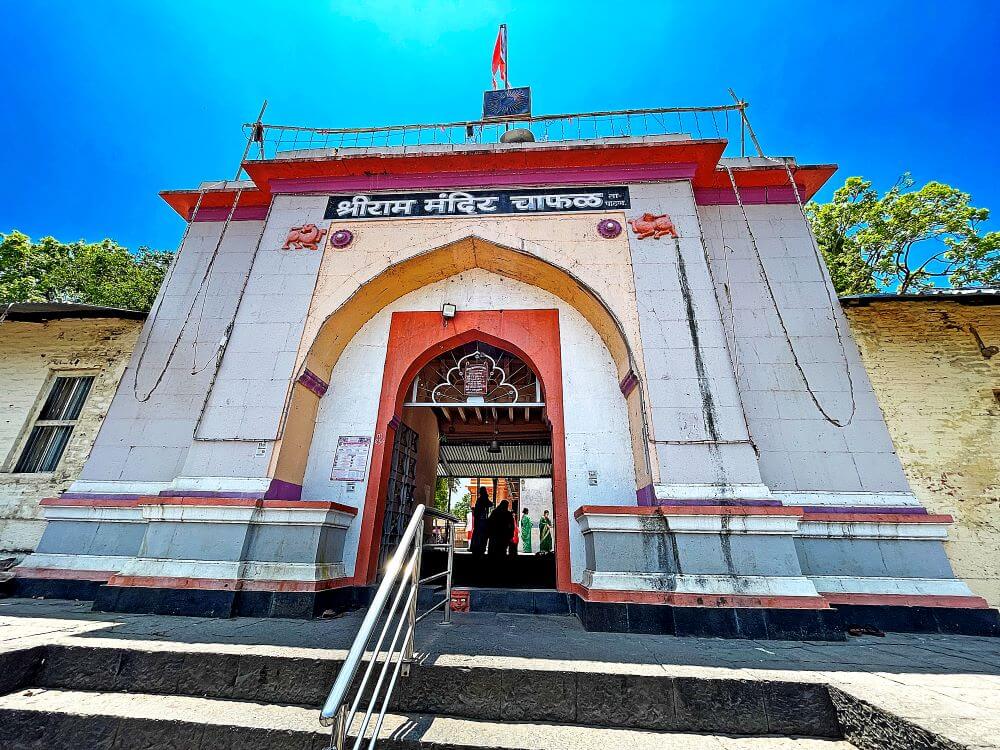
Shop Photo FramesThe village of Chaphal, nestled amidst the surrounding mountain ranges, dense foliage, and shrubs, on the banks of the Mand River, was deeply cherished by Samarth Ramdas Swami. It was in this very village that Samarth resided for thirty-five to thirty-seven years of his seventy-three-year life. Although he spent the last six to seven years on Sajjangad at the behest of Chhatrapati Shivaji Maharaj, he would still come to Chaphal every year from there for the Shri Rama Janmotsava. Chaphal village is renowned due to his stay and the Shri Rama Mandir he established here. Besides this temple, three of the eleven Maruti temples established by Samarth are also in Chaphal.
According to historical and scriptural records, Chaphal was formerly a hamlet of the village of Nanaghol. At that time, this area was known as Chaphalwadi. After Samarth Ramdas Swami arrived here, he requested land from the villagers to build a temple. The villagers then offered him the cremation ground on the banks of the Mand River. Samarth joyfully accepted the site and began the work of constructing the temple there. Through the voluntary labour of villagers, disciples, and devotees, a small temple was completed here in the year one thousand six hundred and forty-seven. However, as Samarth remained silent about the idol for the temple, confusion arose among his disciples and the villagers.
After the temple was completed, Samarth would earnestly pray to the Lord. Once, Maruti appeared to him in a dream and revealed that an idol of Shri Rama was in the Angapur Dhoh (deep pool). That very idol would be installed in his temple. Following this dream vision, Samarth found two idols in the Dhoh at Angapur. One of them was of Anglai Devi (this Devi is in the Anglai Mandir on Sajjangad), and the other was of Suryanarayana. As instructed by Maruti, Samarth, belonging to a family of Surya worshippers, regarded that idol as the idol of Shri Rama. As Samarth set out for Chaphal with these idols, the villagers of Angapur intercepted him at the village entrance and declared that the idols from their Dhoh would remain in their own village. The place where Samarth was stopped by the villagers is now famous as ‘Sukhtan’. Due to the villagers’ opposition, Samarth left the idols there and proceeded to Chaphal.
When the villagers of Angapur attempted to lift the idols that Samarth had left, with the intention of taking them into their village and installing them, the idols would not budge from their spot. The same thing happened repeatedly despite their efforts. Therefore, these villagers went to Chaphal and requested Samarth himself to accept these idols. Accordingly, Samarth had these idols brought to Chaphal by his disciples.
In the year one thousand six hundred and forty-eight, the news that the idol of Shri Rama would be installed in the Shri Rama Mandir at Chaphal spread far and wide by word of mouth, and thousands of people gathered at Chaphal for the darshan of Shri Rama. There was immense enthusiasm everywhere. On this occasion, invitations were also sent to deities such as Ninai Devi of Khanoli, Ghanai Devi of Karve, Janai Devi of Dusale, Nandlai of Chaphal, Khanduai of Dadholi, and Somjai. The villagers of Angapur, from whose Dhoh the idol was found, were given the honour of holding the staff of the Janmotsava banner. This tradition continues to this day. In the presence of all, the Prana Pratishthapana (consecration) of Shri Rama’s idol was performed. In the same year, the first Shri Rama Janmotsava was celebrated in the temple. At that time, the land of Chaphal was imbued with the spirit of Rama.
After his coronation, Chhatrapati Shivaji Maharaj, on Ashwin Shuddha Dashami, that is, Vijayadashami, bestowed upon this temple thirty-three villages, four hundred and nineteen Bighas of land, one pasture, and one hundred and twenty-one Khandis of grain as a grant. This was the largest assistance given by Chhatrapati Shivaji Maharaj to any temple during his reign. When Shivaji Maharaj expressed his desire to build a grand temple in place of the small Shri Rama Mandir here, Samarth assured Maharaj that the time had not yet come, and a new temple would be built in the future according to Shri Rama’s will when the opportune moment arrived.
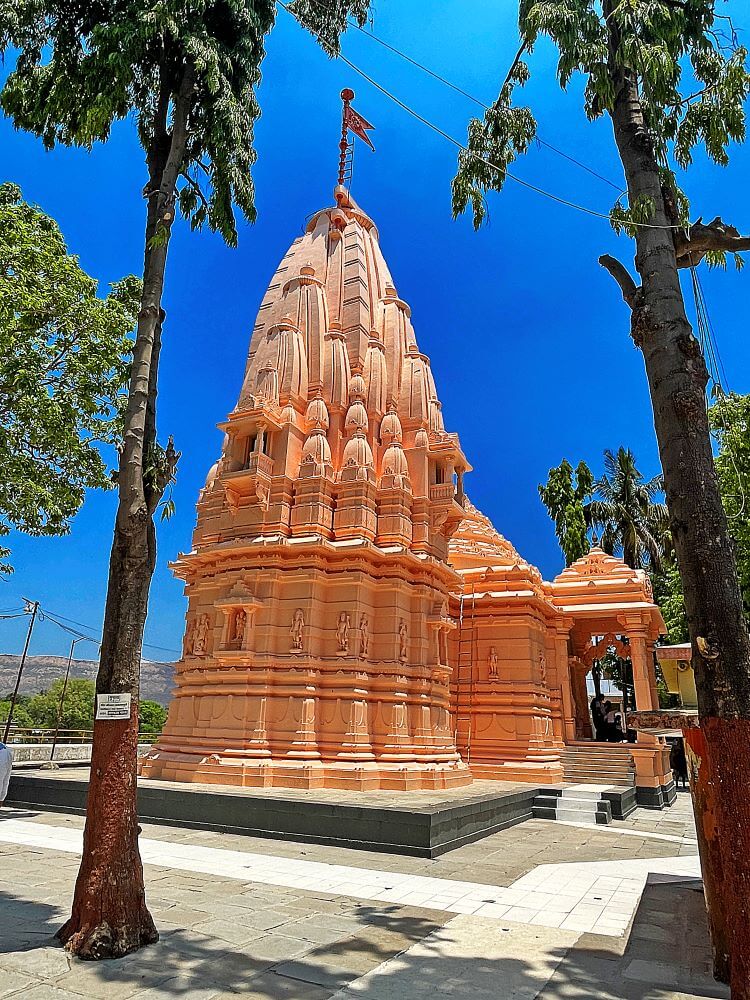
That time came on the eleventh of December, one thousand nine hundred and sixty-seven. On this day, the temple was damaged in an earthquake in the Koyna region. Therefore, the reconstruction of the temple was necessary. At that time, the renowned industrialist Arvindsheth Mafatlal was present with the then District Collector, Shri Padmanabhan, who had come to Chaphal to inspect the earthquake damage. Seeing the condition of the temple, he decided to undertake the burden of its renovation. Accordingly, the renovation work began on the tenth of May, one thousand nine hundred and sixty-eight. A grand temple was erected on this site at a cost of approximately twenty-one lakh rupees. On the first of May, one thousand nine hundred and seventy-one, the flag and the golden kalasha were installed by Ishwaranand Saraswati of Karhad.
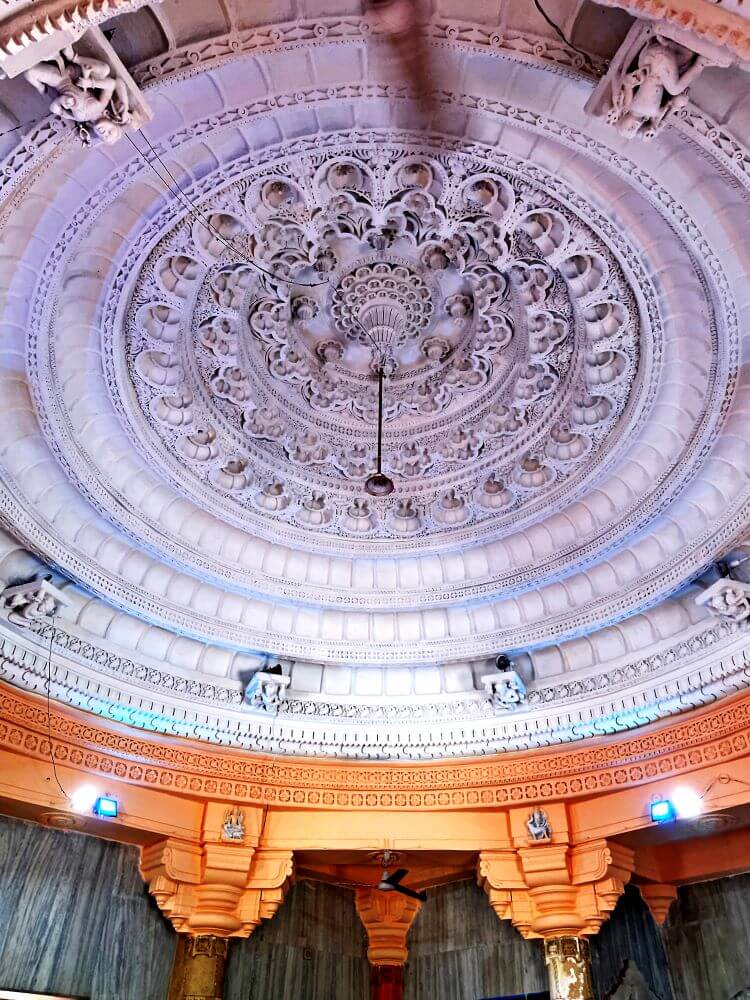
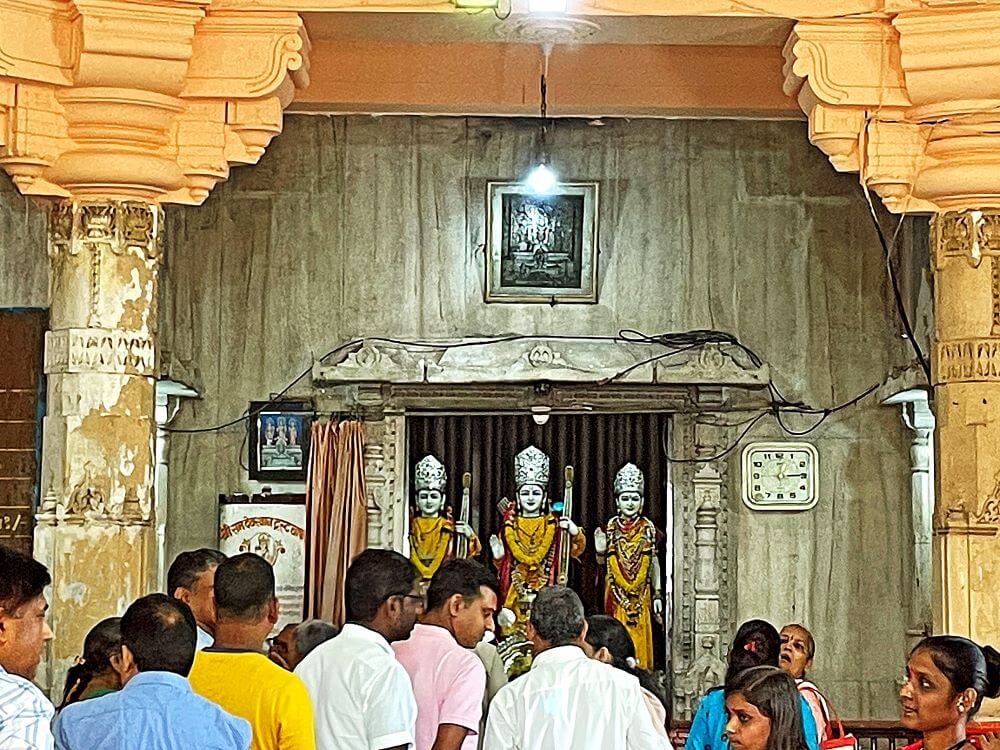
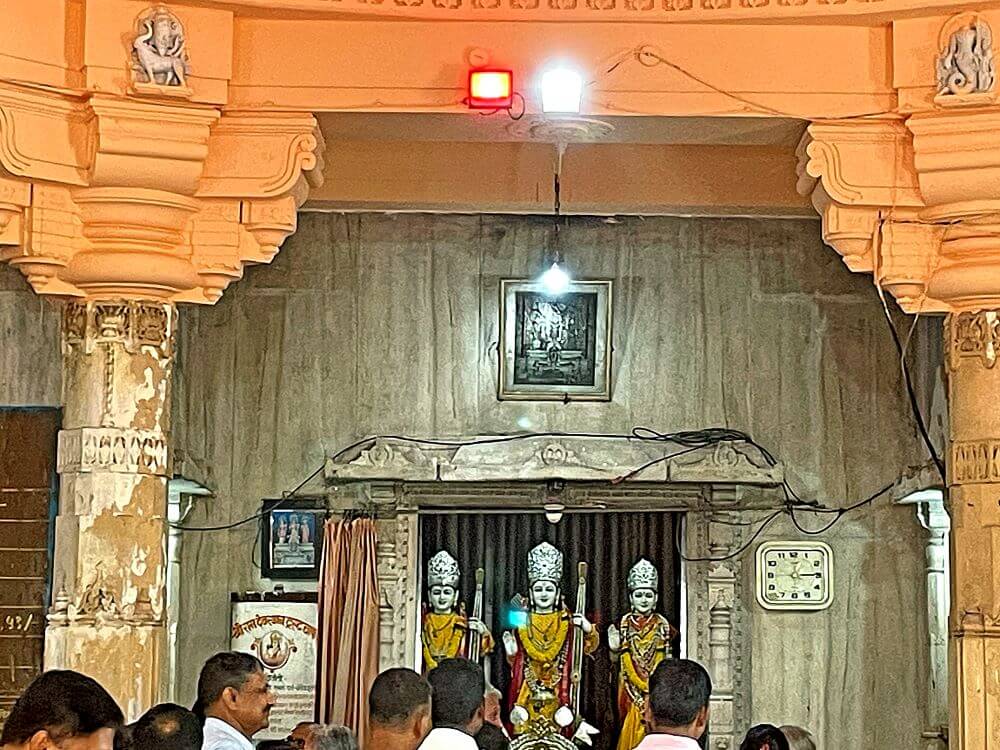
This temple stands on a high plinth and has a structure comprising a Mukhamandap (entrance hall), a Sabhamandap (assembly hall), and a Garbhagriha (sanctum sanctorum). There is intricate carving on the walls and pillars of the temple at various places. In the Garbhagriha, the original idol established by Samarth Ramdas is in the front, and behind it are idols of Shri Rama, Sita, and Lakshmana, approximately three feet tall, made of white marble. The original idol, found by Samarth in the Angapur Dhoh and currently in the Garbhagriha, holds lotuses in its two hands. This idol is standing, and on the front side of the idol are seven faces of horses. To the side are one male and one female Gana. Devotees can have darshan at the Shri Rama Mandir from four-thirty in the morning to twelve-thirty in the afternoon, and from one-thirty in the afternoon to nine in the evening.
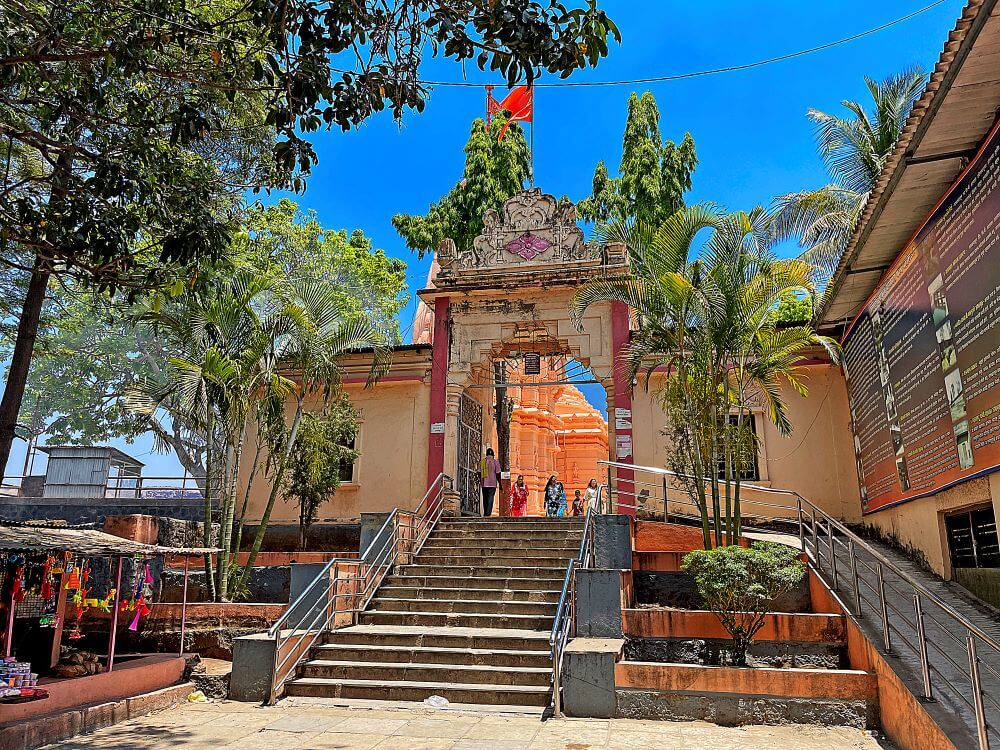
The premises of this Shri Rama Mandir, located on the banks of the Mand River, are vast. Three of the eleven Maruti temples established by Samarth are in the Chaphal area itself. Among them, Das Maruti is established directly in front of the Shri Rama Mandir. This Maruti was established by Samarth in the year one thousand six hundred and forty-nine. The idol of Maruti here is six feet tall, and its gaze appears to rest on the feet of Shri Rama. This idol has thick anklets on its feet, bangles on its hands, armlets on its upper arms, and a garland around its neck. The tail of this Maruti comes from behind, over its head, and extends below the elbow of its left hand. Within the back wall of this temple is a Ganesha temple established by Samarth. It contains a vermilion-smeared Ganesha idol, approximately three feet tall.
In the courtyard of the Shri Rama Mandir, behind the temple, there is a Dhyanagumpha (meditation cave). It is said that Samarth Ramdas Swami and Chhatrapati Shivaji Maharaj held their secret consultations in this cave. There is a stairway to descend into this cave, and at the beginning of this path, there is a pit barely one and a half feet square and three to four feet deep. From there, one can proceed down the stairway into the underground cave.
At a distance of एकशे मीटर from here is another Maruti Mandir established by Samarth Ramdas Swami. This is known as Pratap Maruti or Veera Maruti. The murti of Maruti here is seven to आठ feet tall. In accordance with the saying, ‘Puchchha te muradile matha…’ (the tail curled up to the head), this murti has a graceful and slender form, with a golden langoti and bells upon it. The garland around His neck reaches His stomach, and a demon lies beneath His left foot. Thick bangles and armlets adorn the murti’s wrists. It is said that Samarth Ramdas Swami might have installed this Maruti on Ram Navami in the year सोळाशे अठ्ठेचाळीस.
In Shinganwadi, approximately दीड किलोमीटर from the Shri Rama Mandir in Chaphal, Samarth Ramdas Swami installed a Maruti in the year सोळाशे पन्नास. This is the third Maruti in Chaphal. It is known as Bala Maruti or Khadicha Maruti. This mandir is situated on a small hillock and is the smallest among the अकरा mandirs established by Samarth Ramdas Swami. The murti in this mandir, which is merely दोन meters square, faces north, with a Trishul in the raised left hand and the right hand in an uplifted posture. The tail comes from behind the body, over the head, towards the palm of the left hand. It is said that in the year सोळाशे एकोणपन्नास, Samarth Ramdas Swami and Chhatrapati Shivaji Maharaj met in Shinganwadi. It was at this time that Samarth Ramdas Swami bestowed His grace upon Chhatrapati Shivaji Maharaj. This meeting took place under a tamarind tree here. It is still said that the golden hons scattered by Chhatrapati Shivaji Maharaj at that time are found in this area even today.
This sacred temple stands as a testament to deep spiritual devotion, ancient architectural grandeur, and rich local cultural traditions.
The sanctum sanctorum houses the divine idol consecrated according to ancient Vedic traditions, surrounded by serene courtyards and traditional temple architecture.
Navratri, Maha Shivratri, Annual Temple Jatra & Deepotsav
Compare and book flights, secure top-rated local hotels near the temple, hire reliable guides, and rent cars instantly.
Extend your pilgrimage by visiting other highly sacred temples located nearby.


Add ₹999 more to unlock FREE SHIPPING!
Your sacred cart is currently empty.
Shop Photo FramesFill in your delivery details below to place your order.
Add comment