
Add ₹999 more to unlock FREE SHIPPING!
Your sacred cart is currently empty.
Shop Photo FramesSajjangad Fort in Satara district is famous for being the place sanctified by the presence of Samartha Ramdas Swami and as his final resting place. This fort, which was under the control of Adil Shah of Bijapur, was conquered by Chhatrapati Shivaji Maharaj in 1673, who then requested Ramdas Swami to reside there. Originally known as Parali Fort after the village of Parali at its base, the fort was renamed Sajjangad by the Chhatrapati after Samartha took up residence.
Sajjangad Fort is located to the northwest of Satara city. As this area was once the penance ground of the sage Ashwalayan, the ancient name of the fort was Ashwalayan Gad. In the 11th century, a Shilahar king built this fort and named it Parali Fort due to the village of Parali at its base. From 1358 to 1375, the fort was under the control of the fourth Bahmani king. Since the Adil Shah of Bijapur was a successor to the Bahmani kingdom, the fort remained with him for some time. During his tenure, it was named ‘Navrastara’. On 2 April 1673, Chhatrapati Shivaji Maharaj conquered this fort.
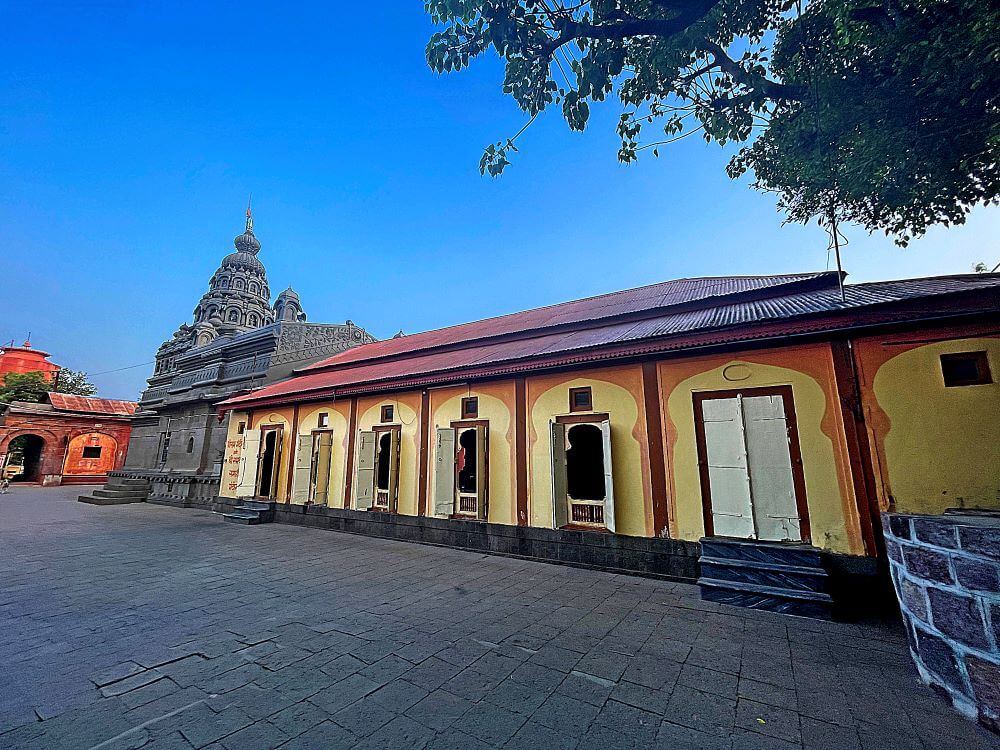
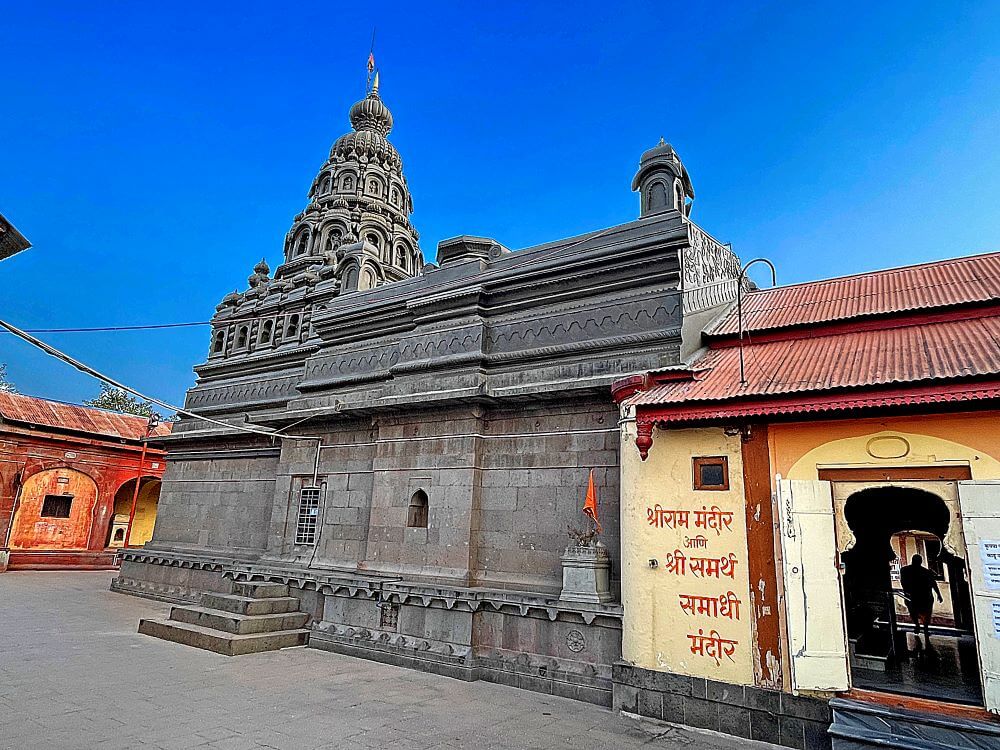
Samartha Ramdas Swami used to stay in this fort occasionally. Due to his advancing age, Chhatrapati Shivaji Maharaj requested Samartha to reside in the fort permanently. After Samartha agreed, a letter was written in 1676 to the fort commander, Jijoji Katkar, ordering him to make excellent arrangements for Samartha. After Samartha arrived here, the name of the fort was changed to Sajjangad. Having sanctified this fort with his six-year stay, Samartha left his mortal body at Sajjangad on 22 January 1682. In his memory, Chhatrapati Sambhaji Maharaj built the Shri Ram Mandir and the Samartha Samadhi Mandir here.
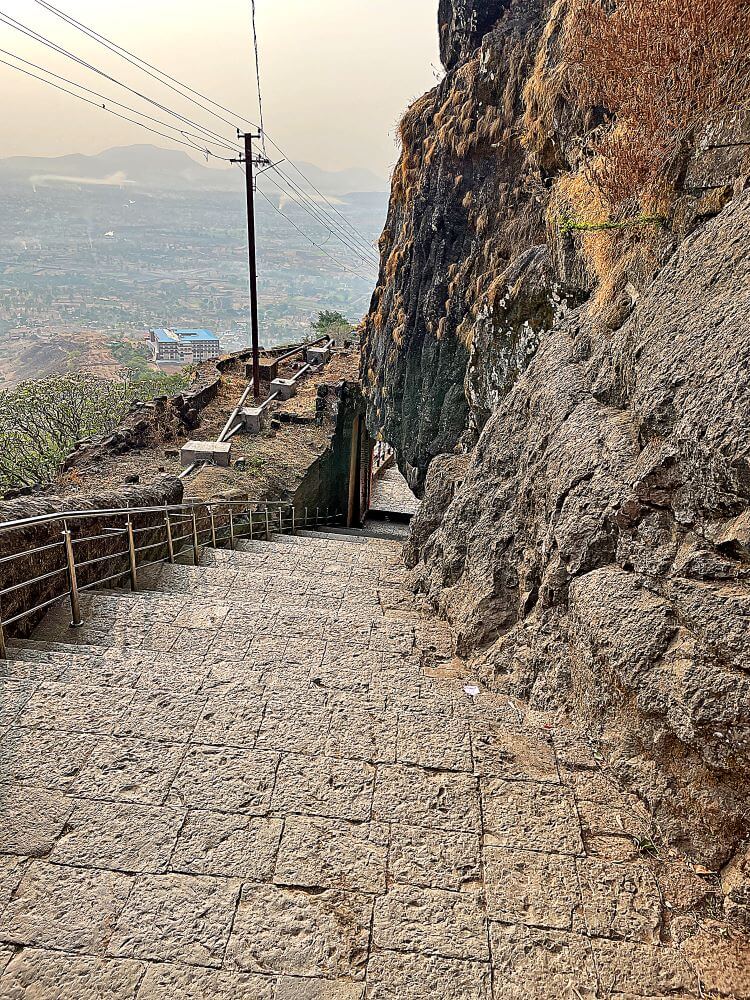
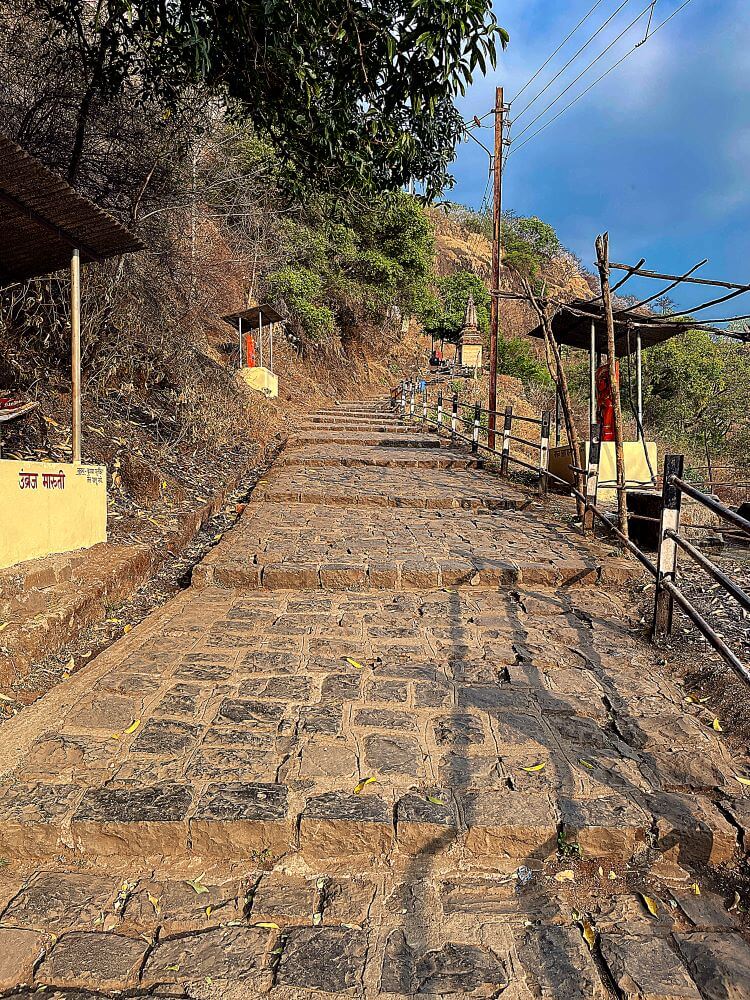
Sajjangad Fort is situated at an altitude of 3000 feet above sea level. The fort is surrounded by valleys on all sides, and there are some villages at the base. From one of these, Gajawadi village, there is a paved road leading to the base of Sajjangad. From there, there are about 250 steps to reach the fort. There is also an old footpath leading from Gajawadi to Sajjangad. On the path of steps, there is first a Kamadhenu temple and a Hanuman temple in front of it. After climbing 130 steps from the base, one reaches the Chhatrapati Shivaji Maharaj Mahadwar (Main Gate). After climbing another 50 steps from this main gate, which is situated between high and well-defined bastions, there is another door. It is named ‘Samartha Mahadwar’. The main gates are closed between 9 PM and 5 AM.
After passing through the Samartha Mahadwar, one enters the top of the fort. Near the Ghodale lake on the left side, at one end of the fort, is the Anglai Devi temple. According to historical records, the goddess in this temple was installed by Samartha. He had found this idol in a pool at Angapur. In that pool, he had found two idols: Shri Ram and Anglai Devi. He installed the idol of Shri Ram at Chaphal and the idol of Anglai Devi at Sajjangad. This idol of the goddess is beautiful and carved from a single piece of black stone.
After proceeding from the Anglai Devi temple along the main path of steps, there is a Maruti temple in the left Peth (it is believed that there was a settlement here previously). It is said that this temple existed even before Samartha came to live on the fort. The specialty of the Maruti idol in the temple is that its mouth is open. Behind the Maruti temple is the ‘Sonere Tale’ (Golden Lake), which is used for drinking water. There are some ancient caves on the north side of this lake. They are visible when the water level in the lake is low. The entire top of Sajjangad is shaped like a conch.
Next to the Maruti temple in the Peth is the Shridhar Kuti, sanctified by the stay of Samartha’s disciple, Shridhar Swami. The disciples of Shridhar Swami and members of the Shri Samartha Seva Mandal built this hut in 1951. In this hut, there is a temple of the padukas (footwear) of Samartha Ramdas Swami and Shridhar Swami. Abhishek Puja of these padukas in Shridhar Kuti takes place daily from 6 AM to 7.30 AM. After the Aarti, Tirtha-Prasad is distributed. The worship that had been taking place in the temple since 1950 has been held in Shridhar Kuti from 6 PM to 7.15 PM since 2001. After this worship, Aarti is performed and Mahaprasad is given to the devotees present.
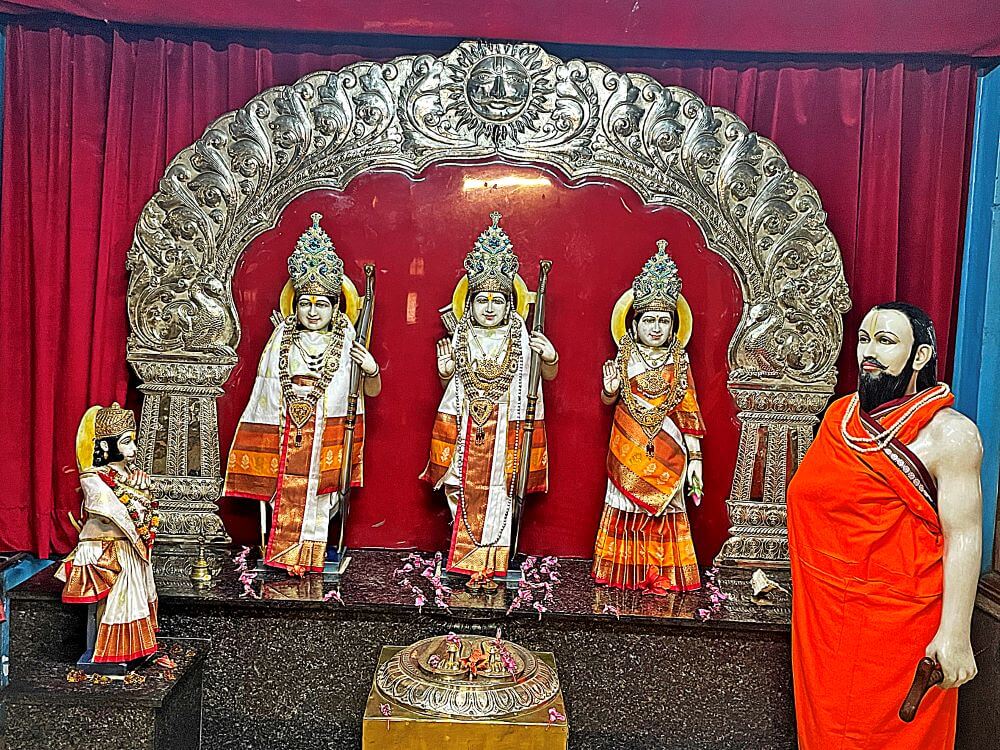
The main structures on the fort are the Shri Ram Mandir and the Samadhi of Samartha. The idols of Shri Ram, Lakshman, Sita, and Hanuman in the Shri Ram Mandir were made by a blind craftsman named Arnikar from Thanjavur and gifted to Samartha by Vyankojiraje. Along with these idols, there is a small idol of Ramdas Swami here. The Samadhi of Samartha is in the basement of the sanctum sanctorum of the Shri Ram Mandir. This Samadhi is made of black stone, is rectangular, and has carvings on the brass canopy above it. It is said that there was a pit at the site of this Samadhi earlier. After Samartha Ramdas Swami’s disciple, Uddhav Swami, performed the funeral rites on his mortal remains, this stone Samadhi appeared at this spot the next day. Therefore, this Samadhi is considered Swayambhu (self-manifested). There are 108 niches for lighting lamps in the Samadhi temple.
To the right of the Shri Ram Mandir, on a high plinth, is Samartha’s Shejghar (sleeping chamber). This is the very monastery built by Chhatrapati Shivaji Maharaj for Samartha’s residence. He breathed his last in this monastery. Now, items of his daily use are kept here. These include the bed with brass legs given to Samartha by Shivaji Maharaj, and on it is a portrait of Samartha drawn by his disciple and the head of the Thanjavur monastery, Meruswami, after seeing him. Among Samartha’s weapons are the Gupti (concealed sword) in a walking stick given by Shivaji Maharaj, an ornamental walking stick, a cane, and a baton. Apart from this, there are his daily-use drinking water pot, betel nut box, and spittoon. The copper pots in which his disciple Kalyanswami used to bring water for Samartha Ramdas from the Urmodi dam are also kept here. In front of the main temple, in the Ashok Vatika, is the Vrindavan of Samartha’s disciple, Akkaswami. After Ramdas Swami left his body, Akkaswami managed the affairs of the monastery and temples on Sajjangad for 29 years.
After exiting through the door on the west side of the fort from the temple courtyard, there is a Hanuman idol on a platform at the very edge of the fort to the right. Further ahead is the Dhabyacha Maruti temple. This Maruti temple was built by Samartha himself. Samartha had named it ‘Dhabyacha Maruti’ because it would strike terror into the hearts of enemies coming from the west.
For the convenience of devotees on the fort, two multi-storey pilgrim accommodation buildings, Bhaktadham and Kalyan Smruti, have been constructed. These provide free lodging facilities for devotees staying on the fort. The Annadan (offering of food) service, which has been conducted here by the Samarth Seva Mandal since 1960, has been held in the spacious assembly hall of the Bhakta Niwas since 2001. This facility provides tea and breakfast in the morning, and Mahaprasad (sanctified meal) in the afternoon and at night for the devotees. Every year during the Dasnavami festival, from Pratipada to Navami, the Manache Shlok and Dasbodh are recited in the assembly hall of the Bhakta Niwas for these nine days.
This sacred temple stands as a testament to deep spiritual devotion, ancient architectural grandeur, and rich local cultural traditions.
The sanctum sanctorum houses the divine idol consecrated according to ancient Vedic traditions, surrounded by serene courtyards and traditional temple architecture.

Navratri, Maha Shivratri, Annual Temple Jatra & Deepotsav
Compare and book flights, secure top-rated local hotels near the temple, hire reliable guides, and rent cars instantly.
Extend your pilgrimage by visiting other highly sacred temples located nearby.


Add ₹999 more to unlock FREE SHIPPING!
Your sacred cart is currently empty.
Shop Photo FramesFill in your delivery details below to place your order.
Add comment