
Add ₹999 more to unlock FREE SHIPPING!
Your sacred cart is currently empty.
Shop Photo FramesLord Shiva manifested in the form of a radiant column of light. Wherever He appeared, a Jyotirlinga has been established at that site. There are twelve such Jyotirlingas across the country, three of which are in Maharashtra. These are Shri Bhimashankar in Pune district, Shri Grishneshwar in Chhatrapati Sambhajinagar district, and the third is Shri Trimbakeshwar in Nashik district! It is here that the Simhastha Kumbh Mela is held.
Situated at the foothills of Brahmagiri and on the banks of the Godavari River, the Trimbakeshwar Jyotirlinga possesses an extraordinary characteristic. It is the presence of the Tridev—Brahma, Vishnu, and Mahesh—in the form of a Linga within the temple here. One can behold all three deities within a single Jyotirlinga.
The legend of the temple states that Goddess Parvati was jealous of the Ganga flowing from the matted locks of Lord Mahadeva. Parvati wished for Mahadeva to remove Ganga from his locks, but as it was difficult to separate Ganga from them, Parvati took Lord Ganapati into her confidence and entrusted this responsibility to him. Accordingly, Ganapati assumed the form of a cow. The cow went to a field near the ashram of Sage Gautama on the Brahmagiri mountain and began eating the crops. Seeing the cow eating the crops, Sage Gautama consecrated a blade of Darbha grass and threw it at the cow. Due to that blade of grass, the cow died on the spot.
Due to this, Sage Gautama incurred the sin of killing a cow. Thereafter, Ganapati revealed His original form to the sage and told him that he should propitiate Lord Mahadeva and summon the Ganga to the Earth. By which the sin of cow slaughter incurred by them would also be washed away. As per the instructions of Ganapati, Sage Gautama performed severe penance. Pleased by this, Shankara appeared before him and granted him a vision. At the request of Sage Gautama, Mahadeva released the Ganga from his matted locks here and agreed to reside in the form of the Trimbakeshwar Jyotirlinga.
Another legend of Tryambakeshwar is that once a dispute arose between Mahadeva and Brahmadeva. As the dispute escalated, Mahadeva cursed Brahmadeva, saying, “You shall fall to the earth as a mountain, and because of this, no one will worship you.” In a fit of rage, Brahmadeva also counter-cursed Shankara, saying, “Wherever I become a mountain, you too shall have to reside there with me.” Consequently, Mahadeva began to reside at the foothills of the Brahmagiri mountain in Tryambakeshwar as Tryambakeshwar.
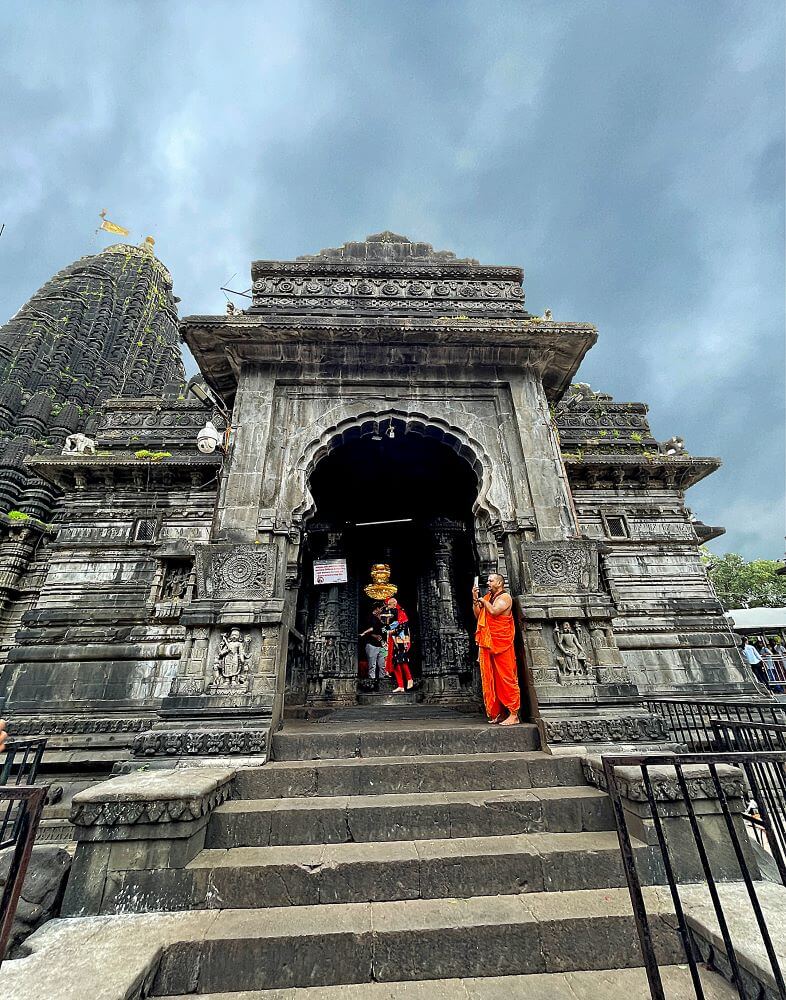
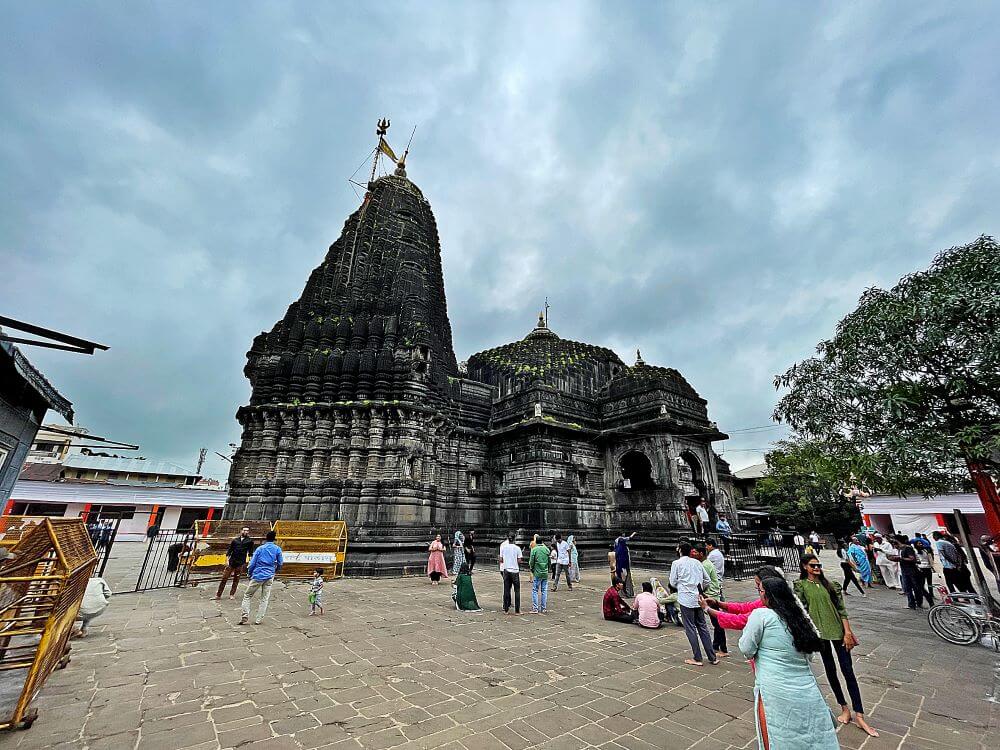
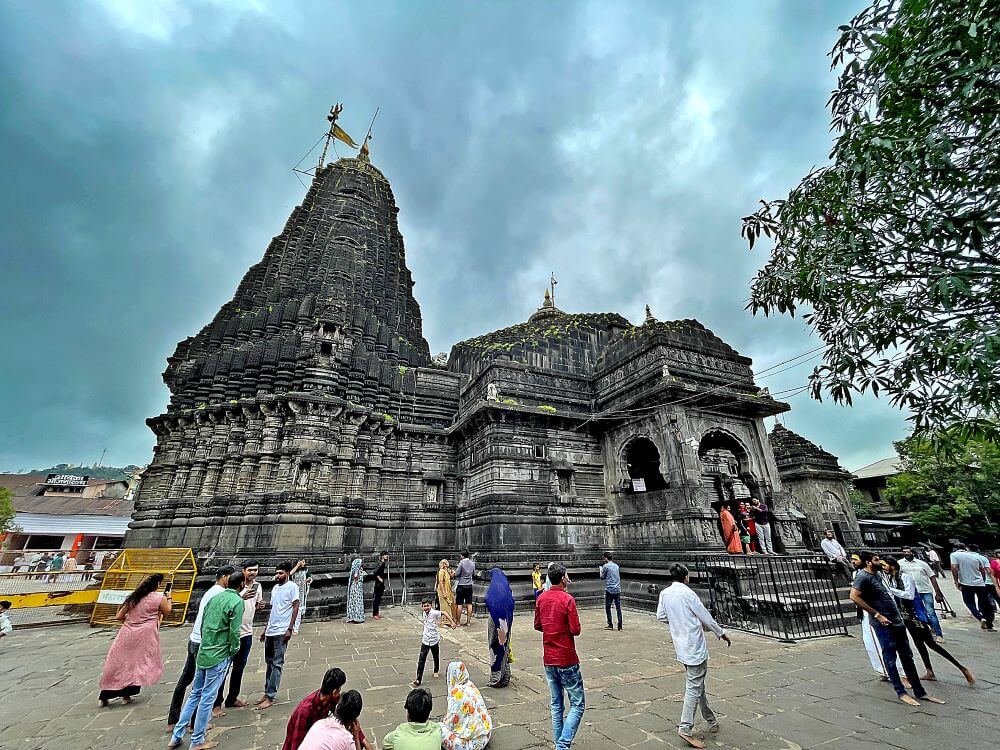
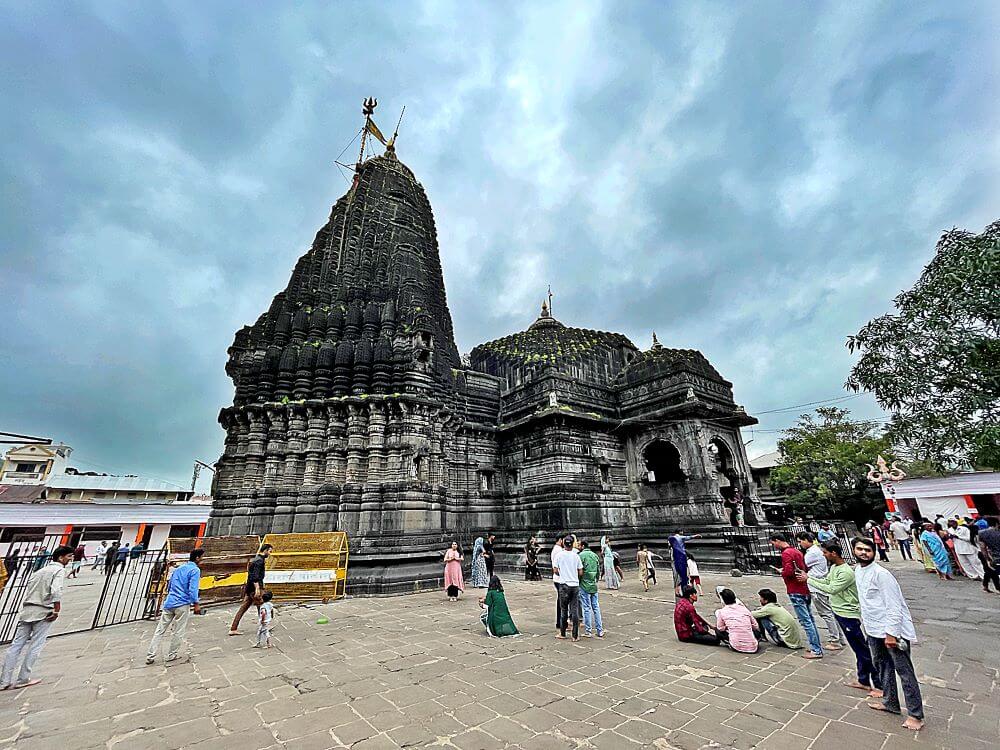
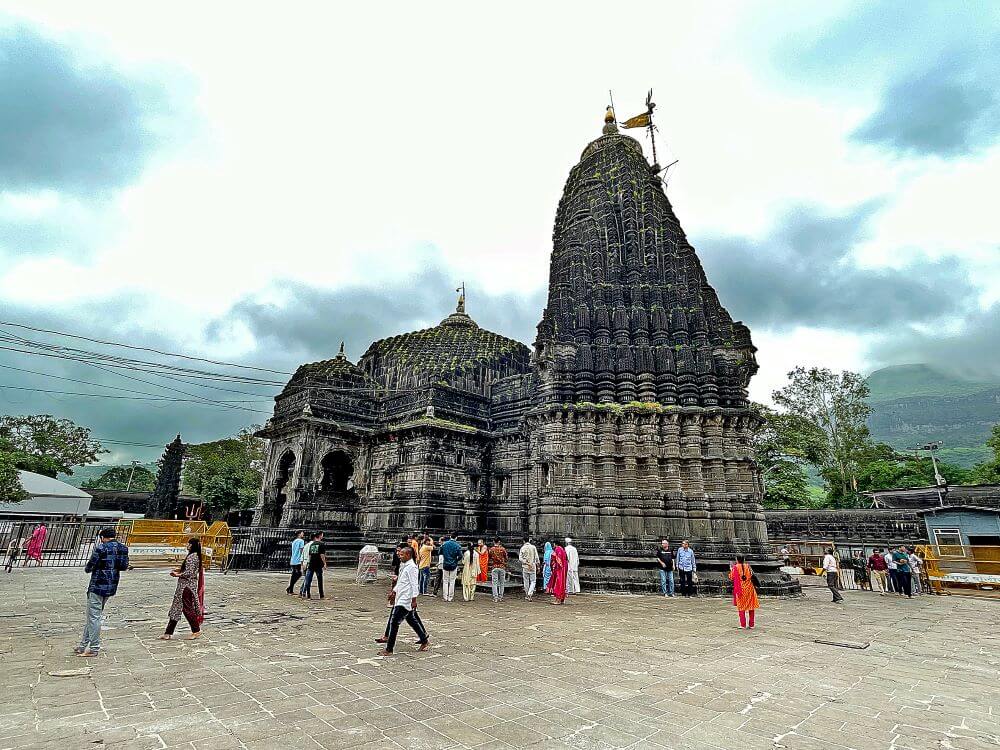
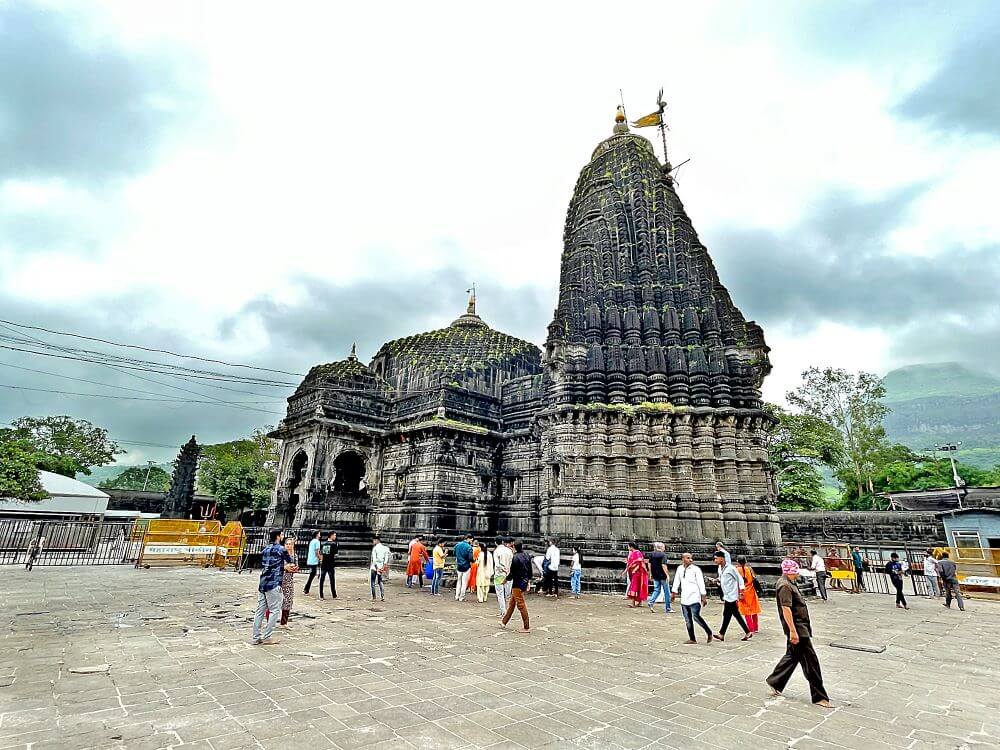
As one enters through the gateway of this area, which is filled with the resounding chants of ‘Har Har Mahadev’ and ‘Bambam Bhole’, one catches a glimpse of the golden spire of the Trimbakeshwar Temple, built of black stone, along with the trident and the five-metal Shiva flag shimmering atop it. Adorned with exquisite carvings, stone-sculpted idols of gods and goddesses, Yakshas and Gandharvas, black stone pillars, a massive dome, and stone arches, this temple is built in the Hemadpanti style. The Government of India declared this temple a National Protected Monument in 1941.
This Shivalaya was built by the tenth-century Shiva devotee, Shilahar King Jhanjha. Later, in the eighteenth century, Nanasaheb Peshwa undertook its renovation. According to historical records, the construction of the temple continued for 31 years. Under the supervision of Narayan Bhagwant and his son Ganesh Narayan, 786 artisans built the temple. Marble stone was specially procured from Makrana in Rajasthan for the temple. It was transported here by 48 camels, 85 elephants, and 112 horses. It is recorded that the renovation of the temple cost 9 lakh rupees at that time. On 16 February 1756, on the auspicious occasion of Mahashivratri, the inauguration ceremony of the temple took place amidst the sounds of sanai-chaughade, bheri, tutari, and ranshinga. This temple, measuring 265 feet in length from east to west and 218 feet in width from north to south, is enclosed by a stone wall and features four grand gateways in all four directions. An inscription detailing the construction of the temple is carved onto the northern gateway.
Devotees enter the temple after taking darshan of the steps of the North Maha-Dwara. Between the West and South entrances of the temple, in the courtyard, lies the Amrit Kund. The water from it is used for worship. The unique feature of this kund is that its depth is equal to the height of the temple.
The main temple faces west. The temple, measuring 160 feet in length and 131 feet in width, stands at a height of 96 feet from the ground. A statue of Nandi is situated in front of the main temple entrance. Upon entering through the eastern doorway of the temple, one sees a domed hall adorned with attractive arches. There, a 12-foot-tall statue of a tortoise carved in marble is present. To the west of the temple, one must descend five steps to enter the main sanctum sanctorum. It is there that the Swayambhu Jyotirlinga of Mahadeva is located. Within this Linga, there are three smaller Lingas representing the Trinity of Brahma, Vishnu, and Mahesh. One can witness the Ganges continuously flowing from the Banalinga of Shivshankar. To the east of the Jyotirlinga stands a marble statue of Parvati.
It is said that the golden pinnacle of the temple and the five-metal flag were offered by Annasaheb Vinchurkar, a chieftain of the Peshwas. When the Peshwas gained control of the Delhi treasury, it contained a jewel-studded crown that the Mughals had looted from Mysore. The Peshwas offered this crown to Trimbakeshwar. Since then, it has been a tradition to carry this crown of Trimbakeshwar in a procession to the Kushavarta Tirtha for a ritual bath every Monday.
In this temple, the worship of Lord Brahma is performed daily from 7 to 8:30 in the morning, Lord Mahadev from 10:45 to 12:30, and Lord Vishnu from 7 to 8:30 in the evening. Along with this daily worship, various religious festivals are also celebrated here. Special decorations are arranged at the Trimbakeshwar temple during Nag Panchami in the month of Shravan, as well as on Narali Purnima. A festival is also held here on the day of Vinayaka Chaturthi in the month of Bhadrapada. On the Ashtami of the Ashwin month, sarees and blouses are offered to the goddesses Bhuvaneshwari, Kolambika, and Nilambika located in the temple premises. On the day of Vijayadashami, weapons and deities are worshipped here. The deity’s palanquin procession departs at four o’clock in the evening. During Diwali, a morning worship ritual is performed on the occasion of Naraka Chaturdashi. The festival of Lakshmi Pujan is also celebrated here. The palanquin procession of the jewel-studded crown of Trimbakeshwar, which takes place on the evening of Padwa in the month of Kartik, is a spectacle worth experiencing. A Kirtan ceremony is held in the temple for three days during Kartik Trayodashi, Chaturdashi, and Purnima.
The Trimbakeshwar Devasthan Trust has made arrangements for pilgrim accommodation at the Bhakta Niwas, as well as a dining hall; bookings for these can be made through the Trust’s website. Apart from this, there are many Dharamshalas and hotels in Trimbakeshwar where accommodation can also be arranged.
This sacred temple stands as a testament to deep spiritual devotion, ancient architectural grandeur, and rich local cultural traditions.
The sanctum sanctorum houses the divine idol consecrated according to ancient Vedic traditions, surrounded by serene courtyards and traditional temple architecture.
Navratri, Maha Shivratri, Annual Temple Jatra & Deepotsav
Compare and book flights, secure top-rated local hotels near the temple, hire reliable guides, and rent cars instantly.
Extend your pilgrimage by visiting other highly sacred temples located nearby.


Add ₹999 more to unlock FREE SHIPPING!
Your sacred cart is currently empty.
Shop Photo FramesFill in your delivery details below to place your order.
Add comment