
Add ₹999 more to unlock FREE SHIPPING!
Your sacred cart is currently empty.
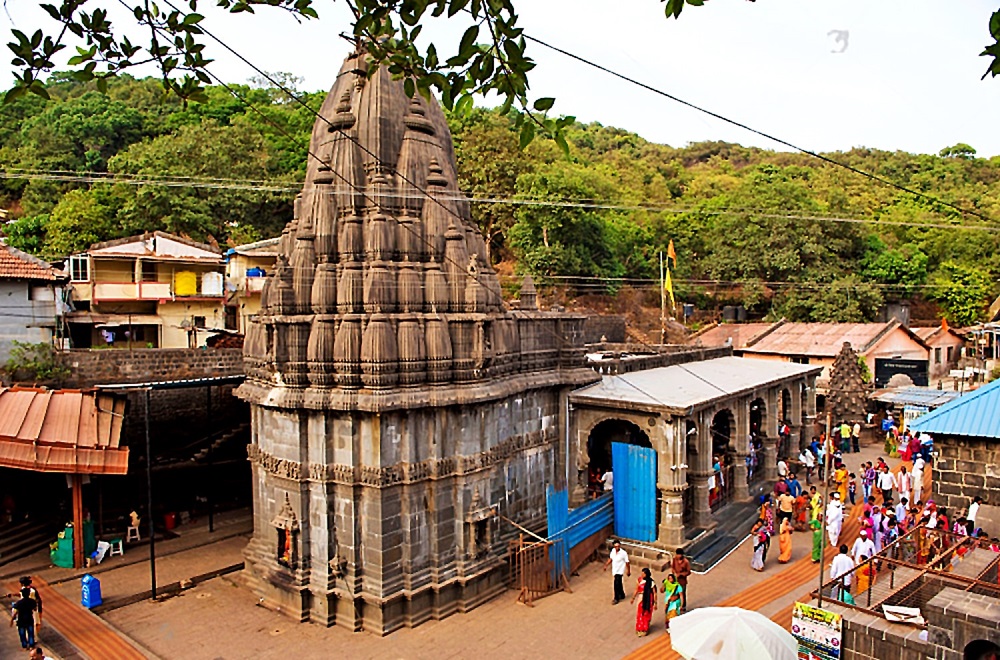
Shop Photo FramesIn the spiritual tradition of Bharatavarsha, the twelve Jyotirlingas hold a place of paramount importance. These twelve sacred abodes, which are founts of Bhagwan Shankara’s infinite effulgence and divine energy, are revered by millions of devotees. Spread across various regions of our sacred land, these Jyotirlingas serve to bind the nation together with a spiritual thread. Among these hallowed Jyotirlingas, the Bhimashankar Mandir, the sixth in this divine lineage, is nestled in the Sahyadri mountain ranges of Pune district in Maharashtra. This pilgrimage site, considered to be the dwelling of Bhagwan Shankara and the source of the Bhima River, holds special significance from both a spiritual and historical perspective.
According to ancient lore, to resolve the dispute of supremacy between Bhagwan Vishnu and Brahma Deva, Mahadeva manifested as a colossal pillar of light. Failing to find either the origin or the end of this brilliant effulgence, both deities acknowledged Mahadeva’s supremacy and devoutly praised this pillar. These divine shafts of light, which settled in various parts of the Earth for the welfare of devotees, came to be known as ‘Jyotirlingas’. These twelve sacred sites, revered since ancient times, are considered pillars of Bharatiya culture and primary centres of spiritual energy. This sacred journey, commencing from Somnath in Saurashtra, extends to Kedarnath in the Himalayas and Rameswaram in the South. Including Omkareshwar on the Vindhya mountains and Trimbakeshwar on the banks of the Godavari, all these twelve sites are situated in diverse regions of the country. While each Jyotirlinga possesses its own unique narrative and characteristics, all these places are connected by a singular divine principle.
This sacred region, referred to as ‘Dakini Vana’ in the ‘Shatarudra Samhita’ of the ancient scripture ‘Shiva Purana’, is considered a crucial centre for the annihilation of unrighteousness and the manifestation of divine power. As described in this scripture, when Bhima, the son of Kumbhakarna, who resided in the rugged and dense forests of the Sahyadris, learned that Shri Rama had destroyed his lineage, a desire for vengeance arose within him. This mighty demon performed extremely arduous penance to Brahma Deva and received a boon of power to conquer all three worlds. Intoxicated by this power, Bhima began to torment humans on Earth and even the Devas in Svarga. This cruel demon imprisoned Sudakshana, the Shiva devotee king of Kamarupa, and attempted to snatch away his right to worship Bhagwan Shiva. When Bhima struck the clay Shivalinga, which the king devoutly worshipped, with his sword, Mahadeva Himself manifested from it.
Bhagwan Shankara annihilated Bhima with His Trishula, liberating the Earth from the demon’s torment. After this victory, all the deities and Rishis implored Mahadeva to reside permanently at this very spot for the welfare of devotees. Honouring this request, Mahadeva permanently settled here in the form of a Svayambhu Jyotirlinga. From the streams of sweat that flowed from Shankara’s body after the fierce battle, the sacred Bhima River originated. This ‘Bhimarathi’ River, born from Bhagwan Shankara’s sweat, reappears as ‘Gupta Bhimashankar’ a short distance from the main temple. It is believed that the source of this river is within the Jyotirlinga itself. Furthermore, this site is explicitly mentioned in the ‘Sahyadri Khanda’ within the ‘Skanda Purana’ and in the ‘Dvadasa Jyotirlinga Stotram’ composed by Adi Shankaracharya. Records of visits to this sacred site are also found in the Abhangas within Sant Namdev’s scripture, ‘Namdev Gatha’. In the ‘Peshwe Daptar’, a source providing information on historical events during the Peshwa period, official evidence of the renovation of this temple and the contributions of Nana Phadnavis are available.
The history of the Bhimashankar Mandir is exceedingly ancient. Experts believe that the original construction of the temple’s Garbhagriha dates back to approximately the thirteenth century. The expansion and repairs of this ancient temple, built during the Yadava period, continued over many subsequent centuries under various dynasties. Particularly during the Maratha Empire, the temple received special royal patronage. Historical records indicate visits by Chhatrapati Shivaji Maharaj and Chhatrapati Rajaram Maharaj to this sacred place. In the eighteenth century, during the Peshwa period, the temple acquired its present magnificent form. Nana Phadnavis renovated this temple around १७८६, constructing the Sabhamandapa and a tall Shikhara here. The influence of Peshwa-era Maratha architectural style is still clearly visible throughout this entire construction. During this period, various villages were granted as Inam for the temple’s administration.
To reach this temple, located in Khed Taluka of Pune district, routes are available from Pune or Manchar. The main temple is approximately one kilometre from the Bhimashankar bus stand. As it is situated in a deep valley, one must descend about २५० steps to reach the temple. The presence of a roof over this stairway protects devotees from sun and rain. Along the stairway, there are numerous shops selling puja materials and prasad. Upon descending the steps, one enters the temple courtyard. In front of the temple, on a raised platform, stands an ancient Deepamala. A large brass bell, suspended by two pillars, is situated in front of the temple. This magnificent bell is a major attraction here. Chimaji Appa offered it here as a symbol of victory after defeating the Portuguese in the Vasai campaign of १७३९. The year १७२९ is engraved on this bell, and it bears sculptures of a cross and Mary. Near the pillars supporting this bell, there is a Shani Mandir. At the entrance of this temple, there is a pair of swans holding a pearl necklace in their beaks, and on both sides, there are floral sculptures. Beside the Shani Mandir, in a small niche, there is a stone idol of Hanuman adorned with sindoor.
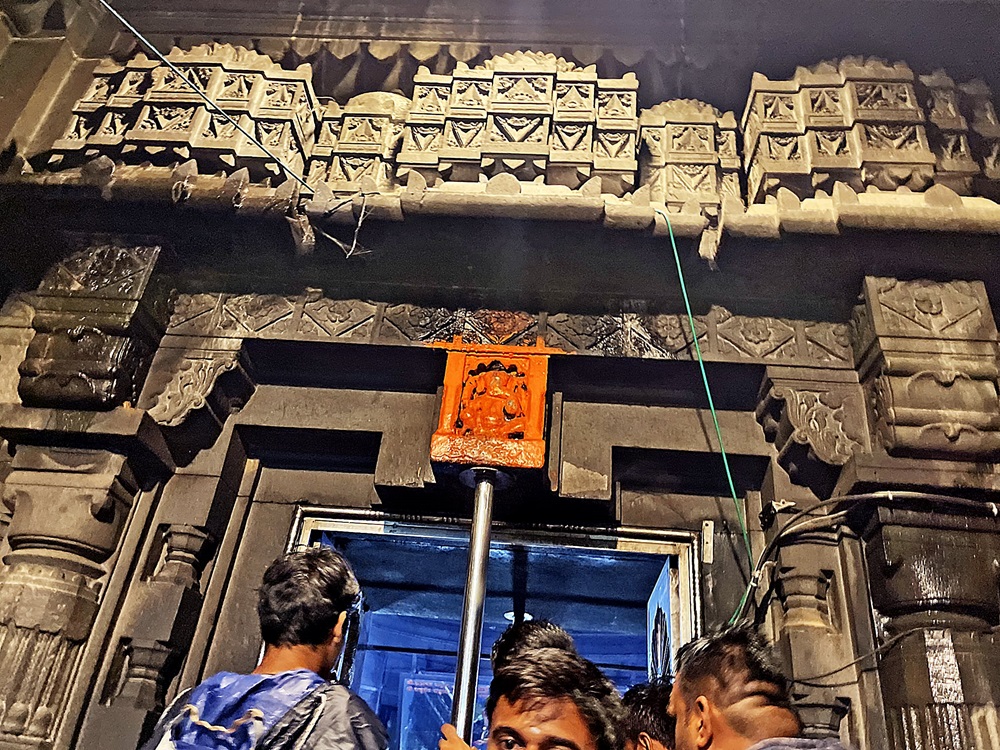
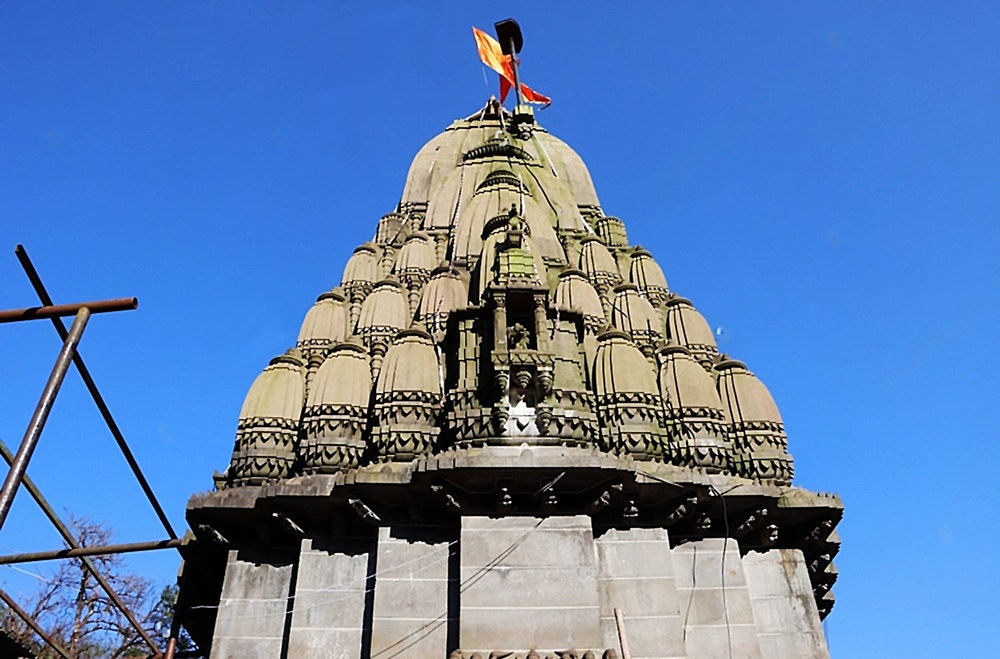
The Bhimashankar Temple’s structure comprises a spacious assembly hall (sabhamandapa) and a sanctum sanctorum (garbhagriha). It is believed that the garbhagriha was constructed around the thirteenth century, while the sabhamandapa dates back to the Peshwa period. At the entrance of the sabhamandapa, there is intricate floral carving and a sculpture of Shri Ganesha. The sabhamandapa features four rows of ornamented pillars. The pillars in each row are connected by arches, and the ceiling displays a chakra (wheel) motif. Further ahead is the entrance to the garbhagriha. This entrance has ornate pillars and a sculpture of Shri Ganesha. The self-manifested Shivlinga within the garbhagriha is adorned with a silver covering. In a niche (devakoshtha) on the wall in front of the pindi, there is an idol of Devi Parvati. The outer walls of the garbhagriha are adorned with sculptures of revered sages (Rishimunis). In the niches on the outer walls on the three sides behind the temple, there are idols of Shri Krishna, Shri Hanuman, and Devi Mahishasuramardini. The roof of the garbhagriha is crowned by a square, tall, and tapering spire (shikhara). Within the shikhara, there are idols of deities in four niches, one in each direction. The shikhara features smaller shikharas in four tiers. At the upper part of the main shikhara, there are three amalakas, topped by a kalasha (finial) and a flag.
Behind the temple are stone-built water tanks, known as Mokshakunda and Jnanakunda. The Bhima River originates from this very spot. Here, there are also temples dedicated to Sakshi Vinayak and Shri Hanuman. Adjacent to the tanks are verandas (ovaryas) providing facilities for devotees to change clothes. At some distance from the temple is the Shri Ram Temple. This recently constructed temple houses idols of Shri Rama, Shri Lakshmana, Devi Sita, and Shri Hanuman. Next to the Shri Ram Temple is the Parvati Temple. At a certain distance from the temple is the Karamja Devi Temple. The premises of this temple contain ancient sculptures. Approximately two kilometres from the Bhimashankar Temple, nestled in the forest, is the Gupt Bhimashankar site. It features a beautiful waterfall that flows only during the monsoon season.
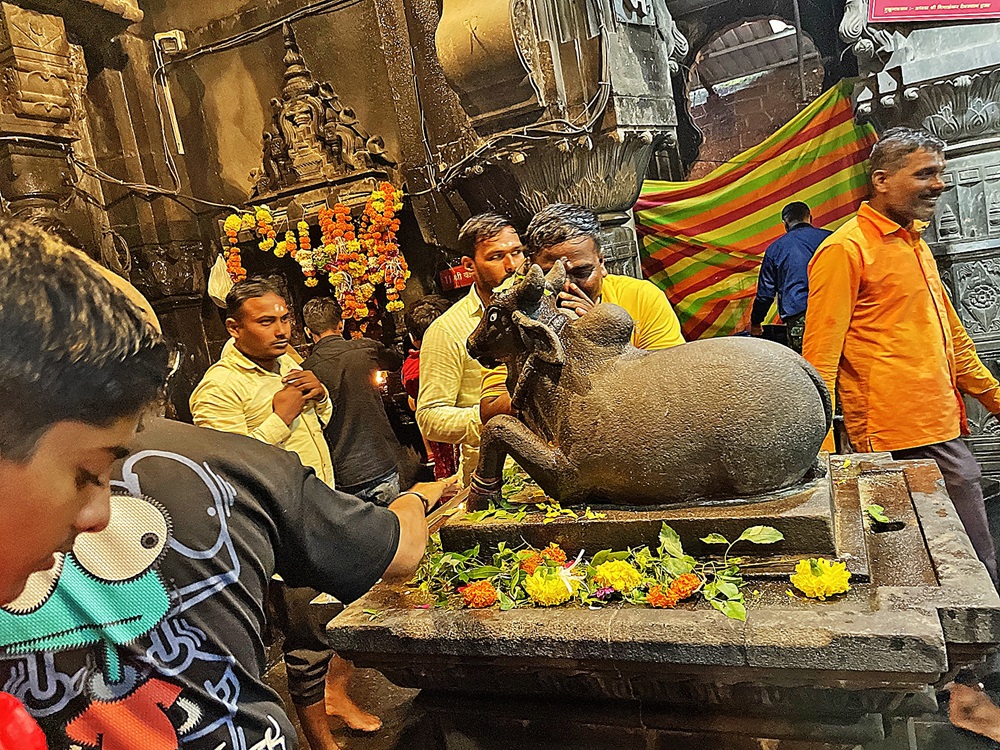
Various religious rituals and festivals are celebrated with great enthusiasm at the Bhimashankar Temple. The festival of Mahashivaratri is the grandest celebration here, drawing millions of devotees for darshan on this auspicious day. During this festival, special yagnas are organized in the temple. In the month of Shravana, there is a large gathering every Monday. At this time, devotees perform abhishek (ritual bathing) of the Shivlinga with the sacred waters of the Bhima River. On Kartik Purnima, a Deepotsav (festival of lights) is celebrated, illuminating the entire temple complex with the glow of lamps.
This sacred temple stands as a testament to deep spiritual devotion, ancient architectural grandeur, and rich local cultural traditions.
The sanctum sanctorum houses the divine idol consecrated according to ancient Vedic traditions, surrounded by serene courtyards and traditional temple architecture.
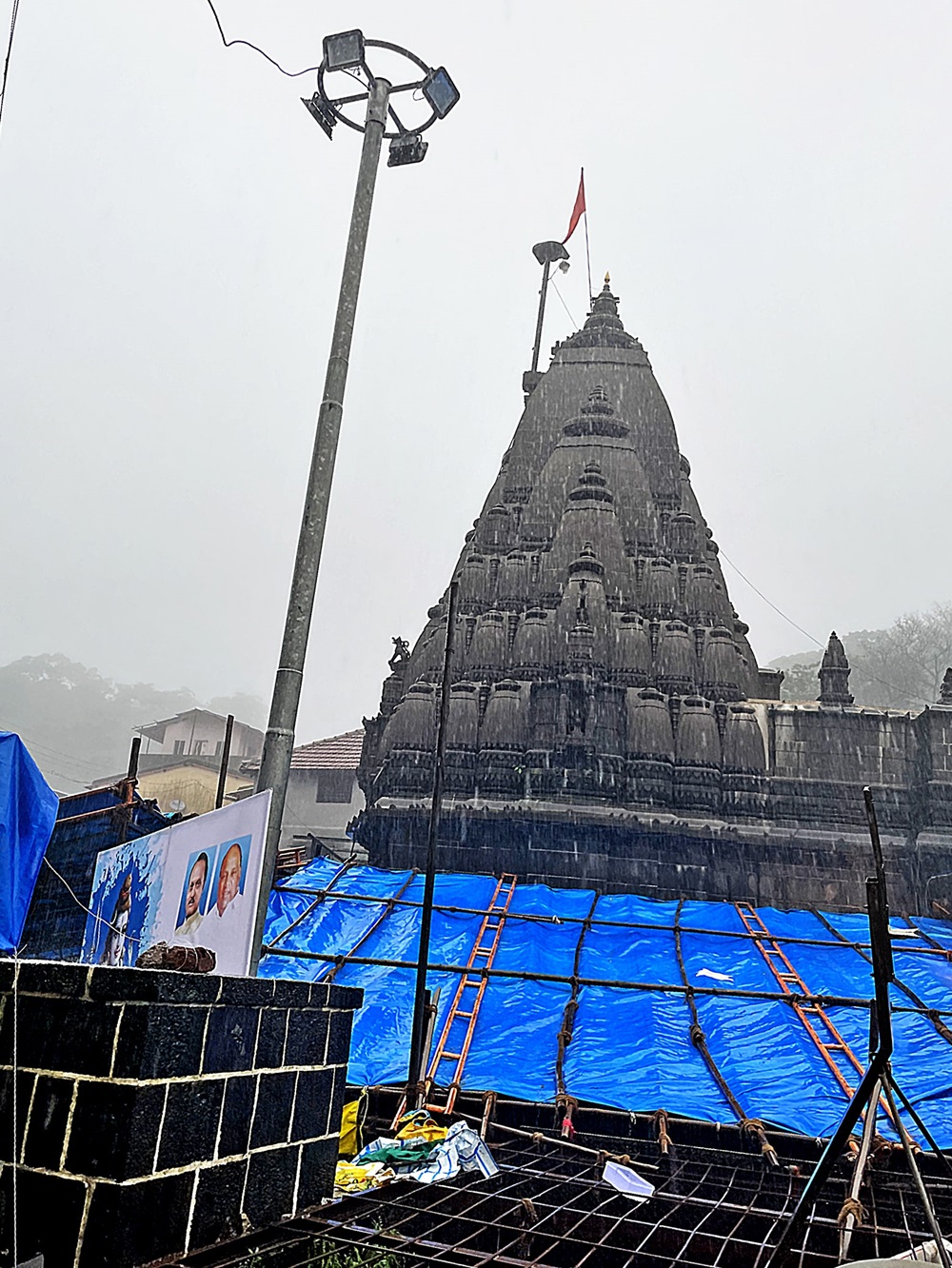
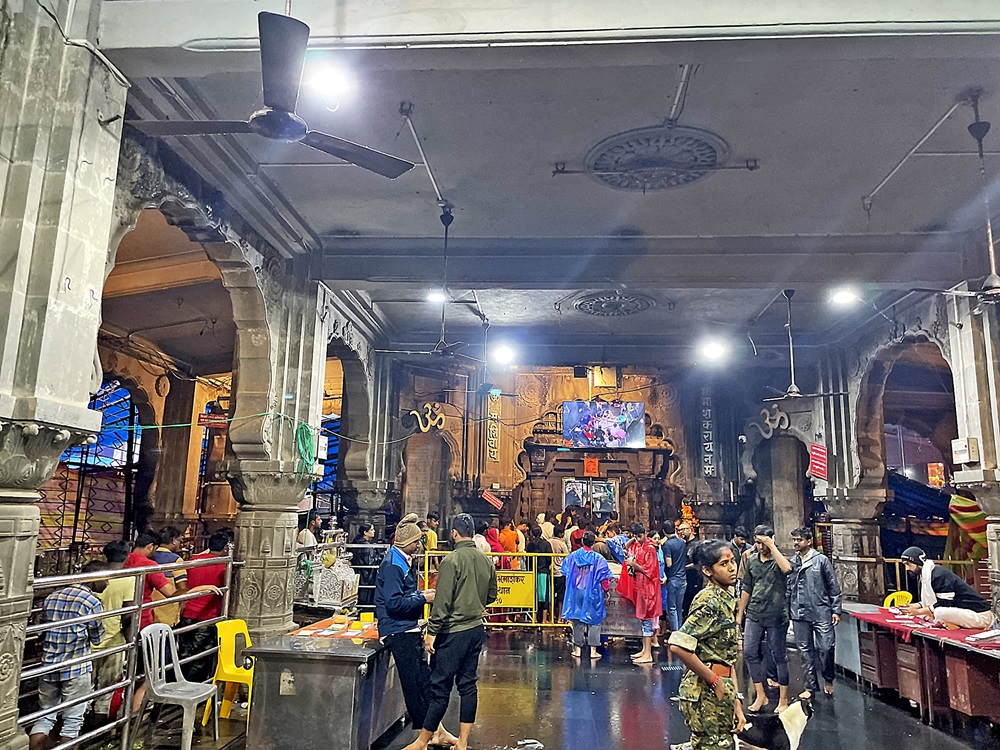
Navratri, Maha Shivratri, Annual Temple Jatra & Deepotsav
Compare and book flights, secure top-rated local hotels near the temple, hire reliable guides, and rent cars instantly.
Extend your pilgrimage by visiting other highly sacred temples located nearby.


Add ₹999 more to unlock FREE SHIPPING!
Your sacred cart is currently empty.
Shop Photo FramesFill in your delivery details below to place your order.
Add comment