
Add ₹999 more to unlock FREE SHIPPING!
Your sacred cart is currently empty.
Shop Photo FramesLocated in the central part of the state of Maharashtra, the Jalna district in the Marathwada region is rich in historical heritage. Until the thirteenth century, the city of Jalna was known as Hivardi. Historians estimate that the city and district were later named Jalna after a ruler named Jalrao. In ancient times, this region was dominated by the Yadavas and subsequently by the Nizamshahi. Jalna became an independent district on 1 May 1981, following the bifurcation of the Aurangabad and Parbhani districts. The ancient Vyankeshwar Mahadev Temple in Uswad village of the district’s Mantha taluka is particularly famous. Devotees believe that the Mahadev here is ‘Jagrut’ (awakened) and that He responds to the calls of His devotees.
Indian spirituality and the Puranas elucidate the inseparable principle between Hari and Hara, that is, Vishnu and Shiva. Although the name Vyankeshwar or Vyankateshwar is generally associated with the form of Lord Vishnu in the Kali Yuga, the ‘Vyankeshwar Mahadev’ form of Lord Shiva is also worshipped with deep devotion due to the inherent harmony between the Shaiva and Vaishnava traditions in the Sanatan Dharma. The original spiritual meaning of the etymology of this name is clarified in the Brahmanda Purana and the Bhavishyottara Purana. According to the Sanskrit interpretation in the Puranas, ‘Vem’ refers to the sins committed by the soul, and ‘Kat’ refers to the complete eradication of those sins. The Supreme Lord who destroys the accumulated sins of the devotees surrendered at His feet is entitled to the term ‘Vyankat’. This God in the form of Shiva, who cleanses sins, has been addressed as ‘Vyankat-Ishwar’, or ‘Vyankeshwar’.
The Skanda Purana sheds more light on the reference titled ‘Vyankatachala Mahatmya’. According to mythological descriptions, Tirumala in South India, or the Vyankat Mountain, was originally the ancient meditation site and penance ground of Lord Shiva. At the beginning of the Kali Yuga, when Lord Vishnu incarnated on Earth as Shrinivasa, Shiva vacated this place for the residence of His supreme friend. However, to ensure that no distinction remained between Shaiva and Vaishnava followers and to establish the unity of both principles, the presiding deity on this mountain became a synthesis of both Shiva and Vishnu powers. Based on the name of the mountain, this combined principle was called Vyankeshwar, and subsequently, through this tradition, self-manifested (Swayambhu) Shiva Lingas were established in many places as ‘Vyankeshwar Mahadev’.
Apart from this philosophical foundation, the Varaha Purana and regional history associate this name with a devotional story. In the Somanath region in the west, due to the unique devotion of a Shiva-devotee princess, the braid (veni) of her hair merged into the Shiva Linga. Initially, Mahadev was called ‘Veneswar’, the God who wears a braid, which over time, due to the influence of regional language, became corrupted to ‘Vyankeshwar’. Thus, respecting both the philosophical truth in the scriptures and the faith of the devotees, the sacred form of Lord Shiva, unified with Vishnu, has been established in Puranic literature by the name ‘Vyankeshwar Mahadev’.
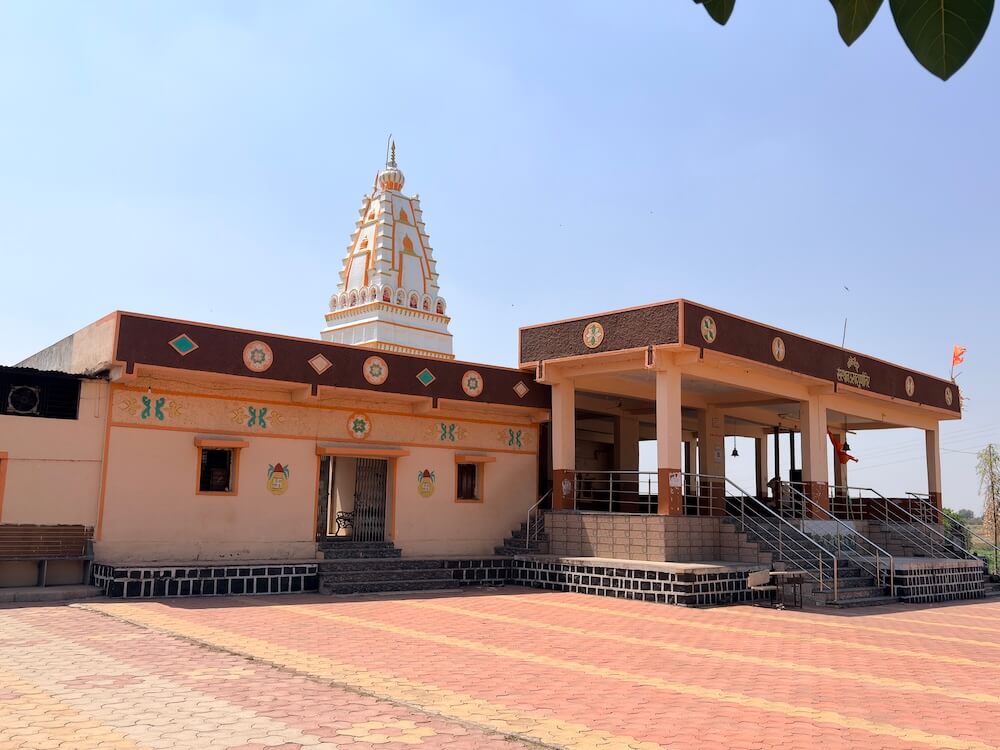
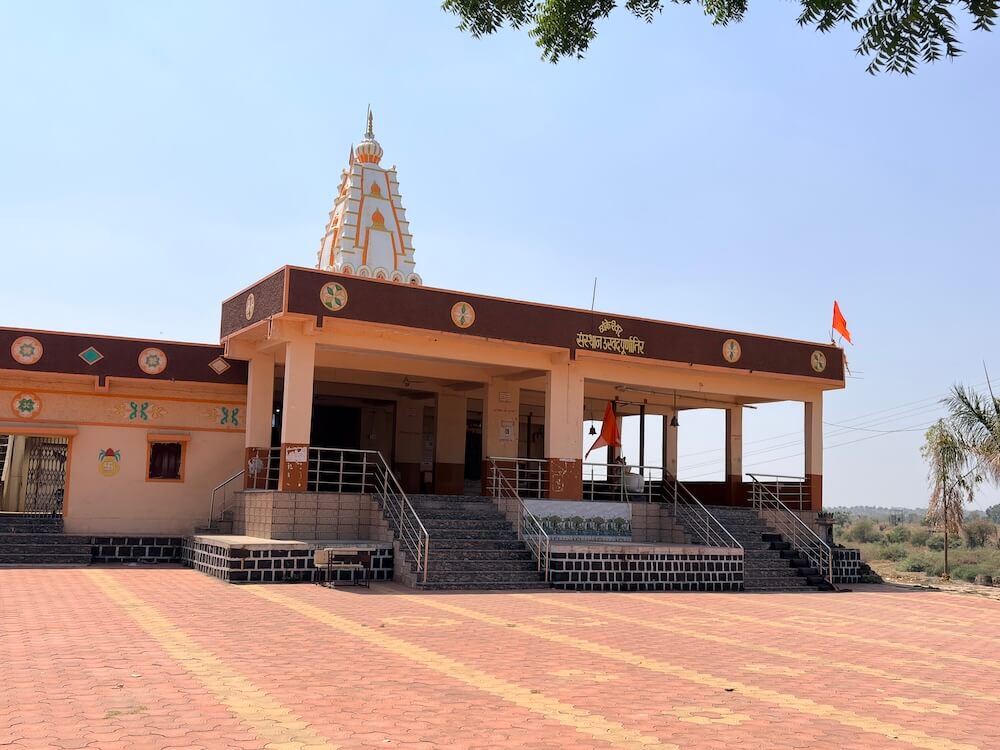
Locals say that this temple is about 700 years old. Situated on the banks of the Purna River flowing near the village, the temple is enclosed by a fortification wall with an entrance gate. On both sides of the entrance, there are two pillars, and on the horizontal eaves above the pillars, there are five niches (makhar). These niches contain idols of deities, and there are dome-shaped spires (shikhara) at the top. At the apex of the spires are stupikas and kalashas. The temple courtyard, paved with paver blocks, features various types of trees and seating for devotees.
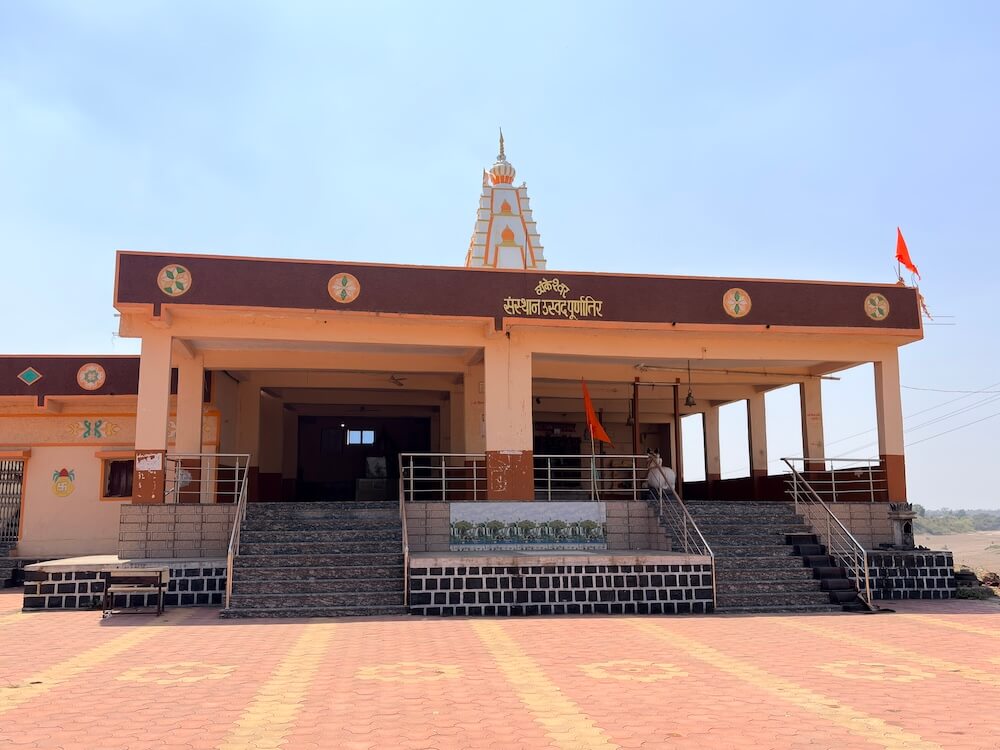
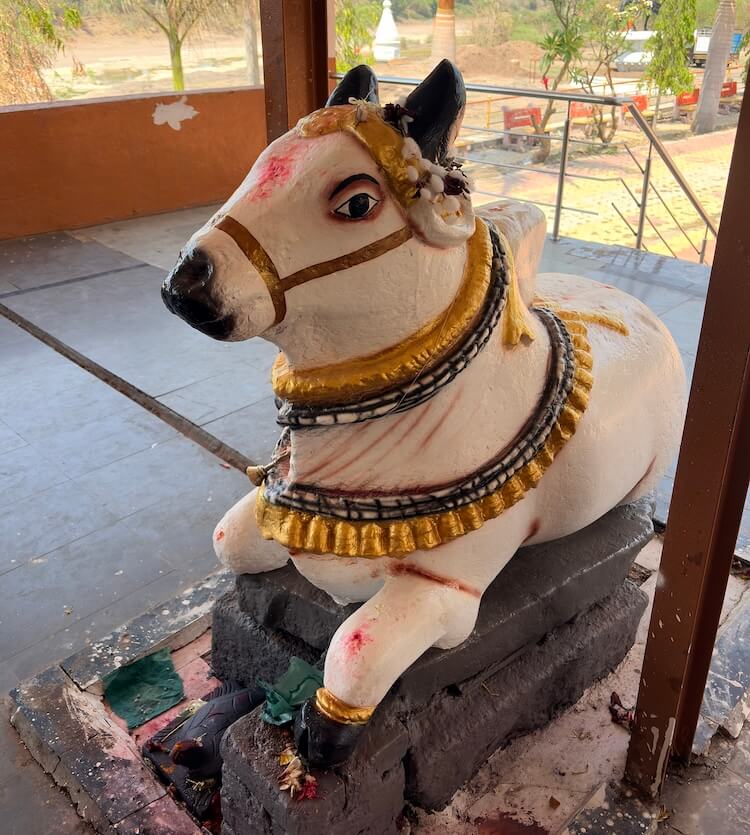
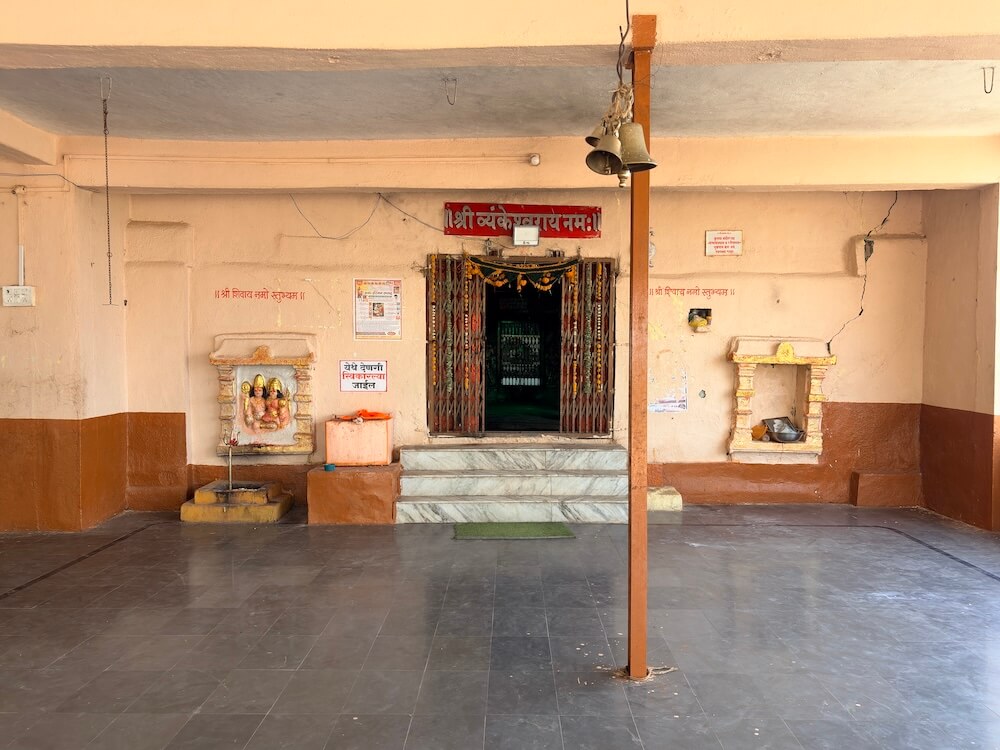
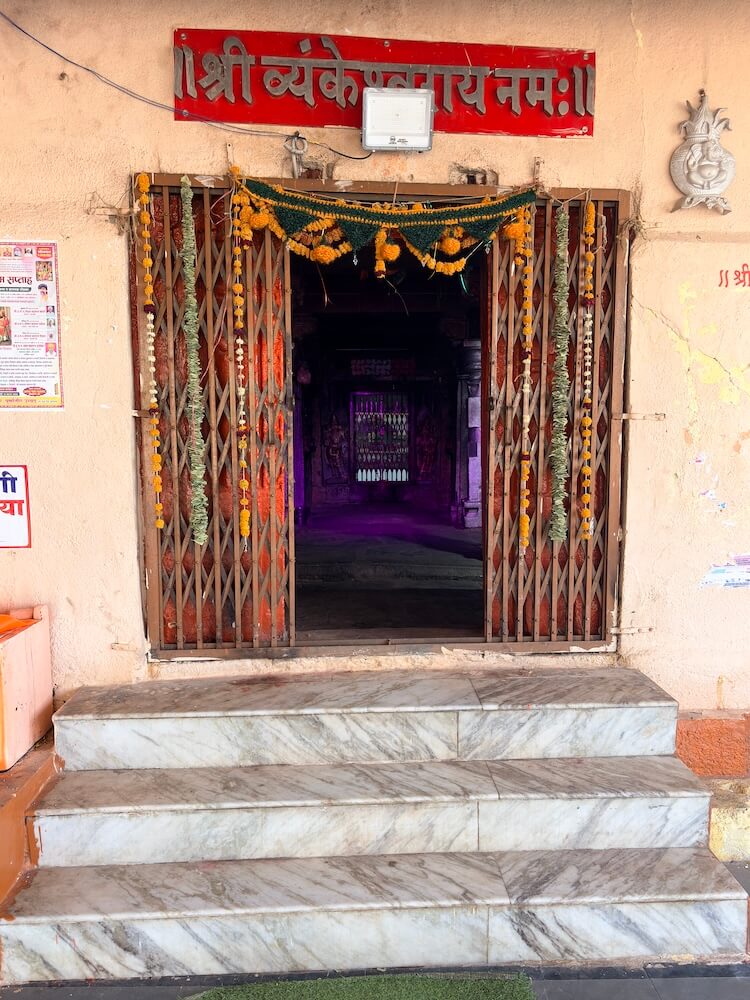
The temple is situated on a platform (jagati) about 6 feet high. The structure of the temple consists of a Sabha Mandap (assembly hall), a main Sabha Mandap, an Antarala (vestibule), and a Garbhagriha (sanctum sanctorum). A new Sabha Mandap has been constructed adjacent to the original temple. The entrance to the Sabha Mandap, which is higher than the courtyard, has 10 steps. The semi-open Sabha Mandap has a railing on the outer side. The railing features square pillars, and the ceiling has a wheel motif. There is an idol of Nandi on a Vajrapitha in the Sabha Mandap. The entrance to the Sabha Mandap is about 2 feet high and has 3 steps. On the front wall of the Sabha Mandap, on both sides of the entrance, there are two niches (devakoshthaka). The entrance features intricately carved door frames.
The Sabha Mandap has 4 rows of 4 pillars each. All pillars stand on square bases. The shafts of the middle 4 pillars feature various geometric shapes such as squares, hexagons, octagons, and circles. At the top of all pillars are capitals (kani) and above them are brackets (hasta). The brackets support load-bearing Yaksha sculptures. The beams here are carved with wheel motifs and sculptures of deities. The side walls of the Sabha Mandap have niches.
The Antarala has niches on the right and left walls. Further ahead, the entrance to the Garbhagriha is at a higher level than the Antarala. There are door-guardian sculptures on both sides of the entrance. The door frames are intricately carved. There is a sculpture of Ganapati on the lintel and a Chandrashila (moonstone) at the threshold. The Garbhagriha is about 4 feet deeper than the entrance, with steps leading down into it. In the center of the Garbhagriha floor is the Vyankeshwar Mahadev Linga. Above this Linga is a brass replica of a serpent holding a canopy, and a copper vessel for ritual bathing (abhishek) is suspended from the ceiling. The Garbhagriha contains a brass mask of Mahadev, which is placed on the Shiva Linga during festivals.
The ceiling of the Sabha Mandap features a dome-shaped spire. The spire has a Shukanasika (ante-fix) structure, and it is said that there is a secret chamber there. At the top of the spire is an Amalaka and a Kalasha. In addition to the structure on the ceiling of the Sabha Mandap in front of the Garbhagriha, the roof of the Garbhagriha has a four-tiered square spire. There is a safety railing around the spire. Each tier of the spire is divided by eaves on brackets, and the upper two tiers each have 20 niches containing idols of various deities. On the fourth, tapering tier of the spire, there is a structure of subsidiary spires (angashikhara). There are sculptures of a trident (trishul) and a drum (damaru) there. At the apex of the spire are an Amalaka, a Kalasha, and a flag (dhwajapataka).
In the courtyard in front of the temple, there is a spacious hall. Cultural and religious programs are organized here during festivals. This is where the Mahaprasad is distributed. Adjacent to the temple are the residences for the priests and temple staff, a granary, a kitchen, and rooms for the pilgrims’ accommodation. On the bank of the river behind the temple, there is an equestrian statue of Chhatrapati Shivaji Maharaj on a raised platform. Here, there is a square-shaped stepped water tank. A continuous stream of water flows into the tank from a Gomukh. Beside the tank is an ancient Samadhi temple.
Mahashivratri is the main annual festival celebrated here. During this time, thousands of devotees come here for the darshan of the deity and to fulfill their vows. A fair is held in the temple premises during this occasion. On all Mondays of the month of Shravan, there is a large crowd of devotees for darshan. A seven-day Harinam Saptah is organized in the month of Margashirsha. Apart from this, festivals and celebrations like Nag Panchami, Shravan Purnima, Dussehra, and Diwali are observed here. During all festivals, programs such as Laghurudra, Mahabhishek, recitation of the Mahamrityunjaya Mantra, scripture reading, Bhajans, Kirtans, and Mahaprasad are organized in the temple. There is a crowd of visiting devotees at the temple on days like Monday, Pradosh, Purnima, and Amavasya. Devotees can have darshan here every day from five o’clock in the morning until nine o’clock at night.
This sacred temple stands as a testament to deep spiritual devotion, ancient architectural grandeur, and rich local cultural traditions.
The sanctum sanctorum houses the divine idol consecrated according to ancient Vedic traditions, surrounded by serene courtyards and traditional temple architecture.
Navratri, Maha Shivratri, Annual Temple Jatra & Deepotsav
Compare and book flights, secure top-rated local hotels near the temple, hire reliable guides, and rent cars instantly.
Extend your pilgrimage by visiting other highly sacred temples located nearby.


Add ₹999 more to unlock FREE SHIPPING!
Your sacred cart is currently empty.
Shop Photo FramesFill in your delivery details below to place your order.
Add comment