
Add ₹999 more to unlock FREE SHIPPING!
Your sacred cart is currently empty.
Shop Photo FramesAhobilam in Andhra Pradesh is considered to be the sacred place of manifestation (Avatara Bhumi) of Lord Vishnu’s Narasimha form. There are nine temples of Lord Narasimha there. The Ahobila Math here is a very important center of the Vadakalai tradition within the South Indian Vaishnava lineage. This Math has numerous branches across India. The branch in the suburb of Chembur in Mumbai is considered one of the important branches among them. The temple of Lakshmi-Narasimha in this Math is a major center of faith for countless South Indian Vaishnavas in Mumbai. Devotees believe that having the Darshan of this deity bestows courage and protection.
In the South Indian Vaishnava tradition, a total of 108 ‘Divya Desams’ are recognized. ‘Divya’ means sacred and ‘Desam’ means place. Between the years 500 and 850 CE, twelve Tamil Vaishnava saint-poets lived. They are called ‘Alhvars’, meaning those who are completely dedicated. These Alhvar saints sang the glories of the sacred abodes of Lord Vishnu. These holy places are called ‘Divya Desams’. They identified 108 such great abodes of Lord Vishnu, namely ‘Divya Desams’. Out of these, 106 places are on the earthly plane. Kshirasagara and Vaikuntha are the remaining two ‘Divya Desams’. According to their geographical locations, these places are divided into divisions such as Chola Nadu, Chera or Malai Nadu, Nadu Nadu, Thondai or Pallava Nadu, Pandya Nadu, Vada Nadu, and Vinnulaga Nadu.
Among these, Vinnulaga Nadu refers to Kshirasagara and Vaikuntha. Vada Nadu refers to places located outside Tamil Nadu and Kerala. The other Nadus are places within Tamil Nadu and Kerala. Ahobilam is included within this Vada Nadu. Situated in the Nallamala mountain range in the Nandyal district of Andhra Pradesh, Ahobilam is known as the Nava-Narasimha Kshetra. The temple of Ahobila Narasimha is located on the mountain here. Along with this, in the upper part of the mountain are the temples of Bhargava Narasimha, Yogananda Narasimha, Krodha or Varaha Narasimha, and Chaturvarna Narasimha. In the lower part are the temples of Malola, Pavana, and Karanja Narasimha. At the peak is the temple of Jvala Narasimha, who is considered the fiercest form of Lord Narasimha. All these temples together are considered to be one ‘Divya Desam’.
In the tenth chapter of the ‘Srimad Bhagavad Gita’, Lord Sri Krishna praised a devotee of God with the words, “Among the Daityas, I am Prahlada” (“Prahladaschasmi Daityanam”). It is said that the mythological story of that Prahlada took place at Ahobilam. According to the story in the ‘Bhagavata Purana’, at the request of his son Prahlada, Lord Vishnu took the Narasimha Avatar for the destruction of the demon king Hiranyakashipu. Hiranyakashipu is a corrupt form of the original Sanskrit name. The description of this Avatar is given in the ‘Agni Purana’ as follows: “Simhasya kritwa vadanam MurariH sada karalam cha suraktanetram | Ardha vapurvai manujasya kritwa yayou sabham daityapateH purastat ||” This means that Lord Vishnu assumed the fierce face of a lion. His eyes were blood-red. Half of his body was that of a human. Assuming such a form, he emerged from a pillar in the court of the demon king’s palace and, at twilight (neither day nor night), slew Hiranyakashipu. It is said that this palace of Hiranyakashipu was at Ahobilam. A pillar is carved inside the Ahobila Narasimha temple here. It is believed that Lord Narasimha manifested from this pillar.
The Ahobila Math here was established in the fourteenth century by Athivan Satakopa Yatindra Mahadesika (Athivan Satakopa Jeeyar). He was born in the year 1379 at Thirunarayanapuram, also known as Melkote, near Mysore. Before accepting Sannyasa Ashrama, his name was Kidambi Srinivasacharya. At the tender age of twenty, he had attained exceptional mastery in Vedanta Shastra. He was renowned as a great scholar of Ramanujacharya’s Visishtadvaita Vedanta. A legend is told about him. According to it, one day he had a divine vision (Darshana) of Lakshmi-Narasimha. Lord Narasimha asked him to come to Ahobilam. Accordingly, upon going there, he offered prayers with great devotion before the idol of Lakshmi-Narasimha. While the prayer was ongoing, an elderly ascetic appeared before him. This divine ascetic gave Sannyasa initiation to Kidambi Srinivasacharya and bestowed upon him the ascetic name Satakopa Yatindra Mahadesika. He is famous in the Vaishnava world by the name Athivan Satakopa Jeeyar. High-ranking ascetics or preceptors in the Vaishnava tradition are called ‘Jeeyar’. Thereafter, in September 1398, he formally established the Math of the Vadakalai tradition within the Vaishnava lineage here. He is the first ascetic preceptor (Acharya) of the Math, known as ‘Alagiyasingar’. The philosophy of this Math tradition is based on the Visishtadvaita principle. The ‘Upanishads’, ‘Brahma Sutra’, and ‘Bhagavad Gita’ are the three authoritative texts of this tradition. Together, these three texts are called ‘Prasthanatrayi’. Devotion to Lord Sri Narasimha and worship according to the Pancharatra Agama are the principal features of this Math.
The Lakshmi-Narasimha Temple and Math at Chembur is a branch of this very Ahobila Math. A popular etymology of the village name Chembur is told. According to it, crabs (chimbori) used to be found in large numbers in this area. Therefore, this area came to be named Chimbori. However, since the British found it difficult to pronounce Chimbori, they began calling it Chembur. The primordial king of Mumbai, Pratap Bimb, established his capital at Mahim in Mumbai in the year 1142 CE. Furthermore, in the year 1295 CE, Bimbadeva Yadav, the son of the Yadava king Ramdevray, came to power. The history of these kings is given in the text ‘Mahikavatichi Bakhar’. In this text, this village is found mentioned as ‘Chembhur’. Therefore, the etymology that the name Chembur originated from Chimbori is rendered invalid. This was an important village in ancient times. It is said that international trade was conducted from the Mahuli creek here. Some historians are of the opinion that “Simulla” or “Timulla”, mentioned by the Greco-Roman mathematician and geographer Claudius Ptolemy in the first century of the Common Era, is actually Chembur. Inscriptions dating back to the reign of the Silahara king Aparaditya I, who ruled North Konkan between the years 1170 and 1197 CE, have been found here. These inscriptions record that the king allocated a fixed revenue from a garden in the village of Vadivali near Chembur for the maintenance of the shrine. After the Sion Bridge was constructed in January 1805 during the tenure of British Governor Jonathan Duncan, this region was connected to the island of Mumbai by road. Railway transport between Mumbai and Thane began in the year 1853. Subsequently, in 1906, the railway route from Kurla to Chembur was opened. This route was constructed for the transport of waste. Large swathes of land were created here by filling the marshy areas in regions such as Chembur, Mankhurd, and Mandala with this waste. On February 4, 1924, this route was opened for passenger traffic. It is said that during those times, Chembur was a peaceful village abundant in natural beauty. Surrounded by hills covered in dense forests, streams, paddy fields, lush green meadows, and the creeks of the Arabian Sea, this area was truly enchanting. To encourage population growth here, the government allotted plots of land to citizens at extremely low rates between the years 1925 and 1940. In 1945, Chembur was included within Greater Mumbai. During that period, camps were set up here for the rehabilitation of refugees displaced by the Partition. Today, Chembur is a modern yet peaceful suburb.
The Samprokshanam, also known as the Mahakumbhabhishekam, of this temple was performed on August 25, 1968, in the presence of the 44th Azhagiyasingar of Ahobila Mutt, Sri Vedantha Desika Mahadesika. Following this, on July 11, 2005, the second Samprokshanam of the temple took place in the presence of the 45th Azhagiyasingar, Sri Narayana Yatindra Mahadesika. Thereafter, the fifth Mahasamprokshanam of the independent sannidhi (shrine) dedicated to Mahalakshmi, known as the “Tayar” deity, took place on February 9, 2007; the Dhanvantari Sannidhi on November 9, 2014; and the main sanctum sanctorum on August 31, 2020.
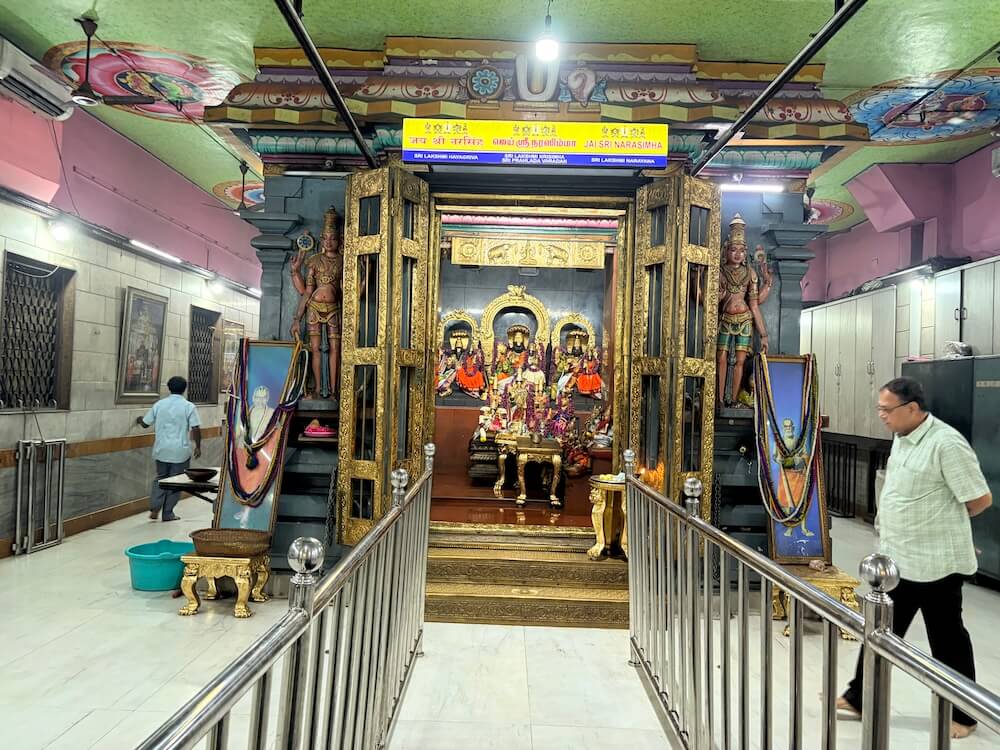
The architecture of this temple follows the Dravidian architectural style. The structural layout of the temple consists of a Rajagopuram, a sabhamandapa (assembly hall), an antarala (vestibule), the main sanctum sanctorum, and various sannidhis within the mahamandapa. The Rajagopuram of the temple is five-tiered. It features sculptures of Lakshmi-Narasimha, the Acharyas of Ahobila Mutt, Lord Vishnu, and Garuda. This gopuram is adorned with Vaishnavite symbols such as the Urdhvapundra, also known as the “Thirunamam”, the conch (shankha), and the discus (chakra). These Vaishnavite symbols are also carved at various places inside the temple. In the gopuram of the temple, there is a five-stepped flight of stairs clad in golden-hued metal sheets. The deities Garuda and Hanuman are installed in the ornamented sannidhis situated on both sides of this stairway. The sabhamandapa of the temple features a gold-plated main entrance known as the “Bangaru Vakili”, which is adorned with intricate carvings. Sculptures of Garuda, as well as the “Thirunamam”, conch, and discus, are also present on the upper section of the doorframe. The ceiling of this marble-floored sabhamandapa is flat, and a large painting of Sheshashayi Vishnu is depicted on it. Directly ahead in the sabhamandapa is the main sanctum sanctorum of the temple.
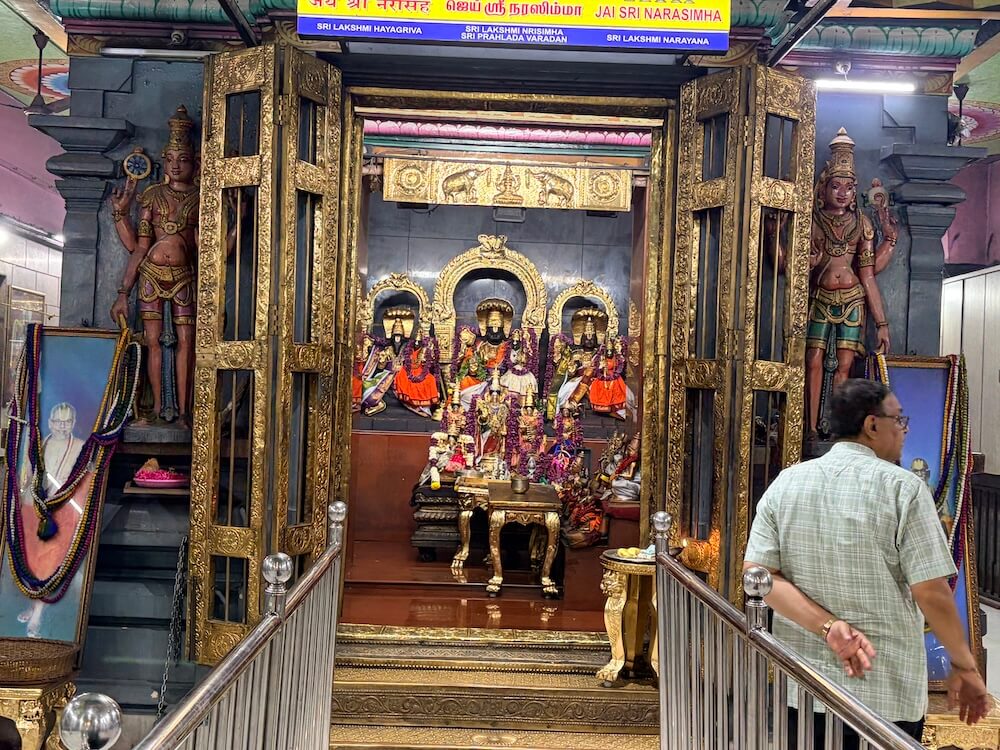
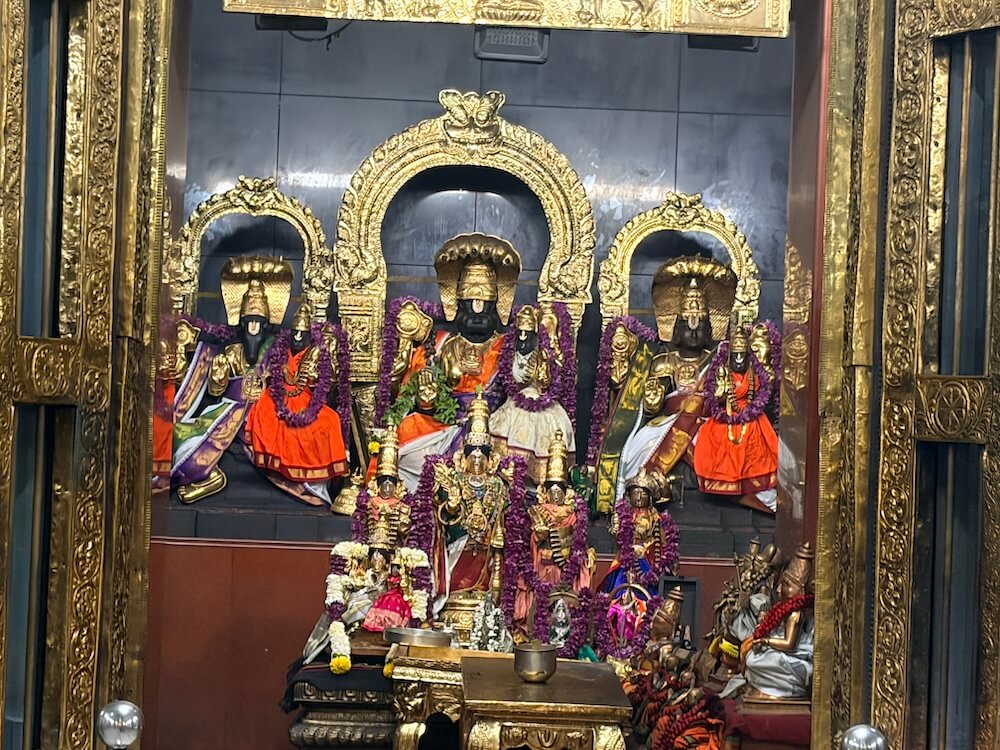
On the front wall of this Dravidian-style sanctum sanctorum, there are exquisite sculptures of the Vaishnavite doorkeepers (dvarapalas), Jaya and Vijaya. The sanctum features a door adorned with an intricately carved golden sheet. Its doorframe, as well as the two steps here, are also covered in golden sheets. Near the ceiling on the upper part of the doorframe are sculptures of flowers, conches, and the Urdhvapundra gandha symbol representing the lotus-like feet of Lord Vishnu. Inside the sanctum sanctorum, upon a high altar and within a golden aureole, are three vigrahas (deities). In the center is the murti of the principal deity here, Lakshmi-Narasimha. Lord Narasimha is seated here with a lion-like face, four arms, with Sri Mahalakshmi seated on His lap, holding a conch and discus, and displaying the abhaya and varada mudras (gestures of assurance and bestowing boons). To the left of this principal deity in the temple is the murti of Lakshmi-Hayagriva. Lakshmi-Hayagriva is the presiding deity of knowledge, learning, and the Vedas. Hayagriva is seated here with the face of a horse, a four-armed form, holding a sacred text and displaying the jnana mudra (gesture of knowledge). To the right, the murti of Lakshmi-Narayana is installed. All these murtis are sculpted from black stone. The murtis are adorned with garments, ornaments, and garlands of flowers. These murtis are embellished with golden armor (kavacha). Above the murtis of Narayana, Hayagriva, and Narasimha, Lord Sheshanarayana holds a protective canopy. In front of this altar, on a tall metallic dais (chauranga), are installed the panchaloha (five-metal) murtis of Prahlada Varada, Sridevi, Bhudevi, Andal, the Acharyas, and the utsavamurtis (processional deities).
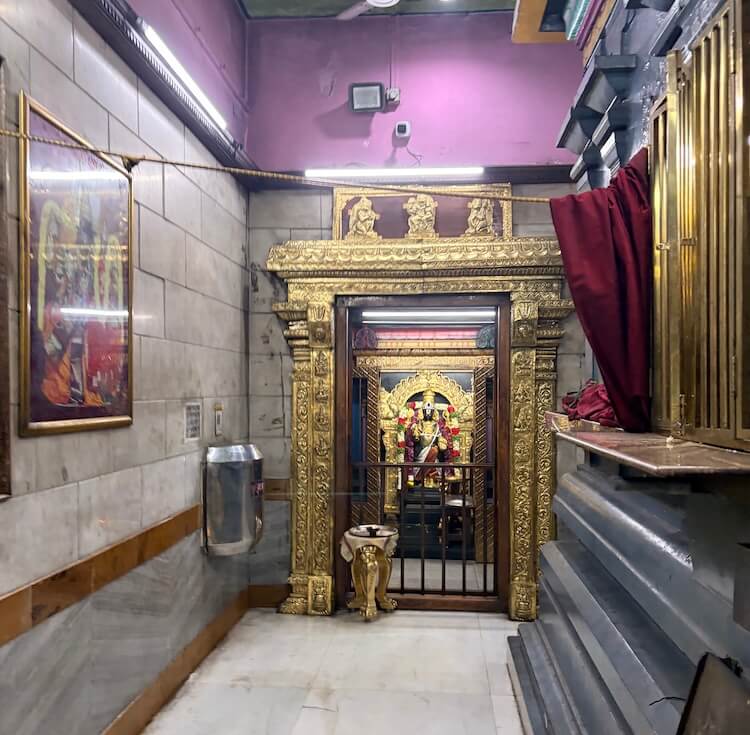
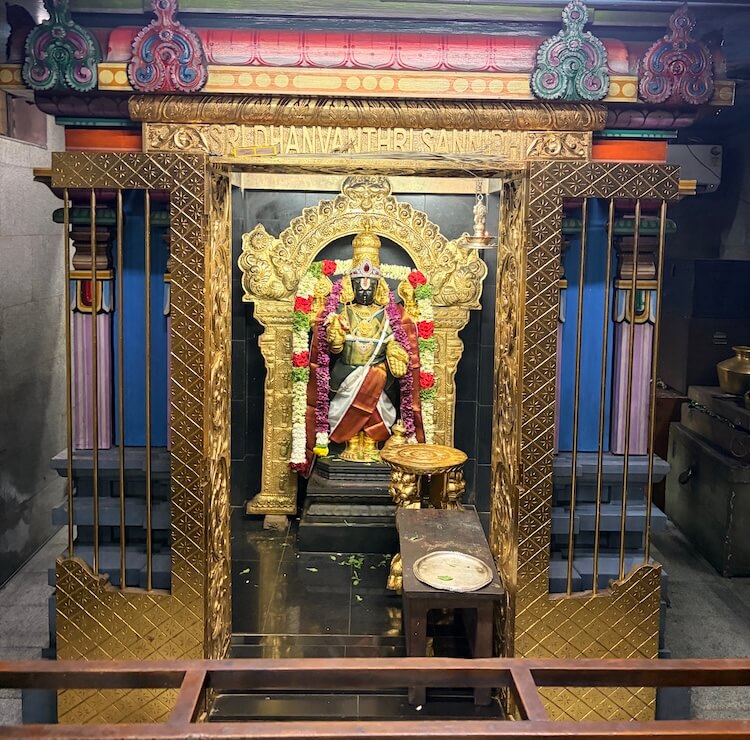
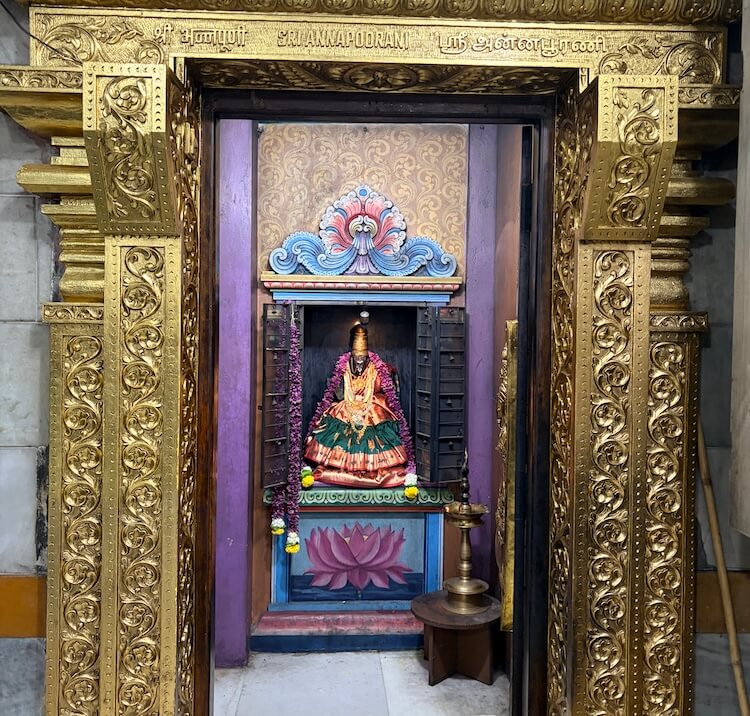
In the devakoshtas (niches) on the outer walls of this sanctum sanctorum, or upa-sannidhis, murtis of Ganesha, Sri Srinivasa of Tirumala, Jvala Narasimha, Guruvayurappan, and Suryanarayana are enshrined. Along the pradakshina patha (circumambulation path) of the sanctum, at the rear, is a sannidhi dedicated to the deity Dhanvantari, clad in golden-hued sheets. Within it, on a high altar and inside a golden makhar (arch), is seated the black stone murti of Dhanvantari displaying the varada mudra. Similarly, there is also a sannidhi dedicated to Goddess Annapurna here. Within it, on a high altar inside a small niche, the murti of Goddess Annapurna, adorned with garments and ornaments, is enshrined. In Vaishnavite temples, ‘Tayar’, meaning Mahalakshmi, is given as much importance as Lord Vishnu Narayana. To the right in the sabhamandapa of this temple is an independent shrine of Mahalakshmi. Here, seated upon a lotus pedestal (kamalapitha), are the murti of Mahalakshmi, i.e., ‘Tayar’, along with the utsavamurti of Chenchulakshmi. Chenchulakshmi is considered to be the consort of Narasimha. According to mythological legends, after slaying Hiranyakashipu, Narasimha married a maiden from the Chenchu tribe of Ahobila to pacify His fierce form; she is none other than Chenchulakshmi. To this day, the people of the Chenchu tribe in Andhra Pradesh consider Lord Narasimha to be their son-in-law. The scene of this marriage is carved on a main pillar in a temple at Ahobilam.
In this temple, devotees can have the blessed darshan of the Lord from Monday to Thursday between 6:00 AM and 11:00 AM, and from 5:00 PM to 9:00 PM. From Friday to Sunday, the darshan timings are from 6:00 AM to 12:00 PM, and from 5:00 PM to 9:00 PM. All rituals and pujas in this temple are performed according to the Pancharatra Agama tradition. Daily rituals such as Tiruvaradhanam, Veda Parayanam, Divya Prabandha Parayanam, Swati Homam at the Jvala Narasimha Sannidhi during the Swati Nakshatram, and Srisukta Homam are conducted here. Additionally, Chenchulakshmi Thayar Dolotsavam is held every Friday, Mahalakshmi Sahasranama Archana every Sunday, Achit Parayanam on Ekadashi, and Annadanam known as Dvadashi Paranam on every Dvadashi. Similarly, festivals like Narasimha Jayanti, Vaikuntha Ekadashi, Brahmotsavam, and the birth anniversaries of various Acharyas are celebrated with great enthusiasm and in accordance with the religious traditions of the Matha.
This sacred temple stands as a testament to deep spiritual devotion, ancient architectural grandeur, and rich local cultural traditions.
The sanctum sanctorum houses the divine idol consecrated according to ancient Vedic traditions, surrounded by serene courtyards and traditional temple architecture.
Navratri, Maha Shivratri, Annual Temple Jatra & Deepotsav
Compare and book flights, secure top-rated local hotels near the temple, hire reliable guides, and rent cars instantly.
Extend your pilgrimage by visiting other highly sacred temples located nearby.


Add ₹999 more to unlock FREE SHIPPING!
Your sacred cart is currently empty.
Shop Photo FramesFill in your delivery details below to place your order.
Add comment