
Add ₹999 more to unlock FREE SHIPPING!
Your sacred cart is currently empty.
Shop Photo FramesThe Kali Mata Temple is situated in the Collector Colony area of Chembur, in the eastern suburbs of Mumbai. This temple is a major center of faith for the Bengali community settled in the Chembur and Mankhurd areas of Mumbai. The worship of Kali Mata holds unique significance in the culture, art, and spiritual life of Bengal. Durga Puja is celebrated on a grand scale every year at this Kali Mata temple in Chembur, and it is considered one of the most important religious festivals in this region. Directly in front of this temple is a temple dedicated to Lord Shri Ram.
According to Hindu Puranas, Kali, Tara, Tripurasundari (Shodashi), Bhuvaneshwari, Chhinnamasta, Tripura Bhairavi, Dhumavati, Bagalamukhi, Matangi, and Kamala are considered the Dasha Mahavidyas. Kali Mata holds the first place among them. In Hinduism, she is considered the Goddess of Time, Dissolution, and Death. She is primarily worshipped in the Shakta and Tantric traditions. Ancient texts and Puranas contain numerous references to the fierce and benevolent forms of Goddess Kali. The ‘Brahmana’ texts mention a goddess named ‘Dirghajihvi’. In the ‘Mundaka Upanishad’, Kali is described as one of the seven flickering tongues of the sacrificial fire (Yajna). In the ‘Kathaka Grihyasutra’, associated with the Katha branch of the ‘Krishna Yajurveda’, Kali is mentioned as a deity primarily worshipped during marriage rituals. In the ‘Sauptika Parva’ of the ‘Mahabharata’, Kali is depicted as dark-complexioned, with bloodshot eyes and mouth, holding a noose in her hand.
Based on these texts, it is believed that the primordial nature, Adimaya Bhagavati Mahalakshmi, created the two forms of Mahakali and Mahasaraswati from Tamoguna and Sattvaguna. Mahakali is considered not only a destroyer but also the Mother of the Universe and a nurturer. Tantric texts like the ‘Kalika Purana’ and ‘Mahanirvana Tantra’ explain the rituals of Kali worship, her meditation (Dhyana), and her spiritual significance. Kali Mata has eight forms: Shri Kali, Mahakali, Bhadrakali, Smashanakali, Chamundakali, Siddhikali, Guhyakali, and Dakshinakali. Kali worship also holds immense importance in the Shakta and Tantric paths, which are Vamamarga sects that emphasize occult practices and mantras. Bengal is said to be particularly renowned for these disciplines.
During the medieval period, Shakta and Tantric traditions spread widely in Bengal. In the eighteenth century, Raja Krishnachandra Roy (1710–1782 AD), the Zamindar of Nadia in West Bengal, was a staunch follower of the Shakti tradition. Raja Krishnachandra Roy was a patron of art, literature, and culture. A remarkable revival occurred in the cultural sphere of Bengal during his reign. Known for his generous patronage of Brahmins, Krishnachandra strictly enforced the Varna system and caste rules within his estate. He built many temples and organized Yajnas. Just as Lokmanya Tilak contributed to political awakening and religious revival in Maharashtra by starting the public Ganeshotsav, Raja Krishnachandra Roy gave Kali Puja a broad, collective form in Bengal. Alongside this, saints like Ramprasad Sen and Ramakrishna Paramahansa rooted the form of Kali Mata in the Bengali consciousness in a very simple and domestic manner. Because of this, Kali Puja is given the highest priority in every auspicious occasion and annual festival in the Bengali community even today. Inspired by the worship of Kali Mata, the musical genre known as Shyama Sangeet became established in Bengal. Kali, who inspired Bengali revolutionaries and freedom fighters during the British colonial era, has also become a source of inspiration for the modern women’s rights movement. There are many Kali Mata temples in Mumbai, known as ‘Kali Bari’. One of the famous ones is in Chembur.
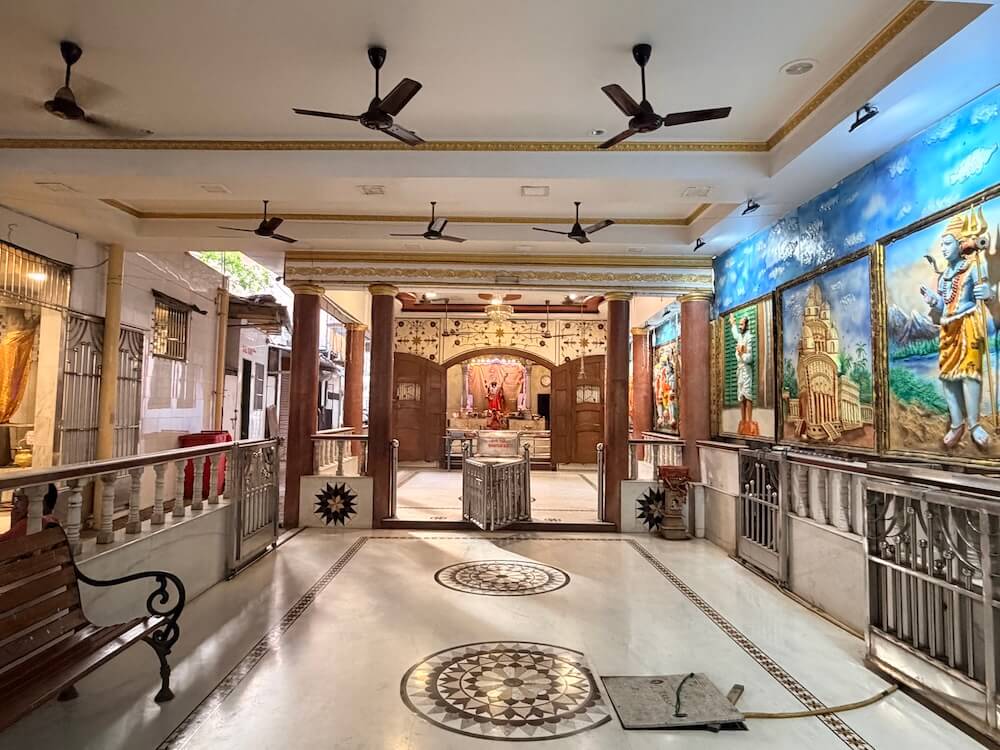
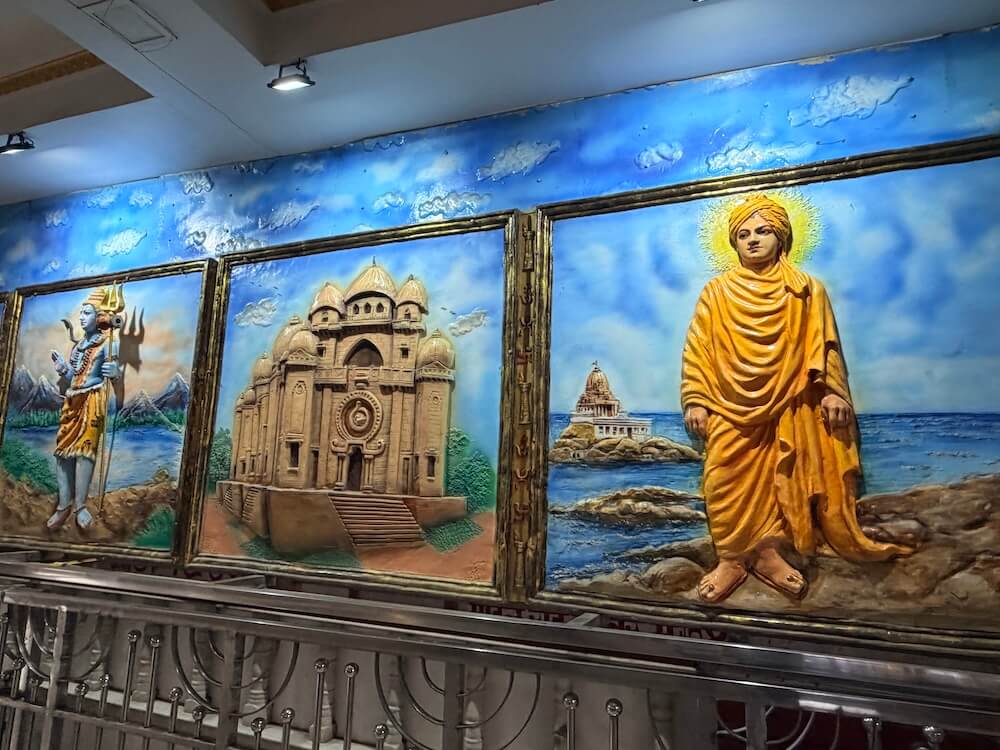
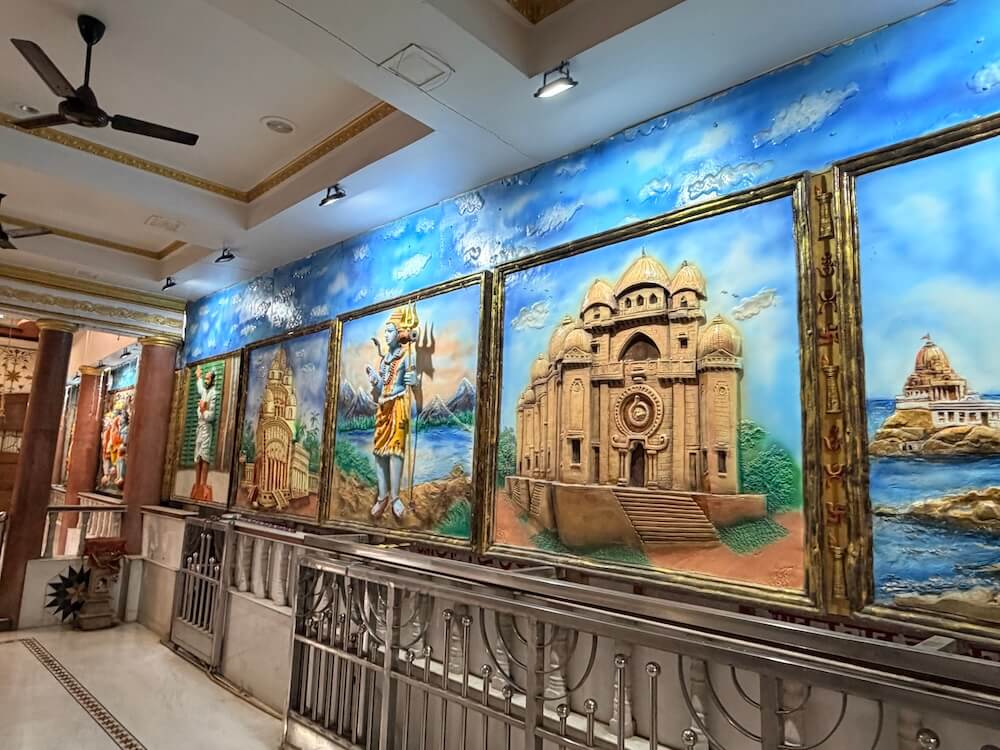
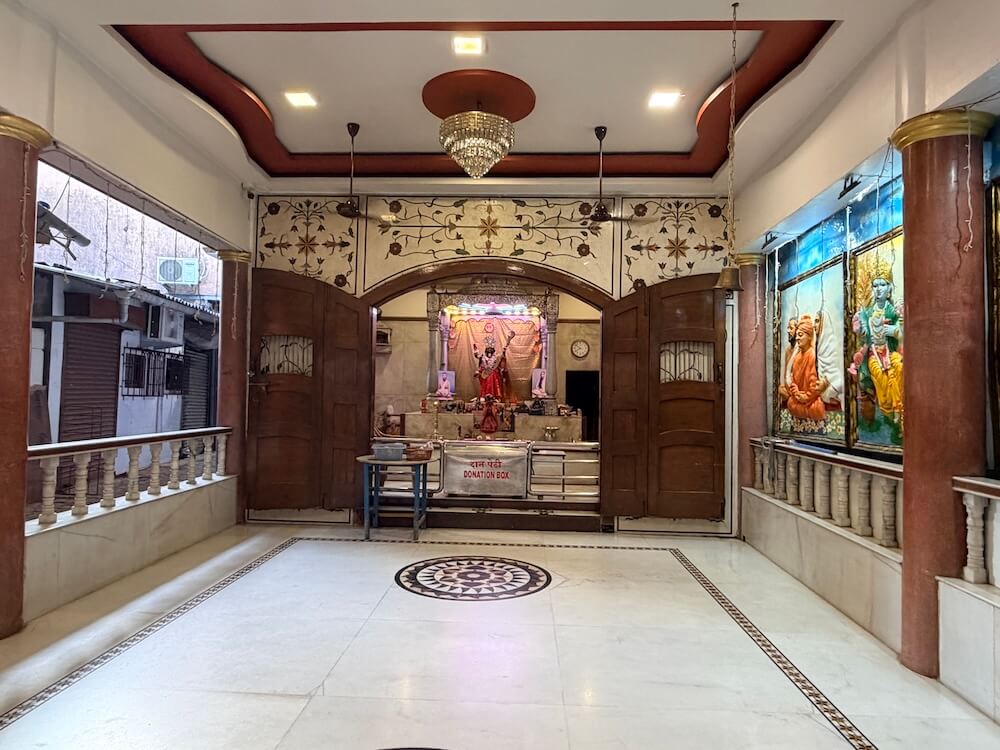
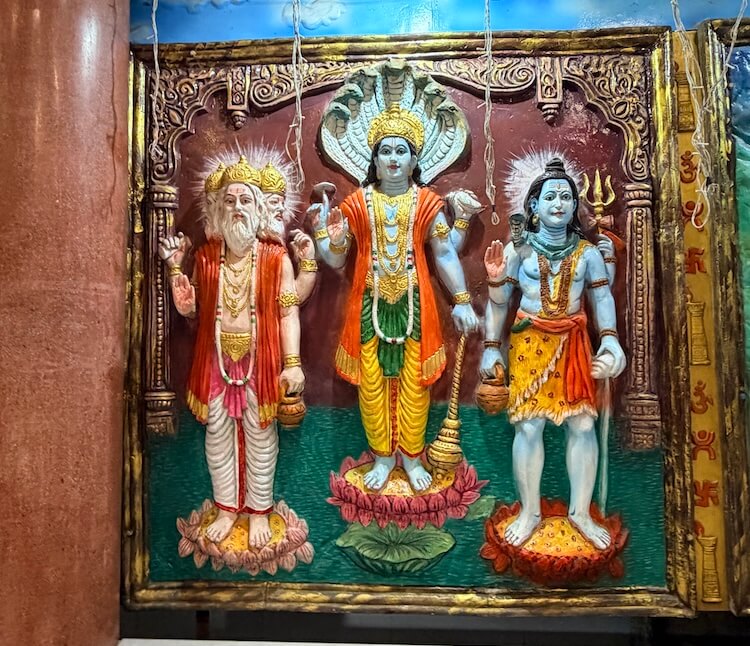
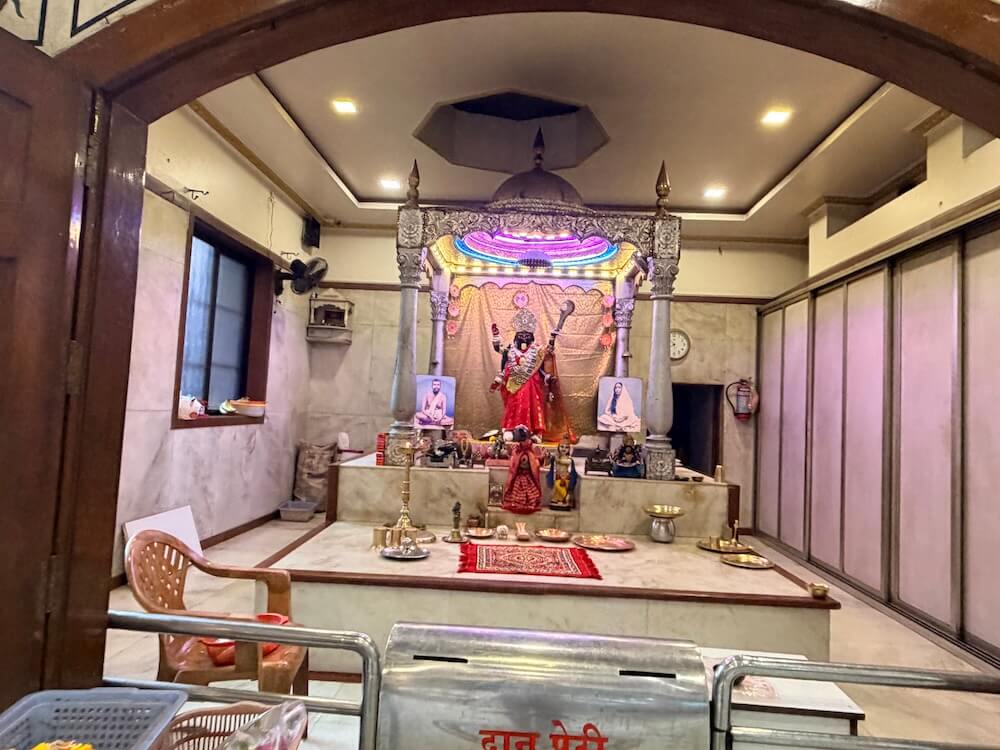
This temple is located on the bustling R. C. Marg in Chembur. There is a large open courtyard in front of the temple, where a large assembly hall (Sabhamandap) with a cement roof has been erected. On the wall to the right, there are relief sculptures of Swami Vivekananda, Lord Shiva, Ramakrishna Paramahansa, as well as the Dakshineswar Kali Temple in Kolkata and the Belur Math established by Swami Vivekananda. Ahead of this is an auxiliary hall, open on two sides and paved with marble. Its walls also feature similar images of Brahma-Vishnu-Mahesh, as well as Ramakrishna Paramahansa and Swami Vivekananda. In the sanctum sanctorum of the temple, the idol of Kali Mata is installed on a high marble altar within a canopy featuring marble pillars and a dome-shaped spire. The idols of Kali Mata are always blue or black in color. Here, she is dark-complexioned and four-armed (Chaturbhuja). Her upper right hand is in Abhaya Mudra (gesture of fearlessness), and her lower hand is in Varada Mudra (gesture of granting boons). In her upper left hand, she holds a sword (Khadga), and in her lower left hand, she holds a severed head. She wears a garland of severed heads around her neck. As described in ancient iconography, her tongue is protruding. The tongue, which is usually depicted as blood-stained, is painted golden here. The idol is draped in a saree and adorned with bead necklaces, pearl strings, armlets, and bangles. On her head is a large crown made of shimmering beads. Along with her, there are also idols of Shri Krishna and Durga Mata. To the left of the main idol are photographs of the Kali devotee Ramakrishna Paramahansa, and to the right, his wife, Sharada Mata.
Next to this Kali Mata temple is a small temple of Shiva. There, a stone Nandi and a tortoise (Kurma) idol are placed on a marble platform. In the sanctum, a stone Shiva Linga is enshrined on the floor in the shape of a marble Yoni. A serpent king (Nagaraja) holds a hood over this Linga, and a brass dripping vessel (Galantika) is placed above it. There is a trident (Trishul) near the Shiva Linga. In the niches of the sanctum, marble idols of Shiva-Parvati and Ganesha are installed.
After crossing the road in front of the Kali Mata Temple, one finds the magnificent Shri Ram Temple directly ahead. This temple is situated on the ground floor of a multi-story building constructed by the ‘Sanatan Dharma Sabha’ organization. The organization was established in the year 1952 with the objective of propagating and spreading Sanatan Dharma. The consecration (Pranpratishtha) of this temple, built by the organization, was performed by Swami Vishuddhanand on the auspicious occasion of Vasant Panchami on February 11, 1997. There is a large welcoming arch for the temple within the boundary wall of the premises. The temple consists of a Sabha Mandap (assembly hall) and a Garbhagriha (sanctum sanctorum). On both sides of the entrance to the Sabha Mandap, there are sculptures of staff-bearing gatekeepers (Dwarapalas). The Sabha Mandap features a spacious layout, shiny marble floors, chandeliers on the ceiling, and electric lamps. On the upper parts of its walls, captivating paintings of various deities are displayed within arched frames. In the front section, there are two large dome-shaped shrines on the left and right sides. In the shrine on the left, a Shiva Linga is enshrined in an octagonal pit on the floor. The Shiva Linga, which features a tall base (Shalunka) covered in silver plating and a Bana Linga, is shielded by a silver serpent king with its hood spread. Above it is a Galantika (a vessel for ritual water offering). Near this Shiva Linga are marble idols of Parvati and Ganesha. Similarly, in the niches of the shrine, there are idols of Shankar-Parvati and Ganesha. In the shrine on the right, a marble idol of Hanuman, adorned with garments and ornaments, is seated in a large throne (Makhar). In front of it is a brass idol of Hanuman. Beside the throne of this idol is an idol of Lord Jhulelal, while an idol of Lord Brahma is enshrined in one of the niches.
The temple has three sanctums: one main and two subsidiary. In the central sanctum, tall marble idols of Lord Shri Ramachandra, Sita, and Lakshman are installed on a high pedestal. These idols are crafted according to the tradition of the ‘International Society for Krishna Consciousness’ (ISKCON), founded by ‘Bhaktivedanta Swami Prabhupada’. The idols are adorned in accordance with the same tradition. Here, in front of the idol of Shri Ram, there is an idol of Hanuman in a posture of salutation, as well as small brass idols of Shri Ram-Janaki-Lakshman. In the right-side subsidiary sanctum, an idol of the Goddess mounted on a lion is installed. Here, Durga Mata is in her eight-armed (Ashtabhuja) form. She holds various weapons and is mounted on a lion. In the left-side subsidiary sanctum, an idol of Radha-Krishna in the ISKCON temple tradition is installed.
Devotees can visit this Shri Ram Temple for darshan from 7:00 AM to 12:00 PM and from 5:00 PM to 9:00 PM. Various religious programs are continuously organized here for the purpose of religious propagation. These include the recitation of Ramcharitmanas and Sundarkand, chanting of Hanuman Chalisa, and Bhajan-Kirtan. Various festivals and celebrations such as Ram Navami, Krishna Janmashtami, Hanuman Jayanti, Navratri, Vijayadashami, and Maha Shivratri are celebrated in the temple according to religious traditions.
Devotees can visit the Kali Mata Temple for darshan from 6:30 AM to 12:30 PM and from 5:00 PM to 9:30 PM. Various religious and cultural programs are held in the temple throughout the year. Durga Puja (Sharadiya Durgotsav) is a major festival at this temple. During this festival in the month of Ashwin, special worship of the Goddess, cultural programs, and Bhog Prasad are organized over all four days. On the night of Kartik Amavasya, special worship of Kali Mata and a Homa are performed at midnight. Additionally, the Jagaddhatri Puja, celebrated after Durga Puja, is also performed in this temple according to Bengali tradition. During Durga Puja and Kali Puja, there is a large crowd of devotees at the temple.
This sacred temple stands as a testament to deep spiritual devotion, ancient architectural grandeur, and rich local cultural traditions.
The sanctum sanctorum houses the divine idol consecrated according to ancient Vedic traditions, surrounded by serene courtyards and traditional temple architecture.
Navratri, Maha Shivratri, Annual Temple Jatra & Deepotsav
Compare and book flights, secure top-rated local hotels near the temple, hire reliable guides, and rent cars instantly.
Extend your pilgrimage by visiting other highly sacred temples located nearby.


Add ₹999 more to unlock FREE SHIPPING!
Your sacred cart is currently empty.
Shop Photo FramesFill in your delivery details below to place your order.
Add comment