
Add ₹999 more to unlock FREE SHIPPING!
Your sacred cart is currently empty.
Shop Photo FramesAdi Shankaracharya Bhagavadpada established four Mathas in the four directions of India: Badrinath, Dwarka, Jagannath Puri, and Sringeri. For devout Hindus, he is considered Dakshinamurti or the very embodiment of Lord Shiva. In addition to these, he also established the Kanchi Kamakoti Peetham. In Mumbai, there is a Shankar Math affiliated with the Kamakoti Peetham in Matunga, while in the suburb of Chembur, there is a branch of the Sringeri Dakshinamnaya Sharada Peetham. This Math-temple is dedicated to Goddess Sharada Mata, Adi Shankara, and Maha Ganapati. This temple-monastery is a center of faith for countless Sanatani devotees in Mumbai and keeps the flag of the eternal Vedic Dharma culture flying high.
Adi Shankaracharya was a great philosopher. He systematically refuted the ‘Astika’ (orthodox) schools of thought such as Sankhya-Yoga, Nyaya-Vaisheshika, and Purva Mimamsa, as well as the ‘Nastika’ (heterodox) schools such as Buddhism, Jainism, and Lokayata, and established the philosophy of Kevaladvaita on a firm foundation. Because he performed the unifying task of bringing together the followers of the six Hindu sects—Shaiva, Vaishnava, Shakta, Saura, Ganapatya, and Kaumara (the sect worshipping Kartikeya)—he is revered as ‘Shanmata Sthapakacharya’. He demonstrated the syncretic path of worshipping the five popular deities of that era—Aditya, Ambika, Vishnu, Gananatha, and Maheshwara—together through the medium of Panchayatana Puja. There is no consensus among scholars regarding his tenure, but his period is generally considered to be from 788 to 820 CE.
Kevaladvaita, the philosophy that the one Nirguna Brahman alone is the Truth, the individual soul is not different from It, and the entire universe is illusory, was championed by the epoch-making Vedantin who advocated for religious reform in such clear words as, “There is no rule that because an ancestor was foolish, one must also be foolish” (Nahipurvajo mudha asidityatmani mudhena bhavitavyamiti kinchidasti pramanam – Brahmasutra 2.1.11). Adi Shankaracharya was born in the village of Kalady near the town of Aluva in Kerala. His lineage belonged to the Nambudiri Brahmins of the Krishna Yajurvediya Taittiriya branch. Since details regarding his birth and the period of his life are subjects of debate, his works are considered his true biography. His life story is summarized in the verse: “Ashtavarshe chaturvedi dvadashe sarvashastravid. Shodashe kritavan bhashyam dvatrinse munirabhyagat.” This means that “by the age of eight, he had studied all four Vedas, By the age of twelve, He possessed knowledge of all the Shastras, by sixteen, He had composed commentaries on the Prasthanatrayi, and at the age of thirty-two, He attained Mahaprasthana. In Hinduism, the Shrimad Bhagavad Gita, the Upanishads, and the Brahmasutra are collectively known as the Prasthanatrayi. During His thirty-two-year lifespan, the Acharya wrote approximately four hundred miscellaneous works in addition to His commentaries on the Prasthanatrayi. The hymns He composed, such as Dakshinamurti, Harimide, Anandalahari, and Saundaryalahari, are especially renowned. To ensure the uninterrupted continuation of His philosophical tradition, He established monasteries in all four directions of India: Badrinath, Dwarka, Jagannath Puri, and Sringeri. In the year 1361, Vidyaranya Swami ascended the throne of this monastery, which boasts a tradition spanning over twelve hundred years, and it was He who built the Sharada Temple within this monastery. The warrior brothers Harihara and Bukka were disciples of Vidyaranya Swami, and it was from Him that they received the inspiration to establish the Vijayanagara Empire.
Sringeri is situated on the banks of the Tunga River (the headstream of the Tungabhadra) in the Chikmagalur district of Karnataka. According to mythological legends, this was the land of penance for Rishyashringa, the son of Sage Vibhandaka. The place derived its name, Sringeri, from him. While traveling through South India, Adi Shankaracharya arrived at Sringeri. He was captivated by the natural beauty of the place. According to a legend, he witnessed a miraculous sight here: a frog, suffering from the pangs of labor, was being shielded from the scorching afternoon sun by a cobra that had spread its hood over it. Impressed by this absence of enmity between natural enemies like a snake and a frog, Adi Shankaracharya decided to establish a Matha here. This is the first Matha established by Shankaracharya.
Jagadguru Vidyaranya Swami, who ascended the throne of this monastery, which has a tradition of one thousand two hundred years, in the year one thousand three hundred sixty-one, has a major contribution to the political history of India. The two chieftain brothers, Harihara and Bukka, were his disciples. It was Vidyaranya Swami who inspired them to establish the Vijayanagara Empire. Just like the Vijayanagara Emperor Harihara, many kings who came to power later expressed their reverence for this Matha by offering donations, tributes, and agraharas. This included rulers such as Bajirao Peshwa II, Hyder Ali of Mysore, his son Tipu Sultan, and the Nizam-ul-Mulk of Hyderabad. According to the information provided on the official website of the Sringeri Matha, during the Third Mysore War (AD 1790-1792), the army under the leadership of the Peshwa’s general Parashurambhau Patwardhan, specifically the Pindaris, looted the Sringeri Matha. A record regarding the damage caused in this attack is found in a letter written by Trimbakrao, the son of Raghunathrao Peshwa, to his uncle in Miraj. It states, “Before the army could cross the Tunga River, the Lamans and Pindaris reached Shimoga. They looted the Swami’s Matha at Sringeri. The Swami’s staff and kamandalu were taken. Nothing was left. Women were atrocities committed upon. Many women committed suicide. The Swami’s idol, Shivling, etc., were looted. The elephant stables were emptied and taken over by the Lamans. The Swami performed penance by fasting. After fasting for five days, he renounced his life.” After this incident, Tipu Sultan provided significant aid to rebuild the Matha. The website also states that Tipu frequently sought the blessings of the Acharyas of the Matha. The Sringeri Shankara Matha in Chembur, known as ‘Shri Sringeri Sharada Vidya Kendra’, is affiliated with this very Matha.
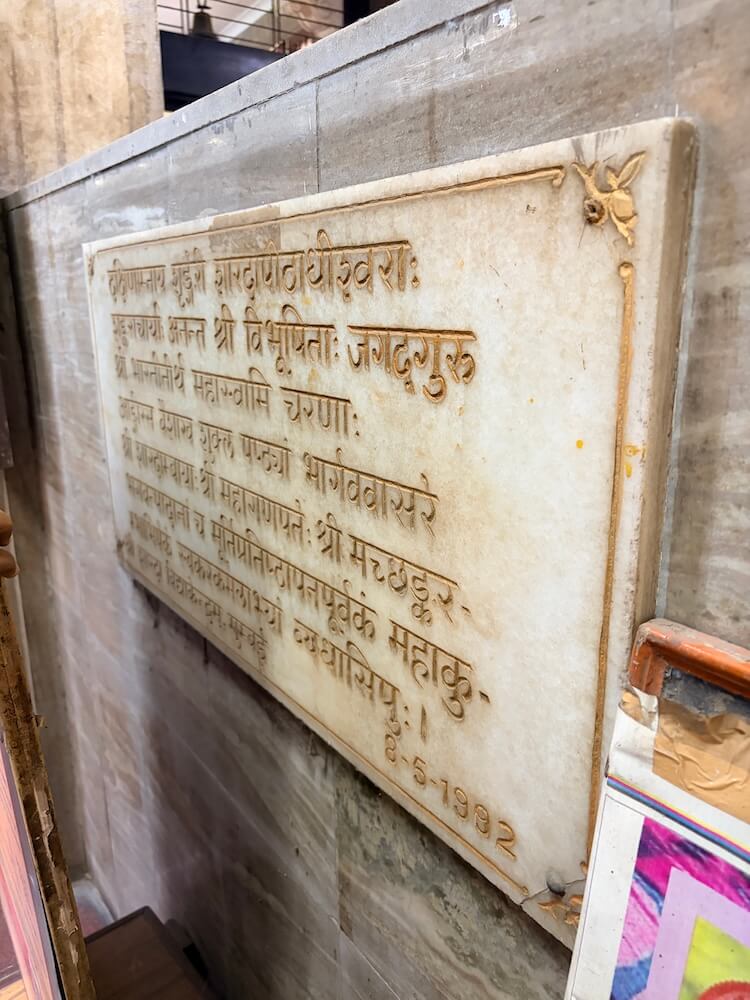
This Matha-temple was established fifty-three years after the founding of the Shankara Matha in Matunga. According to the inscription in the Matha, the consecration of the Panchaloha idols of Maha Ganapati, Adi Shankara, and Sharadamba was performed in this Matha-temple on May 8, 1992, between 7.30 and 8.30 in the morning, according to Vedic traditions, by the hands of Jagadguru Bharati Tirtha Swamiji of the Sringeri Matha. Prior to the consecration, several rituals such as Jaladhivasa and Dhanyadhivasa were performed here. Following the Kumbhabhishekam of the temple, the golden pinnacle atop the temple was consecrated by the Shankaracharya. Subsequently, rose petals were showered upon the temple from a helicopter. In the year of the temple’s Prana Pratishtha, the Jagadguru observed the Chaturmasya Vrata here.
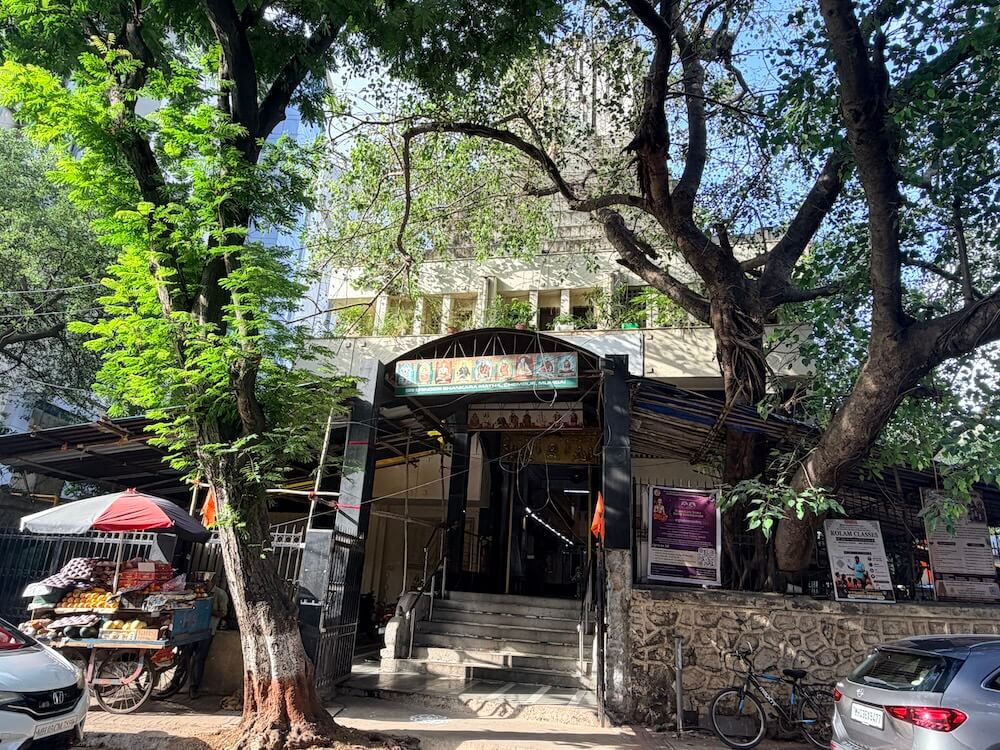
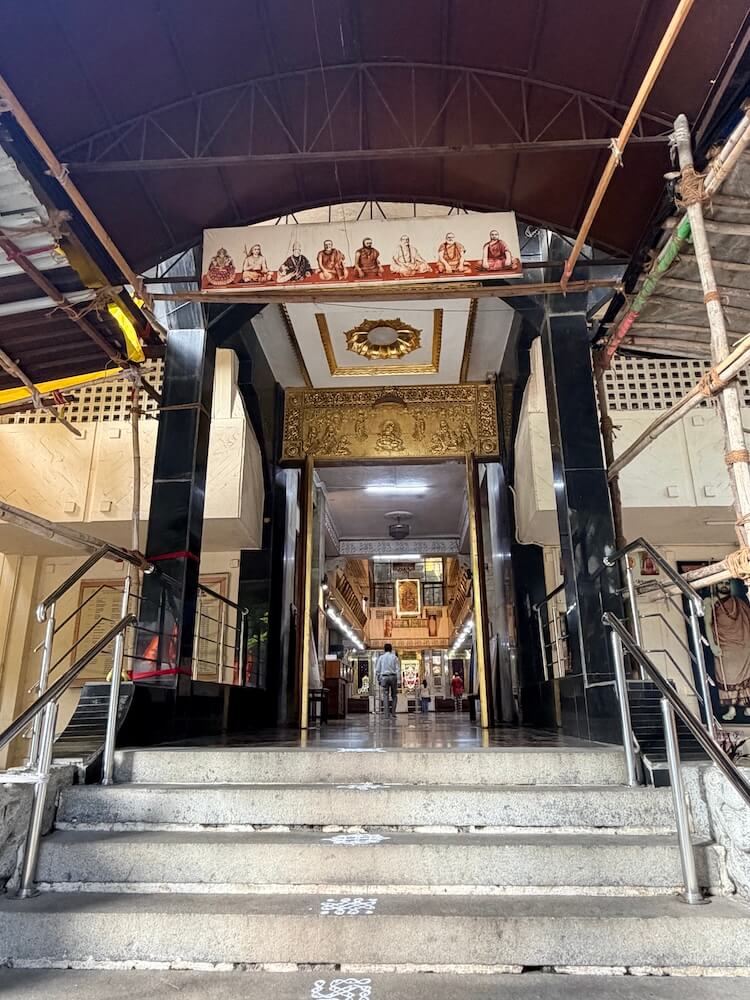
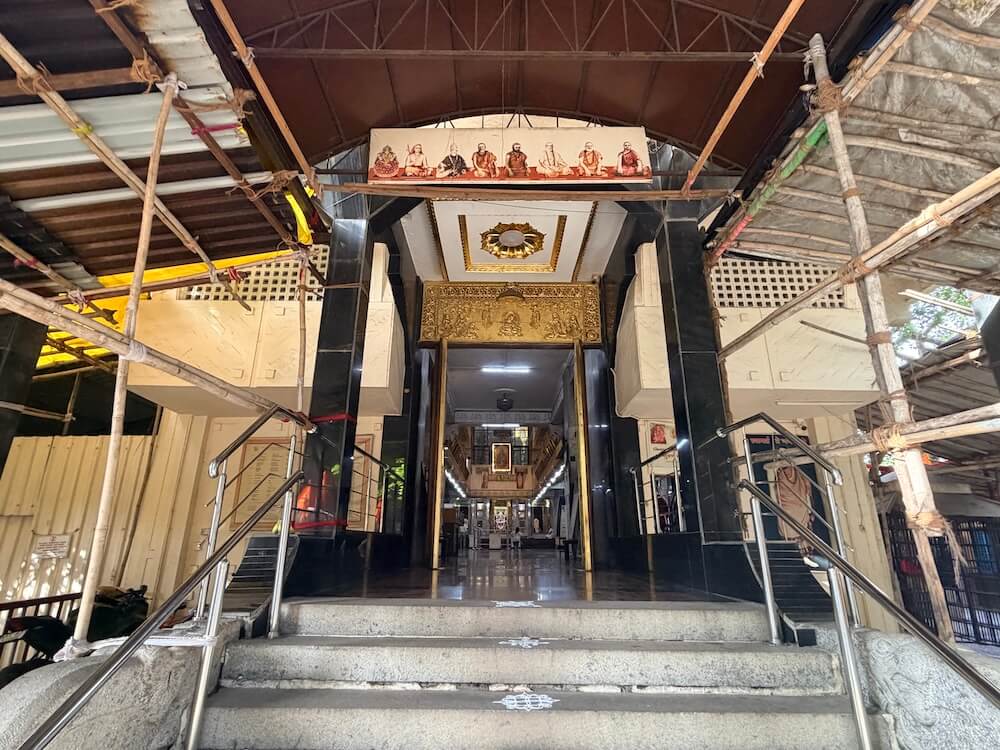
This Matha-temple, an important heritage of South Indian religious, cultural, and architectural tradition in Mumbai, features a tall and symmetrical structure. The design of this edifice is heavily influenced by Dravidian architecture as well as the Matha architectural styles of Karnataka and Tamil Nadu. The temple structure consists of an Ardhamandapa, a Sabhamandapa, and a Garbhagriha. The significant principle of Indian temple architecture, ensuring that the main entrance, the Sabhamandapa, and the Garbhagriha are aligned in a straight line, has been meticulously followed here. Situated on a high Jagati, the temple is accessed by seven steps. These steps are covered by a gajaprishthakara (elephant-back shaped) metal roof. From here, one enters the Ardhamandapa, which features a ceiling adorned with golden floral patterns. Above the entrance arch of the Ardhamandapa is a gallery of portraits of the Jagadgurus in the Guru lineage. This gallery depicts the unbroken tradition from Adi Shankaracharya to the present Jagadguru of the Sringeri Peetham.
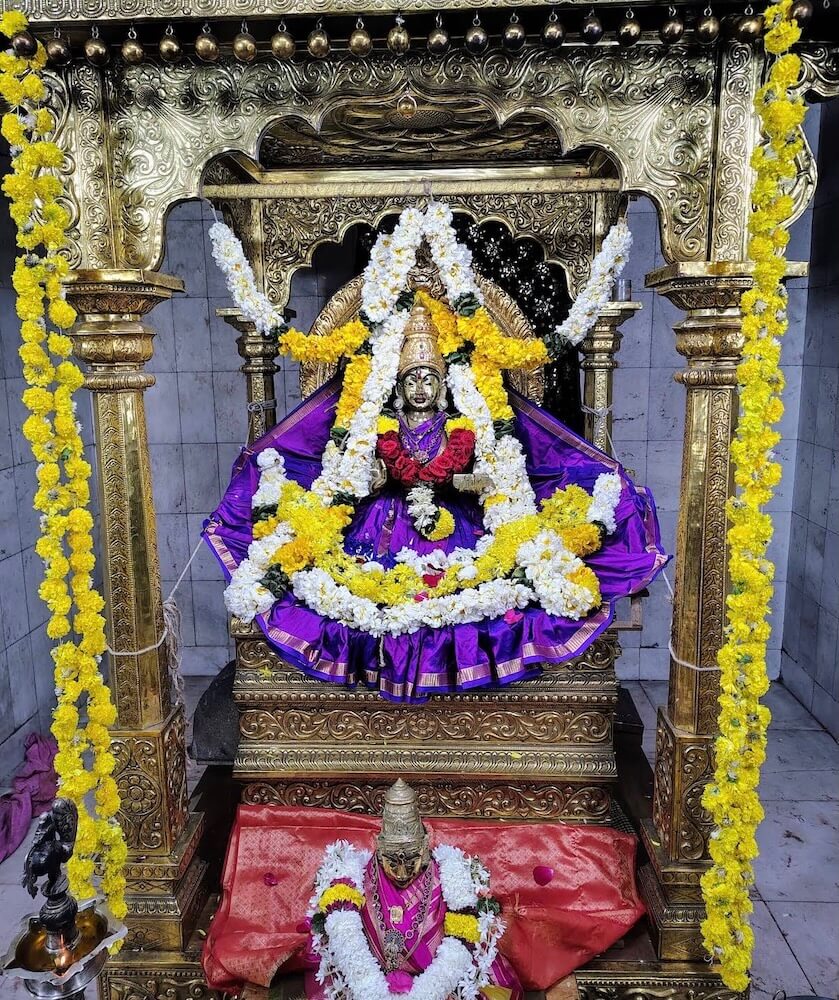
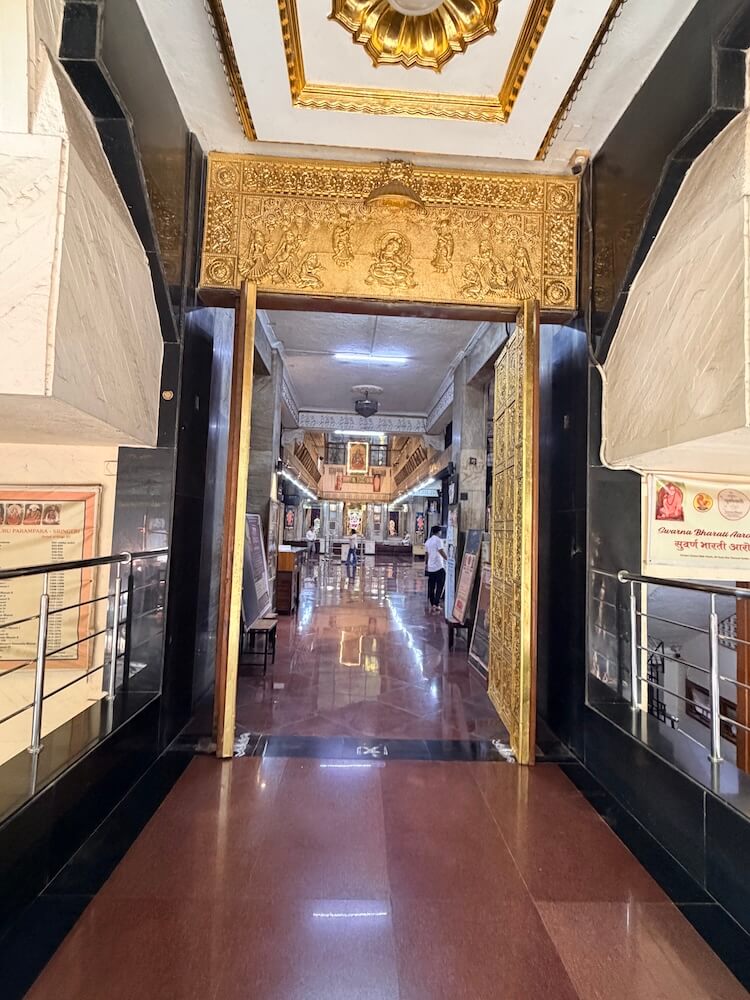
The entrance to the Sabhamandapa has massive brass doors. The upper portion features brass plates embossed with images of deities. The temple’s Sabhamandapa is spacious and three-storied. The second floor has a balcony-like structure. Its walls are adorned with paintings and photographs of various great personalities and Jagadgurus associated with the Matha. Glass panes are installed in the upper section to allow natural light into the Sabhamandapa. In the center of the front portion of this Sabhamandapa, which features polished marble flooring, lies the main Garbhagriha of the temple. This Garbhagriha is situated on a pedestal four steps higher than the ground level of the hall. Its entrance features a golden door frame with intricate carvings. In this Garbhagriha, on a high altar, is installed the idol of Goddess Sharadamba, considered the presiding deity of knowledge, learning, speech, philosophy, and spirituality. Adi Shankaracharya had established the tradition of knowledge by consecrating Sharada at Sringeri. A reflection of that same tradition is seen here. In the sub-shrine to the left of this main Garbhagriha, the idol of Maha Ganapati is installed, while the idol of Adi Shankaracharya is installed in the sub-shrine to the right.
Devotees can seek the blessings of the deity in this temple from 6 to 11.30 in the morning and from 5 to 8.30 in the evening. Various religious programs, Homas, Anushthanas, and Pujas are performed in the temple according to the traditions of the Sringeri Matha. Daily rituals like Sri Chakra Puja and Sahasranama Archana are performed before the Goddess. Similarly, festivals like Shankaracharya Jayanti, Ganesh Jayanti, and Navaratri are celebrated here with great religious fervor and enthusiasm. This temple, which preserves the Vedic tradition, sees a crowd of local devotees every morning and evening.
This sacred temple stands as a testament to deep spiritual devotion, ancient architectural grandeur, and rich local cultural traditions.
The sanctum sanctorum houses the divine idol consecrated according to ancient Vedic traditions, surrounded by serene courtyards and traditional temple architecture.
Navratri, Maha Shivratri, Annual Temple Jatra & Deepotsav
Compare and book flights, secure top-rated local hotels near the temple, hire reliable guides, and rent cars instantly.
Extend your pilgrimage by visiting other highly sacred temples located nearby.


Add ₹999 more to unlock FREE SHIPPING!
Your sacred cart is currently empty.
Shop Photo FramesFill in your delivery details below to place your order.
Add comment